



NMES After Knee Surgery: Quadriceps Settings, Electrode Placement and Progression
Neuromuscular electrical stimulation, or NMES, uses surface electrodes to activate motor nerves and create a visible muscle contraction. After knee surgery, it is commonly incorporated into rehabilitation when swelling, pain, and altered joint input make it difficult for the patient to recruit the quadriceps voluntarily.
This postoperative loss of muscle activation is often called arthrogenic muscle inhibition. NMES does not eliminate the underlying surgical or joint condition, but it can supplement voluntary exercise when the quadriceps cannot yet generate an adequate contraction.
This guide focuses on:
- Quadriceps activation after knee surgery
- Clinician-selected NMES settings
- Two- and four-electrode placement
- Intensity and contraction quality
- Pairing NMES with voluntary exercise
- Progression and discontinuation criteria
- Procedure-specific precautions
- Device and electrode selection
For detailed explanations of ramp, synchronous, and alternate modes, use Balego NMES Settings Explained. For a dedicated medial-quadriceps discussion, see NMES for VMO Activation.
Post-operative use notice: NMES should be initiated and progressed according to the surgeon’s restrictions and the treating rehabilitation professional’s plan. Surgery type, graft choice, wound condition, weight-bearing restrictions, range-of-motion limits and associated procedures can materially change the appropriate setup.
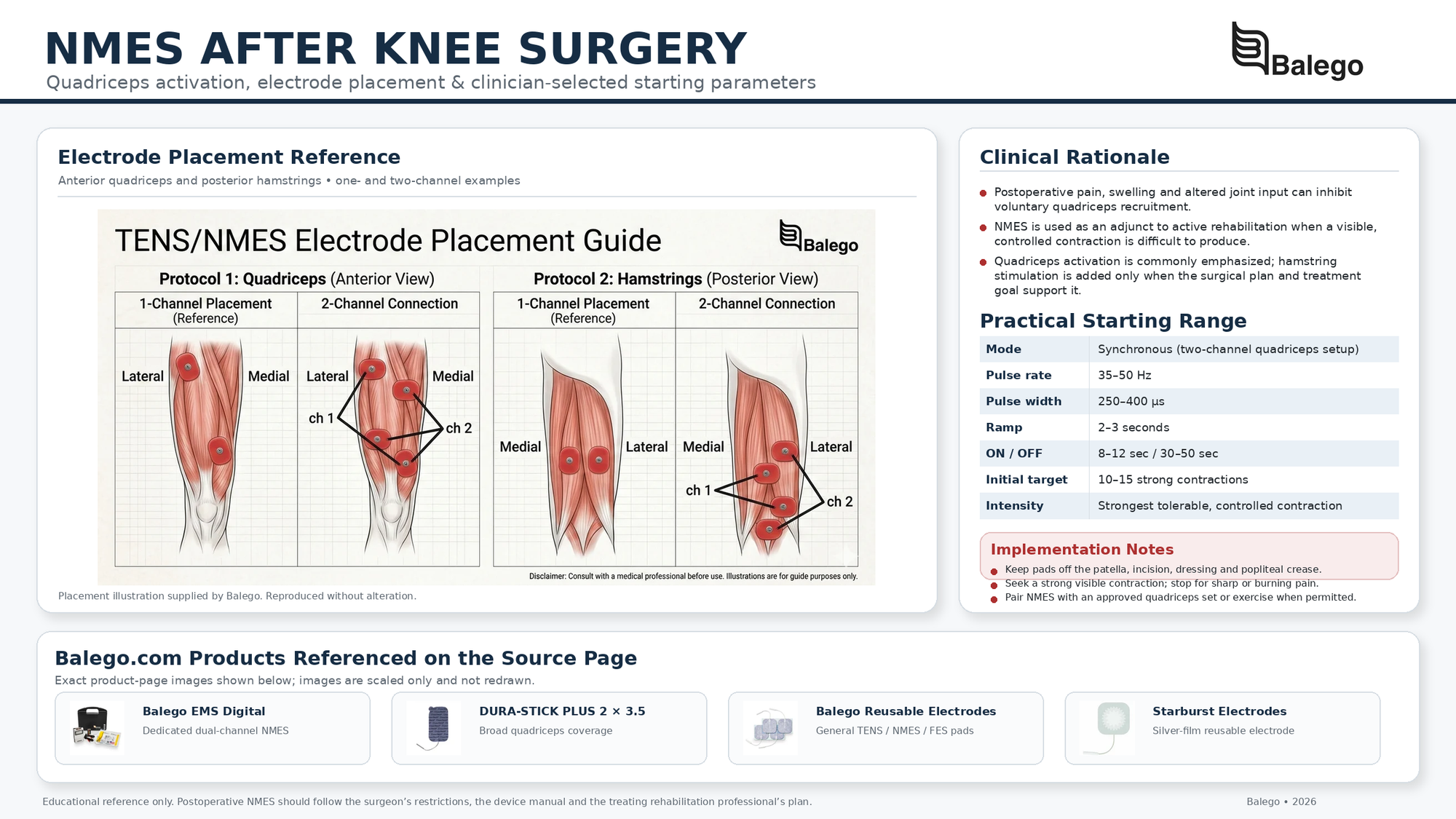
Post-op knee NMES starting-point table
The settings below are a practical clinician-directed starting range for an adjustable NMES unit such as the Balego EMS Digital NMES Stimulator. They are not a universal prescription.
| Parameter | Practical starting range | Clinical objective |
|---|---|---|
| Mode | Synchronous for a two-channel quadriceps setup | Activates both electrode pairs together |
| Pulse rate | Approximately 35–50 Hz | Produces a sustained quadriceps contraction |
| Pulse width | Approximately 250–400 µs | Recruits motor nerves in a large muscle group |
| Ramp | Approximately 2–3 seconds | Creates a controlled contraction onset |
| ON time | Approximately 8–12 seconds | Allows a quadriceps contraction and voluntary effort |
| OFF time | Approximately 30–50 seconds | Provides recovery and limits rapid fatigue |
| Initial contraction count | Approximately 10–15 strong contractions | Emphasizes contraction quality |
| Session length | Commonly about 10–20 minutes | Depends on duty cycle and prescribed contraction count |
| Intensity | Strongest tolerable, controlled contraction | More than sensory tingling is required |
| Voluntary effort | Quadriceps set or approved exercise during ON phase | Reinforces active recruitment |
| Frequency | Individually prescribed | Depends on procedure, tolerance and home program |
Published post-ACL studies have used a broad range of frequencies, pulse widths, and duty cycles rather than one standardized setting. Frequencies in the recent review ranged from approximately 20–75 Hz, with many protocols using 30–50 Hz and a strong or maximally tolerable visible contraction.
The APTA TKA guideline similarly states that varied study interventions prevent the recommendation of one exact setting, but the studies consistently sought tetanic quadriceps contractions, with stronger contractions generally producing better outcomes.
Who may benefit from postoperative knee NMES?
NMES may be considered when a patient has:
- Difficulty performing an effective quadriceps set
- A visible or measurable quadriceps activation deficit
- Knee-extension lag during straight-leg raising
- Marked early postoperative quadriceps weakness
- Trouble maintaining terminal knee extension
- Reduced muscle recruitment caused by postoperative swelling or pain
- Difficulty progressing into active strengthening
- A therapist-prescribed need for supplementary muscle activation
The strongest guideline support is for patients after total knee arthroplasty who demonstrate quadriceps activation deficits. NMES has also been studied after ACL reconstruction and other knee procedures, but its application must match the specific surgical precautions.
NMES does not replace post-operative rehabilitation
NMES is an adjunct—not a complete knee-rehabilitation program.
It does not replace:
- Surgeon follow-up
- Wound and swelling management
- Range-of-motion work
- Gait training
- Progressive strengthening
- Balance and neuromuscular training
- Weight-bearing progression
- Functional exercise
- Return-to-work or return-to-sport criteria
The APTA TKA guideline recommends NMES in addition to progressive strengthening and exercise, rather than as a substitute for active rehabilitation.
Procedure-specific considerations
“Knee surgery” includes procedures with very different healing constraints.
| Procedure | Primary NMES consideration |
|---|---|
| Total knee arthroplasty | Early quadriceps activation is commonly emphasized |
| ACL reconstruction | Follow graft-specific and associated-procedure restrictions |
| Meniscus repair | Weight-bearing and knee-flexion restrictions may affect exercise position |
| Meniscectomy | Progression may differ from a repaired meniscus |
| Patellar or quadriceps tendon repair | Contraction and active extension may be restricted initially |
| Patellofemoral stabilization surgery | Avoid assuming a generic VMO or quad protocol is appropriate |
| Cartilage-restoration procedure | Loading and range restrictions may be prolonged |
| Fracture fixation | Obtain explicit clearance before strong contractions |
| Multiple-ligament reconstruction | Position and muscle sequencing require procedure-specific planning |
ACL reconstruction caution
Do not state that the hamstrings should always contract before the quadriceps to “protect the ACL.”
Appropriate muscle selection can depend on:
- Whether a hamstring, patellar tendon, or quadriceps-tendon graft was used
- Whether a meniscus was repaired
- The surgeon’s early loading restrictions
- Knee position
- The selected exercise
- The desired contraction intensity
- Associated ligament or cartilage procedures
A hamstring-graft patient may have specific hamstring-loading restrictions. Quadriceps re-education is commonly a central early goal after ACL reconstruction, but timing and exercise selection should follow the operative protocol.
When can NMES begin after surgery?
There is no universal start date for every knee operation.
Evidence supporting early application includes:
- TKA studies beginning NMES as early as postoperative day two
- ACL studies showing stronger quadriceps recovery when NMES was initiated within the first week rather than later
Early use must still be approved by the surgical and rehabilitation team. The incision, dressing, sensation, swelling, medical status, and procedure-specific restrictions should be checked first.
Two-electrode quadriceps placement
A one-channel setup uses two electrodes.
General placement
Place both pads on the quadriceps muscle—not on the knee joint or incision.
A practical arrangement is
- Proximal electrode: Over the upper quadriceps muscle belly, often toward the proximal-lateral thigh
- Distal electrode: Over the lower quadriceps muscle belly, often toward the distal-medial quadriceps when that placement produces a useful contraction
The objective is to span responsive quadriceps tissue and obtain the strongest controlled contraction with the least necessary current.
Motor-point adjustment
Motor-point location varies among patients. A small placement adjustment can significantly change contraction quality.
With the intensity at zero:
- Move one pad slightly.
- Reapply it fully.
- Retest at low intensity.
- Compare the resulting contraction.
- Mark or photograph the clinician-approved placement for home reproduction.
Avoid placing an electrode:
- Directly over the patella
- Over the surgical incision
- Over staples, adhesive strips or a dressing
- Directly over markedly swollen tissue
- On an area with absent sensation
- Inside or directly across the groin
- In the crease behind the knee
Four-electrode quadriceps placement
A dual-channel setup may improve comfort and recruitment across the large quadriceps muscle.
One practical configuration is the following:
| Channel | Proximal electrode | Distal electrode |
|---|---|---|
| Channel 1 | Proximal-lateral quadriceps | Distal-medial quadriceps |
| Channel 2 | Proximal-medial or central quadriceps | Distal-lateral quadriceps |
Both channels should activate together when synchronous mode is used.
The objective is not to form a perfect geometric pattern. The goal is to distribute current across responsive motor points and produce a balanced knee-extension contraction without excessive discomfort.
Four electrodes may be especially useful when:
- Two pads produce a localized or sharp sensation
- A larger thigh requires broader recruitment
- One portion of the quadriceps remains difficult to activate
- Higher intensity cannot be tolerated comfortably with smaller pads
- The therapist wants to distribute current across more muscle tissue
Should electrode polarity matter?
For most portable NMES units using charge-balanced biphasic stimulation, placement over effective motor points is generally more important than labeling one pad “positive” and the other “negative.”
Follow the polarity instructions in the exact device manual. When a charge-balanced biphasic waveform is used, clinicians generally focus primarily on motor-point placement and contraction quality. A monophasic device may require specific active- and dispersive-electrode positioning.
The Balego EMS Digital NMES Stimulator provides adjustable, dual-channel NMES programming, including synchronous, constant, and alternate operation.
Choosing electrode size
Large thigh muscles frequently respond better to electrodes that provide broader conductive coverage.
| Electrode size | Practical role in quadriceps NMES |
|---|---|
| 2 × 2-inch square | General-purpose option; may feel more concentrated |
| 2 × 3.5-inch rectangle | Broader quadriceps coverage |
| 2 × 4-inch rectangle or oval | Useful on larger thighs and muscle bellies |
| 2.75-inch round | Broad rounded contact |
| Very small pad | More concentrated current and often less comfortable |
Useful Balego options include:
- DURA-STICK PLUS Electrodes, including 2 × 3.5-inch and 2 × 4-inch options
- Balego Reusable TENS, NMES, and FES Electrodes
- Starburst Electrodes, including a 2 × 4-inch rectangle
- Classic TENS/NMES/FES Electrodes
- Our complete Electrotherapy Electrode collection
Balego’s electrode listings include broader rectangular options suited to large muscle groups, while the standard 2-inch square remains the most universal general-purpose format.
Step-by-step quadriceps NMES setup
1. Confirm surgical clearance
Verify:
- Procedure performed
- Postoperative date
- Weight-bearing status
- Range-of-motion restrictions
- Whether active quadriceps contraction is permitted
- Wound and dressing status
- Any brace requirements
- Whether home NMES has been prescribed
2. Position the patient safely
The treating professional should select the knee and hip position.
Depending on the phase and procedure, NMES may be performed during:
- A supported quadriceps set
- A therapist-assisted straight-leg raise
- Supported knee extension
- Short-arc quadriceps exercise
- Another approved exercise
Do not copy a knee angle from a generic internet protocol when the operative instructions specify something different.
3. Turn all channel intensities to zero
Connect and move electrodes only while output is off.
4. Inspect the skin and surgical area
Do not apply pads over:
- An unhealed incision
- Staples or sutures
- A wound dressing
- Drain sites
- Blistered skin
- Cellulitis or suspected infection
- Areas with markedly reduced sensation
5. Clean and dry the electrode sites
Remove:
- Lotion
- Massage cream
- Topical analgesics
- Oil
- Perspiration
- Adhesive residue
Clip excessive hair when needed instead of shaving immediately before treatment.
6. Apply two or four electrodes
Press every edge of each pad firmly onto the skin.
Keep lead wires positioned so they do not pull on the incision, brace, or electrode connectors.
7. Select the clinician-prescribed program
For the Balego EMS Digital, a common quadriceps starting setup is the following:
- Synchronous mode
- 35–50 Hz
- 250–300 µs
- 2–3-second ramp
- 8–12 seconds ON
- 30–50 seconds OFF
These are starting ranges, not fixed rules. The device’s clinical NMES settings guide provides related examples without replacing procedure-specific instructions.
8. Increase intensity gradually
Raise the output during the ON phase until there is a strong, visible quadriceps contraction.
The contraction should:
- Clearly tighten and lift the quadriceps
- Produce the intended patellar or knee-extension response
- Remain controlled
- Avoid sharp or burning pain
- Not pull against a prohibited range or brace restriction
Research after TKA has found that greater tolerated NMES contraction intensity is associated with better quadriceps strength recovery. That does not mean the patient should ignore pain, wound restrictions, or unsafe joint movement.
9. Add voluntary effort
When permitted, instruct the patient to tighten the quadriceps during the NMES ON phase and relax during the OFF phase.
Useful cues include:
- “Push the back of the knee toward the support.”
- “Tighten the thigh as the stimulation rises.”
- “Hold the contraction through the ON phase.”
- “Relax completely during the rest interval.”
Pairing stimulation with active effort helps connect the electrical contraction to voluntary motor control.
10. Monitor fatigue
Stop or reduce the workload when:
- Each contraction becomes progressively weaker
- The knee can no longer maintain the intended position
- The patient substitutes with hip movement
- Pain increases
- The pads begin to sting
- The contraction pulls against a surgical restriction
NMES can produce significant muscle fatigue. Longer sessions are not automatically better.
How many contractions should be performed?
Use a clinician-prescribed contraction target rather than a universal four-times-daily schedule.
A practical early session may include:
- Approximately 10–15 high-quality contractions
- One or two daily home sessions when prescribed
- A longer rest period than contraction period
- Additional supervised use according to the rehabilitation plan
One well-known TKA study used 15 contractions per session, twice daily, six or seven days per week. Other studies and guidelines have used more frequent daily applications. Because protocols vary greatly, the frequency should be selected for the individual rather than copied directly from one research trial.
The APTA guideline notes that earlier, more frequent application and longer cumulative time at the maximum tolerated intensity were associated with better outcomes in the reviewed TKA studies, but it does not establish a single dosage for every patient.
Contraction quality matters more than dial position
The intensity number shown on an NMES device is not itself the treatment goal.
Evaluate:
- Visible quadriceps recruitment
- Patellar movement
- Ability to achieve or maintain knee extension
- Amount of extensor lag
- Whether the intended muscle contracts rather than a neighboring muscle
- Patient tolerance
- Contraction decline across the session
A weak tingling sensation without a meaningful contraction is unlikely to meet a muscle reeducation or strengthening objective.
Do not compare one patient’s milliamp setting directly with another patient’s. Pad size, placement, skin resistance, thigh size, and device waveform all affect the required output.
When should NMES be progressed?
Progression may involve:
- Increasing contraction intensity
- Improving motor-point placement
- Adding voluntary quadriceps effort
- Reducing reliance on therapist assistance
- Combining NMES with an approved exercise
- Progressing from an isometric contraction to functional strengthening
- Improving the number of high-quality contractions
- Reducing extensor lag
- Improving gait and stair performance
Do not progress solely by:
- Extending every session to 40 minutes
- Shortening the OFF time until the muscle fatigues
- Raising the current despite sharp pain
- Adding hamstring stimulation without a treatment objective
- Performing more sessions despite declining contraction quality
When can NMES be discontinued?
Discontinuation should be based on clinical progress rather than a fixed date.
Possible criteria include:
- Consistent voluntary quadriceps activation
- Straight-leg raising without meaningful extensor lag
- Adequate terminal knee-extension control
- Strong contractions during active exercise
- Progression into resistance training
- Improved gait and stair function
- Little additional benefit from NMES
- Intolerance or skin reaction
- Completion of the prescribed postoperative NMES phase
The TKA guideline states that the studied NMES programs were applied for at least three weeks, but the duration for each individual should be based on clinical need and response.
Hamstring NMES after knee surgery
Do not include hamstring stimulation automatically in every postoperative knee program.
It may be prescribed when the treatment objective involves the following:
- Hamstring activation deficits
- A procedure-specific co-contraction program
- A later strengthening phase
- Bilateral or reciprocal muscle training
- A clinician-selected functional task
Avoid pads:
- Directly in the popliteal crease
- Over an incision or graft-harvest wound
- Over areas with altered sensation
- Where sitting pressure will lift or compress the pad
After hamstring-tendon graft harvest, follow the surgeon’s specific restrictions before adding resisted or electrically stimulated hamstring contractions.
Co-contraction protocols
Quadriceps and hamstring co-contraction may be useful in selected rehabilitation programs, but the treating professional should establish the sequence.
A co-contraction setup requires decisions about the following:
- Surgical procedure and graft source
- Knee angle
- Weight-bearing status
- Relative quadriceps and hamstring intensity
- Whether channels contract together or alternate
- Functional objective
- Resulting joint movement
The Balego EMS Digital offers synchronous and alternate channel modes. Neither mode should be selected solely because it is available.
Evidence summary
| Post-operative population | Evidence-informed conclusion |
|---|---|
| Total knee arthroplasty | APTA recommends NMES to improve quadriceps strength, gait, performance and patient-reported outcomes |
| ACL reconstruction or repair | A recent randomized-trial meta-analysis found better quadriceps-strength recovery when NMES was added |
| Early initiation | Earlier use appears advantageous when surgically and medically appropriate |
| Functional scores | Strength improvement does not guarantee improvement in every patient-reported score |
| Intensity | Stronger tolerated contractions are generally associated with better strength recovery |
| Range of motion | NMES should not be promoted as directly restoring knee ROM |
| Exact parameters | Research protocols vary too much to establish one universal setting |
| Active rehabilitation | NMES is most appropriately used as an adjunct to exercise and progressive rehabilitation |
Post-operative safety checklist
Do not begin or continue NMES without professional guidance when there is
- A demand-type pacemaker or implanted electronic device
- Unexplained cardiac symptoms
- An unhealed or infected incision
- Active bleeding
- Severe skin irritation
- Absent or unreliable skin sensation
- A damaged electrode site
- A restriction against active muscle contraction
- A fracture or repair not cleared for contraction
- A brace or dressing that prevents safe placement
- A new neurological deficit
- Concern about a postoperative complication
Follow the contraindications in the exact NMES device manual. The Balego EMS Digital product information also links to its operating and safety resources.
Stop and contact the surgical team for possible complications
NMES should not be used to mask warning signs.
Seek prompt medical guidance for:
- New or increasing calf pain
- Marked one-sided calf swelling
- Sudden shortness of breath
- Chest pain
- Fever
- Increasing incision redness
- Drainage or opening of the incision
- Rapidly increasing knee swelling
- A painful pop or traumatic event
- New weakness unrelated to expected postoperative inhibition
- Loss of previously achieved knee function
Suspected deep-vein thrombosis, pulmonary embolism, wound infection, or structural injury requires medical evaluation rather than additional stimulation.
Troubleshooting quadriceps NMES
| Problem | Likely reason | Corrective action |
|---|---|---|
| Strong tingling but little contraction | Pads are not near effective motor points | Turn off and adjust placement |
| Contraction is localized to a small area | Pads may be too small or too close | Use broader spacing or larger electrodes |
| One channel feels much sharper | Unequal pad adhesion or placement | Inspect both pads and reduce that channel |
| Contraction weakens rapidly | Muscle fatigue or insufficient rest | Stop or lengthen the OFF interval |
| A wrong muscle activates | Placement is too medial, lateral or distal | Reposition under professional guidance |
| The knee moves into a restricted range | Position or intensity is inappropriate | Stop and review surgical precautions |
| Pad stings near one corner | Edge lift or dry hydrogel | Replace or reapply the electrode |
| No output from one channel | Incomplete circuit or loose connection | Confirm two pads and all plugs |
| Both channels feel weak | Battery, pad or device issue | Replace battery and inspect electrodes |
| Skin remains markedly red | Sensitivity, concentrated current or worn pads | Discontinue and inspect the skin |
| The incision is under a pad | Incorrect placement | Stop and reposition away from the wound |
| Contraction quality varies at home | Placement cannot be reproduced | Mark or photograph clinician-approved sites |
NMES device comparison for post-op knee rehabilitation
| Device | Channels and modalities | Knee-rehab advantage | Best fit |
|---|---|---|---|
| Balego EMS Digital NMES Stimulator | Two-channel dedicated NMES | Adjustable rate, width, ramp and work-rest timing | Focused, economical quadriceps re-education |
| Chattanooga Intelect NMES Digital | Two-channel dedicated NMES | Broad adjustable frequency and pulse-width ranges | Clinicians preferring a Chattanooga-branded dedicated unit |
| EMS 5.0 Analog NMES Stimulator | Two-channel NMES with analog controls | Straightforward 5, 30, and 100 Hz selector | Simple analog muscle-stimulation workflows |
| InTENSity Twin Stim IV | Two-channel TENS and NMES | Rechargeable unit combining pain and muscle programs | Users needing both TENS and NMES |
| InTENSity Select Combo II | Two-channel TENS, NMES, IF, and Russian | Knee presets plus customizable programs | Broader multi-modality rehabilitation |
| Twin Stim Plus DS5402 | Four-channel TENS, EMS, IFC, and Russian | Up to eight pads and broader multi-muscle setups | Clinics needing four-channel coverage |
The Balego EMS Digital and Chattanooga Intelect NMES Digital are the most focused choices when quadriceps activation is the primary goal. Combination devices are more appropriate when TENS or additional modalities are also part of the rehabilitation plan.
Frequently asked questions
What are common NMES settings after knee surgery?
A clinician may begin around 35–50 Hz, 250–400 µs, a two- to three-second ramp, and approximately 8–12 seconds ON and 30–50 seconds OFF. The intensity should create a strong, controlled quadriceps contraction.
Is 35 Hz the only correct frequency?
No. Research studies have used a wide range, including approximately 20–75 Hz. Settings should be selected according to the device, patient, and treatment goal.
How high should the NMES intensity be?
Increase toward the strongest tolerable contraction that remains safe and controlled. Research suggests higher contraction intensities are associated with better strength recovery after TKA.
Is a tingling sensation enough?
No, not when the goal is quadriceps re-education or strengthening. A visible, useful contraction is generally required.
Should I tighten my quadriceps during stimulation?
Usually, yes, but only if a voluntary contraction is performed. Tighten the quadriceps during the ON phase and relax during the OFF phase according to the therapist’s instructions.
How many pads should be used?
Two pads may be sufficient for a focused one-channel setup. Four pads can improve current distribution and recruit a broader portion of the quadriceps.
Where should the pads go?
Place them over responsive quadriceps muscle bellies—commonly using proximal and distal positions. Keep every pad away from the incision, patella, groin, and posterior knee crease.
Can pads be placed over the surgical incision?
No. Do not place an electrode over an unhealed incision, staples, sutures, adhesive strips, or a dressing.
Are larger pads better?
Larger pads can distribute current more broadly and may be more comfortable on the quadriceps. Motor-point location and complete adhesion remain important.
Can NMES begin immediately after surgery?
Only with approval from the surgical and rehabilitation team. TKA research has begun as early as postoperative day two, and ACL evidence favors earlier use when medically appropriate.
How often should NMES be used?
Frequency varies. Some programs use one or two sessions daily, while TKA studies have included more frequent application. Follow the prescribed contraction count and schedule.
Should every session last 40 minutes?
No. Session duration should reflect the duty cycle, contraction quality, fatigue, and treatment goal. More time is not automatically more effective.
Can NMES reduce knee swelling?
NMES is primarily being used here for muscle activation. It should not be promoted as a substitute for evaluation and management of postoperative swelling.
Can NMES improve knee range of motion?
It may support muscle control during rehabilitation, but the TKA guideline found no clear postoperative range-of-motion advantage from NMES itself.
Should hamstrings be stimulated after ACL reconstruction?
Only when specifically prescribed. Graft choice and procedure-specific restrictions can affect when hamstring loading is appropriate.
Should hamstrings always contract before the quadriceps?
No. That should not be presented as a universal ACL-protection rule.
What if I cannot perform a straight-leg raise?
Quadriceps activation deficits and extensor lag are common reasons a clinician may add NMES. Use it only with the approved knee position and assistance.
How do I know when NMES is no longer needed?
The clinician may discontinue it once voluntary quadriceps recruitment, straight-leg raising, terminal extension, gait, and strengthening have progressed sufficiently.
Can I use TENS instead?
TENS is primarily sensory stimulation for temporary pain modulation. It does not substitute for contraction-producing NMES when the goal is quadriceps re-education.
Key protocol summary
| Element | Recommended approach |
|---|---|
| Primary target | Quadriceps muscle |
| Mode | Synchronous for a four-pad, two-channel setup |
| Frequency | Approximately 35–50 Hz starting range |
| Pulse width | Approximately 250–400 µs |
| Ramp | Approximately 2–3 seconds |
| Work interval | Approximately 8–12 seconds |
| Rest interval | Approximately 30–50 seconds |
| Intensity | Strongest tolerable controlled contraction |
| Voluntary effort | Quad set or approved exercise during ON phase |
| Electrode count | Two or four |
| Electrode size | Larger rectangular pads often fit the thigh well |
| Session target | High-quality contractions rather than maximum session length |
| Main precautions | Surgery-specific restrictions, incision condition, swelling and fatigue |
| Stop criteria | Pain, skin reaction, weak declining contractions or complication warning signs |
NMES can be a valuable bridge between inhibited postoperative quadriceps and active strengthening, but its success depends on electrode placement, sufficient contraction intensity, appropriate rest, and integration with the rest of the rehabilitation plan.
Review the Balego EMS Digital NMES Stimulator, compare neuromuscular stimulation devices, browse NMES protocols and placement guides, or shop replacement electrotherapy electrodes.


