


The Balego EMS Digital Neuromuscular NMES Stimulator is a portable, two-channel device designed for programs in which the goal is controlled muscle stimulation rather than pain-focused sensory stimulation.
This FAQ answers common practical questions about choosing the device, obtaining a useful muscle contraction, using two channels, selecting accessories, managing the battery, and knowing when professional help is needed.
For complete operating steps, technical specifications, and safety information, use the Balego NMES Instruction Manual. For specific parameter examples, visit Popular Clinical NMES Settings for the Balego EMS Digital.
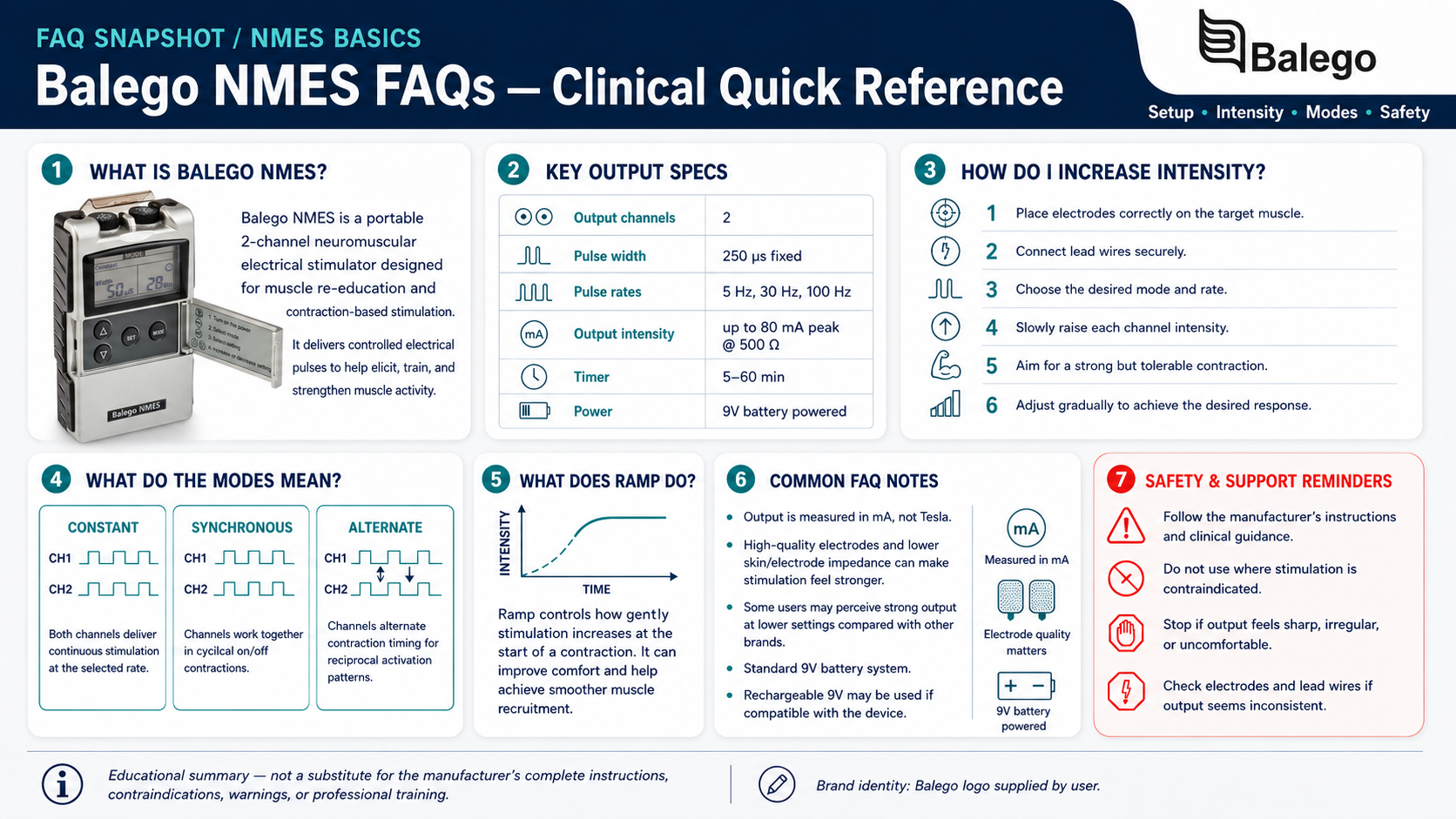
Find the Right Balego NMES Resource
| Your question | Best Balego resource |
|---|---|
| How do I connect, program, and operate the unit? | Balego NMES Instruction Manual |
| What do "constant," "synchronous," "alternate," and "ramp" mean? | Balego NMES Settings Explained |
| What settings are commonly used by clinicians? | Popular Clinical NMES Settings |
| Why does the unit feel strong at a low dial position? | Why Balego NMES Feels Strong at Low Intensity |
| Can the device deliver continuous 20 Hz stimulation? | Can Balego NMES Deliver Constant 20 Hz? |
| Where can I find body-area protocols? | NMES Protocols, Settings and Electrode Placement |
| Do I need NMES, TENS, or both? | TENS vs. NMES Guide |
| Where can I buy pads and accessories? | Electrotherapy Electrodes |
General Balego NMES Questions
What is the Balego EMS Digital designed to do?
The Balego unit is designed to send adjustable electrical pulses through surface electrodes to motor nerves and muscles. In an NMES program, the desired response is commonly a visible or palpable muscle contraction.
Powered muscle stimulators are classified by FDA as devices that repeatedly contract muscles by passing electrical current through electrodes contacting the body. The Balego device provides adjustable intensity, pulse rate, pulse width, ramp, contraction time, relaxation time, and treatment duration.
Is the Balego device an NMES unit or a TENS unit?
It is a dedicated NMES/EMS muscle stimulator.
| Modality | Primary response |
|---|---|
| NMES or EMS | Motor-level stimulation intended to produce muscle contraction |
| TENS | Sensory-level stimulation generally used for temporary pain modulation |
| Combination device | Includes separate TENS and NMES operating programs |
Choose the Balego EMS Digital when muscle activation is the main objective. When you need both sensory pain-management programs and muscle stimulation, consider a TENS/NMES combination device instead.
Read TENS vs. NMES for a detailed comparison.
Are EMS and NMES the same?
The terms overlap.
EMS means electrical muscle stimulation and is the broader product-category term. NMES means neuromuscular electrical stimulation and is more commonly used in rehabilitation, where stimulation is applied to motor nerves to produce a muscle response.
The term used on a product label is less important than its waveform, available settings, output, treatment purpose, and operating instructions.
Is “medical grade” a meaningful description?
“Medical grade” is not a precise feature or performance specification.
More useful questions include:
- Is it designed as a powered muscle stimulator?
- What parameters can be adjusted?
- How many channels does it have?
- Does it provide timed contraction and rest cycles?
- What is its available pulse-width range?
- Does it include a treatment timer?
- Does it include treatment-use records?
- Are replacement electrodes and lead wires readily available?
The Balego EMS Digital is a regulated muscle-stimulation device with two isolated channels and adjustable NMES parameters. Powered muscle stimulators are classified as Class II devices under federal regulations.
Who is the Balego NMES best suited for?
It is most appropriate for someone who needs the following:
- A dedicated muscle-stimulation device rather than TENS.
- One or two electrode-pair circuits.
- Manually adjustable NMES parameters.
- Timed contraction and rest cycles.
- Constant, simultaneous, or alternating channel operation.
- A portable device powered by a replaceable 9V battery.
- A home program established or reviewed by a qualified professional.
It may be less suitable for someone who wants one-button body-area presets, an internal rechargeable battery, four independent channels, or several electrotherapy modalities in one device.
Contraction and Intensity Questions
What should NMES feel like?
At low intensity, NMES may feel like tingling, tapping, or buzzing. As intensity increases and motor nerves are recruited, the target muscle should begin to tighten or move.
A properly configured contraction should generally be the following:
- Visible or clearly palpable.
- Located in the intended muscle.
- Strong enough to meet the treatment objective.
- Controlled rather than abrupt.
- Tolerable without burning or sharp pain.
- Followed by adequate rest when a cycled program is used.
The intended intensity depends on the treatment plan. Do not assume that maximum output is necessary.
Why can I feel stimulation but see no muscle contraction?
This phenomenon commonly occurs when sensory nerves are being stimulated but motor recruitment remains insufficient.
| Possible cause | What to check |
|---|---|
| Intensity remains too low | Increase gradually only within the instructed range |
| Pads are not near an effective motor point | Have placement checked by a clinician |
| Electrodes are too small for the target area | Consider an appropriately larger compatible pad |
| Pads have poor skin contact | Replace dried or lifting electrodes |
| Pulse width is very narrow | Confirm the professionally selected parameter |
| Muscle is fatigued | Allow adequate recovery |
| The battery is weak | Install a fresh 9V battery |
| The lead wire is damaged | Test with a known good, compatible lead |
| Nerve function is impaired | Obtain professional evaluation rather than continually increasing output |
Electrode location and stimulation intensity have a major effect on the resulting contraction. The Balego manual recommends recording an effective placement once it has been identified so it can be reproduced in later sessions.
Why does the Balego NMES feel strong near the beginning of the dial?
The rotary control is not a simple numbered milliampere scale. There is no reliable formula such as “each mark equals 10 mA.”
Perceived strength changes with:
- Pulse width and pulse rate.
- Electrode size.
- Pad quality and hydrogel condition.
- Skin resistance.
- Electrode placement.
- Distance between pads.
- Target muscle size.
- Individual sensitivity.
- This can depend on whether the stimulation is in an active contraction or rest phase.
Fresh, high-quality electrodes with excellent contact can transfer current more consistently than worn or partially detached pads. This effect can make a low dial position feel stronger than expected.
Read Why Balego NMES Feels Strong at Low Intensity for the complete explanation.
Why do Channel 1 and Channel 2 feel different?
The two channel intensities are controlled independently. Even when both knobs appear to be in similar positions, each electrode pair may encounter different
- Skin resistance.
- Pad adhesion.
- Muscle depth.
- Nerve sensitivity.
- Electrode spacing.
- Body contours.
- Placement accuracy.
Exchange the lead wires and electrode pairs between channels with the unit turned off. If the difference follows the electrodes or lead wire, the accessory or placement is likely responsible. If the same output socket remains consistently weak with known-good accessories, contact Balego.
Why does stimulation feel different from one day to another?
Normal variation can result from:
- Small changes in electrode position.
- Skin hydration and temperature.
- Lotion, perspiration, or body oil.
- Electrode age.
- Swelling or soreness.
- Muscle fatigue.
- Body position.
- Battery condition.
- Changes in pulse width, rate, or timing.
Marking or photographing clinician-approved pad locations can improve consistency, provided doing so is appropriate for the treatment plan.
Should I increase intensity during the contraction or rest period?
The safest operating practice is to increase output slowly while observing the active stimulation cycle.
If intensity is raised only during a rest interval, the next contraction may be unexpectedly strong. A clinician may instead instruct the user to make small adjustments during the active phase so the resulting contraction can be assessed immediately.
Reduce both channel intensities before substantially changing pulse width, rate, electrode position, or operating mode.
What should I do if the lowest setting is uncomfortable?
Stop the session and check:
- Are the electrodes completely attached?
- Are any pad edges lifted?
- Is the skin clean, dry, and intact?
- Are the pads worn or dried out?
- Is the selected pulse width unusually high for the intended program?
- Are the pads placed over a particularly sensitive area?
- Is a lead-wire pin partially exposed?
- Is the correct mode selected?
Do not continue if stimulation causes burning, sharp pain, or persistent skin irritation. Review the Balego NMES Instruction Manual and consult the responsible healthcare professional.
Electrode Placement Questions
How do I know whether the pads are positioned correctly?
Useful indicators include:
- The intended muscle contracts.
- The resulting movement matches the treatment goal.
- The contraction occurs without excessive movement in an unrelated muscle.
- The sensation is distributed across the pad rather than concentrated at one corner.
- A repeatable response occurs at a tolerable intensity.
Poor placement may produce only tingling, contraction of the wrong muscle, unwanted joint movement, or discomfort before a useful response is reached.
Because motor-point location varies among individuals, a diagram provides only an approximate starting area. A therapist may need to move a pad in small increments to identify the most effective location.
Can you provide one universal placement chart?
No single chart can account for differences in anatomy, diagnosis, surgical precautions, nerve status, and movement goals.
Balego maintains separate condition- and muscle-specific articles so the general FAQ does not present one pad arrangement as universally correct:
| Application | Related guide |
|---|---|
| Postoperative quadriceps and hamstring re-education | NMES After Knee Surgery |
| VMO and quadriceps activation | NMES for VMO Activation |
| Foot-drop questions and mode selection | Ramp, Alternate, Constant and Foot Drop |
| Calf and posterior-thigh stimulation | Calf and Thigh Circulation Stimulation |
| Muscle-spasm program | NMES for Muscle Spasms |
These resources are educational starting points. Individual placement should follow the treating professional’s evaluation.
Should larger muscles use larger electrodes?
Larger pads can provide broader coverage and may feel more comfortable because the current is distributed over a greater skin area. They can be useful for larger muscle groups such as the quadriceps, hamstrings, or gluteal muscles.
Larger is not automatically better. The pad must still:
- Fit the anatomy.
- Maintain full skin contact.
- Permit appropriate spacing.
- Work with the intended lead-wire connector.
- Target the desired motor area.
Browse electrotherapy electrodes or compare Balego reusable TENS, NMES, and FES electrodes.
Can I place pads directly over a joint?
Electrodes are generally positioned over soft tissue and the target neuromuscular pathway rather than directly over a prominent bony joint surface.
Placement depends on the muscle, desired movement, and professional protocol. Avoid irritated, damaged, infected, or markedly inflamed skin and follow the complete safety instructions.
Channel and Mode Questions
Can I use only one channel?
Yes. One channel operates with one connected electrode pair.
| Active setup | Lead wires | Electrodes |
|---|---|---|
| Channel 1 only | 1 | 2 |
| Channel 2 only | 1 | 2 |
| Both channels | 2 | 4 |
Leave an unused channel turned fully off.
Can the two channels have different intensity levels?
Yes. Each channel has its own intensity knob.
This is useful when two electrode pairs encounter different resistance or when one side requires less output than the other.
Can each channel use different pulse settings?
No. Pulse rate, pulse width, ramp, on time, off time, timer, and operating mode apply to the device program. Only output intensity is independently adjusted for each channel.
A device with independently programmable treatment groups may be more appropriate when two unrelated programs must run simultaneously.
What do "constant," "synchronous," and "alternate" mean?
| Mode | Channel behavior |
|---|---|
| Constant | Delivers continuous pulses according to the selected rate, width and timer |
| Synchronous | Both active channels enter the contraction and rest phases together |
| Alternate | Channel 1 and Channel 2 take turns stimulating |
This FAQ intentionally does not reproduce the full timing instructions. Read Balego NMES Settings Explained for diagrams and operating examples.
What do ramp, on-time, and off-time controls do?
| Setting | Plain-language meaning |
|---|---|
| Ramp | How gradually a contraction increases and decreases |
| On time | The contraction or work period |
| Off time | The recovery period between contractions |
| Pulse rate | How many pulses occur each second |
| Pulse width | How long each electrical pulse lasts |
| Timer | Total session duration |
The Balego unit’s available pulse-width range is 50–300 µs. Recommendations above 300 µs cannot be entered on this device.
Is there one best NMES setting?
No.
A useful program depends on:
- Treatment objective.
- Muscle size.
- Electrode placement.
- Nerve integrity.
- Desired movement.
- Fatigue.
- Patient comfort.
- Exercise being performed.
- Postoperative or medical restrictions.
For examples that stay within the device’s actual capabilities, use Popular Clinical NMES Settings for the Balego EMS Digital.
Can the Balego NMES provide continuous 20 Hz output?
Yes. The pulse rate can be set to a nominal 20 Hz because the device’s selectable range is 2–150 Hz. Constant mode can deliver ongoing stimulation according to the selected rate, width, and timer.
That technical capability does not establish that 20 Hz is appropriate for a particular nerve injury or treatment objective. Read Can Balego NMES Deliver Constant 20 Hz? for the evidence limitations and clinical considerations.
Treatment and Results Questions
Does NMES replace strengthening exercise?
No. NMES is generally used as an adjunct to exercise and rehabilitation rather than a replacement for progressive movement, strength training, and functional practice.
For example, research evaluating NMES after ACL surgery examines it as an addition to postoperative rehabilitation. Reviews suggest that it can improve quadriceps strength in selected populations, but outcomes depend on the program, intensity, and patient characteristics.
Should I voluntarily contract the muscle during the NMES on-cycle?
A clinician may instruct the user to tighten the muscle at the same time as the stimulated contraction. Pairing voluntary effort with electrical contraction can be useful in muscle-reeducation programs.
This approach is not appropriate for every postoperative restriction or movement goal. Follow the prescribed exercise and timing instructions.
How long will it take to see results?
There is no universal timeline.
A correctly positioned unit may produce a visible contraction during the first session. Changes in strength, movement quality, or function generally require repeated practice over time and depend on the following:
- Diagnosis and nerve status.
- Baseline muscle weakness.
- Contraction intensity.
- Session frequency.
- Exercise participation.
- Recovery and fatigue.
- Surgical restrictions.
- Adherence to the broader rehabilitation program.
A lack of visible contraction despite correct setup should be evaluated rather than treated by indefinitely increasing the intensity.
Can NMES restore a denervated muscle?
Conventional surface NMES generally depends on an excitable peripheral motor nerve to produce a normal muscle contraction. If the motor nerve is significantly damaged or the muscle is denervated, a standard portable NMES unit may not produce the expected response.
Do not conclude that a device is defective solely because it produces a contraction on one person but not another. An appropriate clinician should assess the diagnosis, nerve continuity, and required waveform.
Can Balego NMES be used for every condition mentioned online?
No. The fact that NMES is discussed in connection with a diagnosis does not mean the same electrode placement, settings, or outcome applies to every person. NMES is not a cure for:
- Sciatica.
- Spinal stenosis.
- Stroke.
- Foot drop.
- Paralysis.
- Spasticity.
- Postoperative weakness.
- Chronic pain.
- Neuropathy.
NMES may be incorporated into a professionally selected program when muscle activation is an appropriate objective. The underlying condition still requires diagnosis, monitoring, and a broader treatment plan.
Can the Balego unit be used for weight loss or body-fat reduction?
It should not be marketed as a weight-loss or fat-reduction device.
The FDA notes that an electrical muscle stimulator may temporarily strengthen, tone, or firm a muscle, but EMS devices should not be represented as producing weight loss, girth reduction, or “rock-hard” abdominal results without supporting clearance.
Battery, Portability and Accessories
Does the Balego NMES have a built-in rechargeable battery?
No. It uses one replaceable 9V battery.
The stimulator does not contain an internal charging circuit. A compatible rechargeable 9V battery must be removed from the unit and charged in its own external charger.
How long should a 9V battery last?
There is no dependable number of sessions because battery life changes with the following:
- Battery chemistry and quality.
- One-channel versus two-channel use.
- Output intensity.
- Pulse width and frequency.
- Session length.
- Number of sessions.
- Storage conditions.
Keep a spare battery on hand in case the home program is interrupted.
Can I use the device while traveling?
Its compact size, belt clip, carrying case, and replaceable battery make it portable. However, do not use it while driving, operating machinery, or during an activity in which an involuntary contraction could cause injury.
Can I walk while using it?
Walking or exercising during NMES should occur only when that activity is part of a clinician-directed program and the user has been trained in the timing, pad security, and movement.
An unexpected contraction, shifting electrode, or loose wire can affect balance and movement quality.
What comes with the Balego NMES?
The current kit includes the stimulator, two lead-wire sets, four reusable electrodes, a 9V battery, a carrying case, and instructions. Confirm current package contents on the Balego EMS Digital product page before ordering.
What replacement accessories should I keep available?
Frequent users may benefit from keeping:
- A spare 9V battery.
- Replacement electrode pads.
- An extra compatible lead-wire set.
- A storage bag or case for the electrodes.
- Larger compatible electrodes when professionally recommended for a large muscle group.
Shop 45-inch TENS and NMES lead wires and electrotherapy electrodes.
Why do electrode pads stop sticking?
Common causes include:
- Lotion or skin oil.
- Perspiration.
- Hair or lint.
- Repeated repositioning.
- Pad edges being pulled by the lead wires.
- Exposure to air.
- Heat or direct sunlight.
- Normal hydrogel wear.
Apply electrodes to clean, dry skin and return them to their liner and sealed storage bag immediately after use.
Should the electrodes be shared?
Reusable self-adhesive electrodes are generally intended for individual-patient use. Sharing pads can create hygiene and cross-contamination concerns.
A clinic should follow the electrode labeling and its infection-control policy.
Troubleshooting Questions
Why is one channel not functioning?
With the device switched off:
- Confirm that two electrodes are connected to the channel.
- Push the lead-wire plug fully into the output socket.
- Check both electrode-pin connections.
- Inspect the cable for cuts or loose pins.
- Replace the battery if the display or output seems weak.
- Exchange the Channel 1 and Channel 2 lead wires.
- Test with known-good electrodes.
If the problem follows the lead wire, replace it. If it remains at the same device socket, discontinue use and contact Balego.
Why does the stimulation turn on and off?
Intermittent output is often associated with:
- A lifting electrode edge.
- Lead-wire movement.
- An internally damaged wire.
- An incompletely inserted connector.
- A weak battery.
- A programmed contraction-and-rest cycle may be mistaken for a fault.
Watch the timer and active cycle before concluding that the unit has stopped.
Why do I experience a sudden jolt?
A sudden sensation may occur when:
- Intensity is increased too quickly.
- The adjustment is made during a rest period, and the next contraction begins.
- A loose pad suddenly regains contact.
- Pulse width has been increased without first reducing intensity.
- A lead wire moves.
- The ramp is very short.
Turn the intensity down, inspect every connection, and confirm the programmed cycle.
Why is the muscle fatiguing quickly?
Possible causes include the following:
- Intensity is high relative to current capacity.
- On time is long.
- Off time is too short.
- Pulse rate is unnecessarily high.
- Too many contractions are being performed.
- The muscle is already fatigued from exercise.
- The user is new to stimulation.
Fatigue management belongs in the treatment plan. Do not independently shorten rest periods merely to fit more contractions into a session.
Safety Questions
Who should not use the device?
The Balego manual identifies a cardiac demand pacemaker as a contraindication. It also warns against stimulation across the chest, through the head, over the carotid-sinus region, over infected or inflamed skin and over or near cancerous lesions.
Other medical conditions, implanted devices, altered sensation, pregnancy, postoperative restrictions, and circulation problems may require specific professional review. Use the complete manual rather than relying on a shortened online checklist.
When should I stop treatment?
Stop and remove the electrodes if you experience:
- Burning or sharp pain.
- Breathing difficulty.
- Dizziness or faintness.
- An unexpected or unsafe movement.
- Persistent skin irritation.
- Blistering.
- A contraction in the wrong muscle.
- New or worsening symptoms.
- Device damage or unpredictable output.
Skin irritation and burns beneath electrodes are recognized potential adverse reactions to stimulation.
Can NMES be used when sensation is reduced?
Reduced sensation makes it harder to judge stimulation strength, heat, pressure, and skin irritation. Use in an area with altered sensation should be reviewed by a qualified clinician and monitored carefully.
Do not rely solely on whether the stimulation “feels comfortable” when normal sensory feedback is impaired.
Balego NMES Product Comparison
This comparison focuses on equipment selection rather than repeating the complete technical specifications found on each product page.
| Device | Modalities | Channels | Control style | Power | Best fit |
|---|---|---|---|---|---|
| Balego EMS Digital NMES | Dedicated NMES/EMS | 2 | Digital manual programming | Replaceable 9V battery | Adjustable muscle stimulation without additional modalities |
| EMS 5.0 Analog NMES | Dedicated NMES/EMS | 2 | Analog knobs and switches | Replaceable battery | Users who prefer direct analog controls |
| Chattanooga Intelect NMES Digital | Dedicated NMES | 2 | Digital manual programming | Replaceable 9V battery | Chattanooga-branded dedicated NMES workflows |
| Twin Stim IV | TENS and NMES | 2 | Presets plus custom programming | Internal rechargeable battery | Users who need both sensory TENS and muscle stimulation |
| Twin Stim Plus DS5402 | TENS, EMS, IFC and Russian | 4 | Multimodality manual programming | AA batteries or AC adapter | Clinics needing four channels and several electrotherapy modes |
The Balego EMS Digital is the most focused option in this group when the primary requirement is an affordable, manually adjustable, two-channel NMES device. The Twin Stim IV is a better fit when TENS is also needed, while the Twin Stim Plus is more appropriate for four-channel or multimodality applications.
Browse our complete collection of NMES units and EMS muscle stimulators.
Final Balego NMES Checklist
Before each session, confirm:
| Check | Complete |
|---|---|
| The device and wires are undamaged | ☐ |
| Both intensity controls begin at OFF | ☐ |
| The correct mode and parameters are displayed | ☐ |
| The electrodes are fresh and fully attached | ☐ |
| Placement follows the treatment plan | ☐ |
| The intended muscle contracts | ☐ |
| The contraction is strong but tolerable | ☐ |
| The rest period is adequate | ☐ |
| No burning or sharp pain occurs | ☐ |
| The skin is checked after treatment | ☐ |
When the response is unclear, improve placement and contact before assuming that more intensity is the answer.
Shop and Learn More
- Balego EMS Digital NMES Stimulator
- Balego NMES Instruction Manual
- Popular Clinical NMES Settings
- NMES Protocols and Electrode Placement Guides
- NMES Units and EMS Muscle Stimulators
- Electrotherapy Electrodes
- TENS vs. NMES
- Contact Balego
This FAQ provides general product education and does not diagnose a condition or prescribe an NMES program. Use the device according to its complete instructions and the treatment plan provided by a qualified professional.


