



NMES for Lumbar Spinal Stenosis: Electrode Placement, Evidence, and Rehab Use
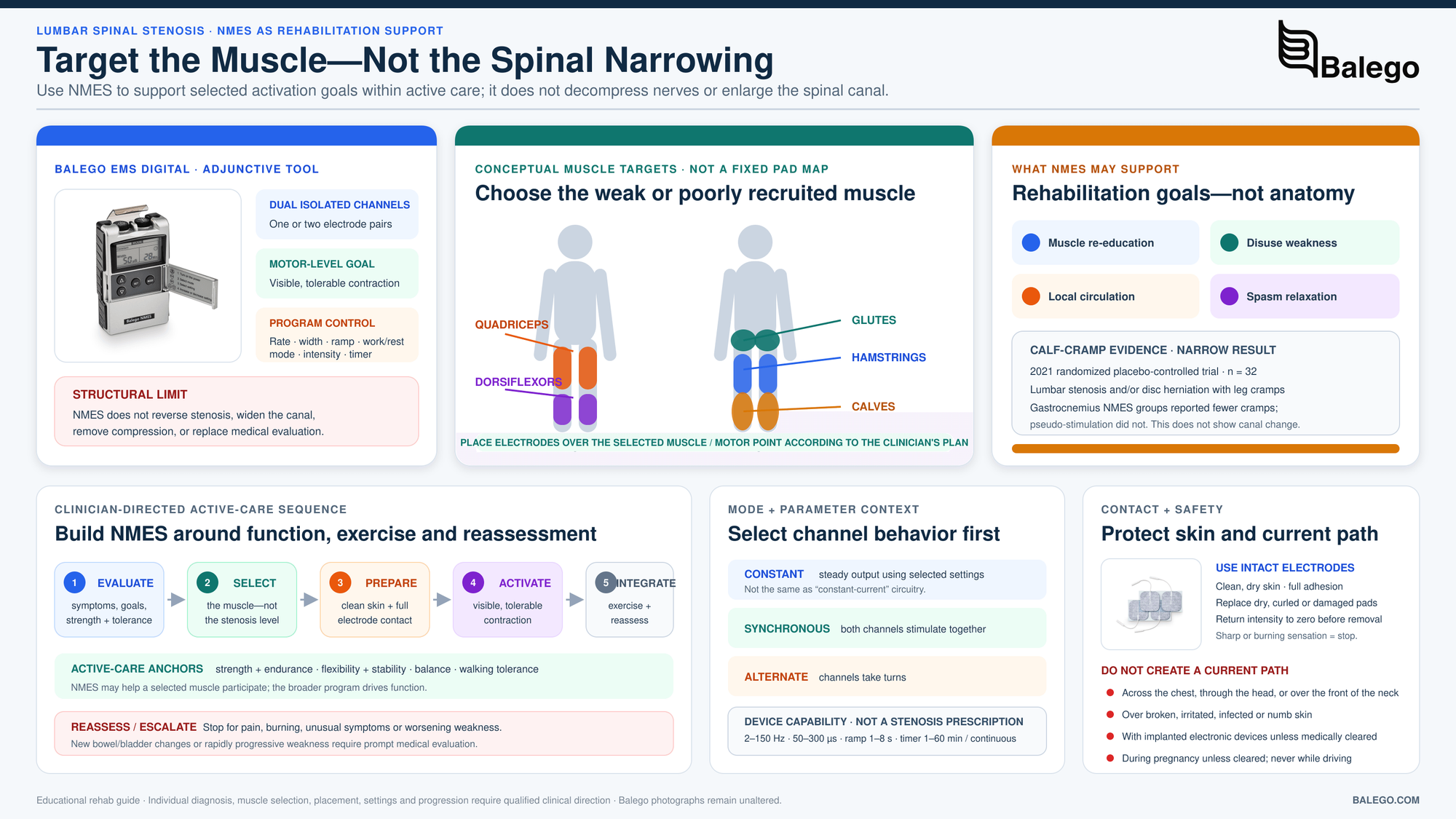
Neuromuscular electrical stimulation, or NMES, can create controlled muscle contractions through electrodes placed on the skin. For someone with lumbar spinal stenosis, NMES can be relevant to a rehabilitation program when the objective is muscle activation, neuromuscular re-education, or addressing a specific muscle deficit.
What NMES does not do is equally important.
NMES does not widen the spinal canal, remove bone spurs, reverse degenerative changes, or directly decompress a spinal nerve.
Current evidence therefore supports thinking about NMES as a muscle-targeted rehabilitation adjunct, not as a treatment for lumbar spinal stenosis itself.
The first question should not be:
“Where do I put the pads for spinal stenosis?”
It should be:
“Which muscle is the rehabilitation program trying to activate, and why?”
That distinction determines electrode placement.
For clinicians looking for an adjustable portable muscle stimulator, see the Balego EMS Digital NMES Stimulator.
NMES and Lumbar Spinal Stenosis: Quick Answer
| Question | Evidence-based answer |
|---|---|
| Can NMES reverse lumbar spinal stenosis? | No |
| Can NMES decompress a compressed nerve? | No |
| Can NMES activate selected lumbar or leg muscles? | Yes, when the motor nerve and muscle can respond |
| Has NMES been studied specifically in people with lumbar stenosis? | Yes, but direct evidence is limited |
| Is there direct randomized evidence for spinal-stenosis-related leg cramps? | Yes, from a small mixed LSS/LDH trial |
| Is NMES proven to improve walking capacity from neurogenic claudication? | Not established |
| Should pads automatically be placed over the stenotic spinal level? | No |
| Should placement follow the muscle being targeted? | Yes. |
| Is TENS the same treatment? | No—TENS and NMES have different objectives |
What Is Lumbar Spinal Stenosis?
Lumbar spinal stenosis describes narrowing within the lower spinal canal or the spaces through which spinal nerves travel.
Symptomatic stenosis can produce neurogenic claudication—pain, heaviness, numbness, tingling, cramping, or weakness in the buttocks and legs that tends to worsen with prolonged standing or walking and often improves with sitting or bending forward.
That pattern matters when considering NMES.
The electrical stimulator is not changing the anatomical narrowing. Instead, it may be used to address a secondary rehabilitation problem such as difficulty activating a muscle, disuse-related weakness, or a selected muscle's contraction pattern.
What Does the Evidence Actually Say About NMES for Spinal Stenosis?
Direct research is considerably more limited than general internet discussions of electrical stimulation may suggest.
The clearest NMES study involved leg cramps.
A randomized placebo-controlled study evaluated 32 people with lumbar spinal stenosis and/or lumbar disc herniation who experienced frequent leg cramps.
Researchers applied NMES to the gastrocnemius calf muscle twice weekly for four weeks. All three active NMES groups experienced reductions in reported leg cramps, while the pseudo-stimulation group did not show a comparable change.
That is meaningful evidence—but it needs to be interpreted precisely.
The study supports:
NMES of the calf as a potential approach to recurrent leg cramps in the population that was studied.
It does not establish that NMES:
- reduces lumbar spinal narrowing;
- decompresses nerve roots;
- improves every symptom of spinal stenosis;
- restores walking endurance;
- should always be applied to the lower back; or
- replaces exercise-based rehabilitation.
The study also included people with either lumbar spinal stenosis or lumbar disc herniation, so it should not be described as a stenosis-only trial.
What About Electrical Stimulation Directly Over the Lower Back?
This requires distinguishing NMES from TENS.
A randomized controlled trial involving 104 adults with imaging-confirmed lumbar spinal stenosis and neurogenic claudication tested paraspinal TENS while participants walked.
Active TENS was applied around L3–S1 and compared with de-tuned TENS.
Both groups improved their walking distance, but active TENS was not superior to the de-tuned treatment. The researchers concluded that paraspinal TENS should not be recommended specifically to improve walking ability in degenerative lumbar spinal stenosis.
Evidence that electrical pads can be placed over the lower back does not mean electrical stimulation has been proven to improve spinal stenosis walking capacity.
For pain-focused electrical stimulation, we already cover the separate topic in its TENS for Low Back Pain guide.
Where Does NMES Fit in Evidence-Based Spinal Stenosis Rehabilitation?
Current clinical guidance favors multimodal rehabilitation rather than relying on a single passive modality.
A clinical practice guideline for lumbar spinal stenosis with neurogenic claudication recommends considering education, lifestyle, and behavioral approaches combined with home exercise, manual therapy, and rehabilitation.
Randomized research has likewise shown that structured conservative programs incorporating exercise, education, and manual therapy can improve walking outcomes in some people with lumbar stenosis.
A systematic review of exercise programs found that successful interventions commonly incorporated components such as
- strengthening;
- trunk exercises;
- stretching;
- aerobic fitness work, particularly cycling;
- flexion-oriented exercise; and
- psychologically informed approaches.
The researchers cautioned that the studies were heterogeneous and did not establish one universally optimal exercise prescription.
Where NMES potentially fits
NMES is best considered when a clinician identifies a specific muscle-level objective inside that larger rehabilitation plan.
Examples might include:
- helping recruit an inhibited muscle;
- providing contraction-based neuromuscular re-education;
- supplementing voluntary strengthening when muscle activation is difficult;
- addressing disuse-related muscle dysfunction; or
- targeting a cramp-prone calf when clinically appropriate.
The role is therefore
Exercise and functional rehabilitation first → NMES added when a particular muscle objective justifies it.
NMES Electrode Placement for Spinal Stenosis: Target the Muscle, Not the MRI
There is no universal “spinal stenosis electrode placement.”
Lumbar stenosis describes an anatomical spinal condition. NMES electrode placement is selected according to the motor nerve and muscle you intend to activate.
That leads to several very different possible treatment regions.
| Rehabilitation problem | Possible NMES target | Where the electrodes conceptually belong | What NMES is trying to accomplish |
|---|---|---|---|
| Reduced lumbar muscle recruitment | Lumbar paraspinals / multifidus region | Over appropriate paraspinal soft tissue | Lumbar muscle activation |
| Hip-extension weakness | Gluteus maximus | Over the gluteal motor region | Hip-extension contraction |
| Hip-stabilizer weakness | Gluteus medius | Lateral hip muscle region | Hip-abductor recruitment |
| Quadriceps weakness | Quadriceps | Anterior thigh over selected motor points | Knee-extension contraction |
| Calf dysfunction or recurrent cramps | Gastrocnemius/soleus | Posterior lower leg | Calf contraction |
| Difficulty activating ankle dorsiflexors | Tibialis anterior / peroneal-nerve-related setup | Anterolateral lower leg as professionally directed | Dorsiflexion assistance or training |
This table is an anatomical decision framework, not a universal prescription.
The correct placement depends on examination findings, motor response, sensation, diagnosis, electrode size, device characteristics, and the intended task.
Should NMES Pads Be Placed Directly Over the Lumbar Spine?
Generally, the objective of surface NMES is to stimulate the target muscle or motor nerve—not to place electrodes directly over a bony spinous process simply because an MRI identifies stenosis at that level.
When lumbar paraspinal or multifidus recruitment is the objective, electrodes are typically positioned over appropriate paraspinal soft tissue, lateral to the spinal midline.
We have a separate evidence review devoted specifically to this question:
Can NMES Reach the Lumbar Multifidus?
That guide reviews ultrasound studies showing that surface stimulation can produce measurable lumbar multifidus activation and discusses a published four-electrode L2/S1 research configuration.
Does NMES Reach Deep Back Muscles?
Surface NMES is capable of recruiting lumbar muscle tissue, including measurable multifidus activation in published ultrasound studies.
But “reach” should not be interpreted as selectively isolating a deep spinal stabilizer.
Electrical current delivered from surface electrodes can recruit:
- multifidus;
- erector spinae;
- other adjacent paraspinal tissue; and
- motor nerves located within the electrical field.
Factors influencing recruitment include:
- subcutaneous tissue thickness;
- electrode location;
- electrode size;
- electrode spacing;
- stimulation intensity;
- pulse width;
- waveform;
- individual anatomy; and
- patient tolerance.
This is why seeing the lower back contract does not prove that the deepest fibers of one specific muscle have been selectively activated.
For the detailed research, see our lumbar multifidus NMES evidence and placement guide.
Should NMES Be Applied to the Back or the Legs?
It depends on the rehabilitation problem.
This is particularly important with lumbar spinal stenosis because many of its functional consequences are experienced below the stenotic spinal level.
A patient may have:
- poor walking tolerance;
- leg heaviness;
- weakness;
- cramping;
- altered gait;
- foot drop; or
- reduced lower-extremity activity.
The most useful NMES target may therefore be nowhere near the lumbar spine.
Example: calf cramping
The direct randomized NMES evidence discussed earlier targeted the gastrocnemius, not the back.
Example: quadriceps weakness
If examination identifies quadriceps inhibition or disuse-related weakness, the relevant electrode placement would be on the quadriceps—not over the site of spinal narrowing.
Example: lumbar stabilization
If the actual objective is lumbar-paraspinal or multifidus recruitment, then a lumbar electrode setup makes more sense.
This is the central rule:
Choose electrodes according to the rehabilitation target, not according to the diagnostic label alone.
NMES vs. TENS for Lumbar Spinal Stenosis
These modalities are often confused because both use adhesive electrode pads.
They serve different purposes.
| Question | NMES | TENS |
|---|---|---|
| Main objective | Muscle activation | Sensory-level pain modulation |
| Expected muscle contraction | Yes. | Usually no |
| Used for muscle re-education | Yes. | Not its primary purpose |
| Work/rest contraction cycles | Often important | Usually unnecessary |
| Primary target | Motor nerves/muscles | Sensory nerves |
| Proven to decompress spinal stenosis | No | No |
| Direct LSS evidence | Limited calf-cramp RCT in mixed LSS/LDH population | RCT found no benefit over de-tuned TENS for walking capacity. |
| Best reason to choose it | Identified muscle-activation objective | Pain-focused sensory-stimulation objective |
We cover the modality distinction more completely in TENS vs. NMES: Differences, Uses & Device Guide.
Can NMES Improve Walking With Spinal Stenosis?
This should not currently be claimed.
Walking limitation is one of the major functional consequences of symptomatic lumbar spinal stenosis, particularly when neurogenic claudication is present.
Structured rehabilitation programs have demonstrated improvements in walking capacity in clinical trials. For example, one randomized trial of 104 participants found substantially greater walking-distance improvement after a six-week comprehensive conservative program than after self-directed care.
That does not mean NMES was responsible for those results.
More broadly, a 2026 network meta-analysis including 35 randomized trials and 3,147 participants found considerable uncertainty across nonsurgical spinal-stenosis treatments and did not identify a clear walking-distance advantage for any particular intervention versus placebo or other treatments.
NMES may address a selected muscle impairment that interferes with rehabilitation, but evidence has not established NMES itself as a treatment for neurogenic-claudication walking limitation.
What About Leg Weakness or Foot Drop?
Lumbar spinal stenosis can cause neurological weakness when compressed nerves no longer activate muscles normally. Foot drop is one possible manifestation.
NMES depends on the motor nerve and muscle being sufficiently excitable.
Therefore:
- muscle weakness from disuse;
- impaired voluntary recruitment; and
- weakness caused by significant nerve-root compromise
are not necessarily the same NMES problem.
A progressively weaker leg or new foot drop warrants medical evaluation rather than simply increasing electrical stimulation.
We do have condition-specific NMES resources, but a patient with spinal-stenosis-related neurological weakness should first have the neurological cause and treatment priorities established professionally.
Does More NMES Intensity Mean Better Results?
No universal milliamp target exists for spinal stenosis.
For motor-level NMES, enough stimulation generally needs to be delivered to achieve the intended contraction, but the correct level depends on:
- target muscle;
- electrode placement;
- electrode size;
- pulse width;
- pulse rate;
- waveform;
- skin-electrode impedance;
- tissue depth;
- nerve integrity;
- fatigue; and
- individual tolerance.
An intensity value taken from one study or one stimulator should not be copied directly onto another device.
Our operating resource explains the controls separately:
Balego NMES Manual: Setup, Modes & Troubleshooting
For broader programming concepts rather than stenosis-specific claims, use the Popular Clinical NMES Settings guide.
Which NMES Device Makes Sense for Spinal-Stenosis Rehabilitation?
Device selection should follow the treatment objective, not the diagnosis alone.
Rather than duplicate every specification already shown on Balego's product pages, this comparison focuses only on the decision relevant to spinal-stenosis rehabilitation.
| Balego option | Modalities | Best fit in this context | Why choose it? |
|---|---|---|---|
| Balego EMS Digital | NMES/EMS | Dedicated muscle-activation program | Straightforward adjustable NMES without paying for pain-focused modalities |
| InTENSity Select Combo II | TENS, NMES, IFC, Russian | The rehab plan requires both pain-focused and muscle-focused stimulation. | One rechargeable device provides several distinct stimulation modes. |
| Chattanooga Intelect NMES Digital | NMES | Clinician wanting a dedicated Chattanooga NMES platform | Professional-focused adjustable NMES |
| Twin Stim IV | TENS + NMES | The user needs only the two most common sensory and motor modalities. | Simpler combination option than a four-mode device |
Balego EMS Digital: best dedicated NMES option
The Balego EMS Digital NMES Stimulator is the most direct choice when the treatment objective is muscle activation rather than pain-focused stimulation.
Its two independent channels and adjustable pulse rate, pulse width, ramp, and contraction/rest timing make it suitable for clinician-designed motor-stimulation programs.
InTENSity Select Combo II: best when both TENS and NMES are needed
The InTENSity Select Combo II combines TENS, NMES, interferential, and Russian stimulation in a rechargeable two-channel device.
That makes more sense when a treatment plan legitimately contains both:
sensory pain-management stimulation + motor-level muscle activation.
The device does include a low-back body-area program group, but a “low back” preset should not be interpreted as a validated treatment for lumbar spinal stenosis.
Chattanooga Intelect NMES Digital: a dedicated clinical alternative
The Chattanooga Intelect NMES Digital is another dedicated NMES option for users who prefer the Chattanooga platform and clinician-oriented programming.
For a broader comparison unrelated specifically to stenosis, use our NMES unit buying guide.
Which Electrodes Should Be Used?
Electrode selection matters because pad area and placement influence:
- current density;
- comfort;
- motor recruitment;
- skin contact; and
- how broadly current is distributed.
Larger muscle groups such as the gluteals, quadriceps, or lumbar paraspinals may sometimes benefit from a broader electrode footprint, while smaller targets may require a more focused arrangement.
Do not choose the smallest available pad simply because you want the stimulation to feel “stronger.” Higher current density can make stimulation less comfortable.
We offer multiple sizes through our TENS/NMES/FES electrode collection.
Poor adhesion, dried hydrogel, and curled pad edges should be corrected rather than compensated for by turning up the intensity.
Why the Balego NMES Modes Matter
The Balego EMS Digital includes constant, synchronous, and alternate operating modes.
These describe how stimulation is timed, not three different treatments for spinal stenosis.
| Mode | What it does | Possible rehabilitation relevance |
|---|---|---|
| Constant | Ongoing stimulation without a programmed work/rest cycle | Selected continuous-stimulation applications |
| Synchronous | Both channels contract and rest together. | Bilateral or paired muscle contraction |
| Alternate | Channels take turns contracting. | Alternating right/left or paired-muscle workflows |
The correct mode depends on the muscle target and treatment objective.
Detailed programming belongs in the Balego NMES operating manual rather than being duplicated on this spinal-stenosis page.
When NMES Should Not Delay Medical Evaluation
Lumbar stenosis can occasionally produce significant neurological compromise.
Seek prompt medical assessment for new or worsening:
- leg weakness;
- foot drop;
- major difficulty walking;
- loss of sensation;
- bowel or bladder dysfunction; or
- numbness around the groin, inner thighs, or saddle region.
Acute cauda equina syndrome is a medical emergency. AAOS specifically identifies loss of bowel/bladder control, saddle-region numbness, and severe leg weakness as warning findings requiring urgent treatment.
Do not respond to progressive neurological symptoms simply by changing electrode placement or increasing NMES intensity.
Frequently Asked Questions
Does NMES help lumbar spinal stenosis?
NMES may be useful for a specific muscle-rehabilitation objective in someone who also has lumbar spinal stenosis.
It has not been shown to reverse spinal narrowing or decompress affected nerves.
Direct NMES evidence in this population is limited. One randomized trial found reduced leg cramps after gastrocnemius NMES in people with lumbar spinal stenosis and/or lumbar disc herniation.
Where should I place NMES electrodes for spinal stenosis?
There is no single spinal stenosis placement.
Electrode location should match the muscle being treated—for example, the lumbar paraspinals, gluteals, quadriceps, or calf—based on clinical assessment.
If lumbar multifidus recruitment is the objective, see our dedicated multifidus NMES electrode-placement guide.
Should NMES pads go over the painful area?
Not necessarily.
NMES placement is designed primarily to produce a useful motor response from a target muscle. The painful location and the best motor-point placement may be different.
If the primary goal is pain-focused sensory stimulation rather than contraction, the relevant modality may instead be TENS.
Is TENS or NMES better for spinal stenosis?
Neither treats the structural stenosis.
Use TENS when the objective is sensory-level pain modulation and NMES when the objective is controlled muscle contraction.
Research specifically examining TENS for walking ability in lumbar stenosis found active treatment no better than de-tuned TENS.
Can NMES strengthen the lower back with spinal stenosis?
NMES can create contraction of lumbar muscles, and research has demonstrated surface-NMES activation of the multifidus.
Whether strengthening those muscles is appropriate for an individual with stenosis depends on that person's examination, symptoms, and rehabilitation plan.
Can NMES help calf cramps caused by spinal stenosis?
This is the most directly supported stenosis-related NMES application identified in the literature.
A small randomized placebo-controlled trial found fewer leg cramps after gastrocnemius NMES in people with lumbar spinal stenosis and/or lumbar disc herniation. (PubMed Central
Because the researchers used a specialized stimulation protocol, the study should not be converted into a universal home NMES setting.
Can NMES improve walking distance?
There is not sufficient evidence to claim that NMES itself improves neurogenic-claudication walking capacity.
Exercise-based and multimodal rehabilitation have a stronger direct evidence base for functional rehabilitation in lumbar spinal stenosis.
Can I use the Balego NMES unit at home?
The Balego EMS Digital can be used in an appropriately guided home program when the user understands the treatment objective, settings, electrode placement, and safety requirements.
For a diagnosed spinal condition, the muscle target and program should ideally be established by a qualified healthcare professional.
What if I also need TENS for pain?
A combination device may make more sense than buying separate stimulators.
The InTENSity Select Combo II provides TENS, NMES, IFC, and Russian stimulation, while dedicated NMES users can choose the simpler Balego EMS Digital.
Bottom Line: Use NMES to Treat the Muscle Problem, Not the Stenosis Itself
The most accurate way to position NMES for lumbar spinal stenosis is as a targeted muscle-rehabilitation tool.
NMES does not enlarge the spinal canal or remove nerve compression.
Its potential value arises when spinal-stenosis symptoms, reduced activity, or another associated impairment leave a clinician with a specific muscle-level objective, such as:
- improving voluntary recruitment;
- producing controlled contraction;
- supporting neuromuscular re-education;
- addressing disuse-related muscle dysfunction; or
- targeting recurrent calf cramps when clinically appropriate.
The evidence is strongest when claims remain narrow. A randomized trial supports calf NMES for recurrent cramps in a mixed lumbar-stenosis/disc-herniation population, while evidence for NMES specifically improving walking capacity, neurogenic claudication, or the underlying spinal stenosis remains insufficient.
For a dedicated contraction-based device, compare the Balego EMS Digital NMES Stimulator.
For lumbar multifidus-specific research and placement, read Can NMES Reach the Lumbar Multifidus?.
For users who are uncertain whether the treatment objective calls for sensory pain stimulation or muscle contraction, start with our TENS vs. NMES guide.
Medical notice: This article is educational and does not prescribe treatment. Lumbar spinal stenosis can involve neurological compromise. Electrode placement, treatment parameters, and suitability for NMES should follow the applicable device instructions and individualized clinical guidance. New or worsening weakness, saddle numbness, or bowel/bladder dysfunction requires prompt medical evaluation.


