



ORTHOGEL Ingredients: Menthol 3.5%, Uses, Safety and Topical Analgesic Comparisons
ORTHOGEL Advanced Pain Relief Gel is an over-the-counter topical analgesic formulated for temporary relief of minor muscle and joint aches associated with simple backache, arthritis, strains, sprains, and bruises.
Its active drug ingredient is menthol 3.5%. ORTHOGEL also contains aloe, Boswellia serrata extract, dimethyl sulfone (MSM), glucosamine HCl, Ilex paraguariensis extract, vitamin E acetate, and other inactive ingredients.
That distinction matters. Menthol is the ingredient responsible for ORTHOGEL’s labeled topical-analgesic claim. The other ingredients are part of the formulation but are not separately identified as active analgesic drugs on the current Drug Facts label.
ORTHOGEL contains menthol 3.5% as its only active topical-analgesic ingredient. Its inactive ingredients contribute to the complete formulation but should not be described as individually proven treatments for arthritis, inflammation, cartilage damage, tendon injury, or another underlying condition.
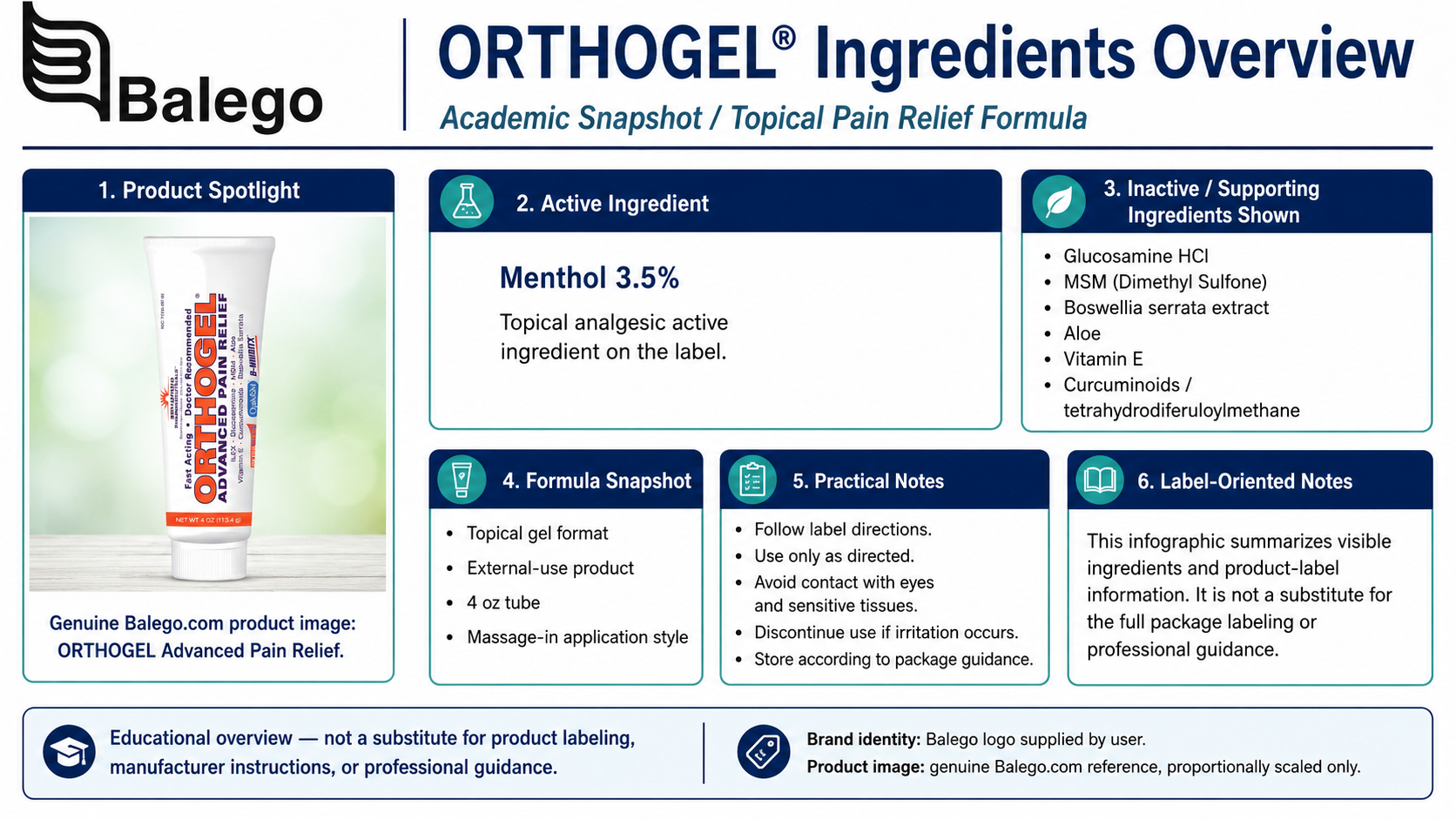
ORTHOGEL Ingredient Summary
| Ingredient category | ORTHOGEL label information | What the distinction means |
|---|---|---|
| Active drug ingredient | Menthol 3.5% | Responsible for the labeled topical-analgesic use |
| Botanical ingredients | Aloe barbadensis leaf extract, Boswellia serrata extract and Ilex paraguariensis leaf extract | Included as inactive formulation ingredients |
| Other recognizable ingredients | Dimethyl sulfone, or MSM, glucosamine HCl, tetrahydrodiferuloylmethane and vitamin E acetate | Present in the formula but not listed as independent active drugs |
| Additional formulation ingredients | Camphor, carbomer, isopropyl alcohol, methylparaben, triethanolamine, water and color additives | Help form the finished gel and its application characteristics |
| Labeled purpose | Temporary relief of minor muscle and joint aches | Symptom relief rather than treatment of the underlying cause |
The current Drug Facts information lists menthol 3.5% as the active ingredient and identifies the product as an OTC monograph drug under the FDA’s external-analgesic monograph. What's the active ingredient in ORTHOGEL?
Menthol 3.5%
Menthol 3.5% is ORTHOGEL’s active topical-analgesic ingredient.
The FDA’s external-analgesic monograph identifies menthol in concentrations from 1.25% through 16% as a counterirritant active ingredient that produces a cooling sensation. ORTHOGEL’s 3.5% concentration falls within that range. ates cold-sensitive sensory pathways in the skin, creating a cooling sensation without necessarily lowering tissue temperature. This sensory effect can temporarily alter the perception of minor muscle and joint discomfort. Labeled to temporarily relieve minor aches and pains associated with:
- Simple backache
- Arthritis
- Strains
- Sprains
- Bruises
- Other minor muscle and joint aches
It is not labeled to repair cartilage, heal a torn muscle or tendon, reverse arthritis, correct joint mechanics, or eliminate the underlying cause of pain. Inactive Ingredients: Why the Difference Matters
The terms "active" and "inactive" have specific meanings on an OTC Drug Facts label.
| Label status | Meaning |
|---|---|
| Active ingredient | The drug ingredient associated with the product’s labeled therapeutic purpose |
| Inactive ingredient | A component of the finished formulation that is not separately labeled as providing the drug’s therapeutic action |
| Included in the formula | Confirms that an ingredient is present, but does not prove that it independently treats a medical condition |
| Discussed in ingredient research | Does not automatically demonstrate that the complete ORTHOGEL formula produces the same effect |
| Recognizable wellness ingredient | Does not permit claims beyond the finished product’s Drug Facts labeling |
Research on orally consumed glucosamine, isolated Boswellia extracts, or other separately administered ingredients cannot automatically be applied to the amount, delivery method, or finished formulation used in ORTHOGEL.
For that reason, a compliant ingredient discussion should say that these ingredients are included in the formula, not that each ingredient independently reduces inflammation, rebuilds cartilage, or heals injured tissue.
Complete ORTHOGEL Ingredient List
The current Drug Facts label lists the following ingredients.
- Menthol 3.5%
Inactive ingredients
- Aloe barbadensis leaf extract
- Boswellia serrata extract, listed as B-NHIBITX™
- Camphor
- Carbomer
- Dimethyl sulfone, listed as OptiMSM®
- FD&C Yellow No. 5
- FD&C Blue No. 1
- Glucosamine HCl
- Ilex paraguariensis leaf extract
- Isopropyl alcohol
- Methylparaben
- Tetrahydrodiferuloylmethane
- Tocopheryl acetate, or vitamin E acetate
- Triethanolamine, also called trolamine,
- Water
Ingredient lists can change. Customers with allergies or sensitivities should review the Drug Facts panel on the specific package before use.
Understanding the Recognizable Inactive Ingredients
Several inactive ingredients are familiar from skincare, botanical, or dietary supplement products. Their presence helps distinguish the ORTHOGEL formula, but the product’s therapeutic claim still comes from menthol 3.5%.
| Ingredient | What can accurately be said | What should not be assumed |
|---|---|---|
| Aloe barbadensis leaf extract | Aloe is included as an inactive botanical ingredient | That ORTHOGEL is an aloe treatment for burns, wounds or skin disease |
| Boswellia serrata extract | A Boswellia-derived ingredient is present in the formula | That the finished gel has independently proven anti-inflammatory effects from Boswellia |
| Dimethyl sulfone or MSM | A sulfur-containing ingredient is included | That topical ORTHOGEL reproduces results from oral MSM supplements |
| Glucosamine HCl | Glucosamine is included as an inactive ingredient | That the gel rebuilds cartilage or reverses osteoarthritis |
| Ilex paraguariensis extract | A plant-derived extract is present | That it independently relieves pain in the finished product |
| Tetrahydrodiferuloylmethane | A curcuminoid-related ingredient is included | That ORTHOGEL provides the effects claimed for oral turmeric or curcumin products |
| Tocopheryl acetate | A vitamin E derivative is present | That it independently treats an injury or joint condition |
| Camphor | Camphor appears on the inactive-ingredient list | That it is a separately labeled active analgesic in ORTHOGEL |
How Does ORTHOGEL Compare With Other Topical Pain-Relief Ingredients?
Topical pain relievers are not interchangeable. They may contain different active ingredients, have different labeled uses, and carry different warnings.
| Topical product category | Typical active ingredient | General sensory or drug approach | Important distinction |
|---|---|---|---|
| ORTHOGEL | Menthol 3.5% | Cooling counterirritant | Broad temporary-relief labeling for minor muscle and joint aches |
| Other menthol gels | Menthol in varying concentrations | Cooling counterirritant | Cooling intensity and inactive formula vary by product |
| Menthol and methyl salicylate rubs | Two counterirritant active ingredients | Often combines cooling with a stronger warming sensation | Contains an active salicylate and may carry different precautions |
| Capsaicin creams | Capsaicin, commonly 0.025%–0.25% under the monograph | Produces warmth or burning and affects pain-sensing pathways with repeated application | Initial burning can be prominent; careful handwashing and exposure avoidance are important |
| Topical diclofenac gel | Diclofenac sodium 1% | Topical nonsteroidal anti-inflammatory drug | OTC labeling is directed toward arthritis pain in specified joints and includes NSAID warnings |
| Lidocaine topicals | Lidocaine in a labeled concentration | Local anesthetic effect | Different drug class, indications, application limits and warnings |
The FDA external-analgesic monograph recognizes menthol, methyl salicylate, and capsaicin as counterirritant active ingredients within specified concentration ranges. Diclofenac gel is a topical NSAID with its own arthritis-specific labeling rather than a menthol counterirritant. For a brand comparison, see our guide to the best topical pain-relief products.
Here is a clean replacement for the damaged section:
ORTHOGEL vs. Menthol and Methyl Salicylate Rubs
ORTHOGEL lists menthol 3.5% as its active ingredient. Methyl salicylate is not listed among its current active or inactive ingredients. This distinguishes ORTHOGEL from topical rubs that combine menthol with methyl salicylate, sometimes called oil of wintergreen.
| Feature | ORTHOGEL | Menthol and methyl salicylate rubs |
|---|---|---|
| Active ingredient profile | Menthol 3.5% | Menthol plus methyl salicylate in product-specific concentrations |
| Active salicylate | No methyl salicylate listed | Yes |
| Product category | OTC topical counterirritant analgesic | OTC topical counterirritant analgesic |
| Typical skin sensation | Primarily cooling | Often produces a combination of cooling and warming sensations |
| Labeled purpose | Temporary relief of minor muscle and joint aches associated with simple backache, arthritis, strains, sprains and bruises | Temporary relief of minor muscle and joint aches according to the individual product label |
| Formula consideration | Contains menthol along with several inactive botanical and formulation ingredients | The formula varies; some products contain additional counterirritants or inactive ingredients |
| Salicylate consideration | May be useful when comparing products that do not list methyl salicylate as an active ingredient | Requires consideration of methyl salicylate exposure, allergies, medications and product-specific warnings |
| Heat precautions | Do not use with a heating pad or heating device | Generally should not be combined with external heat; follow the exact Drug Facts label |
| Best selection question | Does the user prefer a menthol-based gel without active methyl salicylate? | Is a dual-active counterirritant appropriate for the user’s needs and health history? |
People who are sensitive or allergic to aspirin or salicylates, take anticoagulant medication, are pregnant, or have other medication concerns should consult a pharmacist or healthcare professional before using a methyl salicylate product. Product formulations differ, so the Drug Facts label on the specific package remains the controlling source for ingredients, directions, and warnings.
ORTHOGEL vs. Capsaicin Cream
| Feature | ORTHOGEL menthol gel | Capsaicin cream |
|---|---|---|
| Main sensation | Cooling | Warming or burning |
| Typical use pattern | Applied for temporary minor muscle and joint pain relief | Often requires consistent, repeated use according to the specific label |
| Initial tolerability | Cooling or tingling may occur | Burning can be substantial, especially during early applications |
| Handling concern | Avoid eyes, mucous membranes and damaged skin | Particularly careful handwashing and avoidance of eyes, airways and sensitive skin are needed |
| Heat warning | Do not combine with a heating pad or device | Heat can also increase the risk of excessive irritation or burns |
| Best selection question | Does the user want a moderate cooling gel? | Can the user tolerate and follow a capsaicin-specific application routine? |
Capsaicin labels commonly emphasize the risk of burning and the importance of avoiding heat and contact with the eyes or mucous membranes.
ORTHOGEL vs. OTC diclofenac sodium 1% gel
| Feature | ORTHOGEL | OTC diclofenac sodium 1% gel |
|---|---|---|
| Drug class | Menthol counterirritant | Nonsteroidal anti-inflammatory drug |
| Labeled role | Temporary relief of minor muscle and joint aches | Temporary relief of arthritis pain in specified joints |
| Body areas | Follow ORTHOGEL’s Drug Facts and intact-skin precautions | OTC labels typically specify hands, wrists, elbows, feet, ankles and knees |
| Immediate sensation | Cooling | Not selected primarily for a cooling sensation |
| Application approach | Thin film, no more than the label permits | Measured dosing and a scheduled arthritis-treatment routine |
| Major warning category | Skin irritation, damaged skin, heat and bandaging precautions | NSAID allergy, bleeding, cardiovascular, liver and other warnings |
| Best fit | General temporary relief of qualifying minor aches | Diagnosed arthritis pain in joints included on the diclofenac label |
OTC diclofenac labeling states that it is for arthritis pain in designated joints and is not labeled for other areas such as the back, hip, or shoulder.
The most defensible ORTHOGEL benefits are those supported by its label and current product characteristics.
1. Temporary localized symptom relief
ORTHOGEL can be applied directly to an appropriate area of minor muscle or joint discomfort instead of being taken orally.
2. Moderate menthol concentration
The 3.5% menthol concentration provides a cooling counterirritant option without using the much higher menthol concentrations found in some intense sports rubs.
3. No active methyl salicylate
Methyl salicylate is not listed on the current ORTHOGEL Drug Facts label. This differentiates it from dual-active menthol and methyl-salicylate products.
ORTHOGEL is greaseless, non-staining, and without a strong lingering odor, making it practical for daytime, workplace, clinic, and athletic-training use.
ORTHOGEL is offered in roll-on, tube, jar, and pump formats. Detailed size and format comparisons are available on the ORTHOGEL product page rather than repeated here.
A topical analgesic can temporarily change how an area feels, but symptom reduction is not the same as restored strength, mobility, or tissue capacity.
| Rehabilitation goal | Possible role for ORTHOGEL | What still requires active care |
|---|---|---|
| Make minor soreness more manageable | Temporary localized symptom relief | Identify why the soreness developed |
| Improve comfort around movement | May help some users tolerate light activity | Gradual mobility and exercise progression |
| Manage post-activity aches | May be incorporated into a recovery routine | Appropriate training volume and recovery |
| Support care between appointments | Convenient home topical option | Follow the prescribed home program |
| Address recurring joint pain | Can provide temporary relief when label-appropriate | Medical evaluation when symptoms persist or recur |
| Return to sport or work | May reduce a minor symptom barrier | Strength, endurance and task-specific conditioning |
Explore our resistance-band and exercise products for active rehabilitation tools selected according to a professional or home exercise plan.
ORTHOGEL does not diagnose an injury or determine whether activity is safe. Pain that is severe, unexplained, associated with trauma, or accompanied by weakness, deformity, significant swelling, neurological symptoms, or loss of function should be evaluated.
How to Apply ORTHOGEL
Follow the Drug Facts label supplied with the product.
The current label directs adults and children 12 years and older to rub a thin film over the affected area no more than three to four times daily and to wash their hands afterward with cool water.
- Check that the skin is intact and not irritated.
- Apply only a thin film to the affected area.
- Spread the gel gently rather than aggressively massaging a painful injury.
- Wash your hands afterward with cool water unless the hands are the treated area.
- Allow the product to dry before covering the area with loose clothing.
- Stay within the maximum frequency listed on the package.
Using more gel or applying it more frequently does not necessarily provide greater relief and may increase irritation.
ORTHOGEL Safety Checklist
| Safety question | Label-based guidance |
|---|---|
| Can it be applied to broken skin? | No. Do not apply to wounds or damaged skin. |
| Can it be used on irritated skin? | Do not apply to irritated skin or continue if excessive irritation develops. |
| Can it be used with a heating pad? | No. Do not use with a heating pad or other heating device. |
| Can the area be wrapped tightly? | No. Do not bandage tightly. |
| Can it be applied near the eyes? | Avoid the eyes and mucous membranes. |
| Is it flammable? | Keep it away from excessive heat and open flame. |
| What about pregnancy or breastfeeding? | Ask a health professional before use. |
| What if it is swallowed? | Seek medical help or contact Poison Control immediately. |
| How should it be stored? | Store at 68–77°F in a cool, dry place away from direct sunlight. |
ORTHOGEL should not be used with:
- Heating pads
- Electric blankets over the application site
- Heated wraps
- Hot-water bottles
- Heat-generating therapeutic devices
- Tight or occlusive bandaging
External heat and tight coverings can increase product absorption and raise the risk of skin irritation or burns. The ORTHOGEL Drug Facts label specifically warns against using the gel with heating pads, heating devices, or tight bandages.
A reusable hot or cold gel pack is a separate comfort modality. Do not place a hot or cold pack over skin that has been freshly treated with ORTHOGEL unless the product labeling and a qualified healthcare professional specifically permit the combination.
When to Stop Using ORTHOGEL
Stop use and ask a doctor when
- Pain, swelling or blistering of the skin develops
- The condition worsens
- Symptoms continue for more than seven days
- Symptoms improve and then return within a few days
- Arthritic pain continues for more than ten days
- Redness is present with arthritic symptoms
- The reaction is unexpected or concerning
Here is the corrected and polished FAQ and closing section:
Frequently Asked Questions
What is the main ingredient in ORTHOGEL?
The active ingredient in ORTHOGEL is menthol 3.5%. Menthol is responsible for the product’s labeled topical-analgesic purpose: the temporary relief of minor muscle and joint aches.
Does ORTHOGEL contain glucosamine?
Yes. ORTHOGEL contains glucosamine HCl as an inactive ingredient. Its inclusion in the formula does not mean that the product rebuilds cartilage, reverses arthritis, or repairs joint damage.
Does ORTHOGEL contain MSM?
Yes. Dimethyl sulfone, commonly known as MSM, is included as an inactive ingredient.
Does ORTHOGEL contain Boswellia?
Yes. Boswellia serrata extract is included as an inactive botanical ingredient.
Does ORTHOGEL contain turmeric or curcumin?
The ingredient list includes tetrahydrodiferuloylmethane, a curcuminoid-related compound. Its presence should not be interpreted to mean that topical ORTHOGEL provides the same effects associated with orally consumed turmeric or concentrated curcumin supplements.
Does ORTHOGEL contain camphor?
Yes. Camphor is included in the formula, but it is listed as an inactive ingredient on the current ORTHOGEL Drug Facts label. Menthol 3.5% is the product’s sole active ingredient.
Does ORTHOGEL contain methyl salicylate?
Methyl salicylate is not listed among the active or inactive ingredients on the current ORTHOGEL Drug Facts label. People with ingredient allergies, medication concerns, or sensitivities should still review the label on the specific package and consult a healthcare professional when appropriate.
Is ORTHOGEL an anti-inflammatory?
ORTHOGEL is labeled as a menthol-based topical analgesic for the temporary relief of minor muscle and joint aches. It should not be described as a topical anti-inflammatory medication in the same category as diclofenac or other nonsteroidal anti-inflammatory drugs.
Can ORTHOGEL cure arthritis?
No. ORTHOGEL may temporarily relieve minor aches associated with arthritis, but it does not cure arthritis, reverse joint damage, or alter the underlying disease process.
Can ORTHOGEL be used before exercise?
ORTHOGEL may be applied before activity when its use is consistent with the Drug Facts label. Because the cooling sensation can temporarily change pain perception, it should not be used to mask an injury, ignore worsening symptoms, or continue an activity that may be unsafe.
Can ORTHOGEL be used after exercise?
ORTHOGEL may be used after activity for label-appropriate minor muscle and joint aches. Do not apply it to skin that is cut, blistered, abraded, sunburned, or otherwise damaged.
Can ORTHOGEL be used with ice?
The Drug Facts label specifically prohibits heating pads and heating devices. Although cold packs are not addressed in the same way, intense cold can alter skin sensation. Avoid placing an ice pack directly over freshly applied ORTHOGEL unless the product labeling and a qualified healthcare professional specifically permit the combination.
Can ORTHOGEL be used with TENS or NMES electrodes?
Do not apply ORTHOGEL beneath self-adhesive TENS or NMES electrodes unless the electrode and device manufacturers explicitly permit it. Topical gels, lotions, and other skin products can interfere with electrode adhesion, electrical contact, and skin tolerance.
Before electrical stimulation, clean and dry the skin according to the electrode and device instructions. Browse our electrotherapy electrode collection for compatible replacement pads and related accessories.
Which ORTHOGEL size should I choose?
The best format depends on the intended application:
- A roll-on may be convenient for targeted, hands-free application.
- A tube or jar may suit individual or household use.
- A larger pump may be more practical for clinics, athletic-training rooms, or higher-volume use.
Because sizes and availability may change, consult the ORTHOGEL product page for current purchasing options.
Key Takeaway
ORTHOGEL is best understood as an over-the-counter topical analgesic containing menthol 3.5% as its active ingredient.
Menthol supports the product’s labeled use for temporary relief of qualifying minor muscle and joint aches. Aloe, Boswellia, MSM, glucosamine, Ilex, vitamin E, and the other inactive ingredients help characterize the overall formulation, but they should not be promoted as independently proven drug treatments within the finished gel.
Use ORTHOGEL only as directed. Avoid applying it to damaged skin or combining it with heating pads, heating devices, or tight bandages. Seek professional evaluation when pain is severe, worsening, unexplained, recurring, or persistent.
Shop ORTHOGEL Advanced Pain Relief Gel, browse our topical analgesic collection, or compare product categories in Best Topical Pain Relief Products for 2026.

