


Long-Term Care Rehabilitation Modalities and Safe Patient Handling
Long-term-care rehabilitation is not defined by a particular machine. It is a coordinated, person-centered program designed to preserve or improve mobility, self-care, communication, swallowing, comfort, safety, and participation in daily life.
Residents of skilled nursing and continuing-care facilities frequently have multiple diagnoses, medications, sensory changes, cognitive limitations, and mobility needs. A treatment that is appropriate for one resident may be ineffective—or unsafe—for another.
Physical agents such as TENS, NMES, therapeutic ultrasound, laser, and shortwave diathermy may sometimes help remove a barrier to activity. Their purpose is generally to support active rehabilitation, not replace strengthening, balance work, transfer practice, gait training, positioning, functional tasks, or resident education.
Falls remain a major concern: well over 14 million U.S. adults aged 65 or older report falling each year. Federal physical-activity guidance recommends that older adults combine balance training with aerobic and muscle-strengthening activities according to their abilities and health status.
Clinical-use notice: This guide does not prescribe a modality, placement or treatment parameter. Long-term-care interventions must follow the resident’s evaluation, goals, care plan, applicable scope-of-practice requirements, facility procedures and current manufacturer instructions.
What is a long-term care rehabilitation modality program?
A useful modality program integrates physical-agent equipment into a broader rehabilitation and restorative-care system.
| Program component | Purpose |
|---|---|
| Person-centered assessment | Identifies the resident’s goals, risks, preferences and meaningful activities |
| Medical and safety screening | Detects contraindications, red flags, implants, vascular risks, skin issues and cognition concerns |
| Functional baseline | Establishes the mobility or activity that treatment is intended to improve |
| Active rehabilitation | Uses task practice, exercise, mobility and participation as the foundation |
| Selected modality | Addresses a defined barrier such as pain, muscle inhibition or stiffness |
| Safe patient handling | Matches transfer and repositioning equipment to resident ability |
| Staff education | Promotes consistent techniques across therapy, nursing and aides |
| Outcome tracking | Determines whether treatment produces useful functional change |
| Care-team communication | Coordinates therapy with nursing, medicine, dietary services, speech-language pathology and caregivers |
| Discharge or maintenance plan | Supports continued movement, positioning, exercise and equipment use |
CMS describes high-quality care as person-centered rather than fragmented around isolated conditions. Its current Minimum Data Set framework includes structured assessment of self-care, mobility, falls, and other resident health conditions.
The central rule: connect every modality to a functional goal
A treatment rationale should explain what the resident is expected to do more successfully after treatment.
Examples include:
- Transfer with less assistance
- Participate in standing practice
- Walk farther with an assistive device
- Complete a seated strengthening program
- Activate the quadriceps during functional exercise
- Tolerate shoulder mobility needed for dressing
- Reposition in bed more comfortably
- Participate in swallowing exercises
- Complete toileting or grooming tasks
- Remain engaged in restorative nursing activities
Apply sensory-level stimulation as a short-duration adjunct, then retest the resident’s ability to complete sit-to-stand practice.
Use NMES during active quadriceps contraction practice, then reassess knee-extension control during transfers.
Long-term-care problem and intervention matrix
| Clinical problem | Foundation of care | Possible modality role | Important limitation |
|---|---|---|---|
| Pain-limiting activity | Examination, positioning, education, movement and graded exercise | TENS, heat, cold or selected clinic modality | Do not use a modality to mask an undiagnosed or worsening condition |
| Muscle weakness or inhibition | Progressive strengthening and task practice | NMES during voluntary contraction or exercise | NMES does not replace active muscle use |
| Fall risk | Balance, strength, gait, medication review, environment and vision assessment | NMES or TENS only when they address a specific contributing impairment | Neither TENS nor NMES is a complete fall-prevention program |
| Functional decline | Daily mobility, resistance exercise, endurance and ADL practice | Active-passive cycling or NMES as an adjunct | Avoid substituting machine time for meaningful activity |
| Contracture risk | Positioning, movement, splinting when indicated and care-plan consistency | Heat, selected ultrasound or diathermy before mobility work | Physical agents do not reverse every established contracture |
| Dysphagia | SLP evaluation, instrumental assessment when indicated, swallowing exercises, and diet planning | Specialized swallowing NMES in selected cases | General-purpose limb NMES devices are not substitutes |
| Urinary incontinence | Evaluation, toileting program and pelvic-floor training when appropriate | Selected pelvic-floor stimulation | Generic surface e-stim is not a universal incontinence treatment |
| Limited exercise tolerance | Graded activity and monitoring of exertion and vital response | Active-passive cycling or supported exercise equipment | Medical stability and resident tolerance govern progression |
| Transfer dependence | Resident-specific mobility training and assistive equipment | Mechanical stand aid or full-body lift when indicated | Safe handling equipment is not a treatment modality |
| Skin vulnerability | Pressure management, hygiene, nutrition, positioning and inspection | Usually no physical-agent treatment until suitability is established | Adhesives, heat and electrical current may increase risk |
Step 1: screen before choosing equipment
Long-term-care residents may have multiple factors that affect modality safety.
Review:
- Diagnosis and recent change in medical status
- Pain location and cause
- Cardiac pacemaker, defibrillator or other implanted device
- Joint replacement or other metal near a diathermy field
- Sensation and ability to report discomfort
- Skin integrity, edema and pressure-injury risk
- Peripheral circulation
- Known or suspected thrombosis
- Active infection or fever
- Malignancy and treatment location
- Anticoagulant use
- Cognition, behavior and ability to follow instructions
- Seizure history when relevant
- Oxygen use and treatment environment
- Fall history
- Transfer and positioning assistance
- Current monitoring equipment
- Recent surgery and movement restrictions
- Resident goals and willingness to participate
A modality should not be used to delay evaluation of a new neurological change, acute shortness of breath, suspected fracture, infection, vascular emergency, rapidly increasing swelling, or unexplained severe pain.
Step 2: measure a meaningful baseline
Choose a measure that relates directly to the resident’s care plan.
| Goal | Possible baseline and follow-up measure |
|---|---|
| Improve transfers | Assistance level, repetitions or sit-to-stand time |
| Improve walking | Distance, speed, device, assistance or rest breaks |
| Improve activity tolerance | Minutes of continuous activity or perceived exertion |
| Improve muscle activation | Contraction quality, strength or task control |
| Improve range of motion | Joint measurement and related ADL performance |
| Reduce pain interference | Pain during the selected activity |
| Improve balance | Appropriate standardized balance or fall-risk measure |
| Improve self-care | Assistance required for dressing, toileting or grooming |
| Improve swallowing | SLP-selected clinical or instrumental outcome |
| Improve positioning tolerance | Time and assistance required without adverse skin response |
| Improve caregiver safety | Transfer method, equipment adherence and handling incidents |
The CMS assessment system emphasizes functional abilities such as self-care and mobility rather than relying solely on impairment-level measurements.
TENS for temporary pain modulation
Transcutaneous electrical nerve stimulation applies pulsed electrical current through electrodes placed on the skin. TENS is usually intended to create a sensory response rather than a structured muscle contraction.
Potential role in long-term care
TENS may be considered when:
- Pain limits participation in exercise or mobility
- The cause of pain has been evaluated
- The resident can report the stimulation accurately
- Skin and sensation permit electrode use
- There is no incompatible implanted electronic device
- A brief trial produces measurable improvement
- Staff can consistently follow the treatment plan
Appropriate goal
Temporarily reduce pain interference enough for the resident to participate in a defined activity.
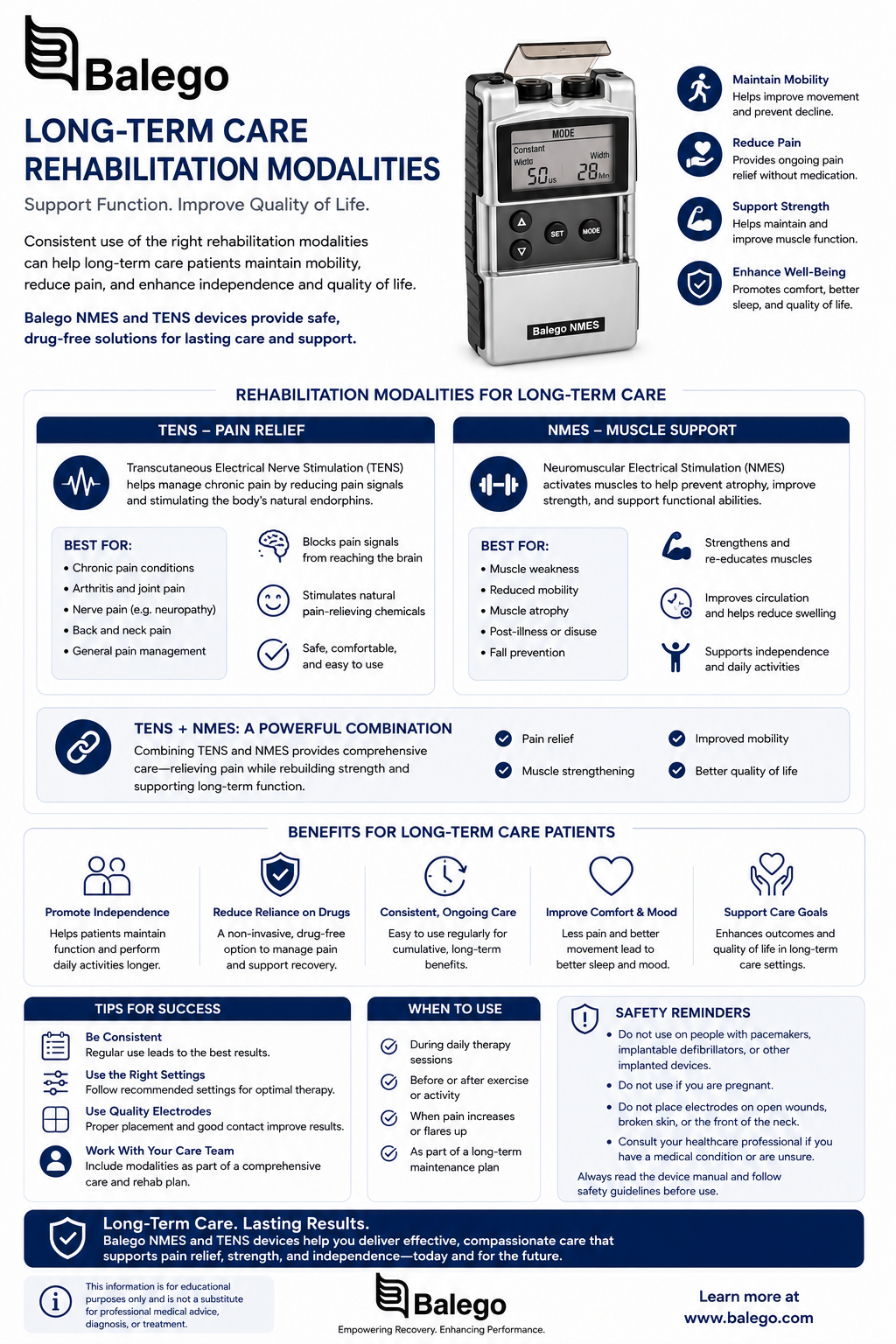
The Balego TENS Digital Edition is a portable dual-channel OTC TENS system. Its FDA-cleared indication is limited to temporary relief of sore and aching muscles associated with exercise and ordinary activity; facility use must remain within its labeling and the resident’s plan of care.
For broader selection principles, read Pain Management Modalities in Rehabilitation.
NMES for muscle activation and motor re-education
Neuromuscular electrical stimulation is used when the intended response is a visible or palpable muscle contraction.
Potential long-term care applications may include:
- Activating an inhibited muscle
- Assisting contraction practice after appropriate clearance
- Pairing stimulation with functional exercise
- Supporting structured work-and-rest strengthening
- Practicing symmetrical or alternating muscle activation
- Helping a resident participate more effectively in a therapeutic task
NMES should remain connected to voluntary activity
A useful program might combine NMES with:
- Seated knee extension
- Sit-to-stand preparation
- Ankle dorsiflexion practice
- Upper-extremity reaching
- Hand-opening or grasp practice
- Bed-mobility exercise
- Other diagnosis-appropriate movement
The Balego EMS Digital NMES Stimulator is a portable dual-channel limb-muscle stimulator with constant, synchronous, and alternate modes and adjustable work-rest controls. It is intended for motor-level stimulation and is distinct from a pain-focused TENS unit.
Important limitation: A portable limb NMES device should not be used for dysphagia or internal pelvic-floor stimulation unless its labeling, accessories, clinician training and treatment protocol specifically support that use.
NMES is not a complete fall-prevention program
NMES may address a defined contributing impairment such as quadriceps inhibition or ankle weakness. It should not be presented as though electrical stimulation alone prevents falls.
A broader fall-prevention plan may include the following:
- Review of previous falls
- Gait and balance assessment
- Progressive strength and balance exercise
- Medication review
- Vision and footwear considerations
- Orthostatic-blood-pressure evaluation
- Environmental modifications
- Assistive-device assessment
- Toileting schedules
- Staff communication
- Resident and family education
The CDC states that falls among older adults are common but preventable and offers STEADI as a structured approach for screening, assessment, and intervention.
Older adults should participate in multicomponent activity that includes balance, aerobic, and muscle-strengthening work according to their abilities.
Specialized NMES for dysphagia
Swallowing NMES is not simply ordinary electrical muscle stimulation applied to the neck.
It should be considered only within a comprehensive dysphagia program that includes:
- Evaluation by a speech-language pathologist
- Appropriate clinical and instrumental assessment
- Identification of the dysphagia cause
- Review of aspiration and respiratory risks
- Swallowing exercises and compensatory strategies
- Diet and liquid recommendations when indicated
- Resident or representative consent
- Condition-specific electrode placement and parameters
- Outcome measurement
- Interdisciplinary communication
ASHA states that SLPs with appropriate training and competence may provide electrical stimulation. Evidence reviews indicate possible benefit in some post-stroke populations but also note uncertainty, study limitations, and variation among diagnoses and protocols. For non-stroke dysphagia, some guidance restricts use to research settings.
After a complete dysphagia assessment, appropriately trained clinicians may use specialized swallowing NMES as an adjunct. It should not replace swallowing therapy, instrumental assessment, aspiration precautions, or diet management.
Therapeutic ultrasound and combination therapy
Therapeutic ultrasound uses acoustic energy transmitted through an applicator and coupling medium. Clinical systems commonly offer approximately 1 MHz and 3 or 3.3 MHz frequencies.
In long-term care, ultrasound may be considered as a condition-specific adjunct when
- A clinician has identified a supported indication
- The treatment area can be positioned safely
- Sensation and circulation are adequate
- The resident can communicate discomfort
- The applicator can be moved correctly
- The treatment is followed immediately by a meaningful intervention
- A functional response will be measured
Use a defined thermal-ultrasound protocol before shoulder mobility and dressing practice, then repeat the target movement.
Current Balego combination systems
The Intelect Transport 2 Combo is a compact platform that combines two-channel electrotherapy, five stimulation waveforms, dual-frequency ultrasound, and combination treatment.
The Intelect Legend 2 Combo offers two- or four-channel configurations, 12 electrotherapy waveforms, 1 and 3.3 MHz ultrasound, a touchscreen, and indication-based setup tools.
The Richmar ComboCare offers two-channel electrotherapy, therapeutic ultrasound, and combination treatment in a more traditional clinical format.
Photobiomodulation and laser therapy
Photobiomodulation, sometimes called low-level laser therapy or cold laser therapy, applies red or near-infrared light using defined treatment parameters.
The older brochure describes laser as healing light that dramatically accelerates tissue healing. That wording should be removed. A current article should explain that the outcome depends on the following:
- Diagnosis
- Wavelength
- Power
- Energy delivered
- Treatment-area size
- Tissue depth
- Applicator
- Pulsed or continuous delivery
- Session frequency
- Total course of treatment
- Other rehabilitation interventions
Photobiomodulation may be incorporated into selected clinician-directed protocols when the diagnosis, dose and device are appropriately matched. It remains an adjunct to the resident’s functional rehabilitation program.
The TheraTouch LX2 is a professional Class IIIb photobiomodulation system with a nine-diode cluster applicator, touchscreen controls, preset protocols, and dosage calculation. Class IIIb laser use requires training, controlled access, wavelength-appropriate eye protection, and adherence to the manufacturer’s safety requirements.
Laser therapy should not be used as a generic treatment for every painful or slowly healing condition.
Shortwave diathermy
Shortwave diathermy uses high-frequency electromagnetic energy to produce thermal or pulsed effects within a treatment field.
It is a specialized clinical modality—not a direct substitute for a hot pack and one of several methods capable of heating deeper tissues.
Potential long-term care use requires careful screening because residents may have:
- Pacemakers or other implanted electronic devices
- Joint replacements or other metal in the treatment region
- Reduced sensation
- Vascular disease
- Cognitive or communication limitations
- Anticoagulation
- Active infection
- Suspected thrombosis
- Malignancy
- Oxygen or other equipment in the environment
- Positioning limitations
- Skin-integrity risks
The Intelect SWD100 Shortwave Diathermy System operates at 27.12 MHz and provides continuous and pulsed modes, clinical protocols, and dedicated applicators. It is a professional system requiring device-specific screening and setup.
Remove the “unattended treatment” language
Even when equipment has a timer, preset, or safety control, the long-term-care team must establish an appropriate observation and response plan.
The residents':
- Cognition
- Sensation
- communication ability
- medical status
- positioning
- skin
- treatment environment
Contracture prevention and management
Contracture management should not be reduced to heating tissue before stretching.
A comprehensive plan may include:
- Identifying the cause and stage of motion loss
- Positioning and repositioning
- Active movement
- Active-assisted or passive range of motion
- Functional task use
- Strengthening through available range
- Splinting or orthotic management when indicated
- Pain management
- Seating and wheelchair positioning
- Consistency between therapy and nursing care
- Skin monitoring
- Caregiver education
Heat, ultrasound, or shortwave diathermy may occasionally be used before movement when the resident is an appropriate candidate. The treatment should be continued only when it produces a useful change in movement, positioning, comfort, or function.
Urinary incontinence and pelvic-floor rehabilitation
The original brochure lists “electrotherapy” as part of urinary-incontinence management without explaining the type of stimulation or the necessary assessment.
A stronger section should begin with:
- Identifying the type and cause of incontinence
- Medical review where indicated
- Bladder and toileting routines
- Mobility and transfer access
- Fluid and medication considerations
- Cognitive and communication needs
- Pelvic-floor muscle assessment
- Pelvic-floor exercise when appropriate
- Environmental and clothing barriers
NICE recommends considering biofeedback, electrical stimulation, or vaginal cones as supplements for women who cannot perform an effective pelvic-floor muscle contraction. It does not position generic electrotherapy as a universal first treatment.
Pelvic-floor electrical stimulation may be considered after an appropriate assessment when the resident cannot perform an effective voluntary contraction or when a qualified clinician identifies another supported indication. Use only a device and probe intended for that purpose.
The Richmar EMG Pro offers EMG biofeedback, EMG-triggered stimulation, TENS, and NMES in probe-compatible configurations for trained professional rehabilitation workflows. It should not be presented as an automatic solution for every form of incontinence.
Active-passive exercise and functional decline
Physical-agent modalities are adjuncts. Movement remains central to maintaining and improving function.
Federal guidance emphasizes aerobic, strength, and balance activity for older adults, adjusted to individual fitness, medical status, and capability. The National Institute on Aging notes that strength and physical activity support mobility, muscle function, and healthy aging.
Long-term care activity programs may include:
- Bed mobility
- Seated movement
- Active-assisted range of motion
- Repeated transfers
- Supported standing
- Walking
- Resistance exercise
- Balance activities
- Upper- or lower-extremity cycling
- ADL practice
- Group exercise
- Restorative nursing mobility
Current alternative to the legacy Moveo section
The original article discusses the discontinued or legacy Moveo XP platform. Replace that product-focused section with a general discussion of graded exercise, followed by the current Richmar APT Performer.
The APT Performer supports passive, active-assisted, active, and active-resistive cycling modes within one rehabilitation platform. It may fit facilities needing graded upper- or lower-extremity movement for residents with different levels of participation.
It should not be described as automatically preventing falls, healing tissue, or restoring walking. Those outcomes depend on the resident, broader program, and actual functional progression.
Safe patient handling is a facility program—not a modality
Safe patient handling includes the policies, resident assessments, equipment, staffing, training, and communication used during
- Bed mobility
- Repositioning
- Transfers
- Toileting
- Bathing
- Standing
- Walking assistance
- Floor recovery
- Transport
Resident-assistance categories
| Resident ability | Possible transfer approach |
|---|---|
| Independent and safe | Supervision or independent mobility as documented |
| Needs verbal cueing | Close supervision and structured instructions |
| Partial weight bearing with upper-extremity participation | Appropriate stand-assist device or supported transfer |
| Unable to bear enough weight safely | Full-body mechanical lift |
| Variable ability | Reassess at each transfer and follow the care plan |
| Recent decline or new symptoms | Stop and obtain clinical reassessment |
| Floor recovery required | Follow the facility’s floor-lift and emergency procedure |
The exact method depends on resident assessment, equipment instructions, sling selection, staffing, and facility policy.
Body mechanics are not enough
Training staff to “lift with the legs” does not eliminate the forces involved in manually lifting or repositioning a dependent resident. OSHA’s materials state that proper body mechanics alone are not an effective injury-prevention strategy and support appropriate mechanical assistance.
Mobility and mechanical assistance are not opposites
Appropriate equipment should preserve as much resident participation as safely possible.
For example:
- A resident may push through the legs during a powered stand-assist transfer.
- A mechanical lift may allow safe access to a therapy session that otherwise could not occur.
- A height-adjustable treatment surface may improve transfer setup.
- A device should not replace independent movement the resident can perform safely.
Long-term-care rehabilitation equipment comparison
| Clinical need | Balego option | Principal capability | Facility-fit consideration |
|---|---|---|---|
| Portable sensory-level stimulation | Balego TENS Digital Edition | Dual-channel OTC TENS | Temporary symptom-modulation programs within labeling |
| Portable limb-muscle activation | Balego EMS Digital NMES | Dual-channel NMES with work-rest controls | Clinician-directed contraction and exercise programs |
| Multi-waveform clinical stimulation | Richmar Quattro 2.5 | Four-channel TENS, EMS, Russian, premodulated and IFC | Treatment room needing multiple stimulation modes |
| Portable ultrasound and e-stim | Intelect Transport 2 | Ultrasound-only or two-channel combo configurations | Smaller therapy rooms and mobile clinical workflows |
| Advanced clinical combo system | Intelect Legend 2 | Two or four channels, 12 waveforms and ultrasound | Larger departments needing broader programming |
| Value-oriented combo system | Richmar ComboCare | Two-channel e-stim, ultrasound and combination therapy | Facilities seeking core modalities in one device |
| Photobiomodulation | TheraTouch LX2 | Class IIIb laser with cluster applicator | Trained professional laser program with controlled access |
| Shortwave diathermy | Intelect SWD100 | Continuous and pulsed shortwave output | Dedicated department able to meet screening and environmental requirements |
| Graded active-passive movement | Richmar APT Performer | Passive through active-resistive cycling | Residents with varying levels of active participation |
| Replacement stimulation pads | Balego TENS/NMES/FES Electrodes | Reusable hydrogel electrodes in several sizes | Facilities standardizing compatible electrode inventory |
Portable device vs. clinical console
| Feature | Portable TENS or NMES | Clinical electrotherapy console | Combination e-stim and ultrasound system |
|---|---|---|---|
| Typical location | Treatment room or trained resident program | Dedicated therapy department | Dedicated therapy department |
| Channels | Commonly 1 or 2 | Commonly 2 or 4 | 2 or 4, depending on system |
| Modalities | TENS, NMES, or selected combination modes | Multiple e-stim waveforms | E-stim, ultrasound and combination therapy |
| Setup complexity | Lower | Moderate to advanced | Advanced |
| Portability | High | Cart or tabletop | Tabletop, cart or optional battery |
| Best role | Focused portable program | Department-wide modality use | Facilities regularly using ultrasound and e-stim |
| Resident instruction | Essential | Clinician-operated | Clinician-operated |
| Monitoring | Based on resident and treatment risk | Direct clinical oversight | Direct clinical oversight |
| Home or room carryover | Possible for correctly labeled portable units | Generally no | Generally no |
A practical long-term-care modality workflow
1. Identify the resident’s goal
Examples:
- Stand for toileting
- Walk to the dining room
- Complete dressing with less assistance
- Improve wheelchair propulsion
- Participate in group activity
- Reduce pain interference during transfers
- Improve muscle activation during exercise
2. Define the barrier
Is participation limited by:
- Pain?
- Weakness?
- Fear?
- Reduced endurance?
- Poor balance?
- Restricted motion?
- Cognition?
- Equipment access?
- Swallowing impairment?
- An unsafe transfer method?
3. Establish a functional baseline
Record the task, assistance, device, distance, time, repetitions, symptoms, and safety observations.
4. Build the active intervention
Select the movement, task practice, strengthening, positioning, or education that addresses the barrier.
5. Choose an adjunct only when needed
Document why TENS, NMES, ultrasound, laser, diathermy, or another modality is expected to help the active intervention.
6. Confirm safety
Review contraindications, skin, cognition, implants, sensation, positioning, and facility procedures.
7. Deliver and monitor treatment
Observe the resident and equipment. Do not rely solely on a device timer.
8. Repeat the functional test
Determine whether the modality changed:
- Movement
- assistance level
- exercise tolerance
- contraction
- range
- pain during activity
- confidence
- another defined outcome
9. Continue, modify or discontinue
A modality should not be continued automatically because it was used previously.
10. Communicate the plan
Share relevant instructions with nurses, aides, restorative staff, the resident, and caregivers.
Documentation framework
| Documentation field | Example |
|---|---|
| Resident goal | Transfer to toilet with one-person assistance |
| Primary barrier | Knee pain and poor quadriceps activation |
| Baseline | Requires moderate assistance for sit-to-stand |
| Active intervention | Repeated sit-to-stand from elevated surface |
| Modality rationale | NMES paired with voluntary quadriceps contraction |
| Safety screening | Skin intact; sensation adequate; no incompatible implanted device |
| Parameters | Recorded according to the device and care plan |
| Resident response | Visible contraction; no adverse skin response |
| Functional retest | Completed three repetitions with minimal assistance |
| Decision | Continue for defined trial period and reassess |
| Staff communication | Transfer status and exercise plan updated |
Avoid documenting only the following:
“E-stim applied for 20 minutes; tolerated well.”
That entry does not establish why treatment was needed or whether it advanced the resident’s functional plan.
Facility implementation checklist
| Program area | Questions to answer |
|---|---|
| Clinical governance | Who approves indications, protocols, and equipment use? |
| Staff competency | Who may operate each device, and how is competency verified? |
| Dysphagia NMES | Which SLPs have appropriate training and credentialing? |
| Laser safety | Is there a controlled area, eyewear, and a written laser-safety procedure? |
| Diathermy safety | Are screening, room setup, and metal/electronic-device restrictions documented? |
| Electrode management | Are pads assigned to one resident and replaced when worn? |
| Infection control | Are applicators, cables, and surfaces cleaned according to instructions? |
| Safe handling | Is a current transfer method documented for each resident? |
| Lift equipment | Are slings matched, inspected, and available where needed? |
| Outcome tracking | Which functional measure determines continued use? |
| Adverse events | How are burns, skin reactions, falls, or equipment problems reported? |
| Preventive maintenance | Who tracks inspection, calibration, accessories, and service? |
| Resident consent | How are benefits, uncertainties, and alternatives explained? |
| Interdisciplinary communication | How are changes shared across nursing and therapy? |
General safety considerations
| Risk area | Long-term-care concern |
|---|---|
| Cognitive impairment | The resident may remove equipment or be unable to report discomfort |
| Reduced sensation | Heat or electrical stimulation may cause injury without an adequate warning response |
| Fragile skin | Adhesive removal or concentrated current may damage skin |
| Implanted electronics | Electrical stimulation and diathermy may interfere with device operation |
| Metal implants | Especially important within a shortwave-diathermy field |
| Circulatory impairment | Changes tolerance for heat, cold and other physical agents |
| Thrombosis | Some modalities may be inappropriate over or near a thrombus |
| Oxygen use | Requires careful review of device and environmental restrictions |
| Anticoagulation | Bruising and tissue risk may influence handling and intervention selection |
| Communication impairment | Requires adapted explanation, observation and stop signals |
| Transfer dependence | Safe positioning and equipment access must be planned before treatment |
| Infection control | Shared devices require manufacturer-compatible cleaning |
| Edema | May affect electrode contact, skin integrity and treatment selection |
| Monitoring equipment | Electrical stimulation may create interference |
| Polypharmacy | Sedation, orthostasis and cognition may affect fall and treatment risk |
Stop treatment for burning, substantial pain, dizziness, breathing difficulty, new weakness, marked skin reaction, acute neurological change, unexpected contraction, or any other concerning response.
Frequently asked questions
What modalities are commonly used in long-term care rehabilitation?
Depending on the resident and facility, options may include TENS, NMES, interferential stimulation, therapeutic ultrasound, heat, cold, laser therapy, shortwave diathermy, and active-passive exercise equipment. No modality is universally appropriate.
What is the best modality for functional decline?
There is no single best machine. Progressive movement, strengthening, balance, endurance, and meaningful task practice form the foundation. NMES or active-passive equipment may support that plan when a defined impairment limits participation.
Does TENS prevent falls?
No. TENS may temporarily affect pain in selected residents, but fall prevention requires a broader assessment and intervention plan.
Can NMES prevent falls?
NMES may address a particular muscle-activation deficit. It does not replace balance training, strengthening, gait practice, medication review, environmental changes, or other fall-prevention measures.
Can the Balego NMES unit be used for swallowing therapy?
No. It is not used as a dysphagia device. Swallowing NMES requires specialized equipment, assessment, training, and a dysphagia-specific protocol.
Is dysphagia NMES proven to work for everyone?
No. Studies suggest possible benefit in selected populations, especially in some post-stroke programs, but evidence quality and results vary. Clinicians should explain the uncertainty and track outcomes. ASHA Apps
Is therapeutic ultrasound useful for contractures?
It may be considered as a thermal adjunct in selected cases, but it should not be represented as reversing every contracture. Positioning, movement, splinting, functional use, and care-plan consistency remain important.
Is shortwave diathermy safe for nursing-home residents?
It may be appropriate for carefully selected residents when operated by trained professionals. Screening for implanted electronics, metal, sensation, circulation, cognition, and environmental risks is essential.
Can shortwave diathermy be performed unattended?
The article should not make a general unattended-use recommendation. Monitoring must reflect the resident, treatment risks, and current device instructions.
Does laser therapy accelerate healing?
That cannot be promised broadly. Photobiomodulation is dose- and condition-specific and should be integrated into an evidence-informed rehabilitation plan.
Can electrotherapy treat urinary incontinence?
Selected pelvic-floor stimulation may supplement training in some residents after appropriate assessment. Generic TENS or limb NMES should not be promoted as universal incontinence treatments.
Does safe-patient-handling equipment reduce resident independence?
Not necessarily. The correct equipment can allow the resident to participate at the highest safe level while reducing injury risk. OSHA notes that mechanical handling can support safety, dignity, and comfort. OSHA
Are effective body mechanics enough for transfers?
No. Body mechanics training alone does not eliminate the hazards of manually lifting dependent residents. Use resident-specific transfer plans and appropriate assistive devices. OSHA
How should a facility decide whether a modality is worthwhile?
Establish a functional baseline, use the modality for a defined purpose, repeat the relevant task, and continue only when the result contributes meaningful value.
Can portable devices be left in a resident’s room?
Only when the device labeling, care plan, resident abilities, staff responsibilities, and facility policy support that arrangement. Access, electrode placement, settings, storage, and misuse risks must be addressed.
Final takeaway
A modern long-term care modality program should not be built around a legacy manufacturer brochure or a list of machines.
It should:
- Begin with the resident’s goals.
- Screen medical, cognitive, sensory, and environmental risks.
- Establish an active rehabilitation foundation.
- Use physical-agent modalities only for defined barriers.
- Separate dysphagia and pelvic-floor stimulation from general-purpose NMES.
- Treat fall prevention as a multicomponent program.
- Implement safe patient handling across the facility.
- Measure changes in mobility, self-care, and participation.
- Discontinue treatments that do not provide meaningful value.
- Coordinate therapy, nursing, medicine, speech-language pathology, and caregivers.
Explore our Which Therapy Modality to Use library, clinical electrotherapy systems, electrotherapy devices, neuromuscular stimulation, ultrasound therapy, laser therapy, and diathermy systems.


