



Pain Management Modalities in Rehabilitation: A Practical Selection Guide
Pain can make it harder to walk, exercise, sleep, work, complete daily activities, and participate fully in rehabilitation. In 2023, almost one-quarter of U.S. adults reported chronic pain, while 8.5% experienced chronic pain that frequently limited life or work activities.
Pain management in rehabilitation is not simply a search for the strongest machine or the modality that feels most soothing. The goal is to identify why pain is limiting function, address contributing impairments, and select interventions that help the patient move toward meaningful activities.
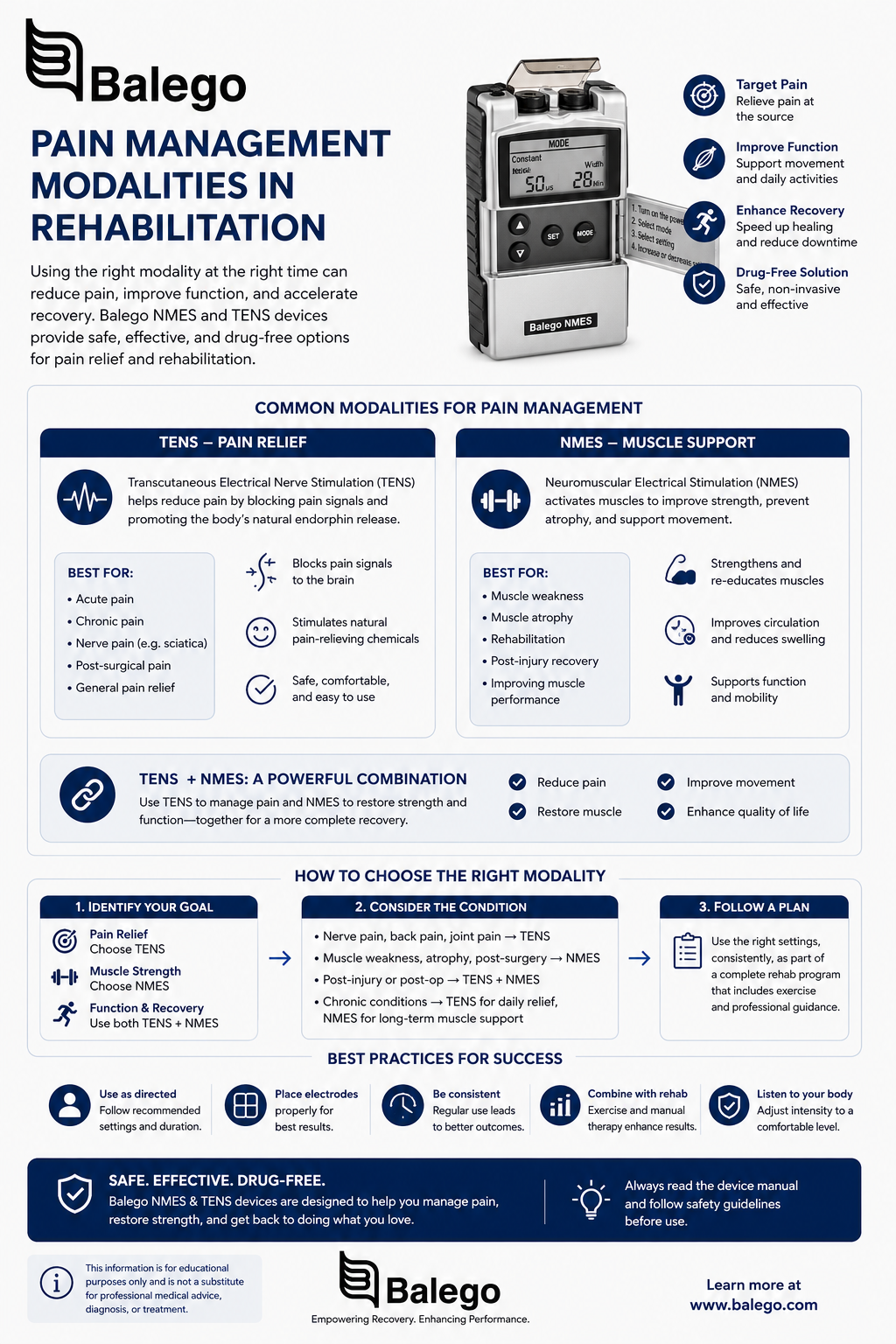
Electrical stimulation, heat, cold, therapeutic ultrasound, photobiomodulation, and shortwave diathermy may sometimes reduce a symptom barrier or prepare a patient for active care. They should ordinarily support—not replace—exercise, education, graded activity, manual treatment when indicated, and progression toward functional goals.
Clinical-use notice: This guide provides a general decision-making framework. It does not prescribe treatment parameters or replace examination, diagnosis, device instructions, professional training, or condition-specific clinical guidelines.
The most important rule: begin with the rehabilitation goal
A modality should be selected because it serves a specific purpose within the plan of care.
| Primary rehabilitation barrier | Modality that may be considered | Intended role |
|---|---|---|
| Pain is limiting exercise or movement | TENS, selected IFC, heat or cold | Short-term symptom modulation |
| A muscle is inhibited or difficult to activate | NMES/EMS | Produce contraction and support motor retraining |
| Stiffness is limiting mobility work | Superficial heat; selected ultrasound or shortwave diathermy | Prepare tissues for movement or stretching |
| Acute soreness or swelling is the immediate barrier | Cold therapy and appropriate movement | Short-term comfort and swelling-management support |
| A clinician has a condition- and dose-specific photobiomodulation protocol | Laser or LED photobiomodulation | Deliver a defined light dose |
| The clinic needs broad electrical-stimulation capabilities | Multipurpose clinical electrotherapy system | Provide TENS, NMES, IFC, Russian or other waveforms |
| The patient needs symptom-management carryover at home | Portable TENS when appropriate | Temporary, patient-managed sensory stimulation |
There is no single “best modality for pain.” The appropriate choice depends on the diagnosis, stage of recovery, precautions, treatment goal, device labeling, available evidence, and individual response.
Modalities should make active rehabilitation easier—not replace it
A useful modality should help the patient do something meaningful, such as the following:
- Tolerate an exercise progression
- Activate an inhibited muscle
- Walk farther or with better mechanics
- Improve movement confidence
- Participate in occupational or daily activities
- Complete mobility or strengthening work
- Follow a home program more consistently
- Return gradually to work, sport or recreation
APTA describes pain management as an individualized process that includes examination, functional measures, cognitive and social considerations, coordinated goals, intervention, outcome tracking, and referral when necessary. It does not reduce pain care compared to applying a passive treatment.
Clinical recommendations are also diagnosis-specific. NICE recommends exercise for low-back pain but advises against routinely offering TENS, interferential therapy, or therapeutic ultrasound for low-back pain and sciatica. Its chronic-primary-pain guideline similarly prioritizes person-centered assessment and active or psychological approaches rather than routinely offering TENS, IFC, or ultrasound. These recommendations should not be generalized to every diagnosis, but they demonstrate why a modality cannot be selected only because “the patient has pain.”
A five-step modality-selection process
1. Screen before treating
Determine whether the patient has findings requiring medical evaluation, emergency care, or coordination with another provider.
Possible concerns include the following:
- New or rapidly worsening neurological symptoms
- Unexplained severe pain
- Recent significant trauma
- Suspected fracture
- Fever or systemic illness
- Suspected infection
- Suspected vascular compromise or thrombosis
- Unexplained weight loss
- New bowel or bladder changes
- Progressive weakness
- Pain inconsistent with the expected presentation
A modality should not be used to mask symptoms that require investigation.
2. Define the primary functional problem
Ask what pain is preventing the person from doing.
Examples include:
- “Pain prevents me from completing quadriceps exercises.”
- “My shoulder stiffness prevents me from reaching overhead.”
- “I cannot tolerate ten minutes of walking.”
- “The muscle will not contract effectively after surgery.”
- “I cannot sleep comfortably enough to participate in morning therapy.”
This produces a more useful treatment target than a pain score alone.
3. Identify the proposed role of the modality
“Use sensory-level stimulation for short-term symptom modulation so the patient can complete the prescribed exercise session.”
or:
“Use NMES to assist quadriceps contraction during active motor-reeducation exercises.”
The rationale should connect the modality directly to the rehabilitation goal.
4. Check diagnosis-specific evidence and device labeling
A modality may be useful for one presentation and unsupported for another. Review:
- Clinical-practice guidelines
- Current device instructions
- Indications and contraindications
- Professional-scope requirements
- Patient-specific risks
- Medication or implant considerations
- Appropriate treatment parameters
5. Reassess function
After a brief trial, repeat the meaningful test:
- Pain during the target movement
- Range of motion
- Sit-to-stand performance
- Walking tolerance
- Muscle contraction quality
- Exercise volume
- Grip or lifting tolerance
- Ability to perform a daily task
Continue the modality when it provides a useful, reproducible contribution to the plan. Modify or discontinue it when it does not improve the intended outcome.
TENS for temporary pain modulation
Transcutaneous electrical nerve stimulation applies pulsed electrical current through skin electrodes. TENS is normally used at a sensory level, producing tingling, tapping, or pulsing without the structured muscle contractions expected from NMES.
When TENS may fit
- Temporary pain modulation during or around exercise
- Portable symptom-management carryover
- A clinician-directed home program
- A patient who responds favorably to sensory stimulation
- A short trial intended to improve movement tolerance
What TENS does not establish
TENS does not:
- Diagnose the source of pain
- Repair every painful tissue
- Replace strengthening or graded activity
- Guarantee reduced medication use
- Automatically constitute the correct treatment for chronic pain
- Work equally well for every diagnosis or person
Some condition-specific guidelines advise against routine TENS use, including for chronic primary pain and nonspecific low-back pain. A favorable response in another clinical context does not override the recommendations for a particular diagnosis.
For device and mode education, visit our TENS Guide Library or compare the Balego TENS Digital Edition.
NMES and EMS for muscle activation
Neuromuscular electrical stimulation is selected primarily when the treatment goal is a visible or palpable muscle contraction.
This distinguishes it from TENS:
| Feature | TENS | NMES/EMS |
|---|---|---|
| Principal response | Sensory stimulation | Motor contraction |
| Common rehabilitation goal | Temporary pain modulation | Muscle activation and motor retraining |
| Expected muscle contraction | Usually not the target | Yes |
| Work-and-rest timing | Usually unnecessary | Commonly important |
| Ramp setting | Not a central feature | Often used for smoother contractions |
| Best matched problem | Pain limits participation | Weakness, inhibition or poor recruitment |
Possible clinician-directed NMES goals include muscle reeducation, contraction practice, support during active exercise, and structured work-rest training when muscle activation is limited.
NMES should not be selected merely because the patient reports pain. The clinician should identify a motor impairment that electrical muscle stimulation can meaningfully address.
Read TENS vs. NMES: Differences, Uses, and Device Guide or view the Balego EMS Digital NMES Stimulator. Our current educational and product pages distinguish sensory-level TENS from contraction-based NMES.
Interferential current and premodulated stimulation
Interferential-current devices use medium-frequency carrier currents to produce a lower-frequency beat pattern. Traditional four-pole IFC uses two intersecting circuits and four electrodes. Premodulated or two-pole stimulation creates the beat pattern within the device and commonly uses two electrodes.
| Feature | Premodulated / two-pole | Traditional four-pole IFC |
|---|---|---|
| Electrodes commonly used | 2 | 4 |
| Beat production | Inside the device | Through interaction of two circuits |
| Setup | Simpler | More placement-dependent |
| Treatment area | More focused | Broader crossed-current field |
| Typical setting | Clinic or portable combination unit | Primarily professional electrotherapy |
IFC may be selected for professionally directed symptom modulation, particularly when the clinic already uses a multipurpose system. It should not be described as universally “deeper,” stronger, or clinically superior to TENS. A more comfortable sensation does not necessarily produce a better functional outcome.
Guidelines for chronic primary pain and low-back pain advise against routine interferential therapy in those specific populations, reinforcing the need for diagnosis-based selection.
The Richmar Quattro 2.5 includes both two-pole premodulated and traditional four-pole IFC, as well as TENS, EMS, and Russian stimulation.
Heat and cold therapy
Hot and cold therapy products offer a comparatively simple method of short-term symptom management.
Cold therapy may be considered when:
- Recent irritation or activity-related soreness is present
- Short-term pain sensitivity is limiting participation
- Swelling management is part of the plan
- The patient prefers cooling after exercise
Heat therapy may be considered when:
- Stiffness is limiting comfortable movement
- A warm-up is needed before mobility work
- Muscle guarding is interfering with treatment
- The patient responds favorably to superficial heat
Heat and cold should be connected to an active next step:
Apply the selected thermal intervention, then reassess movement and proceed to mobility, exercise, gait or functional work.
Skin protection, temperature, duration, sensation, circulation, cognition, and the ability to communicate discomfort must be considered. Heat and cold can cause tissue injury when used improperly.
Balego offers reusable hot and cold gel packs and professional Hydrocollator Moist Heat HotPacs. (Balego)
Therapeutic ultrasound
Therapeutic ultrasound delivers acoustic energy through a sound head and coupling medium. Clinical systems commonly offer frequencies around 1 MHz and 3 or 3.3 MHz.
Ultrasound is often discussed in terms of:
- Thermal applications intended to raise tissue temperature
- Pulsed applications emphasizing nonthermal mechanical effects
- Preparation for stretching or mobility work
- Condition-specific professional protocols
“Use continuous ultrasound as a thermal adjunct immediately before a defined mobility intervention, then reassess range of motion.”
If mobility does not change or the patient cannot progress the active intervention, continued ultrasound should be reconsidered.
Photobiomodulation and laser therapy
Laser therapy, also called low-level laser therapy or photobiomodulation, applies non-ionizing red or near-infrared light.
Its clinical use is highly dependent on:
- Diagnosis
- Wavelength
- Power
- Energy density
- Treatment area
- Tissue depth
- Applicator
- Dosage calculation
- Number and timing of treatments
Laser therapy should not be described as automatically repairing tissue, eliminating inflammation or accelerating recovery for every condition.
Photobiomodulation may be incorporated into selected professional rehabilitation protocols when the device, dose and diagnosis are appropriately matched. It remains an adjunct to the broader plan of care.
The TheraTouch LX2 Laser Therapy Device is a professional Class IIIb system with preset protocols and dosage controls.
Shortwave diathermy
Shortwave diathermy uses electromagnetic energy to produce thermal or pulsed effects in a clinical treatment field.
It may be considered when a trained professional has identified a specific deep-heating goal, such as preparing a stiff region for mobility treatment. Shortwave diathermy involves substantially more equipment-specific screening than a surface hot pack.
Important considerations include:
- Implanted electronic devices
- Metal in or near the treatment field
- Sensation and circulation
- Pregnancy and treatment location
- Active bleeding
- Suspected thrombosis
- Malignancy
- Infection
- Treatment-table and environmental compatibility
- Position of cables and applicators
The Intelect Shortwave Diathermy SWD100 is a professional system offering continuous and pulsed operation, clinical protocols, and dedicated applicators.
Shortwave diathermy should not be presented as a general substitute for surface heat. It is a specialized clinical modality requiring trained application and strict adherence to the device manual.
Modality comparison at a glance
| Modality | Primary treatment role | Typical setting | Active response expected? | Home carryover |
|---|---|---|---|---|
| TENS | Temporary sensory-level pain modulation | Clinic or home | No contraction required | Often possible |
| NMES/EMS | Muscle activation and reeducation | Clinic or trained home use | Yes—muscle contraction | Sometimes |
| IFC/premodulated | Professional symptom-modulation option | Primarily clinic | Usually sensory | Limited/device-dependent |
| Cold therapy | Short-term cooling and symptom support | Clinic, training room or home | No | Yes |
| Superficial heat | Warm-up and comfort before mobility | Clinic or home | No | Yes |
| Therapeutic ultrasound | Condition-specific acoustic or thermal adjunct | Clinic | No | Usually not. |
| Photobiomodulation | Condition- and dose-specific light therapy | Professional clinic | No | Device-dependent |
| Shortwave diathermy | Specialized deep-heating treatment | Professional clinic | No | No |
Which modality fits the clinical problem?
| Clinical presentation | Possible modality role | What should happen next |
|---|---|---|
| Pain prevents a patient from beginning exercise | Brief TENS, heat or cold trial | Reassess the painful task and begin graded exercise |
| Quadriceps activation remains poor after appropriate clearance | NMES during contraction practice | Progress voluntary activation and strengthening |
| Broad pain regions require clinic-based stimulation | IFC or TENS trial | Reassess movement and functional tolerance |
| Stiffness limits mobility | Heat; selected ultrasound or diathermy | Stretch, mobilize or perform active ROM while the effect is relevant |
| Pain and fear limit activity in persistent pain | Education, graded activity and active rehabilitation are central | Build confidence and function rather than relying on passive care |
| Patient needs a home symptom-management option | Portable TENS when indicated and taught safely | Pair it with a written activity and exercise plan |
| No measurable response occurs | Do not simply raise intensity or add more modalities | Reassess diagnosis, goal and treatment approach |
Selecting a Balego device by clinical need
| Clinical need | Balego option | Why it may fit |
|---|---|---|
| OTC home TENS | Balego TENS Digital Edition | Portable dual-channel sensory stimulation |
| Portable muscle activation | Balego EMS Digital NMES Stimulator | Adjustable contraction, ramp and work-rest settings |
| Multi-waveform clinical e-stim | Richmar Quattro 2.5 | TENS, EMS, Russian, premodulated and four-pole IFC |
| E-stim plus ultrasound | Richmar ComboCare | Two-channel stimulation, ultrasound and combination therapy |
| Advanced touchscreen combination system | Intelect Legend 2 Combo | Two- or four-channel configurations, 12 waveforms and ultrasound |
| Professional photobiomodulation | TheraTouch LX2 | Class IIIb laser platform with professional protocols |
| Clinical deep heating | Intelect SWD100 | Dedicated shortwave diathermy system |
| Simple thermal care | Hot and Cold Therapies | Reusable cold packs, moist heat and related supplies |
A practical pain-management workflow
| Step | Responsible team member | Action |
|---|---|---|
| 1. Screen | Intake staff, nurse or clinician | Identify pain, functional impact and urgent concerns |
| 2. Evaluate | PT, OT, physician or qualified clinician | Determine diagnosis, impairments, risks and goals |
| 3. Establish baseline | Treating clinician: | Measure the meaningful movement or functional task |
| 4. Build active plan | Clinician and patient | Select education, exercise, movement and functional progression |
| 5. Select adjunct | Qualified clinician | Choose a modality only when it serves a defined purpose |
| 6. Trial and retest | Clinician | Repeat the baseline task after treatment |
| 7. Progress | Clinician and patient | Increase movement, loading, independence or task complexity |
| 8. Review | Care team | Continue, modify or discontinue based on measurable value |
| 9. Plan discharge | Care team and patient | Provide self-management, activity and equipment education where appropriate |
HHS supports individualized, multidisciplinary pain care rather than a one-size-fits-all approach. APTA likewise emphasizes examining pain presentation, complexity, functional impact, and the need for care coordination.
What should be measured?
A modality is most useful when it changes an outcome that matters.
| Goal | Possible outcome measure |
|---|---|
| Improve walking tolerance | Time, distance, speed or assistance required |
| Improve shoulder movement | Active range and ability to reach a target |
| Improve exercise participation | Repetitions, resistance or duration completed |
| Improve muscle activation | Contraction quality, lag, strength or task performance |
| Improve transfers | Sit-to-stand time or assistance level |
| Improve daily activity | Patient-specific functional scale |
| Reduce pain interference | Pain during the chosen activity—not only pain at rest |
| Improve independence | Ability to carry out the home program safely |
A pleasant sensation during treatment is not enough by itself. The modality should contribute to participation, movement, or function.
Common mistakes to avoid
Applying several passive treatments without a defined purpose
More modalities do not automatically produce a better outcome. Each treatment should have a rationale and a planned reassessment.
Choosing a modality solely from the pain score
Two patients with the same numerical pain rating may have different diagnoses, impairments, risks, and goals.
Using NMES when the actual goal is sensory pain modulation
NMES is chiefly a motor-level intervention. Choose it when contraction and muscle recruitment are intended.
Describing IFC as automatically deeper or more effective than TENS
Current intensity, electrode arrangement, patient comfort, and clinical outcome are separate issues. No universal superiority should be claimed.
Presenting ultrasound or laser as guaranteed tissue-healing treatments
Results depend on diagnosis, dose, technique, and the overall rehabilitation program.
Continuing a modality without retesting function
A treatment that never changes the target movement or participation barrier should be reconsidered.
Sending a patient home with equipment but no plan
Home TENS or NMES requires education concerning the following:
- Intended goal
- Electrode placement
- Device settings
- Treatment schedule
- Skin inspection
- Contraindications
- Stop rules
- Equipment care
- How it fits into exercise and daily activity
General safety screening
Contraindications differ between electrical stimulation, ultrasound, laser, heat, cold, and diathermy. Review the specific device manual before treatment.
Common screening questions include:
| Screening topic | Why it matters |
|---|---|
| Implanted electronic device | Electrical stimulation and diathermy may interfere with device function |
| Impaired sensation | Patient may not recognize excessive stimulation or temperature |
| Impaired circulation | Changes risk with heat, cold and other physical agents |
| Broken or infected skin | May alter electrode contact and infection risk |
| Pregnancy and treatment site | Restrictions vary by modality and body area |
| Known or suspected malignancy | Requires modality- and site-specific consideration |
| Active bleeding or thrombosis | Several thermal and electrical applications may be inappropriate |
| Metal near the treatment field | Particularly important for shortwave diathermy |
| Eye exposure | Lasers require appropriate eye protection |
| Cognitive or communication limitation | The patient must be able to report discomfort or be closely monitored |
| Current monitoring equipment | Electrical stimulation may interfere with ECG or other monitoring |
Stop treatment for burning, significant pain, dizziness, unusual shortness of breath, unexpected weakness, substantial skin reaction, neurological change, or another adverse response.
Frequently asked questions
What is the best physical therapy modality for pain?
There is no universal best modality. Selection depends on the diagnosis, functional goal, contraindications, evidence, treatment setting, and individual response.
Should modalities be used before or after exercise?
That depends on the goal. Heat, TENS, or selected ultrasound may be used before activity when the intent is to improve movement tolerance. Cold may be used after activity when short-term cooling and comfort are desired. The sequence should be planned rather than automatic.
What is the difference between TENS and NMES?
TENS is primarily sensory stimulation used for temporary pain modulation. NMES is motor-level stimulation intended to produce muscle contraction. Read the complete TENS vs. NMES guide.
Is interferential current better than TENS?
No universal superiority has been established. The best choice depends on the diagnosis, electrode setup, treatment goal, equipment, and response.
Does therapeutic ultrasound break up scar tissue?
That wording is too simplistic. Ultrasound delivers acoustic energy and may be used in selected thermal or nonthermal protocols. It does not physically erase scar tissue, and evidence varies by condition.
Does laser therapy accelerate healing?
Photobiomodulation effects are dose- and condition-specific. A professional device should be used according to its labeling and an evidence-informed protocol. Do not promise accelerated healing across all injuries.
Is NMES a pain-relief modality?
Pain may change during a broader NMES program, but NMES is primarily selected to produce muscle contraction and support motor retraining. TENS is generally the more direct sensory-level pain-modulation category.
Can a patient use TENS at home?
Some patients may use an appropriately labeled portable TENS unit after receiving instructions. Home use is not automatically suitable for every diagnosis, implanted device, placement, or pain presentation.
Should TENS be prescribed for every patient with chronic pain?
No. Some condition-specific guidelines advise against TENS, including guidance concerning chronic primary pain and nonspecific low-back pain. Selection must be based on the actual diagnosis and treatment plan.
Can modalities reduce medication use?
A comprehensive, multidisciplinary rehabilitation program may sometimes help patients manage pain with fewer medication-related risks. A product page or blog should not claim that one modality independently reduces medication use unless that outcome has been demonstrated for the specific population and protocol.
Can several modalities be combined?
Yes, when each has a distinct purpose and the combined plan remains safe and efficient. Applying multiple passive treatments without a functional rationale can consume treatment time without adding value.
When should a modality be discontinued?
Reconsider it when:
- It causes an adverse response.
- The target function does not improve.
- Benefits are not reproducible.
- It delays active rehabilitation.
- The patient becomes dependent on passive treatment.
- The diagnosis or clinical status changes.
- A guideline recommends against its use for that condition.
Final takeaway
Pain-management modalities can be useful tools, but they are not the rehabilitation program itself.
A sound plan:
- Screens for conditions requiring referral.
- Identifies how pain affects function.
- Establishes an active treatment foundation.
- Selects a modality for a specific purpose.
- Follows device labeling and diagnosis-specific guidance.
- Retests movement or function.
- Continues only treatments that contribute meaningful value.
- Builds a sustainable self-management and discharge plan.
Explore our complete library of Which Therapy Modality to Use, Clinical Electrotherapy Systems, TENS Products, Neuromuscular Stimulation, Interferential Therapy, Laser Therapy, and Ultrasound Therapy.


