



VMS Waveform in NMES: Benefits, Evidence and Comparison with Russian Stimulation
Variable Muscle Stimulation, usually abbreviated VMS™, is Chattanooga’s proprietary neuromuscular electrical stimulation waveform. It is designed to produce controlled muscle contractions through a symmetrical biphasic pulsed current rather than the medium-frequency sinusoidal carrier used by traditional Russian stimulation.
The defining VMS pulse includes adjustable phase duration and a fixed 100-microsecond interphase interval. Depending on the Chattanooga device, clinicians may have access to standard VMS, VMS Burst, and additional VMS variations.
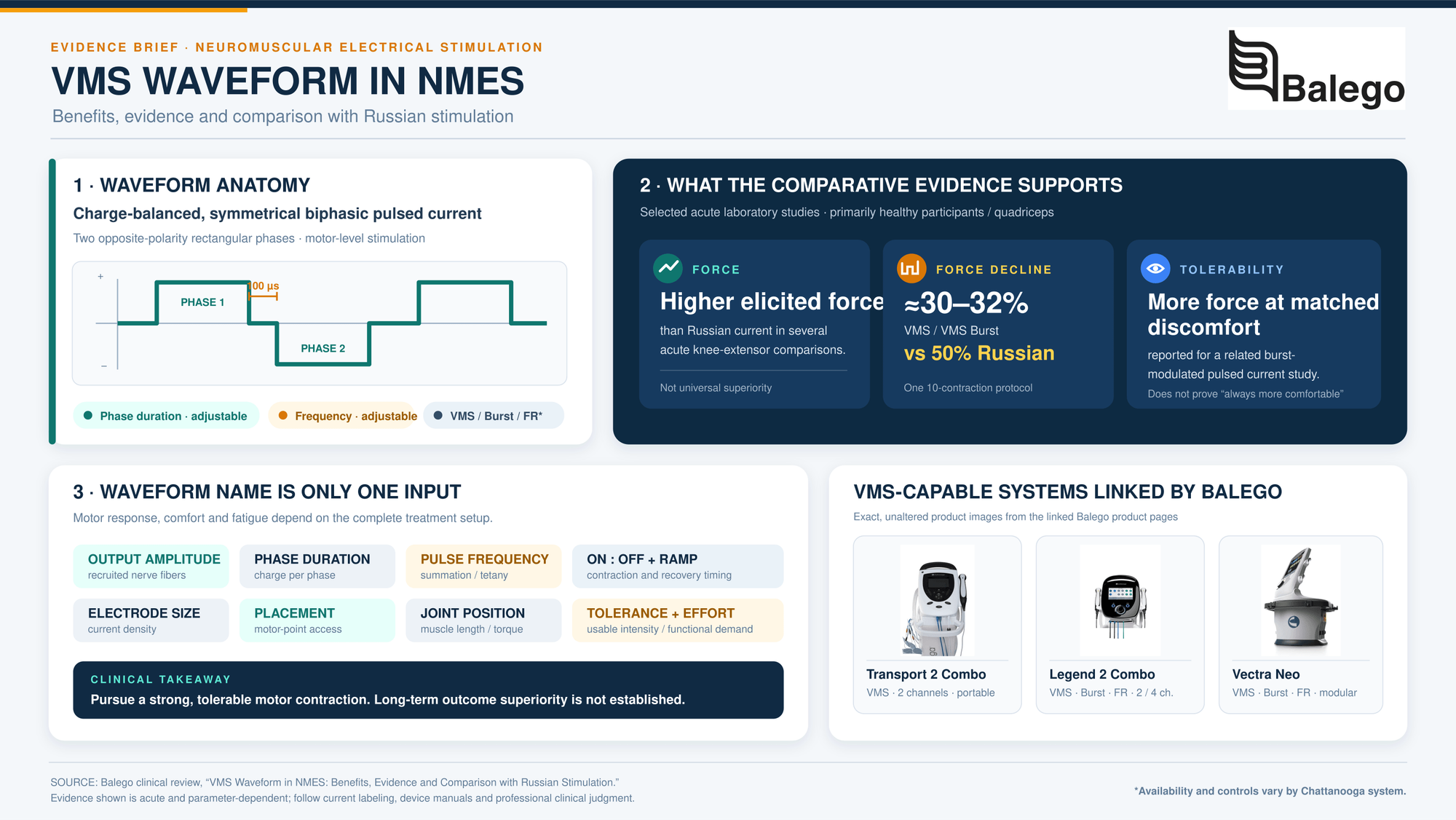
Research involving healthy participants suggests that VMS and related burst-modulated biphasic pulsed currents can generate more knee-extensor force than Russian current under certain test conditions. Some studies also report less force decline during repeated contractions. These findings are relevant when the goal is a strong, repeatable motor contraction, but they do not establish that VMS is the best waveform for every patient, muscle group, or rehabilitation program.
Clinicians comparing VMS-capable systems can review the Chattanooga Intelect Legend 2 Combo, Intelect Transport 2 Combo, and modular Chattanooga Vectra Neo.
What is the VMS waveform?
VMS is a charge-balanced, symmetrical biphasic pulsed waveform. Each pulse contains two phases of opposite polarity separated by a brief interphase interval.
| VMS characteristic | What it means |
|---|---|
| Current family | Symmetrical biphasic pulsed current |
| Pulse shape | Rectangular or square phases |
| Interphase interval | Fixed at 100 microseconds in Chattanooga’s VMS description |
| Phase duration | Adjustable within the controls of the selected device |
| Frequency | Adjustable according to device and treatment setup |
| Delivery | Continuous VMS or burst-formatted VMS on supported systems |
| Primary purpose | Motor-level stimulation intended to produce a muscle contraction |
| Availability | Proprietary to selected Chattanooga electrotherapy systems |
The positive and negative phases help limit net charge accumulation at the electrode-tissue interface. The interphase interval separates those phases and may influence how efficiently a peripheral nerve responds to the pulse.
Studies of biphasic stimulation—not all of them conducted with a commercial VMS device—have found that inserting an interphase interval can increase electrically induced force without necessarily increasing reported discomfort. The effect can vary with interphase duration, electrode position, nerve location, and other stimulation parameters.
Is VMS the same as NMES?
No. NMES is the therapeutic category; VMS is one waveform within that category.
Neuromuscular electrical stimulation includes multiple current and waveform options capable of activating motor nerves. These may include symmetrical biphasic, asymmetrical biphasic, monophasic, Russian, burst-modulated pulsed current, and manufacturer-specific waveforms.
A device does not provide VMS merely because it offers NMES. VMS is a Chattanooga trademarked waveform available only on specified Chattanooga platforms. Balego also carries many portable NMES units and EMS muscle stimulators that use other effective waveform designs.
Why waveform selection matters—but does not work alone
The waveform determines the electrical shape delivered by the stimulator, but it is only one component of an NMES treatment.
Electrically induced force, comfort, and fatigue can also be affected by:
| Parameter | Why it matters |
|---|---|
| Output amplitude | Determines how many excitable nerve fibers are recruited |
| Phase duration | Changes the electrical charge delivered during each phase |
| Pulse frequency | Influences whether contractions remain separate or become tetanic |
| On-and-off timing | Determines contraction duration and recovery between contractions |
| Ramp time | Changes how gradually the contraction begins and ends |
| Electrode size | Affects current density at the skin |
| Electrode placement | Influences motor-point access and recruitment efficiency |
| Joint position | Changes muscle length and the torque measured during contraction |
| Patient tolerance | Often limits the maximum usable intensity |
| Voluntary effort | May change the functional purpose and training demand of NMES |
A randomized crossover trial comparing kilohertz-frequency alternating current with pulsed current found no significant difference in torque, efficiency, or discomfort when phase duration was matched. Wider phase durations produced greater torque but also greater discomfort. That result illustrates why a waveform name alone cannot predict the treatment response.
Recent peripheral-nerve research has similarly found that phase duration may influence sensory-versus-motor recruitment more consistently than waveform category under some experimental conditions.
VMS vs Russian stimulation
Russian stimulation traditionally uses a 2,500 Hz sinusoidal alternating-current carrier delivered in bursts. VMS uses discrete symmetrical biphasic pulses without a continuous kilohertz carrier.
| Feature | VMS | Russian stimulation |
|---|---|---|
| Current structure | Symmetrical biphasic pulsed current | Medium-frequency sinusoidal alternating current |
| Carrier frequency | No continuous kilohertz carrier | Traditionally 2,500 Hz |
| Pulse shape | Rectangular or square biphasic phases | Sinusoidal oscillations within each burst |
| Burst option | VMS Burst on supported systems | Normally delivered as burst-modulated current |
| Interphase interval | 100 microseconds in Chattanooga’s VMS design | Not structured as two rectangular phases with a comparable interval |
| Research trend | Higher elicited force than Russian in several acute quadriceps studies | Lower force or faster force decline in those specific comparisons |
| Patient experience | May generate more force at a comparable discomfort rating in certain protocols | Tolerance varies substantially by parameters and individual |
| Availability | Selected Chattanooga devices | Available on many professional and combination stimulators |
Does VMS produce a stronger contraction?
Several acute studies support that possibility under the conditions tested.
In a 2001 study of 30 healthy adults, rectangular monophasic and biphasic currents generated greater quadriceps torque and were less fatiguing than a 2,500 Hz polyphasic waveform.
A later repeated-measures study compared burst-modulated alternating current, pulsed current, and burst-modulated pulsed current. At the same reported discomfort level, burst-modulated pulsed current produced approximately one-third more force than burst-modulated alternating current. The study did not, however, find every pulsed-current condition superior to every alternating-current condition.
These findings support choosing a biphasic pulsed option when maximizing tolerable contraction force is the primary goal. They do not prove that every VMS setting will outperform every Russian-current setting.
Does VMS reduce fatigue?
The most defensible interpretation is that VMS and VMS Burst have shown less contraction-force decline than Russian current during selected laboratory protocols.
In one comparison of three waveforms, VMS and VMS Burst produced higher initial force than Russian stimulation. Across ten contractions, force declined approximately 30% to 32% with VMS conditions and 50% with Russian current.
This should not be explained as the muscle “resting” during a 100-microsecond interphase interval. That interval is part of the electrical pulse, not a physiologic recovery period comparable to the off-time between NMES contractions. Fatigue is influenced by the complete stimulation pattern, including frequency, intensity, duty cycle, recruitment strategy, and contraction duration.
Is VMS more comfortable?
Comfort comparisons require careful wording.
The strongest evidence is not that VMS always feels milder at the same current setting. Rather, selected biphasic pulsed or burst-modulated pulsed currents have generated more force at the same reported level of discomfort than Russian-style burst-modulated alternating current.
This distinction matters because the desired clinical outcome is often an effective contraction that remains tolerable—not simply the lowest sensory perception.
Individual tolerance can still vary with the following:
- Electrode size and condition
- Current density
- Phase duration
- Intensity
- Skin preparation
- Electrode placement
- Muscle size
- Prior exposure to electrical stimulation
Properly sized, well-adhered electrotherapy electrodes remain important regardless of the waveform selected.
What does the research say about circulation?
A 2022 acute laboratory study found that VMS produced a greater post-stimulation total-hemoglobin response than Russian current after a set of knee-extensor contractions. The authors described this as a higher reactive-hyperemia response and suggested that VMS might provide greater blood volume to the target muscle after stimulation.
That finding should not be expanded into claims that VMS
- Treats vascular disease
- Produces a lasting improvement in circulation
- Improves healing independently of exercise or rehabilitation
- Prevents blood clots
- Replaces medical management of impaired circulation
The evidence supports an acute local response following electrically induced contractions, not a general cardiovascular or vascular treatment claim.
VMS, VMS Burst and VMS FR
Selected Chattanooga systems provide more than one VMS option.
| Waveform option | Practical distinction |
|---|---|
| VMS | Standard symmetrical biphasic pulsed stimulation |
| VMS Burst | VMS pulses organized into burst periods |
| VMS FR | An additional manufacturer-specific VMS variation available on selected advanced systems |
Standard VMS may be preferred when the clinician wants direct control of a pulsed-current contraction pattern. VMS Burst changes the temporal organization of the pulses and has performed similarly to standard VMS in several acute force comparisons.
VMS FR should be selected according to the exact device manual because its controls and channel behavior are platform-specific. The waveform name alone is not a substitute for reviewing frequency, phase duration, channel setup, duty cycle, and intended use.
What are the most meaningful VMS benefits?
The evidence is strongest when VMS benefits are described narrowly.
| Potential benefit | Evidence-based interpretation |
|---|---|
| Greater elicited muscle force | Supported in several acute quadriceps comparisons with Russian current |
| More force at a fixed discomfort level | Supported for burst-modulated pulsed current in one repeated-measures study |
| Less force decline | Supported during short repeated-contraction comparisons |
| Adjustable treatment parameters | Available according to the controls of the selected Chattanooga device |
| Local post-contraction blood-volume response | Observed acutely in one knee-extensor study |
| Better long-term rehabilitation outcomes | Not established by waveform-comparison studies alone |
| Universally better comfort | Not established |
| Superior results for every muscle or diagnosis | Not established |
Most comparative studies have examined short-term responses in healthy participants, commonly using the quadriceps. Research directly comparing long-term patient outcomes across VMS and other waveforms remains more limited.
Which devices provide VMS?
The appropriate system depends less on whether VMS is present and more on the clinic’s required channels, modalities, portability, and workflow.
| Balego device | VMS options | Channels | Other modalities | Best fit |
|---|---|---|---|---|
| Intelect Transport 2 Combo | VMS | 2 | Ultrasound, IFC, premodulated, high-volt, and Russian | Clinics prioritizing portability and core electrotherapy capabilities |
| Intelect Legend 2 Combo | VMS, VMS Burst and VMS FR | 2 or 4 | Ultrasound, combination therapy and 12 electrotherapy waveforms | Clinics wanting broader waveform selection and two- or four-channel configurations |
| Chattanooga Vectra Neo | VMS, VMS Burst and VMS FR | Modular 2- or 4-channel configuration | Optional ultrasound, sEMG, laser and combination therapy | Larger or growing clinics needing a modular multimodality platform |
The Transport 2 combo includes five electrotherapy waveforms and two stimulation channels. The Legend 2 expands the selection to 12 waveforms and is available with two or four channels. Vectra Neo is built around optional modules, allowing a clinic to add stimulation, sEMG, ultrasound, or laser capabilities according to its workflow.
How to select a VMS-capable system
Consider the treatment environment before comparing individual waveform names.
Choose a compact two-channel system when:
- VMS is needed without a large multimodality console.
- Two stimulation channels cover most clinic treatments.
- Portability between treatment areas is important.
- Ultrasound and basic combination therapy are also needed.
- A focused waveform library is sufficient.
The Intelect Transport 2 Combo is the more compact VMS-capable choice among the three systems compared above.
Choose a broader clinical platform when:
- The clinic regularly compares VMS, VMS Burst, VMS FR, and Russian current.
- Four-channel stimulation may be required.
- Indication-based setup tools and saved protocols are useful.
- The clinic wants electrotherapy and ultrasound in one system.
The Intelect Legend 2 Combo provides two- and four-channel configurations with a broader waveform library.
Choose a modular platform when:
- The clinic expects its modality requirements to grow.
- sEMG or sEMG-triggered stimulation is important.
- Ultrasound or laser may be added separately.
- Multiple departments will use the same clinical platform.
- Expandability is more important than portability.
The Vectra Neo Clinical Therapy System can be configured around the clinic’s selected modules rather than a fixed modality package.
Frequently asked questions
What does VMS stand for?
VMS stands for Variable Muscle Stimulation. It is Chattanooga’s proprietary symmetrical biphasic NMES waveform.
Is VMS a TENS waveform?
VMS is primarily a motor-stimulation waveform intended to produce a muscle contraction. TENS is generally selected for sensory-level pain-management applications. A professional electrotherapy system may provide both applications, but they should not be treated as interchangeable.
Is VMS better than Russian stimulation?
VMS and VMS Burst produced more force and less force decline than the Russian current in several acute quadriceps studies. That makes VMS a reasonable choice when maximizing tolerable motor contraction is the goal. The results do not establish universal superiority across all patients, muscles, settings, or clinical outcomes.
What is the difference between VMS and VMS Burst?
Both use Chattanooga’s symmetrical biphasic pulse design. Standard VMS delivers the pulses according to the selected pulse frequency, while VMS Burst groups them into burst periods. Exact controls depend on the device.
Does every Chattanooga NMES device include VMS?
No. VMS availability must be confirmed on the individual product page and current operating manual.
Can VMS prevent muscle fatigue?
No NMES waveform completely prevents fatigue. Selected studies found less force decline with VMS and VMS Burst than with Russian current during short laboratory contraction sets. Frequency, intensity, contraction time, off-time, electrode configuration, and patient characteristics also affect fatigue.
Is a four-channel VMS device always better?
Not necessarily. Additional channels can support bilateral, multi-region, or larger electrode arrangements, but they also increase equipment requirements and setup complexity. Two channels may be sufficient for many routine treatments.
Clinical takeaway
VMS is best understood as a configurable Chattanooga symmetrical biphasic NMES waveform—not as a separate therapeutic modality and not as a guarantee of superior rehabilitation results.
Its most credible advantage is the ability to generate strong motor contractions efficiently. Acute research suggests VMS and VMS Burst may produce greater force and less force decline than Russian current under selected quadriceps-testing conditions. Comfort, fatigue, and therapeutic effectiveness still depend on the complete treatment setup rather than waveform choice alone.
Clinicians should select VMS only after considering the intended motor response, patient tolerance, phase duration, frequency, duty cycle, electrode configuration, voluntary participation, and functional rehabilitation goal.
Professional-use notice: Electrotherapy must be used according to the current device labeling, operating manual, prescription requirements and facility procedures. Treatment parameters, electrode placement and patient monitoring should be determined by a qualified healthcare professional. This article is educational and does not replace clinical evaluation or manufacturer instructions.
Key originality and accuracy improvements
This version:
- Replaces the existing manufacturer-white-paper summary with an independent clinical interpretation.
- Removes the misleading suggestion that 100-microsecond interphase intervals give the muscle meaningful “micro-rest.”
- Distinguishes acute reactive hyperemia from a general circulation-treatment claim.
- Explains that phase duration, amplitude, and electrode configuration can matter as much as the waveform name.
- Separates VMS from NMES as a broader modality category.
- Adds research limitations rather than presenting laboratory findings as guaranteed patient outcomes.
- Introduces a commercially useful but nonduplicative comparison of Balego’s principal VMS-capable clinical systems.


