



IontoPatch Evidence-Based Research: What Clinical Studies Show
IontoPatch is a self-contained iontophoresis device designed to deliver an appropriately selected ionic medication through intact skin using low-level direct current. Unlike conventional iontophoresis systems, it incorporates the power source and both treatment chambers into a disposable patch, eliminating the need for a separate dose controller and external lead wires.
Clinical research supports the underlying ability of iontophoresis to enhance transdermal medication delivery. Research involving musculoskeletal conditions has also reported short-term improvements in selected pain, strength, function, and work-status outcomes. The results are not uniform across every condition, however, and the evidence should not be interpreted as proof that iontophoresis is superior to every injection, exercise program, medication, or other conservative treatment.
The most directly relevant IontoPatch study compared dexamethasone delivered through a self-contained patch with two types of corticosteroid injection in patients undergoing rehabilitation for lateral epicondylitis, commonly called tennis elbow. It found faster improvement in certain outcomes for the patch group, but the treatment groups had equivalent measured outcomes by six months.
For current product specifications, compare IontoPATCH STAT, IontoPATCH 80, and IontoPatch Extra Strength.
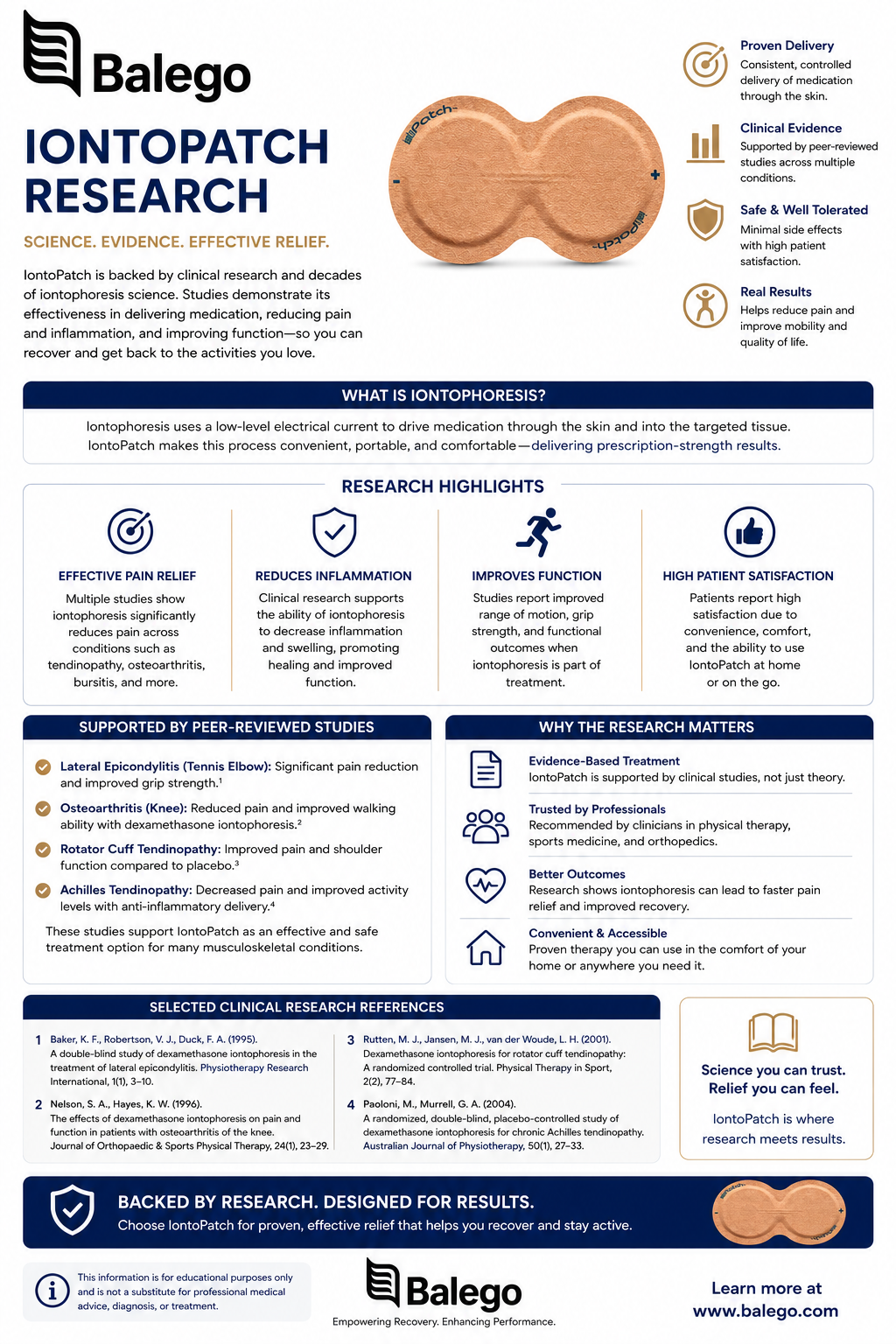
Research Conclusions at a Glance
| Research question | Evidence-based answer |
|---|---|
| Can iontophoresis move dexamethasone through human skin? | Laboratory and human microdialysis studies support enhanced transdermal delivery compared with passive application |
| Has IontoPatch been evaluated in a randomized clinical study? | Yes. A prospective randomized trial compared a self-contained IontoPatch with dexamethasone and triamcinolone injections for lateral epicondylitis |
| Did the IontoPatch group improve? | Yes. The group showed significant improvements in grip strength, pain, function, and unrestricted work status on selected measures |
| Was IontoPatch superior over the long term? | No clear long-term superiority was demonstrated; all three groups had equivalent measured outcomes at six months |
| Is there evidence for iontophoresis beyond tennis elbow? | Yes, but findings vary by condition, medication, device, dose, and study design |
| Is wearable iontophoresis equivalent to wired treatment? | One small patellar-tendinopathy trial found comparable results between a wireless patch and wired controller, although that trial evaluated another patch brand |
| Does research prove IontoPatch works for every condition? | No. Evidence is condition- and protocol-specific |
| Should the patch replace rehabilitation exercise? | No. It is generally best understood as one component of a broader clinician-directed treatment plan |
What Is Iontophoresis?
Iontophoresis uses a low-level electrical field to enhance the movement of charged, water-soluble compounds across intact skin. A medication ion is placed in a chamber having the same electrical polarity:
- Negatively charged medication is placed in the negative chamber.
- Positively charged medication is placed in the positive chamber.
- Like electrical charges repel, helping move the medication away from the chamber and toward the skin.
The treatment dose is commonly expressed in milliamp-minutes, written as mA-min or mA·min:
Dose = current in milliamps × treatment time in minutes
A conventional system might deliver 40 mA-min as 4 mA for 10 minutes. A wearable patch can provide a comparable or larger total electrical dose at a much lower current over several hours.
Read How the IontoPatch Works for a more detailed explanation of medication polarity, chamber preparation, and integrated power.
Evidence Does Not All Mean the Same Thing
Research on iontophoresis can be divided into several levels. A study proving that medication reaches the dermis does not automatically prove that it improves a clinical condition. Likewise, a trial involving a wired dose controller does not directly validate every wearable patch.
| Type of research | What it can show | What it cannot establish by itself |
|---|---|---|
| Laboratory transport study | Whether current increases medication movement across a membrane or skin model | Patient pain relief or functional recovery |
| Human tissue or microdialysis study | Whether medication can be detected in human skin or underlying tissue | Effectiveness for a particular diagnosis |
| Placebo-controlled clinical trial | Whether active drug iontophoresis performs differently from placebo under the study protocol | Superiority over every other treatment |
| Comparative clinical trial | How iontophoresis compares with an injection, wired controller, or another intervention | Results outside the population and protocol studied |
| Systematic review | Overall patterns across several trials | Certainty when the underlying trials are small or methodologically different |
| Manufacturer performance testing | Patch capacity, current behavior, wear time, and reproducibility | Clinical outcomes for a diagnosis |
IontoPatch has direct randomized clinical evidence in lateral epicondylitis and is also supported by broader research on iontophoretic medication transport and musculoskeletal iontophoresis.
Primary IontoPatch Study: Patch vs. Corticosteroid Injection
Study Design
A prospective randomized study published in The Journal of Hand Surgery evaluated corticosteroid delivery methods for lateral epicondylitis.
Researchers assigned participants to one of three groups:
- 10 mg dexamethasone delivered by a self-contained IontoPatch
- 10 mg dexamethasone injection
- 10 mg triamcinolone injection
Every group participated in the same eight-week hand-therapy program involving rest or protection, mobility exercises, and progressive strengthening. Of 101 initially recruited participants, 82 completed the study and were included in the reported analysis. Outcomes were measured at baseline, after treatment, and at six months.
| Study characteristic | Detail |
|---|---|
| Study type | Prospective randomized comparative trial |
| Evidence classification | Therapeutic Level II |
| Participants completing study | 82 |
| Condition | Lateral epicondylitis |
| Iontophoresis medication | 10 mg dexamethasone |
| Patch type | Self-contained patch with a 24-hour battery |
| Comparison groups | Dexamethasone injection and triamcinolone injection |
| Co-intervention | Standardized hand-therapy program for all groups |
| Primary outcomes | Grip strength, pain, and function |
| Secondary outcome | Return-to-work status |
| Follow-up | End of therapy and six months |
Grip-Strength Results
The researchers compared grip strength with the elbow flexed and extended. A smaller difference between these positions indicated improvement.
| Iontophoresis-group measurement | Baseline | After treatment | Study conclusion |
|---|---|---|---|
| Mean percentage difference in grip strength | 20 ± 4 | 12 ± 6 | 1 ± 4 |
The IontoPatch group demonstrated statistically significant improvement relative to its baseline after therapy and at the conclusion of the study. The investigators also reported better grip-strength improvement at approximately six weeks relative to the injection groups.
This finding supports a possible short-term functional advantage under the study protocol. It does not establish that every patient receiving dexamethasone through a current IontoPatch model will experience the same improvement.
Pain Results
Pain was measured using the Patient-Rated Tennis Elbow Evaluation, or PRTEE.
| Treatment | Baseline pain score | Post-treatment | Study conclusion |
|---|---|---|---|
| Iontophoresis | 7.2 | 5.7 | 5.7 |
| Dexamethasone injection | 7.6 | 6.7 | 6.5 |
| Triamcinolone injection | 6.9 | 6.3 | 5.6 |
All three groups experienced statistically significant pain improvement from baseline by the end of the study. Although the numerical patterns differed, the researchers cautioned that changes between groups might not have been clinically significant.
The balanced conclusion is therefore not that IontoPatch eliminated pain better than both injections. Instead, the study found that the patch group improved and performed as well as or somewhat better than the injection groups on several measures, especially earlier in rehabilitation.
Function Results
| Treatment | Baseline function score | Post-treatment | Study conclusion |
|---|---|---|---|
| Iontophoresis | 5.3 | 3.5 | 3.6 |
| Dexamethasone injection | 5.4 | 4.9 | 4.5 |
| Triamcinolone injection | 5.0 | 4.7 | 4.2 |
Lower PRTEE function scores represent less difficulty with daily activities. The iontophoresis and dexamethasone-injection groups demonstrated statistically significant functional improvement immediately after treatment. All groups had significant improvement by six months.
Return-to-Work Results
The study categorized work status as unrestricted work, restricted work, or no work.
| Treatment group | Unrestricted at baseline | After treatment | Study conclusion |
|---|---|---|---|
| Iontophoresis | 40% | 52% | 82% |
| Dexamethasone injection | 42% | 33% | 64% |
| Triamcinolone injection | 40% | 36% | 60% |
The authors reported that patients in the iontophoresis group were more likely to return to work without restrictions than those receiving either injection. The statistical notation in the published table describes changes within each group relative to baseline, so the precise between-group meaning should be presented cautiously.
Long-Term Results
At the six-month follow-up, the three treatment groups had equivalent results across the measured outcomes. The clearest advantage reported for the IontoPatch protocol was therefore earlier improvement, not proven long-term superiority.
This is an important correction to the original article. Phrases such as “more efficacious than injection” are too broad unless limited to the specific short-term measures and protocol studied.
Adverse Events Reported in the Trial
Complications were uncommon:
- One iontophoresis participant developed skin irritation after receiving a second patch.
- The irritation resolved three days after patch removal.
- Two participants experienced minor irritation associated with shaving the application area.
- Fewer than 10% of injection participants reported post-injection pain, which resolved within two days.
Patients should still be screened for medication sensitivity and should report unusual burning, pain, blistering, or another abnormal reaction. Read Dealing With Discomfort While Wearing IontoPatch for practical removal and skin-response guidance.
Important Limitations of the IontoPatch Study
The study is meaningful, but it does not answer every clinical question.
1. There Was No Placebo-Patch Group
The trial compared active patch treatment with active injections. It did not include an inactive patch, a medication-free patch, or a no-medication control. The researchers therefore could not isolate how much improvement resulted from:
- Dexamethasone
- Electrical current
- The patch-delivery method
- Hand therapy
- Activity modification
- Natural recovery
- Patient expectations
The authors specifically acknowledged that a placebo iontophoresis group could have helped separate these influences.
2. Participants Were Not Blinded
Patients knew whether they had received a patch or injection. That knowledge can affect reported pain, satisfaction, adherence, and expectations.
3. Every Group Received Rehabilitation
All groups followed the same hand-therapy program. This was a strength because therapy was standardized, but it also means the study evaluated medication delivery as part of rehabilitation, not as a stand-alone treatment.
The results should not be interpreted as evidence that a patch can replace strengthening, mobility work, load management, or other prescribed rehabilitation.
4. It Evaluated a 24-Hour Patch Protocol
The study used a self-contained patch described as having a 24-hour battery. Current IontoPatch products are listed with average dose-delivery times of approximately the following:
- Four hours for IontoPATCH STAT
- Fourteen hours for IontoPATCH 80
- Eight hours for IontoPatch Extra Strength
The 2012 trial therefore supports the general self-contained IontoPatch delivery approach but should not be described as a direct clinical trial of each current model or wear-time profile.
5. Follow-Up Beyond Six Months Was Limited
The investigators reported reduced follow-up participation after six months and limited their conclusions primarily to short-term findings.
6. The Study Evaluated One Diagnosis
The participants had lateral epicondylitis. The results should not automatically be transferred to plantar fasciitis, Achilles tendinopathy, patellar tendinopathy, shoulder disorders, or other conditions without considering evidence specific to those diagnoses.
7. Product Support Should Be Disclosed
The paper stated that the authors received no direct or indirect financial benefit related to the article. It also reported that the manufacturer supplied 20 patches after the researchers exhausted the inventory available from their local medical-equipment vendor.
Additional Research on Dexamethasone Iontophoresis
The IontoPatch trial is not the only relevant study. Other research helps answer separate questions about short-term outcomes, medication transport, and the comparison between wearable and wired treatment.
Evidence Overview
| Study | Population and design | Main finding | Relevance to IontoPatch |
|---|---|---|---|
| Stefanou et al., 2012 | 82 participants; randomized IontoPatch vs. two injections | Short-term grip-strength and work-status advantages; equivalent measured outcomes at six months | Directly studied a self-contained IontoPatch |
| Nirschl et al., 2003 | 199 participants; double-blind dexamethasone iontophoresis vs. placebo | Greater short-term pain improvement with active medication; smaller difference at one month | Supports dexamethasone iontophoresis, but not a current IontoPatch model |
| Rigby et al., 2015 | 31 participants; wireless patch vs. wired controller vs. sham | All groups improved; active groups reduced functional-task pain more; wireless and wired outcomes were similar | Supports wearable delivery generally; studied ACTIVApatch, not IontoPatch |
| Gurney et al., 2008 | 16 surgical participants; human tendon sampling | Dexamethasone was measurable in 7 of 16 tendon samples after iontophoresis | Mechanistic evidence, not a clinical-outcome trial |
| Sylvestre et al., 2014 | Eight healthy adults; microdialysis comparison | Iontophoresis significantly increased dexamethasone delivery into dermis compared with passive application | Supports the biological delivery mechanism |
| IontoPatch performance testing | Laboratory and human-volunteer measurements | Demonstrated patch capacity, current flow, and delivery variability | Device-performance evidence, not diagnosis-specific efficacy |
Placebo-Controlled Epicondylitis Study
A 2003 randomized, double-blind study evaluated 199 people with medial or lateral epicondylitis. Participants received six 40 mA-min treatments with dexamethasone sodium phosphate or saline placebo.
At two days after treatment:
- The active group improved by 23 mm on a 100 mm pain scale.
- The placebo group improved by 14 mm.
- Fifty-two percent of the dexamethasone group and 33% of the placebo group were rated moderately improved or better.
At one month, pain improvements were 24 mm and 19 mm, respectively, and the difference in global improvement was no longer statistically significant. The authors concluded that the clearest benefit was short-term.
A clinical commentary noted that the nine-point short-term difference was statistically significant but smaller than some commonly used estimates of a clinically important pain difference. That reinforces the need to distinguish statistical significance from the size of benefit a patient is likely to notice.
Wireless vs. Wired Iontophoresis for Patellar Tendinopathy
A randomized trial involving 31 participants compared:
- A wireless iontophoresis patch
- A conventional wired dose controller
- A sham treatment
The two active groups received six 80 mA-min treatments using dexamethasone sodium phosphate. All groups—including the sham—showed clinically important improvement on the Kujala knee scale, with no significant differences among them. The active iontophoresis groups produced greater pain reduction during a sit-to-stand task, and the wireless and wired systems performed similarly across the measured variables.
This study evaluated ACTIVApatch rather than IontoPatch. It is useful evidence about wireless iontophoresis as a category, but it should not be represented as an IontoPatch product trial.
Compare the two wearable product families in our IontoPatch vs. ACTIVApatch guide.
Human Tissue-Delivery Research
In a study of 16 adults undergoing ACL reconstruction, researchers administered a 40 mA-min dexamethasone iontophoresis treatment over the semitendinosus tendon before surgery. Dexamethasone was measurable in seven of the 16 extracted tendon samples, with an average concentration across all samples of 2.9 nanograms per gram of tissue.
This demonstrates that dexamethasone can reach connective tissue in at least some patients, but the variable detection also shows that delivery is not identical in every person.
A separate microdialysis study involving eight healthy adults found that active iontophoresis significantly increased dexamethasone sodium phosphate levels in the dermis compared with passive application.
These studies help validate the delivery mechanism. They do not prove improvement in pain, function, healing, or return to activity for a specific diagnosis.
IontoPatch vs. Injection vs. Wired Iontophoresis
| Comparison factor | IontoPatch | Corticosteroid injection | Wired iontophoresis |
|---|---|---|---|
| Skin penetration method | Low-level current through intact skin | Needle placement | Low-level current through intact skin |
| External controller | No | No | Yes |
| External lead wires | No | No | Yes |
| Treatment duration | Several hours, depending on model and skin resistance | Brief procedure | Commonly delivered during a shorter supervised session |
| Patient mobility | Designed for wearable treatment | No device remains attached | Limited while connected |
| Medication included with device | No | Medication supplied for injection | Medication supplied separately |
| Medication dose control | Patch capacity and model-specific design | Syringe dose | Controller current and time |
| Direct IontoPatch trial | Yes, for lateral epicondylitis | Comparison groups in the same trial | No |
| Main research finding | Possible short-term advantages in selected outcomes | Similar measured outcomes by six months | Wireless and wired methods were equivalent in one small non-IontoPatch trial |
| Main limitation | Longer skin-contact periods and limited diagnosis-specific trials | Invasive and injection-related risks | Requires equipment, leads, and supervised treatment time |
| Best interpretation | A clinician-directed, needle-free delivery option | A different medication-delivery route | A more adjustable clinic-based delivery method |
How Current IontoPatch Models Compare
The clinical trial used an earlier 24-hour patch protocol. Current IontoPatch products vary by labeled electrical dose, average wear time, fill volume, and active area.
| Model | Dose capacity | Average wear time | Fill volume | Main distinction |
|---|---|---|---|---|
| IontoPATCH STAT | 80 mA-min | About 4 hours | 1.0 mL | Shortest-wear current IontoPatch |
| IontoPATCH 80 | 80 mA-min | About 14 hours | 1.3 mL | Lower-current, extended-wear option |
| IontoPatch Extra Strength | 120 mA-min | About 8 hours | 1.0 mL | Higher labeled electrical dose |
Current technical information notes that actual delivery time varies with skin resistance, hydration, cleanliness, and treatment location.
A higher mA-min rating or faster delivery time should not be interpreted as automatically producing a better clinical outcome. Model selection should be based on the prescription, medication, required polarity, intended electrical dose, skin tolerance, treatment location, and clinician-directed protocol.
What the Evidence Supports—and What It Does Not
Reasonable Evidence-Based Statements
The research supports statements such as the following:
- Iontophoresis can increase the transdermal delivery of appropriately charged medication.
- Dexamethasone iontophoresis has demonstrated short-term benefit in some epicondylitis studies.
- A randomized IontoPatch study reported short-term improvements in grip strength and unrestricted work status compared with corticosteroid injection groups.
- All groups in that study had equivalent measured outcomes at six months.
- A wearable patch can provide a practical alternative to a wired controller in appropriate clinician-directed workflows.
- Results vary according to diagnosis, medication, dose, treatment schedule, rehabilitation program, and study design.
How Clinicians Can Apply the Research
The available evidence positions iontophoresis as an adjunctive medication-delivery option, not a complete rehabilitation program.
A research-informed workflow may include:
- Establishing the diagnosis and identifying the functional limitation.
- Determining whether local ionic medication delivery is appropriate.
- Reviewing contraindications, drug allergies, skin conditions, and medication labeling.
- Selecting the medication, concentration, polarity, patch model, dose, and treatment location.
- Pairing symptom management with an appropriate rehabilitation program.
- Establishing measurable outcomes such as pain during a task, grip strength, walking tolerance, range of motion, or work restrictions.
- Inspecting and documenting the skin response.
- Reassessing whether treatment is producing a meaningful functional change.
- Modifying or discontinuing treatment when improvement is not occurring.
The treating professional should avoid using pain reduction as the only outcome. In the IontoPatch trial, grip strength, function, and work status provided useful information beyond the pain score.
For broader product and clinical questions, review our Iontophoresis Frequently Asked Questions.
Frequently Asked Questions
Is IontoPatch supported by clinical research?
Yes. A prospective randomized study directly evaluated dexamethasone delivered through a self-contained IontoPatch against dexamethasone and triamcinolone injections for lateral epicondylitis. It reported short-term advantages in grip strength and unrestricted return to work, while all three groups had equivalent measured outcomes at six months.
Was the current IontoPATCH STAT used in the study?
The study describes a self-contained IontoPatch with a 24-hour battery. It does not identify the current four-hour STAT, fourteen-hour IontoPATCH 80, or eight-hour Extra Strength model as used today. The findings should therefore be attributed to the tested patch protocol rather than to every current variant.
Did IontoPatch work better than steroid injections?
It produced better short-term results on selected outcomes in the study, particularly grip strength and unrestricted work status. Pain and function improved in all groups, and outcomes were equivalent by six months. “Short-term advantage on selected measures” is more accurate than saying it was universally better.
Does IontoPatch contain dexamethasone?
No. IontoPatch does not arrive prefilled with medication. The medication and activation solution are supplied and placed in the appropriate chambers according to the prescriber’s order and device instructions.
Does the research apply to every medication?
No. Medication molecules differ in electrical charge, water solubility, molecular size, concentration, formulation, and compatibility. Results obtained with dexamethasone cannot automatically be transferred to another compound.
Does the research apply to plantar fasciitis or Achilles tendinopathy?
The main IontoPatch trial involved lateral epicondylitis. Separate iontophoresis literature exists for other conditions, but evidence quality and results vary. A clinician should consider research specific to the diagnosis rather than assuming that elbow study results apply to the foot, ankle, shoulder, or knee.
See Common Uses for IontoPatch for examples of clinician-directed applications without treating every listed use as equally supported.
Is a wearable patch as effective as a wired controller?
A small randomized patellar-tendinopathy trial found equivalent outcomes between its wireless patch and wired-controller groups. However, it evaluated an ACTIVApatch system rather than IontoPatch and enrolled only 31 participants.
Can IontoPatch replace physical therapy exercises?
No. The direct IontoPatch study combined medication delivery with standardized hand therapy. The research does not show that the patch should replace graded exercise, activity modification, mobility work, or other prescribed rehabilitation.
Is iontophoresis proven to deliver medication below the skin?
Human microdialysis and tissue-sampling research supports transdermal delivery of dexamethasone, although measured delivery varies among participants and treatment conditions.
What are the main risks?
Potential concerns include skin redness, irritation, burns, adhesive reactions, medication sensitivity, and systemic effects from the delivered drug. IontoPatch should not be applied over damaged or denuded skin or near the orbital region, and it should be removed before MRI.
Where can I compare IontoPatch models?
Review the complete IontoPatch STAT, 80, and Extra Strength comparisons, or browse our full iontophoresis collection.
Evidence-Based Conclusion
The clinical evidence for IontoPatch is promising but should be presented with precision.
A randomized trial in lateral epicondylitis found that dexamethasone delivered through a self-contained IontoPatch produced better short-term grip strength and unrestricted work outcomes than two corticosteroid-injection protocols. Pain and function improved across the treatment groups, and all three groups had equivalent measured outcomes by six months. The study therefore supports IontoPatch as a potential needle-free, clinician-directed treatment option with selected short-term benefits, not as a universally superior or curative intervention.
Broader studies support the ability of iontophoresis to enhance dexamethasone delivery through human skin. Other clinical trials show that active iontophoresis can reduce short-term symptoms in some populations, although placebo responses, small samples, differing protocols, and inconsistent long-term findings remain important limitations.
The strongest practical interpretation is that IontoPatch may be useful as one component of a comprehensive rehabilitation plan when the medication, dose, polarity, treatment site, and patient are appropriately selected.
Explore:
- IontoPATCH STAT, IontoPATCH 80, and IontoPatch Extra Strength
- How IontoPatch Works
- IontoPatch Technical Overview
- Using IontoPatch During Exercise
- Dealing With Discomfort While Wearing IontoPatch
- IontoPatch vs. ACTIVApatch
Medical and Research Disclaimer
IontoPatch is intended for clinician-directed iontophoresis drug-delivery applications. Medication selection, concentration, polarity, dose, treatment site, patch model, wear time, and treatment frequency should be determined by an appropriately licensed healthcare professional.
This research summary is educational. It does not establish medical necessity, guarantee an outcome, replace the complete study publications or product instructions, or substitute for diagnosis and individualized medical care.


