



Balego NMES Settings Explained: Ramp, Alternate, Constant, and Drop Foot Help
Using a Balego NMES device for the first time can feel confusing, especially if you are trying to understand settings like "ramp," "alternate," and "constant." If you are using NMES because of foot drop, the most important goal is usually to create a safe, visible muscle contraction that helps lift the front of the foot.
This guide explains the settings in plain language. For complete device instructions, always refer to the official Balego NMES Instruction Manual.
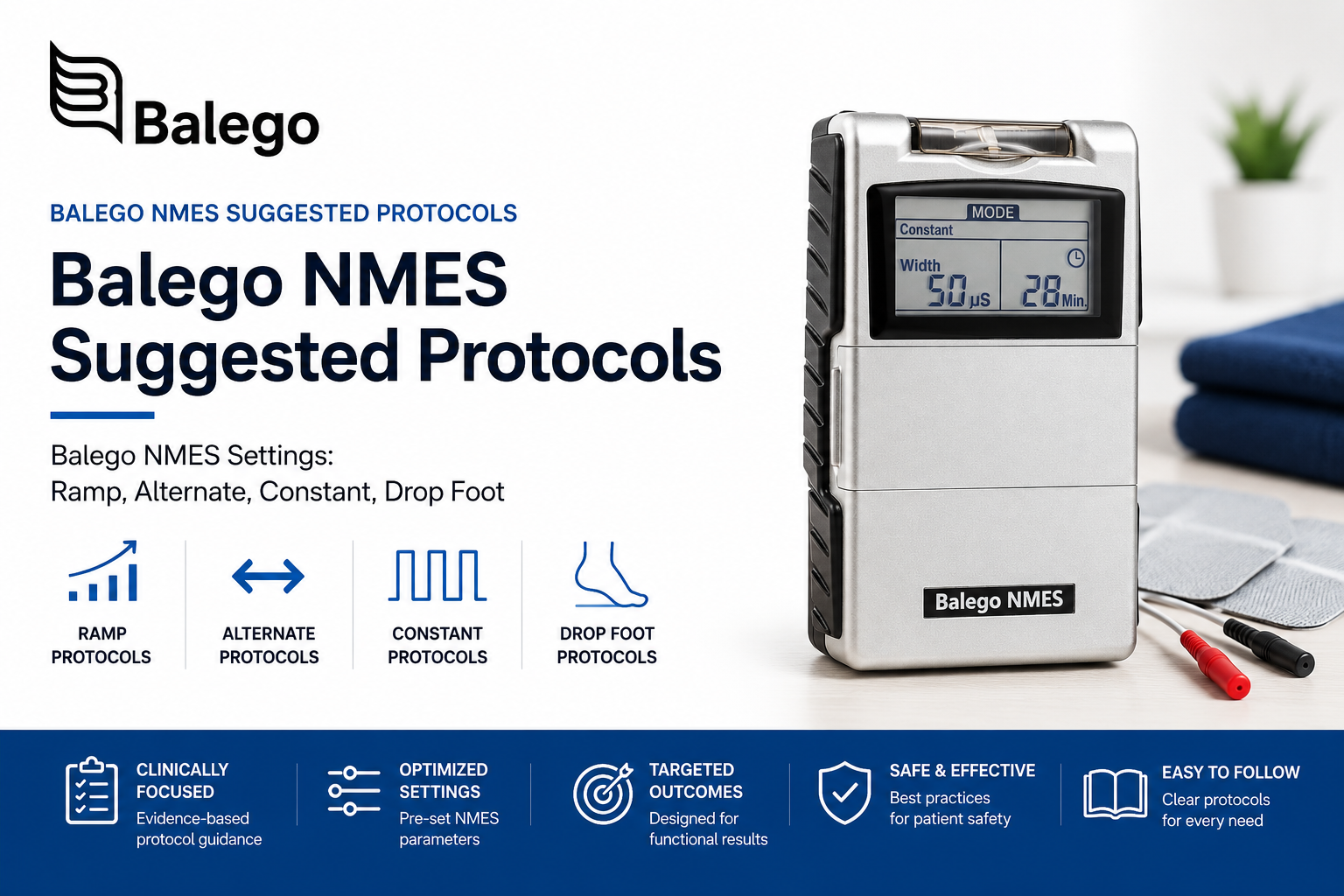
What is NMES?
NMES stands for neuromuscular electrical stimulation. It uses small electrical impulses through electrode pads placed on the skin to help activate targeted muscles. Balego describes NMES as a tool commonly used to support muscle reeducation, reduce muscle spasms, support circulation, and help with disuse-related weakness in appropriate rehab settings.
NMES is not the same as simply “feeling tingling.” The goal is often a visible, useful muscle contraction, especially when NMES is being used for muscle re-education.
Can Balego NMES help with foot drop?
NMES may be used in rehab programs for foot drop when the goal is to help activate the muscles that lift the front of the foot, also called dorsiflexion. Balego’s FAQ notes that the best results usually happen when a PT or OT programs the unit and teaches correct electrode placement for the target muscle.
For foot drop, the desired movement is usually the following:
The front of the foot and toes lift upward.
That is different from stimulating the calf, which points the foot downward. If the foot points down, twists sharply, cramps, or only tingles without useful movement, the pad placement or settings may not be right.
What does "ramp" mean on the Balego NMES device?
Ramp controls how gradually the stimulation turns on and off.
A short ramp makes the contraction start more quickly. A longer ramp makes the contraction build more slowly and feel smoother. Balego lists ramp time as adjustable from 1 to 8 seconds, and the manual describes it as a setting that smooths the beginning and end of the contraction.
Example
If your NMES cycle includes:
- ON time: 10 seconds
- Ramp: 3 seconds
The stimulation may spend part of the cycle gradually building up, hold briefly at the stronger contraction level, and then slowly ease back down.
For many users, ramp makes NMES feel less abrupt and more comfortable.
What does "constant" mean on the Balego NMES device?
Constant mode means the stimulation is delivered steadily according to the selected pulse width, pulse rate, and timer. In Balego’s manual, Constant mode is described as steady stimulation, with fewer timing adjustments than the cycled modes.
Constant mode may be useful in some clinician-directed applications, but for muscle re-education, many users are instructed to use a contraction-and-rest cycle instead. This is because continuous stimulation may fatigue the muscle more quickly.
What does synchronous mode mean?
Synchronous mode means both channels stimulate at the same time.
This mode may be used when both channels are intended to work together during the same contraction cycle. For example, a clinician may use two electrode circuits to help create a stronger or better-controlled contraction of one target area.
Balego’s manual notes that in synchronous mode, ON time includes ramp up and ramp down, so the ON time should be long enough to allow for those ramp intervals.
What does "alternate mode" mean on the Balego NMES device?
Alternate mode means Channel 1 and Channel 2 do not stimulate at the same time. Instead, one channel completes its contraction cycle, and then the other channel follows.
Balego’s manual explains that in alternate mode, Channel 2 follows after Channel 1 completes its contraction cycle. The manual also notes that OFF time should be equal to or longer than ON time in alternate mode.
Alternate mode is often used when two different areas or muscle groups are being stimulated in sequence. For a single foot-lifting goal, it may not be the simplest starting point unless a clinician specifically recommends it.
Which Balego NMES mode should I use for foot drop?
There is no single best mode for everyone. Foot drop can happen for different reasons, and NMES success depends on the diagnosis, nerve response, pad placement, and rehab goal.
For many foot drop users, the first priority is not choosing the most advanced mode. The first priority is getting the correct response:
A clean upward lift of the front of the foot.
If you are unsure, ask your PT, OT, physician, or rehab provider:
“Where should I place the electrodes for foot drop, and should I use Constant, Synchronous, or Alternate mode?”
Balego’s FAQ specifically notes that NMES programming and electrode placement are often best guided by a PT or OT.
Where should the pads go for foot drop?
Pad placement for foot drop should be guided by a clinician when possible. The goal is usually to activate the muscles or nerve pathway that lifts the foot upward.
A helpful way to check the response:
Good response
The front of the foot and toes lift upward.
Poor response
The foot points downward, twists strongly inward or outward, cramps, burns, or only tingles.
Do not keep increasing the intensity if the movement is incorrect. Electrode placement is one of the most important parts of NMES success, and Balego’s FAQ notes that incorrect pad placement is a common reason users feel the unit “doesn’t work.”
Can I walk while using NMES for foot drop?
Do not walk with NMES for foot drop unless a clinician has trained you to do so.
Walking with stimulation requires timing, balance, proper electrode placement, and secure pads. Early practice is usually safer while seated or in a controlled therapy setting.
What safety warnings should I know before using Balego NMES?
Before using the device, read the official Balego NMES Instruction Manual, including the warnings, contraindications, and adverse reactions section.
Do not use NMES if you have a cardiac demand pacemaker. Balego’s post-op knee protocol also lists additional precautions, including physician evaluation for cardiac disease with arrhythmia; pregnancy safety being unconfirmed; and avoiding use over skin irritation, wounds, or lesions at electrode sites.
You should also avoid stimulation over areas such as the neck/carotid sinus, across the chest, through the head, infected or inflamed skin, broken skin, or near cancerous lesions unless specifically directed by a qualified medical professional. Refer to the official Balego safety information for complete guidance.
Where can I find the Balego NMES manual?
You can find the official instructions in the Balego NMES Instruction Manual. This is the best place to review device modes, adjustable settings, setup steps, electrode guidance, warnings, contraindications, troubleshooting, and technical specifications.
For additional general guidance, Balego also has Balego NMES FAQs, which explain programming, setup, electrode placement, and why a PT or OT may be helpful when learning to use NMES.
Quick summary: Ramp vs Constant vs Alternate
Ramp controls how gradually the contraction turns on and off.
Constant provides steady stimulation based on selected settings.
Synchronous makes both channels stimulate together.
Alternate makes one channel stimulate first, then the other channel follows.
For foot drop, the key is not just the setting name. The key is whether the stimulation produces the intended movement: a safe, controlled lift of the front of the foot.
Important note
This article is for general education only. NMES is a medical device, and foot drop can have different causes. For the safest and most effective results, ask a qualified clinician to confirm your pad placement, settings, and home program.


