


NMES Billing and Documentation Guide: G0283, 97032, 97014, 97112, and E0745
Neuromuscular electrical stimulation, or NMES, can appear in several different billing situations:
- A clinician applies electrical stimulation in a clinic without remaining in constant one-to-one contact.
- A qualified professional continuously attends and manually provides electrical stimulation.
- NMES is incorporated into a broader skilled neuromuscular re-education activity.
- A home neuromuscular stimulator is ordered as durable medical equipment.
- Electrodes or other supplies are furnished for use with covered equipment.
Those situations do not automatically use the same code.
The correct choice depends on:
- What service or equipment was actually provided
- Whether constant attendance was required
- Whether the code is timed or untimed
- The treatment setting
- The patient’s insurance
- The plan of care
- The indication and coverage policy
- Who performed the service
- Whether the record supports medical necessity
- Applicable National Correct Coding Initiative edits
Billing disclaimer: This guide is educational and is not legal, coding, reimbursement or payer-specific advice. CPT, HCPCS, ICD-10-CM, modifier and coverage rules change. Verify the current code set, payer contract, Medicare Administrative Contractor policy, state scope-of-practice rules and claim instructions before billing.
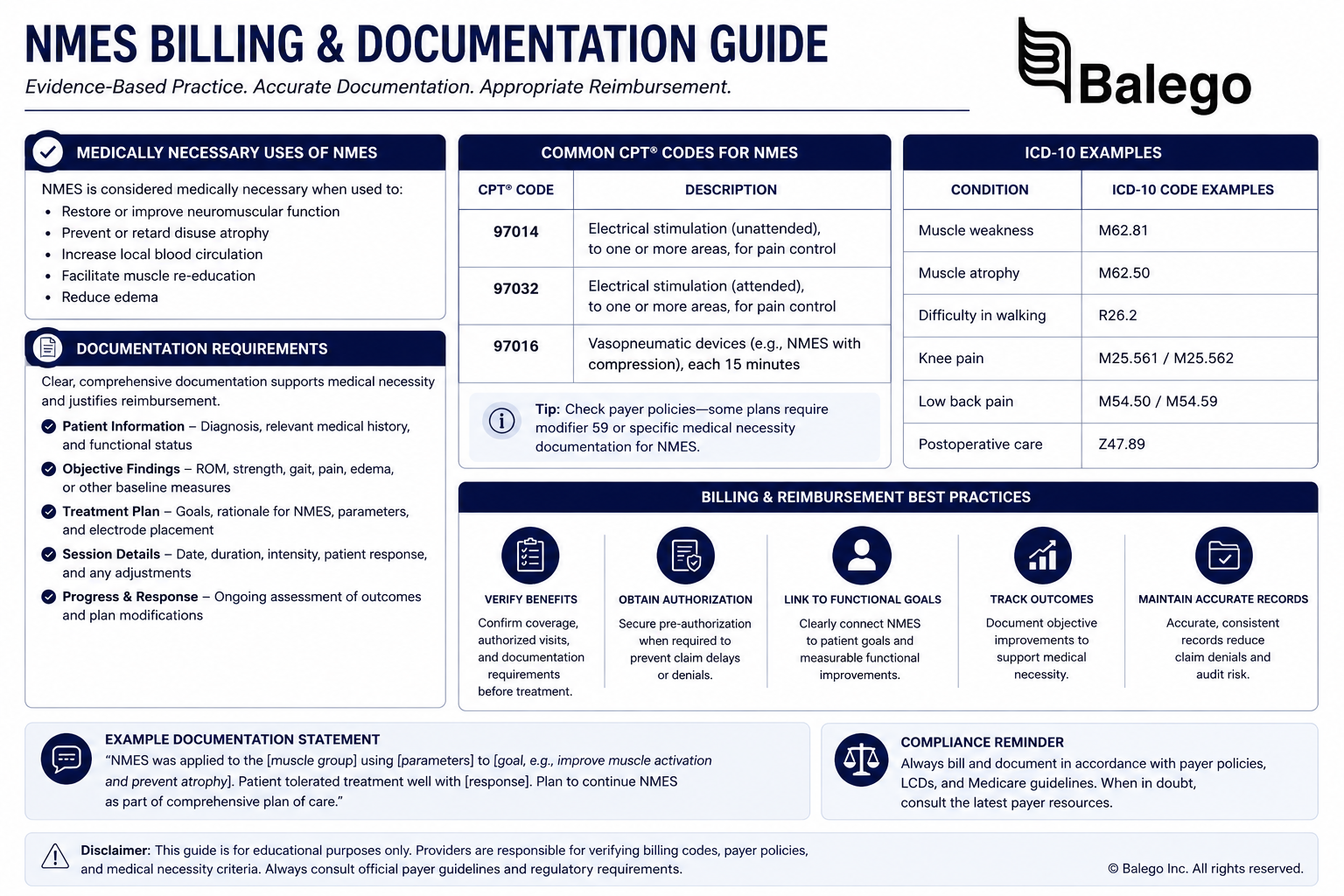
NMES billing codes at a glance
| Code | Plain-language role | Timed? | Common setting | Important limitation |
|---|---|---|---|---|
| G0283 | Unattended, non-wound electrical stimulation under a therapy plan of care | No | Medicare outpatient therapy | Does not describe constant one-to-one attended treatment |
| 97014 | Unattended electrical-stimulation modality | No | Some commercial-payer claims | Medicare does not recognize 97014 and directs providers to G0283 for qualifying non-wound unattended stimulation |
| 97032 | Attended electrical stimulation requiring continuous direct contact | Yes—15-minute units | Skilled one-to-one treatment | Periodic monitoring or merely changing intensity does not automatically support this code |
| 97112 | Skilled neuromuscular re-education | Yes—15-minute units | Active one-to-one therapeutic procedure | Do not use it merely because an NMES device was turned on |
| E0745 | Home neuromuscular-stimulation equipment | DME rules | Home equipment claim | Separate from clinic treatment billing, coverage criteria must be met |
| A4595 and related supply codes | Certain electrical-stimulator supplies | Payer-specific | DME supply claims | Coverage, frequency and bundling depend on the base device and payer policy |
CMS describes G0283 as unattended non-wound stimulation provided under a therapy plan of care. It describes 97032 as electrical stimulation requiring direct one-to-one contact. Medicare does not recognize 97014 for unattended stimulation and instead uses G0283 when the Medicare requirements are met.
Coding is not the same as coverage
A valid code does not guarantee payment.
A claim may still be denied because
- The indication is not covered
- The patient does not meet the payer’s criteria
- The service is not considered skilled
- The documentation does not establish medical necessity
- The service was not included in the certified plan of care
- The wrong supervision level was used
- Time was documented incorrectly
- A modifier was missing or inappropriate
- The service was bundled into another payment
- The equipment did not meet DME requirements
- The diagnosis does not match the applicable coverage policy
- Frequency or duration exceeded the payer’s expectations
- Prior authorization was required but not obtained
The code should be selected according to the service actually provided—not according to which code has the higher reimbursement. CMS expressly warns against selecting a code based on payment and against unbundling a single service into multiple claims.
Medicare coverage of NMES is narrower than its clinical uses
Clinicians may use NMES for several treatment objectives, including muscle activation, re-education, contraction-and-relaxation programs, and selected functional applications. Medicare coverage does not automatically extend to every clinically reasonable use.
CMS’s national NMES policy limits coverage for treatment of muscle atrophy to disuse atrophy when nerve supply to the muscle remains intact. Examples in the national policy include certain cases involving casting or splinting, scar-related contracture, and recovery after hip replacement until orthotic training begins.
The same national policy has separate, highly specific requirements for NMES or functional electrical stimulation used to support walking after spinal cord injury. Those requirements include a defined training program and multiple patient-selection criteria. They should not be applied to a routine portable muscle stimulator used for a different purpose.
Coverage depends on the payer’s policy, the specific indication, the treatment setting, the service delivered and the documentation supporting medical necessity.
G0283: unattended electrical stimulation for Medicare therapy claims
G0283 is generally the relevant Medicare code when non-wound electrical stimulation is applied under a therapy plan of care and does not require the clinician’s continuous direct one-to-one presence.
A typical workflow may involve:
- Inspecting the skin.
- Selecting and positioning electrodes.
- Programming the device.
- Establishing a safe intensity.
- Confirming the intended response.
- Allowing the stimulation cycle to continue without constant manual attendance.
- Periodically monitoring the patient.
- Removing the electrodes and reassessing the response.
G0283 is an untimed service. Its treatment duration may still be documented as part of total treatment time, but those minutes are not included in Medicare’s timed-code unit calculation. CMS gives examples in which unattended electrical stimulation is recorded in total treatment time but excluded from timed-code minutes.
Suggested G0283 documentation
Include:
- Type of stimulation: NMES, EMS, or other applicable electrical-stimulation modality
- Clinical objective
- Target muscle or body region
- Number and general location of electrodes
- Mode or program
- Relevant parameters
- Intensity or contraction response
- Treatment duration
- Patient position
- Skin condition before and after treatment
- Patient tolerance
- Objective or functional response
- How NMES supports the plan-of-care goal
- Why continued use remains reasonable
- Whether NMES was paired with a separate active intervention
- Total treatment time
- Signature and professional identification
Example G0283 treatment note
Unattended NMES applied to the right quadriceps under the established PT plan of care to address impaired voluntary activation following knee surgery. Four electrodes positioned over the proximal and distal quadriceps muscle bellies. Synchronous program used with clinician-selected work-rest parameters. Intensity increased to a strong, visible and controlled quadriceps contraction without increased knee pain. Treatment continued for 15 minutes while the patient remained positioned safely. Skin intact before and after treatment. Patient completed a separate clinician-directed exercise intervention after NMES. Improved quadriceps-set quality observed immediately after stimulation.
97014: unattended electrical stimulation for non-Medicare payers
CPT 97014 may be recognized by commercial insurers, workers’ compensation programs, or other payers for unattended electrical stimulation.
For Medicare:
- 97014 is not recognized.
- G0283 is generally used for qualifying unattended non-wound stimulation.
- The payer’s current claims instructions should control.
Do not automatically replace 97014 with G0283 on every non-Medicare claim. Some commercial payers may require 97014, G0283, another code, or no separate modality billing under the provider’s contract.
Suggested 97014 documentation
Use the same clinical detail recommended for G0283:
- Modality
- Region
- Goal
- Electrode setup
- Parameters
- Duration
- Patient response
- Skin response
- Integration with the treatment plan
Also document that the service was unattended or supervised rather than continuously attended.
97032: attended electrical stimulation
97032 is a timed code for electrical stimulation that requires constant attendance and direct one-to-one contact.
The decisive question is not
“Was a therapist somewhere nearby?”
The question is
“Did the electrical-stimulation service itself require the qualified professional’s continuous direct contact and active skilled involvement?”
Medicare guidance describes attended electrical stimulation as requiring direct one-to-one contact while stimulation is manually provided through probes or other equipment.
Situations that do not automatically justify 97032
- Applying self-adhesive pads and leaving the machine running
- Checking on the patient periodically
- Increasing intensity once after several minutes
- Remaining in the same treatment room
- Performing unrelated paperwork near the patient
- Supervising several patients simultaneously
- Billing attended stimulation because it pays more
- Calling an unattended NMES cycle “manual stimulation”
Documentation supporting attended treatment
The note should explain:
- Why constant attendance was medically necessary
- What the clinician did throughout the interval
- Why an unattended modality was insufficient
- Start and stop time or total direct-contact minutes
- Stimulation method
- Body region
- Parameters and adjustments
- Patient response
- Skilled decision-making
- Functional connection to the plan of care
Example attended-stimulation note
Attended electrical stimulation provided directly to the left tibialis anterior for 16 minutes. Continuous one-to-one skilled contact was required to identify the responsive motor-point region, adjust electrode/probe position, modify output in response to contraction quality and coordinate stimulation with active dorsiflexion attempts. Patient required repeated verbal and tactile cueing to reduce substitution and maintain neutral ankle alignment. Contraction quality improved from trace activation to visible dorsiflexion without inversion. Skin remained intact.
Whether that service is payable as 97032 still depends on the payer and applicable policy.
Medicare’s 8-minute rule for 97032
Because 97032 is reported in 15-minute units, Medicare’s timed-code calculation applies.
| Direct timed-code minutes | Maximum units supported when it is the only timed service |
|---|---|
| Fewer than 8 minutes | 0 |
| 8–22 minutes | 1 |
| 23–37 minutes | 2 |
| 38–52 minutes | 3 |
| 53–67 minutes | 4 |
When several timed procedures are provided on the same date, Medicare calculates the total timed minutes and then allocates the available units among the services according to its timed-code rules.
Do not:
- Round seven minutes up to one unit
- Count unattended G0283 minutes as 97032 minutes
- Count the same minutes toward 97032 and therapeutic exercise
- Count documentation time as treatment time
- Count time when the clinician was treating another patient
97112: neuromuscular re-education is not an NMES equipment code
CPT 97112 describes a skilled therapeutic procedure directed toward neuromuscular re-education. It is not simply another name for electrical stimulation.
The use of an NMES device does not by itself determine whether the service is:
- G0283
- 97014
- 97032
- 97112
- Included in another service
- Not separately billable
A 97112 service may involve active, skilled work addressing matters such as:
- Proprioception
- Balance
- Coordination
- Kinesthetic awareness
- Postural control
- Motor recruitment
- Movement sequencing
When NMES is integrated into active one-to-one neuromuscular training, the provider must determine which code most accurately represents the actual service under that payer’s policy. Do not relabel an unattended electrical-stimulation session as 97112 merely because the stimulation causes muscle contraction.
Documenting a true neuromuscular re-education service
Include:
- Specific motor-control deficit
- Functional consequence
- Skilled activity performed
- Patient participation
- Cueing and facilitation
- Movement or postural response
- Progression or regression
- Direct one-to-one time
- Objective change
- Role of NMES, when used
- Why the service required professional skill
Example
Patient performed active quadriceps recruitment and controlled terminal-knee-extension training with NMES used as an adjunct during the contraction phase. Continuous one-to-one cueing and manual facilitation were required to reduce hip compensation, maintain patellar alignment and coordinate voluntary effort with the stimulation cycle. Twenty minutes of direct neuromuscular re-education completed.
Whether 97112 is appropriate depends on the full service, payer rules, and claim circumstances—not simply the presence of NMES.
Do not bill overlapping direct-contact minutes twice
Medicare does not permit the same one-to-one treatment interval to support two direct-contact timed services.
For example, the clinician should not report the following:
- 15 minutes of 97032 and
- 15 minutes of 97112
for the same 15-minute interval with the same patient.
CMS states that constant-attendance modalities and direct one-to-one therapeutic procedures cannot both be billed for the same time period.
Correct time-recording structure
| Time category | What belongs in it |
|---|---|
| Timed-code treatment minutes | Direct timed procedures and attended modalities |
| Untimed modality duration | G0283 or another applicable untimed service |
| Total treatment time | Timed minutes plus untimed treatment duration |
| Nonbillable time | Waiting, documentation and other times not meeting code requirements |
NCCI edits and modifiers
The National Correct Coding Initiative includes:
- Procedure-to-procedure edits
- Medically unlikely edits
- Add-on-code edits
An NCCI modifier may be used only when:
- The services are genuinely distinct
- The edit permits a modifier
- The circumstances meet the modifier definition
- Documentation supports the distinction
It should not be appended automatically to force separate payment.
Potentially relevant distinctions may involve the following:
- Different anatomical regions
- Separate encounters
- Separate clinical purposes
- Distinct time periods
- Services that are not components of one another
Always check the current quarterly NCCI edit files and the payer’s modifier rules.
Routine therapy supplies
Routine supplies used to provide an outpatient therapy service—such as standard electrodes used during the visit—are generally not separately billed to Medicare as an additional therapy charge. CMS specifically identifies electrodes among supplies that should not be billed separately when used to provide the therapy service.
That is different from medically necessary replacement supplies furnished for a separately covered home DME item. DME supply coverage follows its own rules.
E0745: billing a home NMES unit
E0745 identifies a home neuromuscular stimulator for DME billing purposes. It does not describe the clinician’s treatment session.
CMS lists E0745 among DMEPOS items, but the existence of the code does not mean that every prescribed NMES unit is covered.
Home-device documentation should address
| Documentation element | What to include |
|---|---|
| Treating diagnosis | Condition producing the documented functional deficit |
| NMES indication | The specific reason a home muscle stimulator is required |
| Baseline impairment | Atrophy, activation deficit, weakness, gait deficit or other measurable finding |
| Intact nerve supply | Clearly documented when coverage is requested for disuse atrophy |
| Etiology of disuse | Casting, splinting, postoperative immobilization or other supported cause |
| Prior treatment | Exercise, therapy, bracing or other interventions and the response |
| Clinical trial | Settings, contraction obtained, tolerance and measurable response |
| Functional goal | What activity or ability the equipment is intended to improve or preserve |
| Home-use plan | Muscle, placement, parameters, duration and frequency |
| Patient capability | Ability to apply electrodes, operate controls and recognize unsafe responses |
| Caregiver support | Training provided when a caregiver will assist |
| Equipment ordered | Manufacturer, model and prescribed accessories |
| Follow-up plan | Date and method for evaluating adherence and continued need |
| Contraindication screening | Implanted devices, skin condition, sensation and other relevant risks |
| Ordering information | Treating practitioner, order date, signature and required identifiers |
For Medicare disuse-atrophy coverage, the record should not merely say “weakness.” It should identify the disuse atrophy, its cause, and the fact that nerve supply to the muscle is intact.
Home-NMES letter of medical necessity template
Letter of Medical Necessity—Home Neuromuscular Electrical Stimulator
Patient: Name: Date of birth: Member ID:
Ordering practitioner: Name: NPI: Practice: Address: Telephone:
Equipment requested: Home neuromuscular electrical stimulator Manufacturer/model: HCPCS code being considered: E0745 Required electrodes/accessories:
Diagnosis and clinical history:
- Primary diagnosis:
- Relevant surgery, immobilization, or neurological history:
- Date symptoms or impairment began:
- Relevant precautions:
Objective impairment:
- Target muscle or muscle group:
- Strength measurement:
- Muscle girth or atrophy measurement, when relevant:
- Voluntary activation deficit:
- Range of motion:
- Gait or functional limitation:
- Baseline outcome measure:
Coverage-specific clinical findings:
- Evidence of disuse atrophy:
- Cause of disuse:
- Documentation that nerve supply is intact:
- Reason standard exercise alone is currently insufficient:
Prior care and response:
- Therapeutic exercise:
- Neuromuscular re-education:
- Bracing or orthotic treatment:
- Clinic NMES trial:
- Other conservative care:
NMES trial results:
- Device and mode:
- Electrode placement:
- Parameters:
- Intensity or contraction achieved:
- Patient tolerance:
- Immediate objective response:
- Functional response:
Home treatment plan:
- Target muscle:
- Program:
- Session duration:
- Frequency:
- Planned length of use:
- Voluntary exercise paired with stimulation:
- Skin and safety monitoring:
Functional goals: 1. 2. 3.
Patient or caregiver training:
- Electrode placement demonstrated:
- Device operation demonstrated:
- Teach-back completed:
- Contraindications and stop criteria reviewed:
- Patient or caregiver can safely operate the system:
Follow-up:
- Review date:
- Measures to reassess:
- Criteria for continued use:
- Criteria for discontinuation:
Practitioner attestation: I certify that the requested equipment is medically necessary for the indication documented above and will be used as part of the stated treatment plan.
Signature: Credentials: Date:
This template does not replace a payer-specific order form, prior-authorization form, or DME supplier checklist.
Clinic NMES documentation checklist
| Category | Documentation to capture |
|---|---|
| Medical necessity | Why NMES is required for this patient now |
| Baseline deficit | Strength, activation, ROM, gait, function, pain or spasm measure |
| Functional link | How the impairment limits an activity |
| Treatment goal | Specific measurable plan-of-care goal |
| Modality | NMES or other clearly identified stimulation |
| Muscle and region | Exact muscle group and side |
| Electrodes | Number and general placement |
| Mode | Constant, synchronous, alternate or device-specific program |
| Parameters | Rate, pulse width, ramp, ON/OFF time when relevant |
| Intensity | Device value and, more importantly, resulting contraction |
| Patient participation | Voluntary contraction or task performed |
| Attendance | Unattended, unsupervised, or constant one-to-one |
| Time | Timed minutes, untimed duration and total treatment time |
| Skilled activity | Adjustments, cueing, facilitation and clinical decisions |
| Response | Objective and subjective changes |
| Skin | Condition before and after |
| Plan | Continue, progress, change or discontinue |
| Authentication | Signature, credentials and date |
Weak documentation versus stronger documentation
| Weak entry | Stronger entry |
|---|---|
| “E-stim to knee, tolerated well.” | “Unattended NMES applied to right quadriceps for impaired activation following knee surgery; four-pad synchronous setup produced visible controlled contraction without increased pain.” |
| “NMES for weakness.” | “Quadriceps activation deficit contributes to 12-degree extensor lag and difficulty ascending stairs.” |
| “Intensity 30.” | “Intensity increased to 30 mA, producing visible quadriceps contraction and superior patellar glide without pain.” |
| “Pads on thigh.” | “Two electrodes were placed over the proximal quadriceps and two over distal motor-point regions.” |
| “Patient improved.” | “Straight-leg-raise lag improved from 12 degrees before treatment to 7 degrees immediately afterward.” |
| “97032 × 2.” | “Thirty minutes of direct one-to-one attended stimulation with continuous motor-point adjustment and active movement coordination.” |
| “Needs home unit.” | “Home unit was requested for documented disuse atrophy with intact innervation following immobilization; clinic trial produced repeatable contraction, and patient completed independent setup teach-back.” |
| “Continue as needed.” | “Continue twice weekly for two weeks; reassess quadriceps activation and stair performance at the next progress review.” |
Plan-of-care and progress-report requirements
For Medicare outpatient therapy, the plan of care should address:
- Diagnoses
- Long-term treatment goals
- Therapy service type
- Amount
- Frequency
- Duration
CMS documentation guidance also states that progress reports generally must be completed at least once every ten treatment days and include the required professional authentication.
NMES documentation should therefore show a progression over time rather than repeating an identical modality note at every visit.
Examples of progression include:
- Stronger contraction at a lower or similar intensity
- Better voluntary recruitment
- Reduced extensor lag
- Improved gait
- Increased activity tolerance
- Improved functional-test result
- Reduced assistance
- Transition from passive stimulation to active exercise
- Reduced need for the modality
- Discontinuation when it no longer adds skilled value
Does the NMES device determine the billing code?
No.
A dedicated NMES unit, a combination TENS/NMES unit, and a four-mode stimulator may all be used during services reported under different codes depending on what the clinician actually provides.
| Device characteristic | What it may help document | What it does not determine |
|---|---|---|
| Adjustable NMES parameters | Exact rate, width, ramp and duty cycle | Which billing code is automatically correct |
| Separate channel intensities | Treatment delivered to each electrode pair | Medical necessity |
| Treatment timer | Duration programmed | Direct-contact time |
| Compliance meter | Stored use records | Coverage eligibility |
| Body-area preset | Program selected | Diagnosis or correct electrode placement |
| Four channels | Number of treatment paths | Number of billable units |
| Rechargeable battery | Power source | DME coverage |
Balego NMES device comparison for documentation workflows
| Device | Documentation-relevant features | Practical recordkeeping consideration |
|---|---|---|
| Balego EMS Digital NMES Stimulator | Two channels with adjustable NMES rate, pulse width, ramp and work-rest timing | Record record settings and patient response manually in the treatment note |
| EMS 5.0 Analog NMES Stimulator | Direct analog rate, ramp, contraction and relaxation controls | Document each dial or selector position because there is no digital treatment record |
| InTENSity Select Combo II | TENS, NMES, IF, and Russian modes with stored compliance information | Record the modality—not only the body-area preset—and correlate stored use with the prescribed plan |
| Twin Stim Plus DS5402 | Four channels, two channel-group timers and a compliance meter | Document which channels, electrode pairs and timer groups were used |
| InTENSity Twin Stim IV | Rechargeable TENS and NMES programs | Clearly identify whether the treatment was sensory TENS or contraction-producing NMES |
A compliance meter can support an adherence discussion, but it does not independently prove the following:
- Correct electrode placement
- Correct use
- Medical necessity
- Functional improvement
- Continued coverage
- That a clinician delivered an attended service
For operating and parameter guidance, use the Balego NMES Manual and Balego NMES Settings Explained.
Audit-preparation checklist
Before submitting or defending an NMES claim, verify:
- The code accurately represents the actual service or equipment.
- The payer recognizes the code.
- The indication is covered.
- Prior authorization was obtained when required.
- The diagnosis matches the coverage policy.
- The service appears in the plan of care.
- The note explains why skilled care was required.
- Attendance level is accurately documented.
- Timed minutes are not duplicated.
- G0283 minutes are excluded from timed-code calculations.
- The same service has not been unbundled.
- NCCI edits have been reviewed.
- Any modifier is supported by genuinely distinct services.
- Routine clinic electrodes were not separately billed when prohibited.
- The patient’s objective response supports continuation.
- The progress report is current.
- The clinician’s signature, credentials, and date are present.
- A home-device claim contains DME-specific documentation rather than only clinic notes.
Frequently asked questions
What is the Medicare billing code for unattended NMES?
G0283 is generally used for qualifying unattended, non-wound electrical stimulation provided under a Medicare therapy plan of care.
Can 97014 be billed to Medicare?
No. Medicare does not recognize 97014 and generally directs providers to G0283 for qualifying unattended non-wound stimulation.
What is the difference between G0283 and 97032?
G0283 describes unattended stimulation and is untimed. Code 97032 is timed and requires constant direct one-to-one attendance.
Does adjusting intensity once make treatment effective?
Not necessarily. The record must support continuous direct contact and skilled involvement throughout the billed 97032 interval.
Is G0283 billed in 15-minute units?
No. It is an untimed service.
Does the 8-minute rule apply to G0283?
No. The 8-minute rule applies to 15-minute timed codes such as 97032, not to untimed G0283.
Does the 8-minute rule apply to 97032?
Yes for Medicare timed-code calculations. Eight through 22 minutes supports one unit when it is the only timed service.
Can 97032 and 97112 be billed during the same 15 minutes?
No. The same direct-contact minutes cannot support both services.
Can NMES be billed as 97112?
Only when the actual service meets the requirements of skilled neuromuscular re-education. Merely applying electrodes and running an NMES program does not automatically support 97112.
Is muscle weakness enough to qualify a patient for home NMES?
Not necessarily. The applicable coverage policy may require a specific covered indication. Medicare’s national disuse-atrophy coverage requires intact nerve supply.
What code is used for a home NMES unit?
E0745 may apply to a home neuromuscular stimulator. Coverage and documentation requirements must still be verified.
Are replacement electrodes automatically covered?
No. Coverage depends on the base equipment, payer policy, replacement frequency, order, and medical necessity.
Can electrodes used in the clinic be billed separately?
CMS guidance states that routine supplies such as electrodes used to provide therapy services should not be separately billed under the outpatient-therapy claim.
Does a compliance meter guarantee reimbursement?
No. Usage records may support adherence review, but they do not replace the order, coverage criteria, medical-necessity record, or objective progress documentation.
Must every note include all NMES settings?
The level of detail depends on the payer and clinical situation, but recording the modality, target, program, relevant parameters, intensity response, and duration creates a clearer and more reproducible record.
Should the exact ICD-10 code be listed in this guide?
No universal diagnosis list should be presented. Covered diagnosis codes vary by payer, MAC, indication, and policy revision. Verify the active policy for the patient and date of service.
Is prior authorization required?
It depends on the payer, plan, service, and equipment. CMS currently lists E0745 on its DMEPOS master list but does not identify a national prior-authorization effective period for it on that page. Commercial requirements may differ.
Does an order guarantee home-device payment?
No. An order is only one element. Coverage criteria, medical necessity, documentation, supplier requirements, and payer rules must also be satisfied.
Key billing workflow
| Question | Next step |
|---|---|
| Was stimulation unattended under a Medicare therapy plan? | Review G0283 |
| Was it unattended for a non-Medicare payer? | Check whether the payer requires 97014, G0283, or another method |
| Did the service require continuous one-to-one electrical-stimulation attendance? | Review 97032 and timed-code rules |
| Was the primary service active, skilled motor-control retraining? | Evaluate whether 97112 accurately describes the service |
| Was a home NMES device ordered? | Review E0745 and DME coverage requirements |
| Were replacement supplies furnished for covered home equipment? | Review the payer’s DME supply policy |
| Were multiple services billed together? | Check NCCI edits, time overlap and modifier rules |
| Is continued treatment being billed? | Document objective progress and continued skill needs. |
The safest approach is to code what was actually provided, verify the patient’s exact payer requirements, and build the medical record around the functional deficit, skilled need, treatment response, and applicable coverage criteria.
Browse Balego NMES devices, review NMES protocols, settings, and electrode-placement guides, or compare electrotherapy electrodes.
For product specifications, equipment documentation, or compatible-electrode questions, contact Balego.


