



NMES for Muscle Spasms: Settings, Electrode Placement and Safety
Neuromuscular electrical stimulation, or NMES, uses surface electrodes to activate motor nerves and produce controlled muscle contractions. In selected rehabilitation programs, a clinician may use rhythmic contraction-and-relaxation cycles to help manage muscle guarding or recurrent spasm before stretching, movement retraining, or therapeutic exercise.
The intended sequence is generally:
- Produce a controlled contraction.
- Allow the muscle to relax during the rest phase.
- Reassess tone, discomfort, and movement.
- Follow with an appropriate stretch or active exercise.
NMES should not be presented as a cure for muscle spasms or as a substitute for identifying why the muscle is contracting involuntarily.
The Balego EMS Digital NMES Stimulator is a dedicated two-channel muscle stimulator with adjustable pulse rate, pulse width, ramp, contraction time, relaxation time, and treatment duration. Its constant, synchronous, and alternate modes allow the clinician to select continuous, simultaneous, or alternating channel behavior.
For a complete explanation of those controls, use Balego NMES Settings Explained rather than duplicating the entire device tutorial here.
Clinical-use notice: Muscle spasm is a symptom rather than a single diagnosis. NMES settings, electrode placement and treatment frequency should be selected by an appropriately qualified healthcare professional after the likely cause has been evaluated.
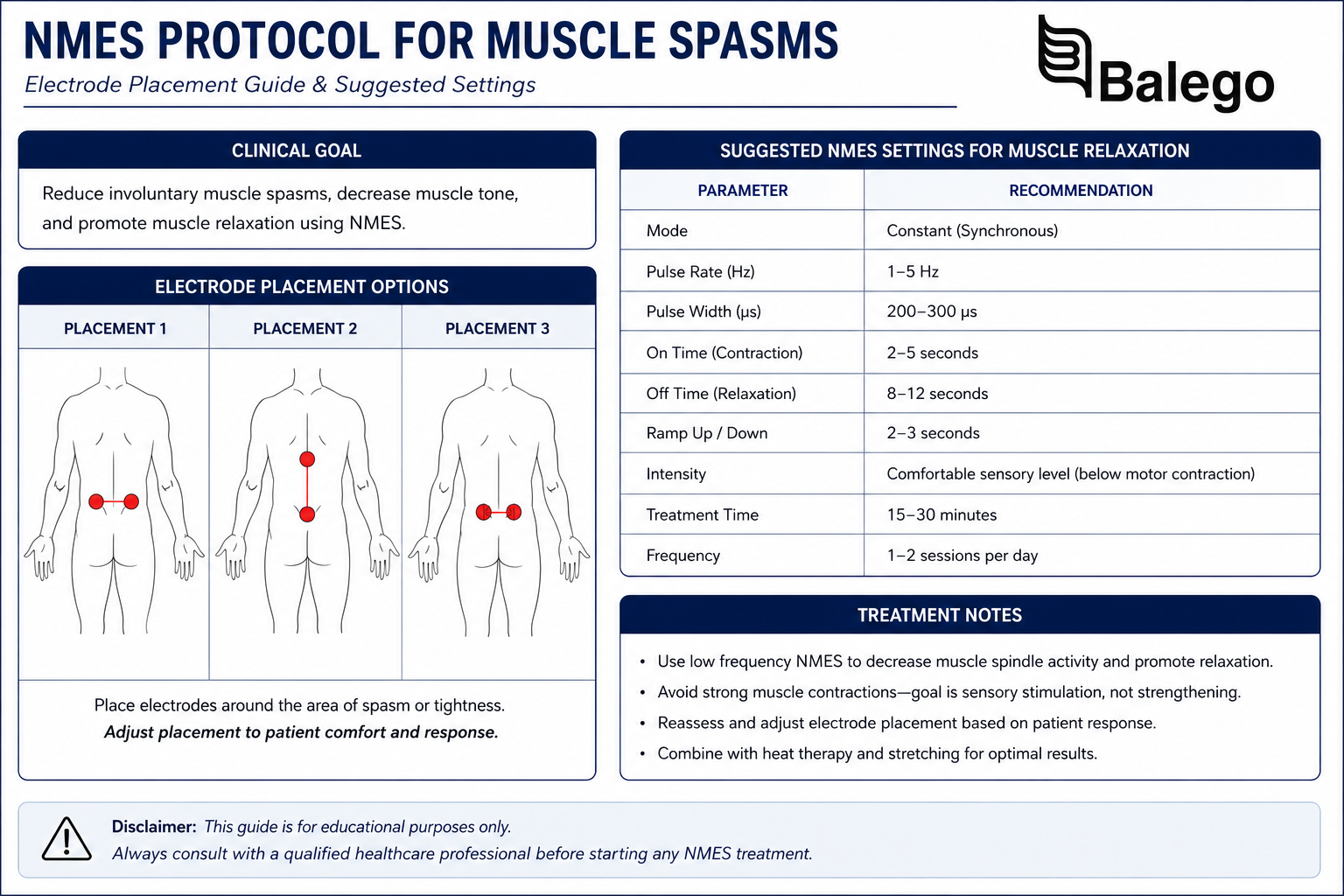
Suggested NMES starting framework for muscle-spasm relaxation
The following table is a conservative clinician-directed starting framework for an adjustable unit. It is not a proven universal prescription.
| Parameter | Practical starting framework | Purpose |
|---|---|---|
| Mode—one muscle or two channels on one region | Synchronous | Activates both electrode pairs together |
| Mode—one channel on each side | Synchronous or Alternate | Treats both sides together or in sequence |
| Pulse rate | Approximately 35–50 Hz initially | Produces a sustained contraction while limiting unnecessary frequency |
| Pulse width | Approximately 250–300 µs | Supports motor-nerve recruitment in a medium or large muscle |
| Ramp | Approximately 3–5 seconds | Creates a gradual, less abrupt contraction |
| ON time | Approximately 5–10 seconds | Provides a brief controlled contraction |
| OFF time | Approximately 10–30 seconds | Allows the muscle to relax and limits rapid fatigue |
| Intensity | Visible, controlled and tolerable contraction | More than tingling, but not an uncontrolled maximum contraction |
| Initial duration | Approximately 10–20 minutes | Allows response and skin tolerance to be assessed |
| Frequency of use | Individually prescribed | Depends on diagnosis, response and accompanying rehabilitation |
| Follow-up activity | Gentle stretch or active movement when appropriate | Uses the temporary relaxation period functionally |
These parameters are deliberately conservative. Frequency, pulse width, duty cycle, and intensity interact, and NMES protocols vary considerably across conditions and devices. Clinical reviews emphasize matching parameters to the treatment goal, muscle size, electrode placement, fatigue, and patient tolerance rather than assuming one setting is optimal for every application.
Spasm, cramp, guarding and spasticity are not the same
The phrase “muscle spasm” is used loosely. Identifying the symptom type is important before choosing electrical stimulation.
| Term | Typical meaning | Is this general NMES protocol automatically appropriate? |
|---|---|---|
| Muscle cramp | Sudden, painful, involuntary contraction lasting seconds to minutes | No, safe stretching and evaluation of the cause are usually the first priorities |
| Protective muscle guarding | Sustained tightening around a painful or injured area | Sometimes, but only after ruling out an injury that should not be forcibly contracted |
| Recurrent musculoskeletal spasm | Repeated involuntary tightening associated with movement, fatigue or pain | Possibly, as one part of a broader rehabilitation plan |
| Trigger point | Localized tender region within a taut band of muscle | Requires a more focused assessment and may use a different stimulation strategy |
| Spasticity | Abnormally increased tone associated with brain or spinal-cord injury | No, use a neurologic spasticity-management plan |
| Dystonia | Neurological condition causing involuntary muscle tightening and abnormal posture | No, it requires neurological evaluation |
| Fasciculation | Small spontaneous muscle twitch | Not an indication to begin this protocol without determining the cause |
True muscle cramps are sudden, involuntary, and painful and may be associated with dehydration, electrolyte disturbance, medication effects, overexertion, vascular disease, radiculopathy, or neurological and metabolic conditions.
Spasticity is increased muscle tone or stiffness associated with upper-motor-neuron dysfunction and should not be treated as an ordinary muscle cramp.
When this protocol may be considered
A clinician-directed NMES trial may be considered when:
- A muscle repeatedly tightens during rehabilitation.
- Guarding interferes with stretching or active movement.
- The target muscle and motor nerve remain responsive.
- The patient can accurately report discomfort.
- The skin is intact and has normal sensation.
- A controlled contraction does not threaten an injured structure.
- The therapist intends to follow stimulation with stretching, positioning, or movement training.
- Bilateral or alternating contractions have a defined treatment purpose.
NMES is less appropriate when the primary complaint is pain without a need for motor-level contraction. A TENS program may be more suitable when the goal is sensory pain modulation rather than muscle activation. See TENS vs. NMES for the distinction.
When recurrent spasms need medical evaluation
Do not simply repeat NMES when spasms or cramps are
- New and unexplained
- Frequent or progressively worsening
- Affecting several unrelated muscle groups
- Associated with new weakness
- Accompanied by numbness or altered sensation
- Associated with muscle wasting
- Occurring after a medication change
- Associated with severe dehydration, vomiting or diarrhea
- Occurring with significant leg swelling or color change
- Associated with fever or systemic illness
- Disturbing sleep regularly
- Causing abnormal joint posturing
- Occurring after significant trauma
- Associated with a known neurological disorder
A history should include the duration, frequency, distribution, triggers, and associated symptoms. Muscle cramps can have medication-related, electrolyte, vascular, metabolic, and neurological causes.
Urgent warning signs
Seek prompt medical care rather than applying NMES for the following:
- Sudden one-sided calf swelling, warmth or tenderness
- Chest pain or sudden shortness of breath
- New loss of bladder or bowel control
- Rapidly progressive weakness
- Severe trauma or suspected fracture
- A hot, red or infected area
- Severe pain that is rapidly worsening
- Spasm associated with altered consciousness
- A new neurological deficit
NMES should never be used to mask symptoms of a possible blood clot, infection, serious neurological condition, or structural injury.
How can contracting a tight muscle promote relaxation?
It can seem counterintuitive to stimulate a muscle that is already tight.
The proposed clinical strategy is not to hold the muscle in a continuous contraction. Instead, NMES creates a structured cycle:
- Gradual contraction
- Brief active phase
- Gradual release
- Defined rest period
The clinician then evaluates whether the muscle is easier to lengthen or activate normally during the rest period.
Potential short-term effects may include:
- More predictable contraction and relaxation timing
- Sensory input from the stimulated region
- Temporary changes in perceived tightness
- Increased awareness of the muscle
- Preparation for stretching or active movement
- Alternating activation of two sides or muscle groups
These mechanisms do not establish that NMES corrects the underlying cause of the spasm. The effect should be measured by improved comfort, movement, or function rather than assumed from the visible contraction alone.
Single-channel electrode placement
A single-channel setup uses two electrodes over one target muscle.
General placement
- Place one electrode near a responsive motor point.
- Place the second over another portion of the muscle belly.
- Keep both pads on healthy muscular tissue.
- Avoid placing a pad directly over a bony prominence or tendon when better muscle contact is available.
- Adjust placement while intensity is at zero until a smooth contraction is obtained.
The objective is to recruit the target muscle without unnecessarily activating neighboring muscles.
Motor-point testing
- Turn the channel intensity fully down.
- Apply both electrodes over the general muscle region.
- Increase stimulation cautiously.
- Observe which muscle contracts.
- Turn the intensity back to zero.
- Reposition one electrode slightly when the response is weak, painful, or occurring in the wrong muscle.
- Retest.
- Mark or photograph the clinician-approved sites for home reproduction.
Electrode placement frequently has more influence on contraction quality than a small difference in pulse settings.
Dual-channel placement on one large muscle
Four electrodes may be useful for a broad muscle group such as the following:
- Quadriceps
- Hamstrings
- Calf
- Gluteal muscles
- Large shoulder or scapular muscles
- Lumbar paraspinal region, when permitted by the device instructions
One electrode pair can cover the proximal region while the other covers a more distal portion of the same muscle.
Use synchronous mode when both channels are intended to contract together.
| Benefit of four-pad placement | Limitation |
|---|---|
| Distributes current over a wider area | Requires more setup and lead management |
| May feel less concentrated | Four pads must maintain full adhesion |
| Can recruit more than one motor-point region | Poor placement can activate unwanted muscles |
| Allows independent channel intensity | Both channels still share the same timing parameters |
Bilateral placement
When similar muscles on the left and right sides are being treated:
- Assign Channel 1 to one side.
- Assign Channel 2 to the other side.
- Place both electrodes from each channel on the same target muscle or side.
- Adjust each channel independently.
- Do not assume the two intensity values must match.
Synchronous versus Alternate
| Mode | Channel behavior | Possible reason for selection |
|---|---|---|
| Synchronous | Both sides contract at the same time | Bilateral simultaneous contraction and relaxation |
| Alternate | Channel 1 and Channel 2 take turns | Sequential activation or greater comfort when simultaneous contraction is undesirable |
| Constant | Continuous pulse delivery without an automatic work-rest cycle | Specialized clinician-directed applications; greater fatigue risk |
Alternate mode does not create a separately programmable 13-second lag. It follows the ON, OFF, and ramp relationships available on the Balego EMS Digital.
For full operating details, read the Balego NMES Manual.
Antagonist stimulation and neurological spasticity
In some neurological programs, a clinician may stimulate the muscle opposite the overactive muscle. This approach is sometimes used to encourage reciprocal movement or temporarily influence tone.
That is a different protocol from directly cycling the muscle described as “in spasm.”
Examples include:
- Stimulating ankle dorsiflexors when plantar-flexor spasticity affects foot position
- Activating triceps when elbow-flexor tone limits extension
- Stimulating wrist or finger extensors when flexor tone limits hand opening
These applications require assessment of:
- Neurological diagnosis
- Joint range
- Contracture
- Sensation
- Voluntary motor control
- Tone pattern
- Functional goal
- Skin integrity
- Safety during resulting movement
Do not improvise an antagonist-stimulation protocol from a generic spasm article.
Does electrode polarity matter?
The earlier protocol instructed users to place the negative electrode over the motor point and the positive electrode over the muscle belly. That instruction should not be applied to every NMES device.
The Balego EMS Digital uses an asymmetrical rectangular biphasic waveform. For a portable biphasic NMES unit, the practical priorities are usually:
- Correct motor-point placement
- Full electrode contact
- Appropriate pad size
- Comfortable current distribution
- A controlled contraction of the intended muscle
Follow any polarity instructions supplied with the exact stimulator. Do not describe a waveform as both monophasic and biphasic.
Choosing electrode size
Electrode size should reflect the target muscle and available placement area.
| Electrode size | Practical use |
|---|---|
| 2 × 2-inch square | Small-to-medium muscle areas and general use |
| 2-inch round | Curved anatomy or limited placement space |
| 2 × 3.5-inch rectangle | Medium or large muscle bellies |
| 2 × 4-inch rectangle | Quadriceps, hamstring, gluteal or other broad muscles |
| Very small electrode | Produces more concentrated current and may feel sharper |
Useful options include:
- Balego Reusable TENS, NMES, and FES Electrodes
- DURA-STICK PLUS Electrodes
- Classic TENS, NMES, and FES Electrodes
- Our complete Electrotherapy Electrode collection
A larger pad generally distributes current over more skin, while a smaller pad creates a more concentrated sensation. The largest pad is not always best if it cannot remain fully attached to the body contour.
Step-by-step NMES setup
1. Identify the type and cause of spasm
Confirm that the treatment is intended for a musculoskeletal muscle spasm or guarding pattern rather than
- An acute unexplained cramp
- Neurological spasticity
- Dystonia
- Vascular symptoms
- A medication reaction
- Electrolyte disturbance
- An acute structural injury
2. Define the treatment goal
The goal should be specific, such as:
- Reduce guarding enough to permit stretching
- Improve comfort during active movement
- Alternate contraction between two sides
- Improve awareness of contraction and relaxation
- Prepare a muscle for therapeutic exercise
“Relax the muscle” alone is difficult to measure.
3. Inspect the device and electrodes
Check for:
- Low battery
- Damaged housing
- Loose output sockets
- Cracked lead wires
- Exposed metal
- Dry hydrogel
- Torn backing
- Curled or lifting electrode edges
4. Prepare the skin
Clean and dry the treatment area. Remove:
- Lotion
- Massage oil
- Perspiration
- Topical analgesic gel
- Adhesive residue
- Dirt and skin oils
Do not place pads over wounds, inflamed skin, infections, absent sensation, or a suspicious lesion.
5. Apply two or four electrodes
Choose the simplest arrangement that produces the intended contraction.
- Two pads: one channel and one muscle
- Four pads over one region: broader synchronous contraction
- Four pads bilaterally: one channel per side
6. Select the operating mode
For the Balego EMS Digital:
- Use synchronous when both channels should contract together.
- Use alternate when the two channels should take turns.
- Avoid constant mode unless continuous output has a specific clinical purpose.
7. Enter the prescribed parameters
A conservative trial may begin around:
- 35–50 Hz
- 250–300 µs
- 3–5-second ramp
- 5–10 seconds ON
- 10–30 seconds OFF
- 10–20 minutes total
The existing 80 Hz, 300 µs, eight-second ramp and ten-second ON values may be used only when a clinician intentionally selects that legacy approach.
8. Increase intensity during the active phase
Raise the intensity slowly until the muscle produces a visible, controlled contraction.
The contraction should not:
- Cause sharp or burning pain
- Create violent joint movement
- Pull against an injured structure
- Trigger a stronger spasm
- Activate the wrong muscle
- Produce intolerable cramping
9. Evaluate the OFF phase
During the rest interval, assess:
- Does the muscle soften?
- Is movement easier?
- Is the pain lower?
- Can the patient relax voluntarily?
- Does the spasm return immediately?
- Is the muscle becoming fatigued?
10. Follow with the planned activity
When appropriate, use the relaxation period for:
- Gentle stretching
- Active range of motion
- Breathing and relaxation
- Motor-control exercise
- Postural correction
- Functional movement
11. Stop before contraction quality deteriorates
A longer session is not automatically more useful. Stop or lengthen the rest interval when contractions become progressively weaker or the muscle becomes more irritable.
How strong should the contraction be?
For this protocol, intensity should produce a contraction that is
- Visible or clearly palpable
- Smooth
- Controlled
- Tolerable
- Confined primarily to the target muscle
- Followed by a distinct relaxation phase
It does not always need to be the maximum tolerable contraction.
A maximal-strength goal is more commonly associated with strengthening or muscle-reeducation programs. A spasm-relaxation program may prioritize smooth cycling, comfort, and the ability to stretch afterward.
How long should treatment last?
Begin with a short monitored trial, commonly around 10–20 minutes, unless the clinician or device-specific program directs otherwise.
After treatment, document:
- Spasm frequency
- Pain or tightness
- Palpable muscle tone
- Range of motion
- Ability to stretch
- Movement quality
- Skin response
- Duration of any benefit
- Fatigue or soreness
The earlier recommendation of 30–60 minutes, two to six times daily, should not be retained as general advice. Treatment frequency should be based on the following:
- Diagnosis
- Cause of the spasm
- Muscle size
- Intensity
- Fatigue response
- Skin tolerance
- Accompanying exercise
- Clinician reassessment
How to tell whether the protocol is useful
A visible contraction does not by itself prove that the treatment helped.
| Outcome to measure | Before | Immediately after | Later that day |
|---|---|---|---|
| Spasm frequency | |||
| Tightness, 0–10 | |||
| Pain, 0–10 | |||
| Joint range of motion | |||
| Ability to stretch | |||
| Movement quality | |||
| Skin reaction | |||
| Duration of benefit |
Continue the protocol only when it contributes to a meaningful result, such as:
- Easier stretching
- Improved movement
- Less frequent spasm
- Better tolerance of exercise
- Reduced guarding
- Improved sleep or daily function
- Greater voluntary control of contraction and relaxation
Troubleshooting NMES for muscle spasms
| Problem | Likely cause | Corrective action |
|---|---|---|
| Tingling without contraction | Intensity too low or placement misses the motor point | Adjust placement and increase cautiously |
| Contraction feels abrupt | The ramp is too short | Increase ramp time |
| Muscle cramps more strongly | Intensity, frequency or ON period may be excessive | Stop and reassess the program |
| Muscles do not relax during OFF time | The rest interval is too short or underlying spasm remains active | Increase OFF time and reassess suitability |
| Contractions weaken quickly | Muscle fatigue | Stop or lengthen the recovery period |
| Wrong muscle contracts | Electrode placement is incorrect | Turn off and reposition |
| One pad stings | Lifted edge, dry gel or small pad | Reapply or replace the electrode |
| One side feels stronger | Different contact, placement or skin resistance | Adjust channel intensities independently |
| Output is intermittent | Loose connector or damaged lead wire | Turn off and inspect the complete circuit |
| Skin remains markedly red | Irritation or concentrated current | Discontinue and inspect the skin |
| The spasm returns immediately | Treatment may not address the underlying trigger | Reassess the diagnosis and treatment plan |
| Alternate mode does not have a 13-second delay | The unit has no separate lag control | Program ON/OFF timing according to its manual |
When NMES makes a spasm worse
Stop treatment when stimulation
- Intensifies the spasm
- Causes a sustained painful contraction
- Produces abnormal joint positioning
- Triggers clonus or repetitive jerking
- Causes new radiating pain
- Produces numbness or weakness
- Creates severe post-treatment soreness
- Causes burning or blistering beneath a pad
Possible reasons include the following:
- Wrong muscle selected
- Stimulation applied directly to an already irritable muscle
- Excessive intensity
- Excessive pulse rate or width
- Inadequate rest
- Neurological spasticity rather than ordinary guarding
- A structural or medical cause that NMES cannot correct
Do not keep increasing output when the response is undesirable.
Contraindications and essential safety precautions
Follow the complete instructions for the exact NMES device.
Do not independently use NMES:
- With a demand-type pacemaker or implanted defibrillator
- With another implanted electronic device without clearance
- Across the chest
- On the front or sides of the neck
- Through the head
- Over broken, infected, inflamed or markedly irritated skin
- Over skin without normal sensation
- Near a known cancerous lesion
- While driving or operating machinery
- Where an unexpected contraction could cause a fall
- During pregnancy without professional guidance
- Over a suspected blood clot
- Over an acute fracture or unstable injury
The Twin Stim IV manual lists relaxation of muscle spasm among its NMES indications but also prohibits use with implanted electronic devices and over open, infected, inflamed, or insensate skin.
NMES device comparison for muscle-spasm programs
| Device | Channels and modalities | Relevant control options | Best fit |
|---|---|---|---|
| Balego EMS Digital NMES Stimulator | Two-channel dedicated NMES | Fully adjustable rate, width, ramp, ON/OFF time; Synchronous and Alternate | Most flexible focused option for a custom spasm program |
| EMS 5.0 Analog NMES Stimulator | Two-channel dedicated NMES | 5, 30, or 100 Hz; 1-, 3-, or 5-second ramp; adjustable work and rest | Simpler analog setup when one of its three rates fits the plan |
| InTENSity Twin Stim IV | Two-channel TENS and NMES | Presets plus adjustable NMES U1 program | Users needing both sensory pain modulation and motor stimulation |
| InTENSity Select Combo II | Two-channel TENS, NMES, IF, and Russian | Body-area presets and custom programming | Multi-modality rehabilitation programs |
| Twin Stim Plus DS5402 | Four-channel TENS, EMS, IFC, and Russian | Four intensity controls and Synchronous or Alternate EMS | Bilateral or multiple-region clinical setups |
The Balego EMS Digital is the best match when the clinician wants to enter a specific rate, pulse width, ramp, and duty cycle. The EMS 5.0 is simpler but cannot reproduce an 80 Hz protocol because its available pulse rates are 5, 30, and 100 Hz.
Combination units are appropriate when pain-focused TENS or another electrotherapy modality is also part of the treatment plan. Additional modes should not be selected merely because they are available.
Frequently asked questions
Can NMES relax a muscle spasm?
It may be used in a clinician-directed contraction-and-relaxation program, but results vary. It does not correct dehydration, medication effects, electrolyte problems, nerve disorders, or other underlying causes.
Should NMES be used during an active painful cramp?
Usually not as the first response. Acute cramps are generally addressed initially with safe stretching and assessment of possible triggers. Recurrent, severe, or unusual cramps require evaluation.
What frequency should be used?
A conservative adjustable-unit starting range is approximately 35–50 Hz. The legacy protocol used 80 Hz, but no single frequency has been established as best for every spasm.
Why was 80 Hz used in the old protocol?
It creates a smooth tetanic contraction but may also fatigue muscles more quickly. It should be treated as a device- and protocol-specific value rather than a universal standard.
What pulse width should be used?
Approximately 250–300 µs is a practical starting range for medium and large muscles. Smaller muscles or sensitive areas may require another setting.
How long should the ramp be?
Approximately three to five seconds often produces a gradual contraction. The legacy protocol used eight seconds.
How long should the muscle contract?
A brief five- to ten-second ON period is a reasonable starting framework. The rest period should generally be at least as long and often longer.
Should the contraction be maximal?
Not necessarily. Use a visible, smooth, controlled, and tolerable contraction appropriate to the clinical goal.
How many pads are needed?
Use two pads for one channel and one target muscle. Use four pads for broader coverage, bilateral stimulation, or two separate target areas.
Where should the pads go?
Place them over responsive portions of the target muscle, typically including a motor-point region and another part of the muscle belly. Avoid wounds, numb skin, bony prominences, and prohibited anatomical areas.
Does the negative pad have to go over the motor point?
Not as a universal rule. Follow the polarity guidance for the exact waveform and device. Motor-point location and complete pad contact are usually the main practical priorities with portable biphasic NMES.
What is the difference between synchronous and alternate modes?
Synchronous mode activates both channels together. Alternate mode makes the channels take turns.
Does alternate mode provide a 13-second lag?
The Balego EMS Digital does not have a separate lag-time setting. Its alternating sequence is determined by the programmed ramp ON and OFF values.
Can NMES be used on both sides of the back?
Only when the device instructions and clinician permit that placement. Use one complete channel per side and avoid any pathway that crosses the chest.
Can NMES be used for neck spasms?
Do not place powered muscle-stimulation electrodes on the front or sides of the neck. Cervical symptoms require especially careful placement and professional direction.
Is NMES the same as TENS?
No. NMES is intended to produce muscle contraction. TENS generally provides sensory stimulation for temporary pain modulation.
Can NMES treat spasticity after stroke or spinal-cord injury?
Neurological spasticity requires a diagnosis-specific treatment plan. It may involve stimulation of the affected muscle, its antagonist, or a functional movement pattern, but that should not be improvised from this general muscle-spasm protocol.
Can I use NMES several times each day?
Only according to a prescribed plan. The previous recommendation of two to six daily sessions should not be treated as routine guidance.
What should be done after stimulation?
When appropriate, follow with clinician-selected stretching, active movement, posture correction, or muscle reeducation while the muscle feels easier to move.
Key protocol summary
| Element | Revised approach |
|---|---|
| Patient selection | Evaluated musculoskeletal spasm or guarding pattern |
| Mode | Synchronous or Alternate according to the channel goal |
| Starting frequency | Approximately 35–50 Hz |
| Legacy frequency | 80 Hz only when intentionally prescribed |
| Pulse width | Approximately 250–300 µs |
| Ramp | Approximately 3–5 seconds |
| ON time | Approximately 5–10 seconds |
| OFF time | Approximately 10–30 seconds |
| Intensity | Visible, smooth and tolerable contraction |
| Initial treatment duration | Approximately 10–20 minutes |
| Electrode count | Two or four |
| Placement | Motor-point and muscle-belly regions |
| Follow-up | Stretching or active movement when appropriate |
| Main precaution | Identify the cause rather than treating every cramp as a simple muscle spasm |
| Continued use | Only when measurable comfort or functional benefit occurs |
NMES may be a useful bridge between muscle guarding and active rehabilitation, but it should not become a repetitive passive treatment without a defined objective.
Review the Balego EMS Digital NMES Stimulator, compare neuromuscular stimulation devices, browse NMES protocols and electrode-placement guides, or shop replacement electrotherapy electrodes.
For help confirming electrode size, lead-wire compatibility, or device features, contact Balego.


