



People comparing the Chattanooga Continuum with the older EMPI Continuum usually are not choosing between two new products. More often, they already own an EMPI device, inherited one from another clinic, or have a rehabilitation protocol originally created around the discontinued EMPI platform.
The practical answer is:
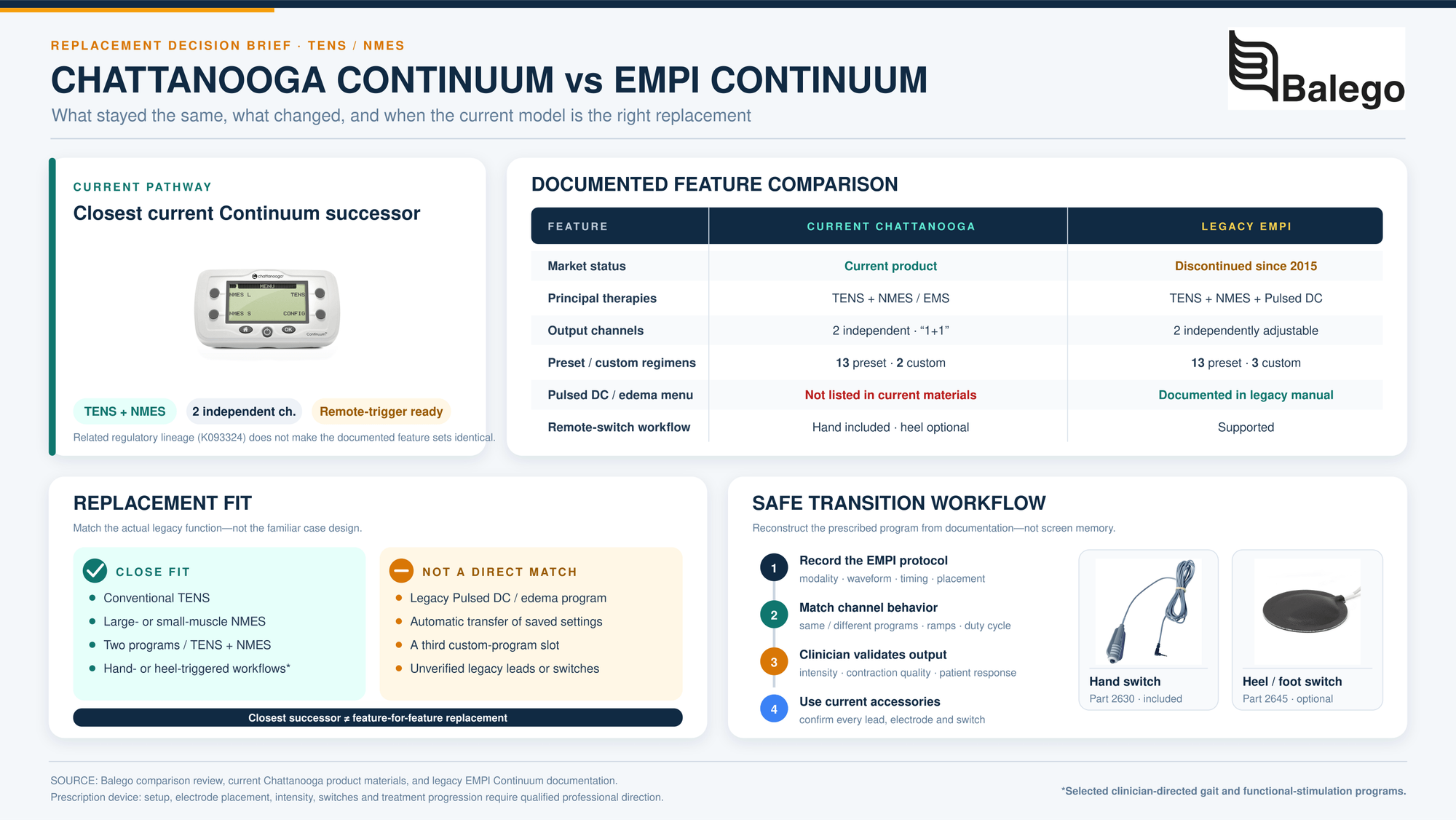
The current Chattanooga Continuum TENS/NMES Stimulator is the closest current continuation of the EMPI Continuum for TENS, NMES, independent dual-channel stimulation and switch-triggered rehabilitation. It is not, however, a complete feature-for-feature replacement for the legacy model’s Pulsed DC and edema programs.
The similarities are substantial. Both devices use a compact two-channel format, provide programmable TENS and NMES, support clinician lockouts, and can coordinate stimulation with a handheld or shoe-mounted switch. The important differences involve the available therapy menus, number of custom programs, included accessories, and current manufacturer support.
Quick comparison
| Question | Practical answer |
|---|---|
| Is the Chattanooga Continuum simply the EMPI unit with a new logo? | No. The products share a closely related platform and regulatory lineage, but their currently documented therapy menus are not identical. |
| Is Chattanooga the closest current EMPI Continuum replacement? | Yes, when the required functions are TENS, NMES, independent channels, or remote-triggered muscle stimulation. |
| Does the current Chattanooga model include pulsed DC or an edema menu? | Current Chattanooga product materials describe TENS and NMES, not the separate pulsed DC therapy family documented in the EMPI manual. |
| Do both have two independent channels? | Yes. The current model calls this its “1+1” function. |
| Can the channels run different programs? | Yes, the current Chattanooga model can run the same program or two different programs at the same time. |
| How many programs are included? | The current Chattanooga materials list 13 preset and two custom regimens. The legacy EMPI manual lists 13 preset and three custom regimens. |
| Do both support remote switches? | Yes. The current kit includes a hand switch, and a heel/foot switch is available separately. |
| Can old EMPI accessories automatically be transferred? | Do not assume compatibility. Verify every lead wire and switch by connector, part number, and manufacturer guidance. |
| Is the current model prescription-only? | Yes. It is intended for clinician-directed treatment and properly instructed home use. |
The current Chattanooga product sheet confirms two independently managed channels, 13 preset regimens, two custom regimens, an included hand switch, and an optional heel switch. The EMPI manual documents the broader TENS, NMES, and pulsed DC configuration with three custom regimens.
Chattanooga Continuum vs. EMPI Continuum specifications
| Feature | Current Chattanooga Continuum | Legacy EMPI Continuum |
|---|---|---|
| Market status | Current Chattanooga product | Discontinued EMPI product |
| Principal therapies | TENS and NMES/EMS | TENS, NMES, and Pulsed DC |
| Output channels | Two independent channels | Two independently adjustable channels |
| Different programs at the same time | Yes, described as 1+1 operation | Independent channel and cycling controls documented |
| Preset regimens | 13 | 13 |
| Custom regimens | Two in current product materials | Three in the EMPI manual |
| Biphasic waveform choices | Symmetrical and asymmetrical | Symmetrical and asymmetrical |
| Pulsed DC or edema therapy | Not listed in current Chattanooga product materials | Included |
| Hand-switch operation | Yes, a switch is included with the current kit | Supported |
| Heel/foot-switch operation | Optional part 2645 | Supported for gait-oriented applications |
| Clinician programming | Yes | Yes |
| Patient lockout | Yes | Yes |
| Compliance information | Documented | Documented |
| Power | Two AA batteries | AA alkaline or compatible rechargeable batteries |
| Portability | Belt clip, kickstand and transport pouch | Belt clip, kickstand and carrying case documented |
| U.S. regulatory lineage | FDA listing associates the current Chattanooga names with K093324 | Originally cleared as EMPI Continuum under K093324 |
EMPI stopped accepting new prescriptions in November 2015, and its last date for direct product purchases was December 16, 2015. Chattanooga remains an active Enovis rehabilitation brand, and the current Continuum remains available through Balego.
What stayed the same?
A portable rehabilitation-first design
Both generations were designed to move between a professional treatment environment and a properly supervised home program. They are more clinically configurable than a basic consumer TENS unit but substantially more portable than a full-sized electrotherapy console.
The shared physical concept includes:
- Two output channels
- A central LCD interface
- Separate channel-intensity controls
- A belt clip
- A pull-out kickstand
- AA-battery operation
- An external remote-switch connection
The current Chattanooga unit measures approximately 1.26 × 3.3 × 4.5 inches and weighs about 226.8 grams with batteries installed.
TENS and NMES remain the core functions
Both units provide TENS for clinician-directed symptomatic pain management programs and NMES for applications requiring a controlled muscle contraction.
This article does not need to repeat a full explanation of the two modalities. Readers who need that background can review TENS vs. NMES: Differences, Uses, and Device Selection.
The important replacement question is whether an existing EMPI program relies primarily on:
- Sensory-level TENS,
- Motor-level NMES, or
- The separate pulsed DC function.
The Chattanooga Continuum is a close match for the first two. The third requires additional review.
Independent channel control
Chattanooga describes the current device as having 1+1 functionality. Its two channels can run the same program or different programs simultaneously.
That permits setups such as the following:
| Channel arrangement | Possible rehabilitation workflow |
|---|---|
| Same NMES program on both channels | Bilateral muscles or broader coverage of one muscle group |
| Different NMES programs | Two muscles requiring different contraction timing |
| Same TENS program | Four-electrode coverage around a larger region |
| Different TENS programs | Two painful regions requiring different sensory patterns |
| TENS on one channel and NMES on the other | Pain-focused stimulation alongside muscle activation |
| One active channel | A focused two-electrode setup |
Clinician programming and lockout
Both devices allow a clinician to establish treatment parameters and then restrict the patient’s ability to change them.
This is important when replacing an EMPI unit used at home. The patient may remember only the program name and intensity—not the pulse rate, phase duration, work-rest cycle, ramps, or channel pattern that the clinician originally programmed.
A replacement unit should therefore be configured from the treatment order or clinical record rather than by attempting to reproduce the old screen from memory.
The detailed operating sequence is covered separately in our Chattanooga Continuum User Guide.
Remote-triggered stimulation
Both generations were designed to coordinate stimulation with movement and functional activity.
The current 2600-KIT includes the Chattanooga Continuum Hand Switch. It allows the clinician or patient to trigger a programmed contraction without reaching for the main device.
The optional Continuum Heel/Foot Switch is positioned in the shoe and can provide a step-related trigger during selected clinician-directed gait programs. The presence of the switch does not by itself establish that the device is appropriate for a particular case of foot drop or neurological weakness. Patient selection, electrode placement, timing, fall risk, and gait mechanics require professional assessment.
What changed?
EMPI is now a legacy brand
The most obvious change is not electrical—it is commercial.
EMPI’s prescription-device business was exited in 2015. That affects the availability of:
- Factory service
- Warranty support
- Original replacement accessories
- Current training resources
- Confirmed software revisions
- Newly manufactured EMPI-branded units
Used EMPI devices may still function, but age, battery leakage, worn switches, damaged ports, and unavailable service can make continued reliance on one impractical.
The Chattanooga model provides a current product pathway with presently available documentation and accessories.
The separate Pulsed DC menu is no longer documented
The legacy EMPI Continuum offered three therapy families:
- NMES
- TENS
- Pulsed DC Current, also described as pulsed galvanic stimulation
The EMPI manual includes acute and chronic pulsed DC regimens associated with edema and local circulation applications. The current Chattanooga product sheet, by comparison, identifies the device as a TENS and NMES stimulator and does not list a separate pulsed DC or edema menu.
This is the most important limitation for a buyer seeking a direct replacement.
A current Chattanooga Continuum should not be represented as preserving the EMPI edema function unless that capability is expressly confirmed on the specific device, software version, and current labeling.
The number of custom programs changed
The legacy EMPI manual lists 13 preprogrammed and three custom regimens across NMES, TENS, and pulsed DC.
The current Chattanooga product materials list 13 preprogrammed and two custom regimens for NMES and TENS.
The current kit has a different documented packing list
The current Chattanooga 2600-KIT officially lists the following:
| Included component | Chattanooga part number |
|---|---|
| Continuum device | 2600-DEV |
| Set of two pin cables | 2615 |
| User manual and practical guide | 13-00183 |
| Transportation pouch | 2049 |
| Hand switch | 2630 |
The heel/foot switch, part 2645, is optional and sold separately.
Legacy EMPI kits were documented with different possible combinations of electrodes, touchproof lead wires, a carrying case, batteries, and a battery charger. An old EMPI packing list should not be used to determine what comes with a new Chattanooga kit.
The devices share an FDA lineage—but that does not make them identical
The original EMPI Continuum received FDA 510(k) clearance under K093324 in March 2010.
The FDA’s current device-listing database associates the proprietary names “Chattanooga Continuum” and “Chattanooga Continuum KIT” with that same premarket submission.
That connection supports the conclusion that the products share a regulatory and technological lineage. It does not prove that every menu, accessory, software revision, or marketed therapy option remained unchanged.
This distinction should be stated clearly:
The Chattanooga Continuum is a current continuation of the underlying Continuum platform, but buyers must compare current labeling and specifications rather than assuming that every legacy EMPI feature carried forward.
Is Chattanooga a direct replacement for your EMPI Continuum?
The answer depends on which EMPI capability is actually being used.
| Existing EMPI use | Replacement fit | What to verify |
|---|---|---|
| Conventional TENS | Close fit | Recreate the prescribed program and electrode placement |
| Large-muscle NMES | Close fit | Frequency, phase duration, work-rest cycle, ramp and intensity |
| Small-muscle NMES | Close fit | Electrode size, placement and contraction quality |
| Two independent programs | Close fit | Confirm the required programs are available in the current menu |
| TENS and NMES at the same time | Close fit | Have a clinician program the two channels |
| Hand-triggered contractions | Close fit | Use the included current hand switch and a compatible custom program |
| Heel-switch gait training | Close fit in selected cases | Use current part 2645 and repeat the gait assessment and setup |
| Compliance tracking | Generally comparable | Confirm the specific information recorded by the supplied software |
| Legacy edema or Pulsed DC program | Not a direct match | Select a current professional system with the required labeled waveform |
| A saved custom EMPI protocol | Requires reprogramming | Reconstruct it from clinical documentation rather than memory |
| Unsupported or damaged legacy accessories | Replace | Order accessories identified for the current Chattanooga model |
Can EMPI electrodes, leads, and switches be reused?
Similarity of appearance is not enough to establish electrical compatibility.
Electrodes
The current Chattanooga kit uses pin-style electrode cables. An existing self-adhesive electrode may be usable when:
- Its connector accepts the current electrode pin.
- The electrode is large enough for the intended output.
- Its gel is intact and adheres completely.
- It is intended for the same patient.
- It is compatible with the prescribed stimulation.
Our reusable TENS, NMES, and FES electrodes include several shapes and sizes. The Continuum manual uses a minimum active area of 16 cm² for routine stimulation and gives a roughly 2 × 2-inch pad as an example. Smaller electrodes can create a more concentrated sensation and should not be substituted without professional direction.
Lead wires
Do not assume an old EMPI lead wire is safe for the Chattanooga device solely because it fits into the port.
Verify:
- Device-side connector shape
- Electrode-side connector
- Touchproof construction
- Manufacturer part number
- Insulation condition
- Absence of exposed conductors
- Intended device compatibility
The current kit is documented with the Chattanooga cable set 2615. Replacing uncertain legacy wires is safer than continuing to use a cable with intermittent output or damaged insulation.
Hand and heel switches
The legacy EMPI and current Chattanooga devices both support remote-switch workflows, but that does not guarantee that every old switch revision is interchangeable.
The most dependable approach is to use the following:
- Current hand switch part 2630
- Current heel/foot switch part 2645
The clinician should also confirm that the selected custom program is configured to respond to the switch correctly.
Batteries and chargers
Both generations operate on AA batteries. The current Chattanooga materials describe two standard AA batteries, while the full operating guidance permits suitable alkaline or rechargeable NiMH cells.
An old EMPI charger should not be connected to the Chattanooga unit. Rechargeable AA batteries should be removed and charged only in a compatible external charger intended for that battery type.
Which current device best replaces an EMPI Continuum?
The Chattanooga Continuum is the most direct choice for most legacy Continuum workflows, but not every EMPI owner needs the same replacement.
| Current product | Best replacement role | Important limitation |
|---|---|---|
| Chattanooga Continuum | Closest match for portable TENS, NMES, independent channels and switch-triggered rehabilitation | No separate Pulsed DC menu in current product materials |
| Primera TENS/NMES with HAN Waveform | Portable TENS/NMES option for users prioritizing multiple preset programs | Not positioned as the direct remote-switch and gait-training successor |
| Chattanooga Intelect NMES Digital | Dedicated, adjustable portable NMES | Does not replace the EMPI TENS or Pulsed DC functions |
| Balego EMS Digital NMES Stimulator | Economical, manually adjustable muscle-stimulation programs | NMES-focused rather than a full Continuum replacement |
| Intelect Legend 2 | Professional clinic needing high voltage, direct current, and a broader waveform library | Clinical console rather than a wearable home-program device |
The Intelect Legend 2 includes high voltage and direct current among its 12 electrotherapy wave forms. Those options should not automatically be treated as identical to the old EMPI Pulsed DC programs. A qualified clinician must match the waveform and labeled application to the intended treatment.
Who should choose the current Chattanooga Continuum?
The current model is the strongest fit when the treatment plan requires the following:
- A portable prescription TENS and NMES system
- Two independently controlled channels
- Different programs on the two channels
- Clinician programming and patient lockout
- Hand-triggered contractions during exercise
- Optional heel-switch activation for selected gait programs
- Replaceable AA batteries
- A current product with available documentation and accessories
It is a weaker replacement when the original program specifically depends on the following:
- EMPI Pulsed DC or edema settings
- A third custom-program slot
- An undocumented proprietary EMPI accessory
- A legacy protocol for which the original parameters cannot be recovered
- Unsupervised patient programming
Frequently asked questions
Is the EMPI Continuum discontinued?
Yes. Enovis states that EMPI stopped accepting new product prescriptions in November 2015 and ended direct EMPI product sales in December 2015.
Is Chattanooga Continuum the replacement for EMPI Continuum?
It is the closest current replacement for the legacy device’s TENS, NMES, independent-channel, and remote-switch workflows. It is not a complete replacement for the separate pulsed DC therapy family.
Are the Chattanooga and EMPI Continuum the same device?
They share a closely related design and FDA clearance lineage, but their current documented feature sets differ. They should be described as related generations of the Continuum platform rather than identical products.
Does the Chattanooga Continuum have an edema program?
The current Chattanooga product sheet lists TENS and NMES and does not identify the separate pulsed DC or edema menu found in the legacy EMPI manual.
Why did the number of custom programs change?
The EMPI manual lists three custom regimens across TENS, NMES, and pulsed DC. Current Chattanooga materials list two custom regimens for TENS and NMES. The removal of the separately marketed Pulsed DC therapy family accompanies the lower current custom-program count, although buyers should rely on the supplied unit’s current documentation rather than assuming the reason for a particular software revision.
Can an EMPI program be copied into a Chattanooga Continuum?
There is no documented automatic transfer process. A clinician must recreate the program using the treatment record, including modality, waveform, frequency, phase duration, channel pattern, ramps, contraction time, and rest time.
Will old EMPI electrodes work?
Some standard pin-compatible electrodes may work with the current Chattanooga lead wires, but connector fit, pad area, gel condition, and intended application must all be confirmed.
Will the old EMPI hand switch or foot switch work?
Compatibility should not be assumed. Use a switch identified for the current Chattanooga Continuum or obtain written compatibility confirmation before connecting a legacy accessory.
Can the current Continuum be used for gait training?
The optional heel/foot switch supports selected clinician-directed gait and functional-stimulation programs. It does not make the device an automatic or universally appropriate treatment for foot drop.
Does the Chattanooga Continuum require a prescription?
Yes. It is a prescription electrotherapy device intended for professional selection and programming. A patient may use it at home after receiving appropriate instructions.
Final recommendation
For a clinic or patient replacing an EMPI Continuum used primarily for TENS, NMES, or switch-coordinated exercise, the current Chattanooga Continuum kit preserves the most important parts of the original rehabilitation workflow.
The replacement should not be treated as a simple equipment swap. Before retiring the EMPI unit, record the active programs, channel arrangement, pulse settings, timing, electrode locations, and switch behavior. A clinician can then determine what can be reproduced on the Chattanooga model and whether a separate clinical system is needed for any legacy pulsed DC application.
Medical-device notice: The Chattanooga Continuum is a prescription device. Program selection, electrode placement, stimulation intensity, remote-switch setup and treatment progression should be established by a qualified healthcare professional using the current manufacturer instructions. This comparison is educational and does not replace the device manual, prescription or individual clinical assessment.


