



Prescription, Assignment of Benefits and Letter of Medical Necessity for DME
Ordering a rehabilitation device may involve several forms, but those documents do not serve the same purpose.
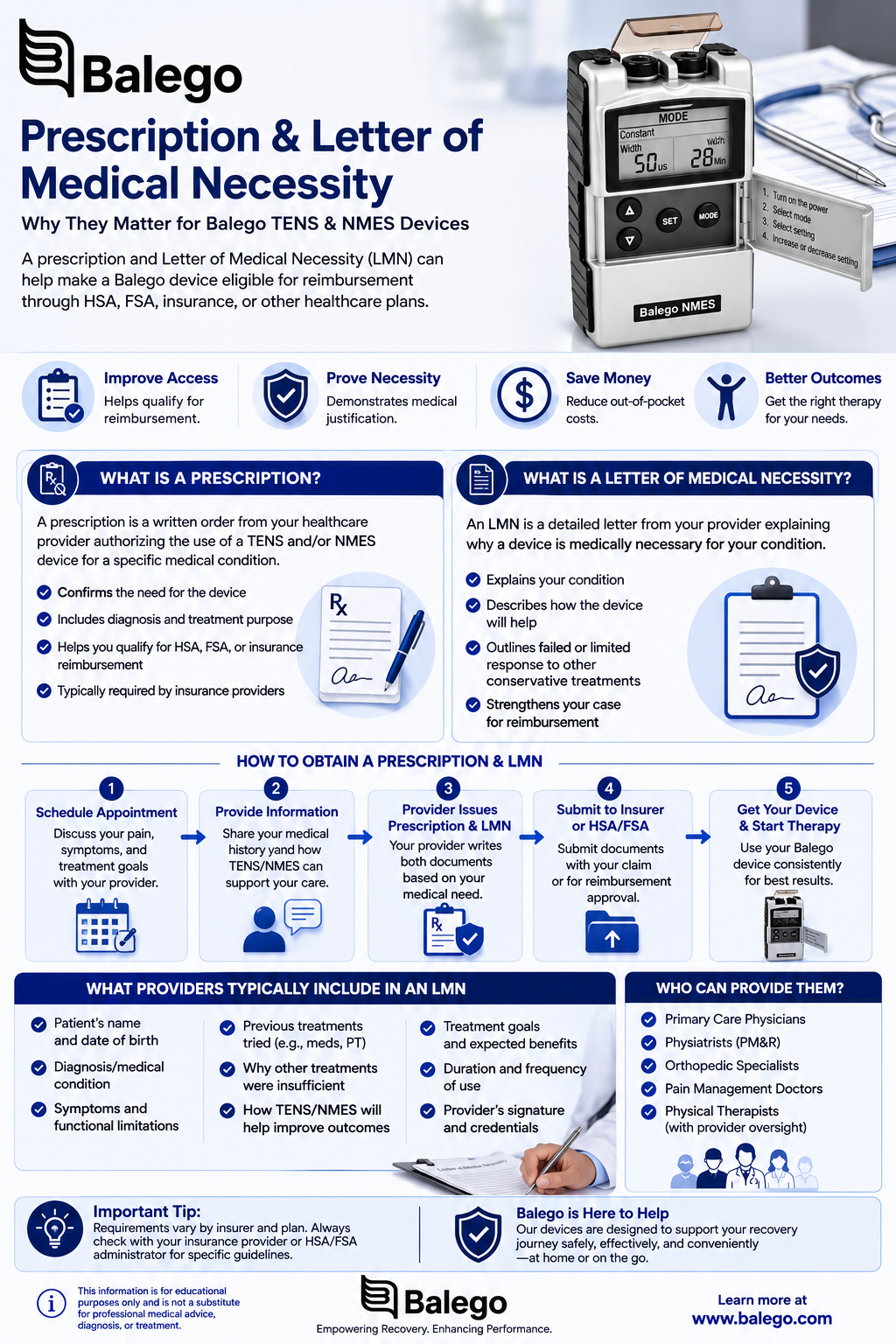
A prescription or Standard Written Order identifies what the practitioner ordered. The medical record supports why the item is needed. A letter of medical necessity can summarize the clinical rationale. An assignment of benefits may allow an insurer to pay the supplier directly. Proof of delivery documents show that the patient received the item. An Advance Beneficiary Notice addresses expected noncoverage by Original Medicare in specific circumstances.
Completing one document does not automatically satisfy the requirements of the others, and none of these forms guarantees insurance payment.
Documentation notice: This guide is educational and is not legal, billing, or payer-specific advice. Suppliers and healthcare providers should verify current requirements with the applicable payer, DME Medicare Administrative Contractor, accrediting body, compliance adviser, and legal counsel.
For help choosing between sensory-level TENS and contraction-based NMES, read our TENS vs. NMES device guide.
DME documentation forms compared
| Document | Primary purpose | Usually completed or signed by | What it does not prove |
|---|---|---|---|
| Prescription or Standard Written Order | Identifies the item being ordered | Treating practitioner | That coverage criteria are met |
| Medical record | Documents the patient-specific condition, evaluation and treatment plan | Treating healthcare professionals | That the supplier delivered the item |
| Letter of Medical Necessity | Summarizes why a particular item is requested | Treating practitioner | Coverage by itself |
| Assignment of Benefits | Requests direct insurer payment to the supplier when permitted | Patient or authorized representative | Eligibility, coverage or payment amount |
| Release of Information | Permits or acknowledges certain information disclosures | Patient or authorized representative when required | Assignment of insurance benefits |
| Prior authorization request | Requests payer review before dispensing or billing | Supplier and treating practitioner | Final payment after delivery |
| Advance Beneficiary Notice | Notifies an Original Medicare beneficiary of expected noncoverage | Supplier/provider and beneficiary | Coverage by another insurance plan |
| Proof of Delivery | Documents that the item was delivered | Recipient/designee or delivery carrier records | Medical necessity |
| Claim form | Requests payer adjudication and payment | Supplier or provider | That the claim will be approved |
CMS requires a written order, supporting medical-record information, correct coding, and proof of delivery for Medicare DMEPOS claims. The exact additional requirements depend on the item and applicable policy. Centers for Medicare & Medicaid Services
1. Prescription or Standard Written Order
For Medicare DMEPOS claims, the prescription is generally called a Standard Written Order, or SWO.
Required Medicare SWO elements
| Required element | Example |
|---|---|
| Beneficiary name or Medicare Beneficiary Identifier | Jane Doe or the patient’s MBI |
| Description of the item | Dual-channel neuromuscular electrical stimulator |
| Quantity, when applicable | One device; four electrodes |
| Order date | July 24, 2026 |
| Treating a practitioner's name or NPI | Practitioner name and NPI |
| Treating the practitioner's signature | Valid handwritten or electronic signature |
CMS requires the completed order to reach the supplier before the supplier submits a Medicare claim. Certain products appearing on the current face-to-face and written-order-prior-to-delivery list require the order before delivery rather than merely before claim submission. Centers for Medicare & Medicaid Services
Useful supplemental fields
Depending on the item and payer, the order may also contain:
| Supplemental field | Why it may be useful |
|---|---|
| Diagnosis and ICD-10-CM code | Helps identify the condition associated with the order |
| Manufacturer and model | Reduces ambiguity about the item |
| HCPCS code | Supports supplier processing when correctly selected |
| Accessories and supplies | Identifies leads, electrodes or other ordered components |
| Frequency or schedule | May be relevant to the treatment plan |
| Length of need | May be requested by a payer or supplier |
| Laterality or treatment region | Clarifies the clinical application |
| Clinical goal | Distinguishes pain modulation from muscle activation |
| Special settings | Relevant when the practitioner is specifying a particular program |
| Supporting records requested | Helps coordinate chart-note submission |
These supplemental fields do not replace the practitioner’s underlying medical record.
Signature correction
The current form says “Prescriber Signature (handwritten).” Medicare permits an acceptable handwritten or electronic signature. Signature and date stamps are generally not accepted, subject to limited exceptions described by CMS.
Recommended wording:
Treating practitioner signature: Handwritten or compliant electronic signature. Signature and date stamps are generally not accepted for Medicare documentation.
2. Medical records and letters of medical necessity
The medical record should establish the clinical facts supporting the order. Depending on the item, that may include the following:
- Diagnosis and relevant history
- Objective examination findings
- Functional limitations
- Prior and current treatment
- Why the requested item is appropriate
- Why a less complex alternative is insufficient
- Expected treatment goal
- Patient ability or caregiver support for using the equipment
- Continued need and continued use when applicable
A letter of medical necessity can provide a concise summary, particularly for a prior-authorization request or appeal. It should be individualized to the patient and should not consist solely of copied coverage-policy language.
Important Medicare limitation
A supplier-produced form or letter of medical necessity—even when signed by the ordering practitioner—is not considered a substitute for the practitioner’s medical record for Medicare payment purposes. The information must be supported by contemporaneous chart documentation.
CMS also discontinued its former Certificates of Medical Necessity and DME Information Forms for claims with dates of service on or after January 1, 2023. Medical necessity is now supported through the order, claim information, applicable policy requirements, and medical record rather than the discontinued CMN/DIF process.
Letter-of-medical-necessity outline
| Section | Information to include |
|---|---|
| Patient identification | Name, date of birth and payer/member information |
| Treating practitioner | Name, credentials, NPI, and contact information |
| Diagnosis | Relevant diagnosis and current clinical status |
| Functional limitation | What the patient cannot do or does only with difficulty |
| Objective findings | Strength, atrophy, range, pain interference or other findings |
| Prior treatment | Relevant therapy, medication, surgery, exercise or other interventions |
| Requested item | Exact device, model, modality and necessary accessories |
| Clinical rationale | Why this item is appropriate for this patient |
| Alternative considered | Why a simpler or different option is insufficient |
| Treatment plan | How the item will be integrated into rehabilitation |
| Expected outcome | A measurable clinical or functional objective |
| Length of need | Estimated duration when relevant |
| Supporting documents | Notes, evaluation, operative report or plan of care |
| Certification | Practitioner signature and date |
Sample LMN narrative
Re: [Patient name and date of birth]
The patient has been evaluated for [diagnosis], which currently results in [specific impairment and functional limitation]. Objective findings include [patient-specific findings].
The requested [exact device and model] is medically appropriate because [explain the relationship between the device, impairment and rehabilitation goal]. The device will be used as part of the patient’s plan of care to support [measurable treatment objective].
Prior or alternative interventions have included [relevant interventions]. These have been insufficient because [patient-specific explanation].
The anticipated length of need is [duration]. Supporting medical-record documentation is attached.
Treating practitioner name, NPI, signature and date
Avoid generic statements such as “the device is medically necessary” without explaining the patient’s diagnosis, findings, functional limitation, and expected benefit.
3. Assignment of Benefits
An assignment of benefits, commonly abbreviated AOB, asks the insurer to direct covered payment to the supplier or provider when the plan and applicable law allow it.
For Medicare, accepting assignment generally means that the participating provider or supplier accepts the Medicare-allowed amount as payment in full, apart from applicable deductible and coinsurance obligations.
An AOB does not:
- Confirm that the patient is eligible
- Establish medical necessity
- Guarantee prior authorization
- Guarantee that the item is covered
- Guarantee payment to the supplier
- Override plan exclusions
- Replace an ABN
- Create proof of delivery
- Permit charges prohibited by the payer contract or law
Recommended AOB concept
To the extent permitted by my health plan and applicable law, I request that benefits payable for covered items be paid directly to the supplier. I authorize the supplier to submit claims on my behalf. I understand that assignment of benefits does not guarantee coverage or payment and that I may remain responsible for applicable deductibles, coinsurance, copayments, and valid noncovered charges after any notice required by law or payer policy.
Avoid stating that the patient is responsible for “all balances not paid by insurance” without accounting for:
- Contractual adjustments
- Medicare assignment rules
- Balance-billing restrictions
- Valid ABN requirements
- State law
- Medicaid restrictions
- Workers’ compensation or auto-insurance rules
4. Assignment of Benefits vs. release of information
An assignment of benefits concerns where payment is directed. A release or authorization concerns how information may be shared.
HIPAA generally permits covered entities to use or disclose protected health information for treatment, payment, and healthcare operations without obtaining a separate authorization for every routine transaction. Broader disclosures may require a valid authorization or another applicable legal basis.
For that reason, avoid presenting one broad paragraph as though it were simultaneously
- A legally complete AOB
- A HIPAA authorization
- A notice-of-privacy-practices acknowledgment
- A release of medical records
- A financial-responsibility agreement
A safer form structure is
| Section | Separate acknowledgment |
|---|---|
| Assignment of benefits | Direct-payment request |
| Claim-processing disclosure | Information needed for eligibility, medical necessity and payment |
| Privacy notice | Acknowledgment that the notice was provided |
| Broader authorization | Separate form when required |
| Financial responsibility | Cost-sharing and valid noncovered-charge terms |
The exact wording should reflect Balego’s role in the transaction, its HIPAA status, payer contracts, and state law.
5. Proof of delivery
Proof of delivery, or POD, documents that the beneficiary actually received the ordered DMEPOS item.
CMS recognizes three general delivery methods:
- Direct delivery by the supplier
- Delivery through a shipping or mail-order service
- Delivery to a nursing facility on behalf of the beneficiary
The documentation requirements vary with the delivery method.
Direct supplier delivery
The delivery record should ordinarily identify:
- Beneficiary
- Delivery address
- Item and quantity
- Date delivered
- Recipient or authorized designee
- Recipient/designee signature
- Serial number when relevant
Commercial shipping or mail order
Carrier and shipping records may be used to establish shipment or delivery according to Medicare’s applicable requirements. A patient should not be asked to sign a proof-of-delivery statement before the package has actually been delivered. Centers for Medicare & Medicaid Services
Retention
Medicare suppliers must retain proof-of-delivery documentation for seven years from the date of service. Centers for Medicare & Medicaid Services
Direct delivery: Recipient or authorized designee signs and dates after receiving the item. Commercial shipping: Retain the shipping-service documentation required by the applicable payer. Do not pre-sign proof of delivery.
The AOB may be signed before the item is supplied. The POD should document the later delivery event.
6. Advance Beneficiary Notice of Noncoverage
A generic financial-responsibility clause is not a substitute for the Medicare Advance Beneficiary Notice of Noncoverage, Form CMS-R-131.
Providers and suppliers use the official ABN for Original Medicare beneficiaries when Medicare payment is expected to be denied in situations where advance notice is required to shift potential financial liability to the beneficiary. Centers for Medicare & Medicaid Services
| Document | Purpose |
|---|---|
| Assignment of Benefits | Requests direct insurer payment |
| Financial-responsibility agreement | Explains applicable patient charges |
| ABN CMS-R-131 | Gives advance notice of expected Original Medicare noncoverage |
| Explanation of Benefits | Reports the payer’s claim decision after processing |
When an Original Medicare ABN is required, use the current official CMS-R-131 form and instructions. Commercial plans, Medicare Advantage plans, Medicaid programs, workers’ compensation carriers, and auto insurers may use different notices.
CMS updated its ABN page and forms in July 2026, reinforcing the importance of linking users to the current official version rather than embedding a potentially outdated facsimile. Centers for Medicare & Medicaid Services
7. Face-to-face, prior authorization, and order-before-delivery rules
Not every DMEPOS item is subject to the same pre-delivery requirements.
All Medicare DMEPOS claims require a written order, but only products placed on the applicable required list need both a qualifying face-to-face encounter and a written order prior to delivery as a condition of payment. Other items generally require the order before claim submission. Centers for Medicare & Medicaid Services
As of April 13, 2026, CMS reports 83 items on its face-to-face encounter and written-order-prior-to-delivery list. The list changes over time and should be checked before dispensing an item. Centers for Medicare & Medicaid Services
Before supplying equipment, verify:
| Verification | Question |
|---|---|
| Benefit eligibility | Is the patient currently enrolled? |
| Supplier status | May the supplier bill this plan for the item? |
| Item coverage | Is the device included in the benefit? |
| Diagnosis criteria | Does the patient meet the current policy? |
| Face-to-face requirement | Is a qualifying encounter required? |
| WOPD requirement | Must the order be received before delivery? |
| Prior authorization | Must approval be obtained first? |
| Rental or purchase | How does the plan classify the item? |
| Trial requirement | Is a monitored trial required? |
| Network rule | Must a contracted supplier be used? |
| Cost sharing | What deductible or coinsurance applies? |
| Documentation | Which chart notes and tests are required? |
A benefits inquiry or prior-authorization approval still may not guarantee final payment if claim, coding, eligibility, delivery, or documentation requirements are not met.
TENS and NMES coverage documentation
TENS and NMES may look similar, but their clinical purposes and coverage criteria differ. Our explanation of the device distinction is in the TENS vs. NMES guide.
| Topic | TENS | NMES |
|---|---|---|
| Principal response | Sensory stimulation | Muscle contraction |
| Common purpose | Temporary pain modulation | Muscle activation and neuromuscular rehabilitation |
| Medicare policy focus | Selected acute postoperative or chronic intractable pain criteria | Selected disuse-atrophy and narrowly defined FES uses |
| Important documentation | Pain condition, duration, prior treatment and trial response | Atrophy, intact nerve supply, cause of disuse and rehabilitation plan |
| Coverage assumption | Should not be assumed from a prescription alone | Should not be assumed from a diagnosis of weakness alone |
Medicare TENS considerations
The current Medicare TENS LCD describes coverage for the following:
- Acute postoperative pain, generally limited to a 30-day rental period
- Certain chronic intractable pain other than chronic low-back pain
- A monitored trial period for qualifying chronic pain before purchase coverage
The same LCD excludes or limits various pain presentations and requires the ordering practitioner to be treating the condition supporting the request. Centers for Medicare & Medicaid Services
Medicare’s national chronic-low-back-pain policy restricted TENS coverage to approved clinical studies during a defined coverage-with-evidence-development period. Routine Medicare coverage for chronic low-back pain should therefore not be assumed. Centers for Medicare & Medicaid Services
Medicare NMES considerations
Medicare’s national NMES policy limits coverage for muscle atrophy to disuse atrophy, where the nerve supply to the muscle remains intact. Examples include selected cases involving casting or splinting, scar-related contracture, and recovery after hip replacement until orthotic training begins. Centers for Medicare & Medicaid Services
The current page’s supplemental questions are concerning:
- Disuse atrophy
- Intact nerve supply
- Muscles and nerves being stimulated
- Surgery
- Rehabilitation plan
are therefore useful for a Medicare-focused NMES request. However, the questions should appear in a separate payer-specific NMES supplement, not as universal requirements for every prescription.
A clinician may use NMES for other medically appropriate purposes, but a valid clinical use does not automatically mean that a particular payer covers a home device.
For a more detailed explanation, link to our NMES billing and documentation guide.
Recommended TENS/NMES order fields
| Field | TENS order | NMES order |
|---|---|---|
| Exact device description | Yes | Yes |
| Quantity | Yes | Yes |
| Diagnosis | Yes | Yes |
| Treatment region | Useful | Useful |
| Pain duration and cause | Important | Usually secondary |
| Prior pain-treatment trial | Often important | Payer-dependent |
| Monitored TENS trial response | May be required | Not applicable |
| Muscle atrophy documented | Not applicable | Important for disuse-atrophy coverage |
| Cause of disuse | Not applicable | Important |
| Nerve supply intact | Not applicable | Important |
| Muscles targeted | Optional | Important |
| Rehabilitation plan | Useful | Important |
| Length of need | Payer-dependent | Payer-dependent |
| Practitioner signature/date | Required | Required |
Product type and documentation comparison
| Balego option | Primary modality | Documentation consideration |
|---|---|---|
| Balego TENS Digital Edition | OTC TENS | OTC availability does not establish insurance coverage |
| Balego EMS Digital NMES Stimulator | Dedicated NMES/EMS | Coverage requires a payer-supported indication and medical-record documentation |
| Twin Stim IV | TENS and NMES | Verify whether the payer covers the ordered modality and combination-device configuration |
| Chattanooga Continuum | Prescription TENS and NMES | Document why the prescription combination system is required |
| Primera TENS/NMES | TENS and NMES | Match the professional or OTC model to the order and treatment plan |
| Balego TENS/NMES/FES Electrodes | Replacement electrodes | Supply quantity and replacement frequency remain payer specific |
The Balego TENS is a dedicated sensory-stimulation device, while the Balego NMES is designed for motor-level stimulation and timed muscle-contraction programs. Combination devices provide both modalities but should not be assumed to fit every payer’s equipment classification.
Recommended DME documentation workflow
1. Identify the payer
Determine whether the request involves:
- Original Medicare
- Medicare Advantage
- Medicaid
- Commercial insurance
- Workers’ compensation
- Auto insurance
- Self-pay purchase
Do not apply Medicare documentation rules automatically to a commercial or workers’ compensation claim.
2. Confirm the device and treatment goal
Determine whether the request is for:
- TENS pain modulation
- NMES muscle stimulation
- A combination device
- Replacement electrodes or lead wires
- Another rehabilitation item
3. Verify benefits and supplier eligibility
Confirm coverage, network status, prior authorization, rental or purchase rules, and documentation requirements.
4. Obtain the patient-specific medical record
Collect the evaluation, relevant progress notes, operative report, plan of care, or other documentation supporting the item.
5. Obtain a complete SWO
Verify all six standard elements before claim submission and before delivery when WOPD rules apply.
6. Request an LMN when useful
Use an individualized LMN for complex cases, prior authorization, reconsideration, or appeal. Do not rely on it as the only supporting record.
7. Complete separate patient acknowledgments
Use separate or clearly identified sections for:
- Assignment of benefits
- Privacy and claim-processing disclosures
- Financial responsibility
- Privacy-notice acknowledgment
8. Issue any required advance notice
Use the official CMS-R-131 ABN for Original Medicare when applicable. Follow the appropriate payer’s process for other plans.
9. Deliver the item
Provide instructions, warranty information, safety information, contact details, and any applicable return or service policies.
10. Create proof of delivery
Document the actual delivery using the method required for direct delivery, shipping, or facility delivery.
11. Submit the claim
Use the correct item description, HCPCS code, modifiers, diagnosis information, supplier data, and ordering-practitioner information.
12. Retain and update records
Maintain the required documentation and obtain new orders or continued-need documentation when the applicable policy requires it.
Recommended printable form structure
Instead of one long form, provide four clearly labeled downloads or print sections.
Form 1: Standard Written Order
| Field |
|---|
| Beneficiary name |
| MBI or payer member ID |
| Date of birth |
| Item description |
| Manufacturer/model |
| Quantity |
| Accessories/supplies |
| Diagnosis |
| Clinical goal |
| Length of need when applicable |
| Order date |
| Treating practitioner name |
| NPI |
| Telephone/fax |
| Practitioner signature |
| Signature date |
Form 2: Letter of Medical Necessity worksheet
| Field |
|---|
| Diagnosis and date of onset |
| Functional limitation |
| Objective findings |
| Relevant treatment history |
| Requested item |
| Why the item is needed |
| Why alternatives are inadequate |
| Rehabilitation plan |
| Expected measurable benefit |
| Anticipated duration |
| Supporting records attached |
| Practitioner certification |
Form 3: Patient authorization and Assignment of Benefits
| Separate section |
|---|
| Patient and insurer identification |
| Assignment-of-benefits acknowledgment |
| Claim-submission acknowledgment |
| Financial-responsibility terms |
| Privacy-notice acknowledgment |
| Patient or representative signature |
| Representative authority and relationship |
| Date |
Form 4: Proof of Delivery
| Field |
|---|
| Beneficiary |
| Delivery address |
| Item description |
| Quantity |
| Serial number if applicable |
| Delivery method |
| Date delivered or shipped |
| Recipient/designee name |
| Recipient/designee signature for direct delivery |
| Relationship to beneficiary |
| Carrier |
| Tracking number |
| Supplier representative |
Frequently asked questions
Is a prescription the same as a letter of medical necessity?
No. A prescription identifies the item ordered. An LMN explains the patient-specific clinical rationale. Some cases need both, but an LMN does not replace a complete order.
Does an assignment of benefits guarantee insurance payment?
No. It may allow direct payment to the supplier, but the claim must still meet eligibility, coverage, coding, documentation, supplier, and delivery requirements.
Can a letter of medical necessity replace the medical record?
Not for Medicare. Supplier-generated records and letters of medical necessity must match the treating practitioner’s medical record.
Does Medicare still require a Certificate of Medical Necessity?
CMS discontinued CMNs and DIFs for claims with dates of service on or after January 1, 2023. Current orders and medical-record requirements still apply.
Must the practitioner sign by hand?
No. A valid electronic signature may be acceptable. Signature and date stamps are generally not accepted for Medicare documentation.
Is “99 months” always the correct length of need?
No. Do not present “99” as a universal rule. Length-of-need fields and coding conventions depend on the payer, item, claim system, and clinical circumstances.
Is the patient’s Social Security number required?
Avoid collecting an SSN on a general public form unless the specific payer or law demonstrably requires it. Use an MBI, member ID, or claim number whenever appropriate.
Is a patient signature always required for shipped home deliveries?
Not necessarily. Direct delivery and delivery through a commercial shipping service have different proof-of-delivery requirements. Shipping and tracking documentation may support mailed delivery.
Can the patient sign proof of delivery before the item ships?
No. Proof of delivery is intended to document that delivery has occurred.
Is an AOB the same as a HIPAA authorization?
No. An AOB concerns payment direction. A HIPAA authorization concerns the use or disclosure of health information when an authorization is required.
Does the patient-responsibility clause replace a Medicare ABN?
No. When a valid ABN is required, the supplier must use the current official CMS-R-131 process.
Is a prescribed device automatically covered?
No. A valid prescription establishes the practitioner’s order but does not establish payer coverage.
Is an over-the-counter device ineligible for reimbursement?
OTC availability alone does not determine benefit coverage. The actual payer policy, item classification, diagnosis, supplier status, and supporting records for claim adjudication.
Will Medicare cover any NMES unit prescribed for weakness?
No. Medicare’s national muscle-atrophy coverage is limited to disuse atrophy with intact nerve supply, subject to the complete applicable requirements.
Will Medicare cover TENS for chronic low-back pain?
Routine coverage should not be assumed. Medicare’s national policy restricted that indication to qualifying approved research studies during a defined period.
Can Balego guarantee insurance reimbursement?
No supplier can guarantee a payer’s final adjudication. We can provide product specifications, manuals, invoices, and product-selection support through the Balego contact page.
:root { --ink: #111; --muted: #555; --line: #cfcfcf; --bg: #fff; --pad: 14px; --radius: 10px; --gap: 12px; --font: ui-sans-serif, system-ui, -apple-system, Segoe UI, Roboto, Helvetica, Arial, "Apple Color Emoji","Segoe UI Emoji"; } * { box-sizing: border-box; } body { margin: 0; background: #f6f6f6; color: var(--ink); font-family: var(--font); line-height: 1.25; -webkit-print-color-adjust: exact; print-color-adjust: exact; } .page { max-width: 980px; margin: 18px auto; background: var(--bg); padding: 22px; border: 1px solid #e6e6e6; border-radius: var(--radius); } header h1 { margin: 0 0 6px 0; font-size: 22px; letter-spacing: .2px; } header .subtitle { color: var(--muted); font-size: 13px; margin-bottom: 14px; } .grid { display: grid; gap: var(--gap); } .grid.two { grid-template-columns: 1fr 1fr; } .grid.three { grid-template-columns: 1fr 1fr 1fr; } .section { border: 1px solid #e9e9e9; border-radius: var(--radius); padding: 14px; break-inside: avoid; } .section h2 { margin: 0 0 10px 0; font-size: 16px; } .section h3 { margin: 10px 0 8px 0; font-size: 14px; } .row { display: grid; gap: 10px; } .row.two { grid-template-columns: 1fr 1fr; } .row.three { grid-template-columns: 1fr 1fr 1fr; } .field label { display: block; font-size: 12px; color: var(--muted); margin-bottom: 4px; } .line { min-height: 30px; border: 1px solid var(--line); border-radius: 8px; padding: 6px 10px; background: #fff; } .small { font-size: 12px; color: var(--muted); } .checks { display: flex; flex-wrap: wrap; gap: 10px 14px; } .check { display: inline-flex; align-items: center; gap: 8px; font-size: 13px; } .box { width: 16px; height: 16px; border: 1.6px solid #666; border-radius: 3px; display: inline-block; } .divider { height: 1px; background: #ededed; margin: 12px 0; } .notice { font-size: 12px; color: #333; background: #fafafa; border: 1px solid #ededed; border-radius: 10px; padding: 10px 12px; } .signature { display: grid; gap: 10px; grid-template-columns: 1.2fr .8fr; align-items: end; } .sigline { height: 38px; } footer { margin-top: 12px; font-size: 11px; color: var(--muted); } /* Print */ @media print { body { background: #fff; } .page { margin: 0; border: none; border-radius: 0; max-width: none; padding: 14mm; } .section { break-inside: avoid; } a { color: inherit; text-decoration: none; } }


