



TENS for Low Back Pain: Settings, Pad Placement and Safety
Transcutaneous electrical nerve stimulation, or TENS, sends pulsed electrical stimulation through reusable electrodes on the skin. Some people use it as a short-term symptom-management tool for evaluated, nonspecific, or strain-related low-back pain.
TENS may temporarily make discomfort feel more manageable, but it does not
- Heal a lumbar muscle strain
- Reverse disc degeneration
- Move a herniated disc
- Correct spinal alignment
- Treat nerve compression
- Build core strength
- Cure chronic low-back pain
- Replace exercise, activity or medical evaluation
TENS may be tried as an optional, time-limited comfort measure when it is safe, appropriately labeled and useful to the individual. It should be continued only when it produces a meaningful improvement in pain, movement or daily function.
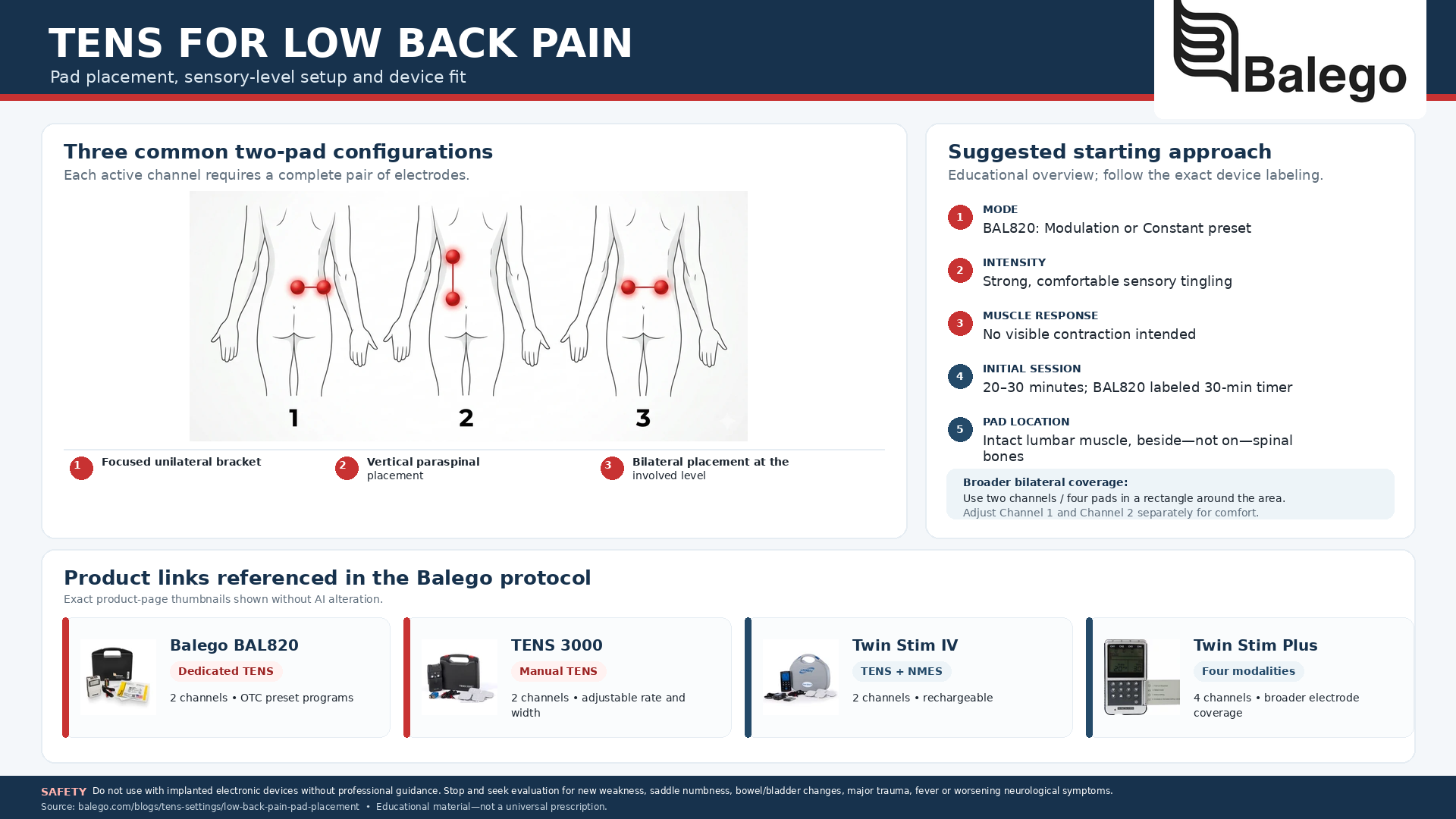
Suggested low-back TENS settings at a glance
The correct setup depends on which device is being used.
| Parameter | Balego BAL820 TENS Digital Edition | Manually adjustable prescription TENS |
|---|---|---|
| Mode | Modulation or Constant preset | Modulation or Normal/Constant |
| Pulse rate | Fixed within the selected preset | Approximately 80–100 Hz as a conservative conventional-TENS starting range |
| Pulse width | Fixed within the selected preset | Approximately 50–100 µs as a conservative sensory starting range |
| Intensity | Strong but comfortable | Strong but comfortable |
| Muscle response | No visible contraction intended | No visible contraction intended |
| Initial session | Select the labeled 30-minute timer or follow professional instructions | Approximately 20–30 minutes |
| Electrodes | Two or four | Two or four |
| Evaluation | Reassess pain, function and skin after the session | Reassess pain, function and skin after the session |
These are educational starting points—not a universal prescription or a claim that one setting has been proven superior.
Important BAL820 correction: pulse rate and width are preset
The Balego TENS Digital Edition uses preprogrammed stimulation modes. Its FDA submission describes each mode’s pulse rate, pulse width, and waveform characteristics as fixed, with intensity being the patient-adjustable output. Users should therefore select an appropriate preset and adjust the channel intensity rather than attempting to enter 100 Hz and 100 µs manually.
For the BAL820:
- Select modulation when a changing sensory pattern is preferred.
- Select "Constant" when a steady sensation is preferred.
- Choose the labeled 30-minute timer for an initial trial unless instructed otherwise.
- Increase each active channel gradually.
- Stop at a strong but comfortable tingling level.
- Do not increase output until the lumbar muscles visibly contract.
The BAL820’s OTC clearance covers temporary relief of sore and aching muscles in the lower back and extremities associated with strain from exercise or normal household and work activities. Follow the current boxed instructions and labeled indications.
When exact 100 Hz and 100 µs settings are required
A clinician who wants to manually select pulse parameters can use a device such as the TENS 3000 Analog TENS Unit.
A conservative conventional TENS starting point may include the following:
| Adjustable setting | Educational starting range |
|---|---|
| Mode | Normal or Modulation |
| Pulse rate | 80–100 Hz |
| Pulse width | 50–100 µs |
| Intensity | Strong but comfortable |
| Initial duration | 20–30 minutes |
The TENS 3000 provides separate pulse-rate, pulse-width, and channel-intensity controls. The exact values should come from the prescribing professional rather than from copying a protocol intended for another device.
For a fuller explanation of Constant, Burst, Modulation, SD1, and SD2, use TENS Modes Explained rather than duplicating the complete mode discussion here.
Who this low-back protocol is for
This guide is most relevant to an adult with previously evaluated discomfort that
- Is localized primarily to the lower-back muscles
- Feels sore, aching, tight or fatigued
- Changes with posture, activity or movement
- Is associated with ordinary exertion or a diagnosed muscular strain
- Has no progressive neurological symptoms
- Has no known serious spinal or systemic cause
- Can be monitored through reliable skin sensation
The phrase "nonspecific low-back pain" means that the symptoms have not been reliably attributed to a serious disease process or one clearly responsible structural lesion. It does not mean that the symptoms are imaginary or unimportant. The WHO defines chronic primary low-back pain as persistent or recurrent pain lasting more than three months that cannot be reliably attributed to an underlying disease or structural lesion.
“Non-discogenic” should not be used as a diagnosis selected by the customer. Disc-related, muscular, joint-related, and neurological symptoms can overlap.
Do not begin this protocol when red flags are present
Seek appropriate evaluation before using TENS when low back pain is associated with the following:
- A serious fall, collision or other significant trauma
- New urinary retention or incontinence
- Loss of bowel control
- Numbness around the saddle or groin region
- Progressive leg weakness
- Severe or increasing neurological symptoms
- Fever, recent infection or immunosuppression
- Known cancer or unexplained weight loss
- Long-term corticosteroid use or known osteoporosis after trauma
- Severe pain that is rapidly changing
- New symptoms affecting both legs
- Pregnancy without professional guidance
- Unexplained pain that is not improving
These findings may require investigation for fracture, infection, malignancy, cauda equina syndrome, or another condition that should not be treated as a routine muscle strain. The VA/DoD guideline emphasizes red-flag screening and appropriate investigation when serious neurological or systemic conditions are possible.
How strong should lower-back TENS feel?
For pain-focused TENS, intensity should generally feel:
- Strong
- Clearly noticeable
- Comfortable
- Non-painful
- Even beneath both pads
- Below the level that produces a repeated muscle contraction
It should not feel
- Sharp
- Burning
- Stabbing
- Highly concentrated beneath one corner
- Painful
- Strong enough to make the lumbar muscles repeatedly twitch
The goal differs from NMES. TENS primarily targets sensory stimulation, while NMES is intended to activate motor nerves and produce muscle contraction. Review TENS vs. NMES before substituting one modality for the other.
A sensation that fades slightly during treatment may reflect normal sensory accommodation. A small intensity adjustment may restore a strong but comfortable sensation, but output should never be increased beyond comfort.
TENS pad placement for the lower back
Place electrodes on clean, intact muscular tissue around the painful region. Do not apply them directly over broken, infected, markedly irritated or numb skin.
Each active channel requires two electrodes.
Option 1: focused unilateral bracket
Use one channel and two pads when discomfort is concentrated on one side.
| Pad | Position |
|---|---|
| Electrode 1 | Above or slightly medial to the painful muscular area |
| Electrode 2 | Below or slightly lateral to the same area |
Both pads should remain on the same general side of the lower back and bracket the symptomatic region.
Option 2: vertical paraspinal placement
Place one pad above and one below the painful level along the lumbar paraspinal muscle.
This arrangement may be useful when discomfort follows a vertical band along one side of the spine.
Avoid placing either pad directly over a prominent spinal bone.
Option 3: bilateral two-pad placement
For discomfort centered across both sides of the lower back, place one electrode on the left lumbar muscle and one on the right at the involved level.
This creates a simple single-channel arrangement across the posterior low-back region. Keep both pads on muscular tissue rather than directly over the spinous processes.
Option 4: four-pad box placement
Use two channels and four pads for broader bilateral coverage.
| Channel | Suggested placement |
|---|---|
| Channel 1 | One pad above and one below the painful region on the left |
| Channel 2 | One pad above and one below the painful region on the right |
The four electrodes form a rectangle around the symptomatic area.
This setup offers separate intensity control on each side. Channel 1 and Channel 2 do not need to display the same number because skin resistance, pad contact, and sensitivity may differ.
Option 5: larger rectangular pads
A 2 × 3.5-inch or similar rectangular electrode may cover more of the lumbar musculature than a standard square pad.
A larger pad:
- Distributes current over more skin
- May feel less concentrated
- Can cover a broader muscle area
- Must still adhere completely
- Must be compatible with the lead-wire connector
Browse Balego reusable TENS, NMES, and FES electrodes or consult the TENS Electrode Buying Guide for connector, size, and shape comparisons.
Low-back electrode size comparison
| Electrode format | Coverage | Practical use |
|---|---|---|
| 2 × 2-inch square | Focused | Standard two- or four-pad placement |
| 2-inch round | Focused with rounded edges | Curved contours where square corners may lift |
| 2 × 3.5-inch rectangle | Medium to broad | Lumbar paraspinal muscle coverage |
| 2 × 4-inch rectangle | Broad | Larger treatment region |
| 2.75-inch round | Broader rounded coverage | Wider curved surfaces |
| Back-style electrode | Very broad | Specialized compatible systems |
Do not automatically choose the smallest pad that fits. Smaller electrodes concentrate current into less surface area and may feel sharper.
Step-by-step low-back TENS setup
1. Confirm that TENS is appropriate
Review the diagnosis, contraindications, and red flags before applying the electrodes.
2. Read the exact device manual
Confirm:
- Whether the device is OTC or prescription
- Its labeled treatment areas
- Whether it uses fixed presets or adjustable parameters
- Available timers
- Contraindications
- Compatible electrode size
- Battery or charging requirements
3. Turn both channels fully down
Intensity should be at zero before connecting lead wires or applying electrodes.
4. Inspect the equipment
Check the:
- Device housing
- Battery
- Lead-wire insulation
- Connector pins
- Electrode pigtails
- Hydrogel
- Pad backing
Do not use a wire with exposed conductors or an electrode that is torn, dry, or unable to remain attached.
5. Prepare the skin
Clean and dry the treatment area. Remove:
- Lotion
- Oil
- Perspiration
- Topical analgesic gel
- Adhesive residue
- Other products that could affect adhesion
6. Apply the electrodes
Choose one of the placement patterns above.
Press across the entire pad surface. No edge or corner should remain lifted.
7. Select the appropriate device setup
BAL820:
- Modulation or Constant preset
- 30-minute labeled timer for an initial trial
- Strong but comfortable intensity
Manually adjustable prescription TENS:
- Normal or Modulation
- Approximately 80–100 Hz
- Approximately 50–100 µs
- Approximately 20–30 minutes
- Strong but comfortable intensity
8. Increase each channel separately
Raise Channel 1 gradually until the intended sensory level is reached. Repeat with Channel 2 when four electrodes are used.
Do not assume both channels should be set to the same numeric level.
9. Monitor symptoms and skin
Stop when stimulation becomes painful, burning, or sharp, or when back or leg symptoms worsen.
10. Turn the unit off before removal
Return every channel to zero, power the device off and then remove the pads by lifting the electrode backing—not by pulling on the wire.
How long should a session last?
A reasonable initial trial is approximately 20–30 minutes.
Afterward, assess:
- Pain level
- Walking tolerance
- Sitting and standing tolerance
- Ability to perform prescribed exercise
- Skin condition
- Duration of any benefit
- Whether symptoms returned differently
Repeated use should follow:
- The exact device labeling
- The treating professional’s guidance
- Skin tolerance
- The individual response
- A defined functional goal
Continuous mode does not mean unlimited or unattended use.
How to determine whether TENS is helping
Do not judge treatment solely by whether the tingling feels pleasant.
Track practical outcomes:
| Measure | Before | During | 30 minutes after | Later that day |
|---|---|---|---|---|
| Pain, 0–10 | ||||
| Walking tolerance | ||||
| Sitting tolerance | ||||
| Standing tolerance | ||||
| Exercise tolerance | ||||
| Skin reaction | ||||
| Duration of benefit |
A useful session may make it easier to:
- Walk
- Change position
- Complete mobility exercises
- Perform a strengthening program
- Return to normal household activity
- Tolerate work tasks
- Reduce guarding during comfortable movement
Discontinue or reconsider TENS when several properly performed sessions produce no meaningful functional or symptomatic improvement.
TENS should support active low-back care
The WHO guideline conditionally supports structured exercise as part of chronic primary low-back-pain care while recommending against routine TENS use. This supports using passive modalities sparingly and prioritizing an individualized active plan.
Depending on the evaluation, active care may include the following:
- Remaining generally active
- Walking
- Lumbar and hip mobility exercises
- Trunk-strengthening exercises
- Gradual exposure to normal activity
- Education and self-management
- Work or lifting modifications
- Sleep and recovery strategies
- Multicomponent care when symptoms are persistent or complex
TENS should not become a reason to avoid comfortable movement or remain inactive.
What does the evidence say?
Evidence for TENS in chronic primary or nonspecific low-back pain remains uncertain.
| Evidence source | Conclusion |
|---|---|
| WHO 2023 guideline | TENS should not be used as part of routine chronic primary low-back-pain care; recommendation is conditional against use with very low-certainty evidence |
| VA/DoD 2022 guideline | Insufficient evidence to recommend for or against TENS |
| Practical implication | A short individual trial may still be reasonable when safe, but continued use should depend on measurable benefit |
The WHO’s position allows for the possibility of temporary comfort for individuals. It means that trials have not established sufficiently reliable benefits to recommend routine TENS treatment across adults with chronic primary low-back pain.
Accordingly, avoid claims such as the following:
- “Clinically proven to cure chronic back pain”
- “Repairs strained lumbar muscles”
- “Reduces disc pressure”
- “Corrects spinal problems”
- “Works for everyone”
- “Replaces physical therapy”
- “Prevents the need for medication”
Troubleshooting lower-back TENS
| Problem | Likely cause | Corrective action |
|---|---|---|
| Stimulation feels sharp | Pad edge lifting, dry gel or excessive intensity | Turn off, inspect the pads and reduce intensity |
| One side feels stronger | Different pad contact or skin resistance | Inspect adhesion and adjust channels separately |
| No output | Incomplete electrode pair or channel at zero | Confirm two pads per channel and all connections |
| Output is intermittent | Loose plug or damaged lead wire | Turn off, reconnect and replace damaged wiring |
| Pads lift while bending | Worn hydrogel or poor skin preparation | Clean and dry skin or replace electrodes |
| Muscles visibly twitch | Intensity too high or wrong modality selected | Reduce intensity and verify TENS mode |
| Skin becomes markedly red | Irritation, repeated placement or concentrated current | Stop and allow the skin to recover |
| Pain spreads farther into the leg | Possible neurological involvement or unsuitable setup | Stop treatment and obtain professional guidance |
| The unit feels weak everywhere | Low battery or worn pads | Replace or recharge the battery and inspect pads |
| Sensation fades gradually | Sensory accommodation | Make a small comfortable adjustment when permitted |
| Stimulation burns under one corner | Incomplete pad contact | Stop immediately and replace or reapply the electrode |
When should TENS pads be replaced?
Replace an electrode when:
- The entire gel surface no longer adheres
- Corners repeatedly lift
- The gel has dried or collected debris
- Stimulation becomes sharp or uneven
- The backing is torn or permanently curled
- The pigtail is cracked or loose
- The pad disconnects intermittently
- It has been used by another person
Reusable electrodes should be assigned to one user. Return them to their liner and sealed package after treatment.
Low-back TENS device comparison
This table focuses on protocol fit rather than duplicating each product page’s complete specifications.
| Device | Modalities | Controls | Best fit for this protocol |
|---|---|---|---|
| Balego TENS Digital Edition | TENS | Preset programs with adjustable intensity | OTC use for labeled low-back muscle aches associated with exercise or ordinary activity |
| TENS 3000 | TENS | Manually adjustable rate, width, mode and two channel intensities | Clinician-directed protocols requiring exact pulse settings |
| Twin Stim IV | TENS and NMES | Rechargeable presets plus customizable programs | Programs requiring both sensory TENS and separate muscle stimulation |
| InTENSity Select Combo II | TENS, NMES, IF, and Russian | Rechargeable presets and U1 programs | Trained users requiring several electrotherapy modalities |
| Twin Stim Plus DS5402 | TENS, EMS, IFC, and Russian | Four channels and two channel-group timers | Clinics requiring broader electrode coverage or multiple modalities |
The BAL820 is the simplest choice for its labeled OTC uses. The TENS 3000 is more appropriate when a clinician specifically requires manual control of pulse rate and pulse width. Combination devices are useful only when the additional modalities are part of the treatment plan.
Contraindications and essential safety precautions
Do not independently use TENS with the following:
- A cardiac pacemaker
- An implanted defibrillator
- Another implanted electronic device
- Unexplained or rapidly changing pain
- Inability to report abnormal sensation reliably
Do not place electrodes:
- Across the chest
- On the front or sides of the neck
- Through the head
- On the face
- Over broken, infected or inflamed skin
- Over-skin lacking normal sensation
- Over a known or suspected cancerous lesion
- Where a pad contacts metal jewelry
- In an arrangement prohibited by the exact device manual
Do not use TENS:
- While driving
- While operating machinery
- While bathing or showering
- While sleeping
- In a way that prevents monitoring of symptoms and skin
Stop immediately for:
- Burning or stabbing pain
- Blistering
- Significant or persistent irritation
- Dizziness or faintness
- Breathing difficulty
- Unexpected heart sensations
- Increasing back pain
- New numbness
- New weakness
- Loss of bowel or bladder control
- Any response outside the treatment plan
Frequently asked questions
What TENS mode is suggested for low-back muscle pain?
Modulation is a practical starting preset when a changing sensation is preferred. Constant or Normal provides steady stimulation.
What settings can be used on an adjustable TENS unit?
A clinician may begin around 80–100 Hz and 50–100 µs in normal or modulation mode for conventional sensory-level TENS. These are educational starting ranges, not settings proven best for every person.
How intense should lower-back TENS feel?
Use a strong, comfortable tingling sensation. It should not burn, sting, or repeatedly contract the lumbar muscles.
Where should two TENS pads go?
Place them around the painful muscular region—above and below it, medial and lateral to it, or on the left and right lumbar muscles. Avoid broken skin and prominent spinal bones.
Where should four pads go?
Use one channel above and below the painful area on the left and the other channel above and below it on the right, creating a box around the symptomatic region.
Can pads be placed directly over the spine?
It is generally preferable to place them on the muscular tissue beside the spinal bones, where they can maintain more uniform contact.
How long should a session last?
Begin with approximately 20–30 minutes and reassess. Follow the current device labeling and professional instructions.
Can TENS be repeated every 30 minutes all day?
That should not be presented as a universal schedule. Repeated use should depend on labeling, skin response, clinical guidance, and whether treatment is providing a measurable benefit.
Should the back muscles twitch?
No visible contraction is intended during this sensory TENS protocol. A repeated twitch suggests excessive intensity or an incorrect modality.
Can TENS treat sciatica?
TENS may temporarily change pain perception for some individuals, but it does not correct nerve compression or the source of radicular symptoms. Progressive weakness, numbness, or bowel or bladder symptoms require evaluation.
Can TENS heal a lumbar strain?
No. It may offer temporary symptom relief, but healing and recovery depend on time, appropriate activity, rehabilitation, and management of the underlying problem.
Can TENS replace exercise?
No, structured activity and exercise have a more established role in chronic primary low back pain management.
Which pad size is best?
A 2 × 2-inch square works for focused placement. A 2 × 3.5-inch or similar rectangle may fit broader lumbar-muscle coverage. Select pads that remain fully attached and match the lead-wire connector.
Why does the unit feel stronger with new electrodes?
New hydrogel pads may create more complete contact and lower impedance than worn pads. Reduce intensity before connecting a new set and increase it gradually.
Key takeaway
For the current Balego BAL820:
| Setting | Suggested approach |
|---|---|
| Mode | Modulation or Constant preset |
| Pulse rate and width | Fixed by the preset |
| Intensity | Strong but comfortable |
| Muscle contraction | None intended |
| Initial timer | 30 minutes according to the labeled timer options |
| Electrodes | Two for focused coverage or four for broader bilateral coverage |
| Placement | Around the painful lumbar muscles, not on damaged skin |
| Continued use | Only when safe and associated with meaningful benefit |
For a manually adjustable prescription TENS device, a clinician may use normal or modulation with approximately 80–100 Hz, 50–100 µs, and an initial 20–30-minute session.
TENS remains an optional symptom-management tool—not a routine stand-alone treatment for chronic low-back pain. Prioritize appropriate evaluation, remaining active, individualized exercise, and reassessment when symptoms persist or change.
Browse Balego TENS units and accessories, compare replacement electrotherapy electrodes, or contact Balego for product and connector assistance.


