



TENS for Menstrual Cramps: Pad Placement, Settings, and Evidence
Transcutaneous electrical nerve stimulation—TENS—is a non-drug option that some people use for temporary relief of menstrual-cramp pain, also called dysmenorrhea.
The research is encouraging, but it is not absolute.
A 2024 Cochrane review concluded that both high-frequency and low-frequency TENS may reduce pain from primary dysmenorrhea compared with placebo or no treatment, although certainty of the evidence was low because studies were generally small and varied considerably. More recent 2026 meta-analyses remain broadly supportive while showing that estimates of the size of the benefit differ considerably between studies.
For practical home use, the most consistently studied approach is sensory-level TENS applied near the painful region at an intensity that feels strong but comfortable without producing visible muscle contraction.
A commonly studied high-frequency protocol is
100 Hz • 200 μs pulse width • approximately 20–30 minutes • strong but comfortable sensory intensity
Those are research-informed parameters—not a universal prescription.
We now offer two particularly relevant options:
- the iStim S1 Wireless TENS Unit with Heat for Menstrual Cramps, a wearable device with a menstrual-pain-specific FDA-cleared indication; and
- the Balego TENS Digital Edition, a conventional dual-channel TENS unit with greater control over pulse rate, pulse width, mode, and electrode positioning.
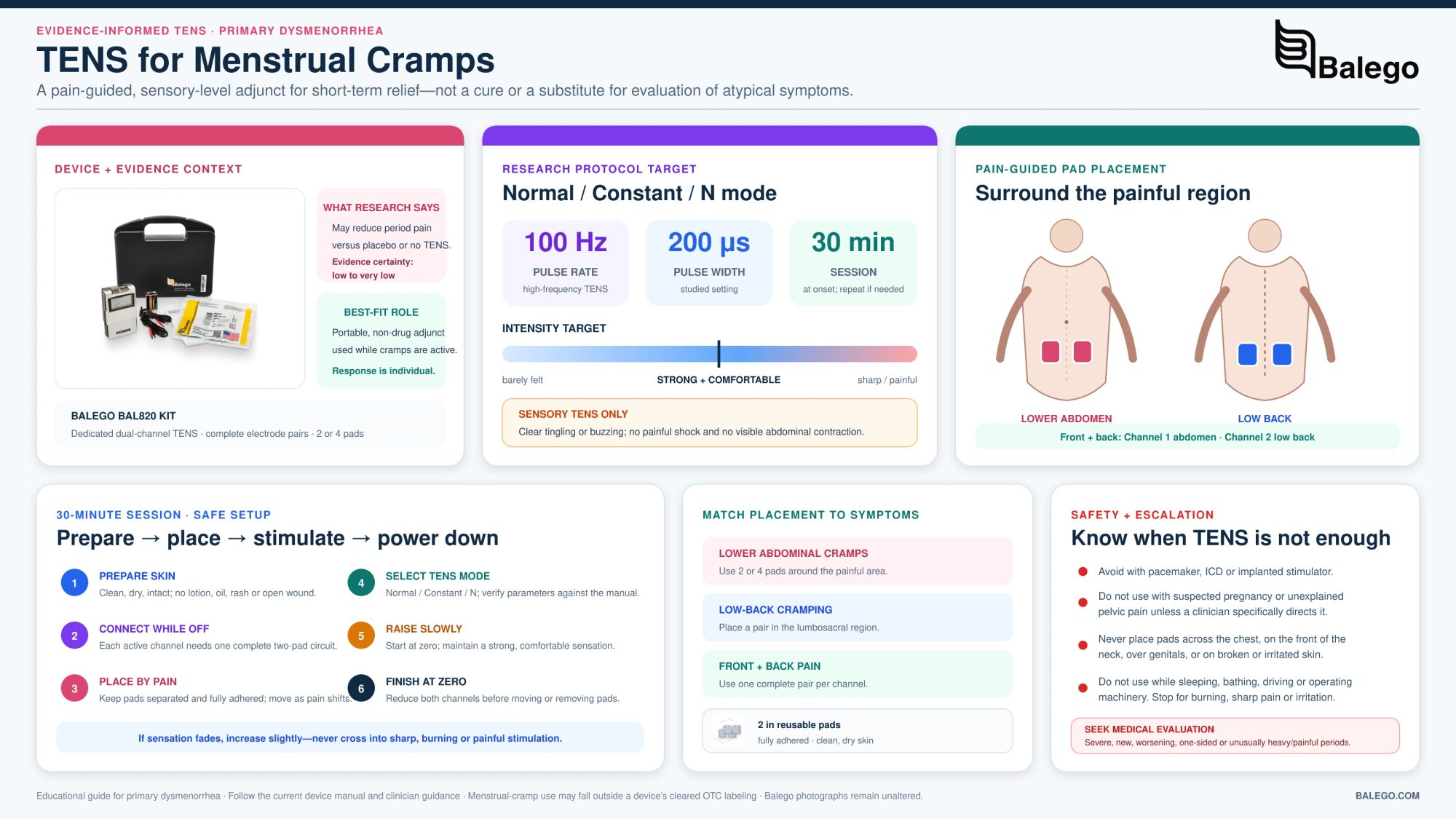
TENS for Period Cramps: Quick Answer
| Question | Practical answer |
|---|---|
| Can TENS help menstrual cramps? | It may reduce pain for some people with primary dysmenorrhea. |
| Is TENS a cure? | No |
| Best-studied frequency | High-frequency TENS around 100 Hz is common in the literature. |
| Commonly studied pulse width | Around 200 μs |
| How strong? | Strong, clearly noticeable, and comfortable; below motor-contraction level |
| How long? | 20–30 minutes is a reasonable research-based starting range. |
| Where do pads go? | Usually around the painful lower abdomen or lower back |
| Should the abdominal muscles contract? | No—not for conventional sensory TENS |
| Can heat be used too? | Yes, when the device is designed for combined heat and TENS |
| Is TENS appropriate for every kind of period pain? | No; new, progressive, or unusual pelvic pain should be evaluated. |
What Is Primary Dysmenorrhea?
Dysmenorrhea means painful menstruation.
Primary dysmenorrhea describes recurring menstrual cramps without another identified pelvic disease causing the pain.
Typical primary dysmenorrhea often includes:
- cramping lower-abdominal pain;
- low-back aching;
- pain extending into the thighs;
- nausea;
- diarrhea;
- headache;
- fatigue; and
- symptoms concentrated around the first few days of menstruation.
The pain is associated in part with prostaglandins that promote uterine contractions and inflammatory signaling.
TENS does not stop the menstrual cycle or correct the underlying prostaglandin activity.
Its purpose is pain modulation.
Does TENS Actually Work for Menstrual Cramps?
The most accurate answer in 2026 is
TENS appears useful for some people, but the evidence remains heterogeneous and does not establish one universally effective protocol.
2024 Cochrane review
The 2024 Cochrane review included 20 randomized trials involving 585 participants.
Researchers concluded that:
- High-frequency TENS may reduce menstrual pain versus placebo or no treatment;
- Low-frequency TENS may also reduce pain;
- evidence certainty was low; and
- Adverse-effect reporting was insufficient for strong conclusions.
For high-frequency TENS, pooled pain scores favored TENS by approximately 1.39 points compared with placebo or no treatment, but results varied substantially between studies.
2026 evidence updates
More recent reviews reinforce both the potential benefit and the uncertainty.
An August 2026 meta-analysis found a significant pooled reduction in menstrual pain with TENS, but statistical heterogeneity reached 94%, indicating very large differences among studies. Researchers specifically cited differences in parameters, placement, study quality, and sample size as reasons for caution.
Another 2026 meta-analysis covering nine studies and 530 participants found that TENS reduced the proportion of participants requiring pain medication and increased the duration of analgesia compared with placebo. However, its pooled analysis did not find a statistically significant difference in pain intensity.
What that means in practical terms
| Claim | Current evidence supports it? |
|---|---|
| TENS can reduce period pain for some people. | Yes, reasonably supported |
| Everyone responds to TENS. | No |
| One specific frequency is proven best. | No |
| 100 Hz is commonly studied | Yes. |
| TENS may reduce the need for additional analgesics. | Some evidence supports this. |
| TENS cures dysmenorrhea. | No |
| TENS treats endometriosis or fibroids. | No |
| TENS can be a useful non-drug adjunct. | Yes. |
Where Should TENS Pads Go for Menstrual Cramps?
There is no single mandatory electrode placement.
Studies have used lower-abdominal, low-back, and other placements. A 2026 meta-analysis found pain reductions across different application locations, although the subgroup evidence was imprecise.
The practical rule is
Place electrodes around the region where menstrual pain is actually felt while following the safety instructions for the specific TENS device.
Placement Option 1: Two Pads on the Lower Abdomen
This is one of the most directly studied arrangements.
Place:
- one electrode on the lower-left abdomen; and
- one electrode on the lower-right abdomen.
Keep both pads:
- below the navel;
- above the genital/pubic region;
- on intact skin; and
- separated from one another.
A published randomized trial applied TENS to the lower abdomen using 100 Hz, 200 μs, and a 30-minute session.
Simple two-pad pattern
| Pad | General area |
|---|---|
| Electrode 1 | Lower-left abdomen |
| Electrode 2 | Lower-right abdomen |
The goal is to bracket the painful lower-abdominal region rather than positioning an electrode directly on the navel or genital tissue.
Placement Option 2: Four Pads Across the Lower Abdomen
A dual-channel TENS unit allows broader coverage.
One possible arrangement is
| Channel | Placement |
|---|---|
| Channel 1 | Upper-left and lower-left portions of the painful lower abdomen |
| Channel 2 | Upper-right and lower-right portions |
The four electrodes effectively surround a broader symptomatic region.
Do not overlap the pads or allow their conductive surfaces to touch.
The Balego TENS Digital Edition supports two independent channels and therefore either two or four conventional electrodes.
Placement Option 3: Lower Back
Period cramps can also be perceived in the lower back.
When pain is predominantly posterior, place a complete electrode pair on the lower-back muscular region, typically on either side of the painful area.
Avoid placing pads directly over prominent spinal bones.
We cover detailed lumbar electrode patterns separately in the TENS for the Low Back Pain Pad Placement Guide.
Placement Option 4: Abdomen and Low Back at the Same Time
A dual-channel TENS machine can cover both regions simultaneously.
The safest conceptual arrangement is
Channel 1: both electrodes on the lower abdomen Channel 2: both electrodes on the lower back
Each channel therefore creates its own local electrical circuit.
Do not place one electrode from the same channel on the abdomen and its matching electrode on the back to intentionally pass current through the torso.
Follow the placement restrictions in the specific device manual.
Which TENS Settings Are Best for Menstrual Cramps?
There is no single universally validated protocol.
Published dysmenorrhea research has used multiple frequencies, pulse durations, session lengths, and electrode locations.
However, high-frequency sensory TENS is one of the most commonly studied approaches.
Research-informed starting parameters
| Parameter | Practical research-based reference | Why |
|---|---|---|
| Mode | Conventional / Normal TENS | Provides steady sensory stimulation |
| Pulse rate | 80–100 Hz | High-frequency range frequently used for dysmenorrhea |
| Pulse width | 100–200 μs | Common sensory-TENS range; 200 μs appears in several trials. |
| Intensity | Strong but comfortable | Studies typically increase toward a strong sensory level. |
| Muscle contraction | None intended | This is TENS, not NMES. |
| Initial session | 20–30 minutes | Common research duration |
| When to use | When menstrual pain is present | Many studies treated during symptomatic periods |
A clinical overview of TENS for primary dysmenorrhea identified 50–120 Hz as a typical high-frequency range, with 100 Hz being particularly common.
Why 100 Hz and 200 μs Are Often Discussed
One randomized controlled trial involving 88 participants used:
- 100 Hz frequency
- 200 μs pulse duration
- 30 minutes
- lower-abdominal application
for the TENS intervention.
Another published trial protocol subsequently used the same 100 Hz / 200 μs combination with a strong-but-comfortable sensory intensity. Its electrodes were placed bilaterally on the lower abdomen.
That makes:
100 Hz + 200 μs + strong, comfortable sensation
a reasonable research-informed reference protocol.
It does not establish that the setting is superior to every other TENS parameter combination.
Important correction about equipment
These research parameters can be reproduced on an adjustable device such as the Balego Digital TENS, but the cited research should not be described as having tested the Balego TENS unless the publication explicitly identifies that product.
How Strong Should TENS Feel?
Intensity may matter at least as much as the precise frequency.
The intended sensation for conventional TENS is generally
- clearly noticeable;
- strong;
- even;
- comfortable;
- non-burning; and
- below the level that causes a visible muscular contraction.
Research protocols frequently increase current until participants describe a strong but comfortable tingling sensation.
The stimulation should not feel:
- sharp;
- stabbing;
- burning;
- painful; or
- concentrated beneath one corner of an electrode.
If it does, reduce the intensity and inspect electrode contact.
Poor pad adhesion can cause current to become concentrated over a smaller effective contact area.
For replacement conventional electrodes, we offer reusable TENS/NMES/FES electrode pads in multiple sizes.
Should You Turn the Intensity Up During Treatment?
Sometimes the TENS sensation becomes less noticeable during a session.
This can occur as the nervous system accommodates to the stimulus.
If the sensation fades substantially, a small increase in intensity may restore a strong but comfortable sensory level.
Do not continually increase the output simply because you can tolerate more.
More intensity is not automatically more effective, and the sensation should remain comfortable.
Should You Use Normal, Burst, or Modulation Mode?
The research-based 100 Hz / 200 μs protocol most closely resembles a steady conventional TENS pattern.
On the Balego Digital TENS, normal/constant mode is therefore the simplest way to reproduce that type of stable stimulation pattern.
However, there is no high-quality evidence establishing that one Balego mode is uniquely superior for period pain.
TENS Modes Explained: Burst, Normal, Modulation, SD1 & SD2
For this post, the important distinction is
TENS should remain sensory stimulation rather than deliberate abdominal muscle contraction.
TENS Is Not the Same as NMES or EMS
This distinction matters when using a multi-function electrical stimulator.
| Feature | TENS | NMES / EMS |
|---|---|---|
| Main objective | Temporary pain modulation | Muscle activation |
| Target | Primarily sensory nerves | Motor nerves |
| Visible contraction expected | No | Yes. |
| Period-cramp role | Pain-focused stimulation | Not the same treatment |
| Typical sensation | Strong tingling | Repeated muscle contraction |
Do not choose an EMS or NMES muscle-contraction program simply because menstrual cramps involve uterine contractions.
A surface NMES unit is designed to stimulate skeletal motor nerves—it is not intended to electrically “control” uterine contractions.
For more on the distinction, see TENS vs. NMES: Differences, Uses & Device Guide.
TENS vs. Heat for Menstrual Cramps
Both have evidence supporting a role in primary dysmenorrhea.
Heat therapy deserves particular attention because a large 2026 systematic review included 57 randomized trials and 5,359 participants and found that heat may reduce menstrual-pain intensity compared with no treatment.
TENS and heat work differently.
| Feature | TENS | Heat |
|---|---|---|
| Main intervention | Electrical sensory stimulation | Local thermal treatment |
| Drug-free | Yes. | Yes. |
| Requires electrodes | Yes. | No, unless integrated with TENS. |
| Electrical sensation | Yes. | No |
| Warmth | No, unless the device includes heat. | Yes. |
| Evidence for primary dysmenorrhea | Supportive but heterogeneous | Supportive |
| Can be combined | Yes, in an appropriate device | Yes. |
There is also randomized evidence evaluating devices that combine high-frequency TENS with thermotherapy.
That makes combined TENS + heat a particularly logical option for someone who already responds well to warmth during menstrual cramps.
iStim S1 vs. Balego Digital TENS for Menstrual Cramps
| Feature | iStim S1 | Balego Digital TENS BAL820 |
|---|---|---|
| Format | Wearable TENS + heat | Traditional handheld TENS |
| Menstrual-specific FDA indication | Yes. | No menstrual-specific indication |
| Pulse frequency | Fixed 100 Hz | Adjustable 2–150 Hz |
| Pulse width | Preset | Adjustable 50–300 μs |
| Intensity | 15 levels | Continuously adjustable by channel |
| Heat | Built in | No |
| Lead wires | None | Yes. |
| Electrode layout | Integrated proprietary pads | Two or four separately positioned pads |
| Channels | Integrated treatment area | Two independent channels |
| Session timer | About 20 minutes | 5–60 minutes or continuous |
| Rechargeable | Yes, USB-C | Replaceable 9V battery |
| Best fit | Simplicity + heat + menstrual-specific design | Maximum setting and placement flexibility |
Choose the iStim S1 when:
- Menstrual-cramp relief is the primary reason for buying the device;
- Built-in heat is important;
- Lead wires would be inconvenient;
- A simple wearable design is preferred;
- fixed high-frequency TENS is acceptable; and
- You do not need independently movable electrodes.
The iStim S1 Wireless TENS Unit with Heat uses a fixed 100 Hz program and 15 intensity levels. Its underlying FDA-cleared FT-615 platform specifically includes temporary relief of pain associated with dysmenorrhea when used with OTC pain medication.
Choose the Balego Digital TENS when:
- You want to manually adjust frequency and pulse width;
- Two separate channels are useful;
- You want two- or four-pad placement options;
- You want to treat the abdomen, low back, or another permitted region with separately positioned electrodes.
- Longer timer options are important; or
- You want several TENS waveform patterns.
The Balego TENS Digital Edition provides adjustable parameters that encompass the commonly studied 100 Hz / 200 μs research protocol. Its FDA-cleared OTC indication, however, is for temporary relief of sore and aching muscles associated with exercise and normal activity—not a menstrual-specific indication.
S1 vs. Conventional TENS: Which Pad Placement Is Easier?
The S1 and BAL820 approach placement differently.
iStim S1
The wearable unit uses a broad integrated lower-abdominal treatment surface with proprietary electrodes.
Advantages:
- no individual wires;
- little pad-position guesswork;
- broad lower-abdominal contact;
- built-in heat.
Balego Digital TENS
A conventional system uses separate electrodes.
Advantages:
- independently position two or four pads;
- target abdominal versus back symptoms separately;
- Reposition electrodes around the painful region;
- independently control two channels.
Neither arrangement is automatically superior.
The better choice depends on whether convenience or placement flexibility matters more.
What Size Electrodes Should You Use?
For a traditional lead-wire TENS unit, 2-inch square electrodes are a practical general-purpose option.
A larger electrode covers more area and generally spreads current over a broader surface.
A smaller electrode produces greater current density at the same output and can feel more concentrated.
Rather than duplicating our complete electrode comparison here, use the dedicated Balego TENS/NMES/FES electrode page or TENS Electrode Guides.
For menstrual-cramp applications, choose a pad that:
- fits comfortably in the intended area;
- remains fully adhered;
- is compatible with the TENS lead wire; and
- does not require positioning over prohibited anatomy.
Can TENS Reduce the Need for Ibuprofen?
Possibly—but TENS should not be presented as a replacement for medication for everyone.
The 2026 Benduch and Stania meta-analysis found that participants receiving TENS were less likely to require pain medication than those receiving placebo, with a reported risk ratio of 0.43. It also found a longer duration of analgesia after TENS.
However, medical therapies such as NSAIDs remain established first-line treatments for primary dysmenorrhea when appropriate.
TENS can therefore be considered:
- an adjunct to medication;
- a non-drug alternative for some users;
- an option when someone prefers to minimize medication exposure; or
- one component of a broader menstrual-pain strategy.
Medication decisions should account for medical history, contraindications, and healthcare-professional guidance.
When During Your Period Should You Use TENS?
Most dysmenorrhea research applies TENS while pain is occurring.
For practical use:
| Situation | Reasonable approach |
|---|---|
| Cramps are just beginning. | Start TENS while pain is still manageable. |
| Pain is already established. | Apply over the painful region and reassess. |
| Pain returns later. | A later treatment may be appropriate if permitted by device instructions. |
| Pain moves from abdomen to back. | Reposition the complete electrode pair or use the second channel. |
| TENS repeatedly provides no benefit. | Reconsider the approach rather than indefinitely increasing intensity. |
There is not enough evidence to define a single ideal number of sessions per menstrual cycle.
Follow the device's instructions regarding treatment duration and frequency.
Can You Wear a TENS Unit While Walking or Working?
A portable TENS device can make treatment easier during normal activities, but the safety instructions for the specific product take priority.
Do not use TENS:
- while driving;
- while operating machinery;
- in a bath or shower;
- while swimming;
- while sleeping; or
- in any situation where an unexpected stimulation change could create a safety risk.
A wearable unit such as the S1 removes dangling lead wires, but that does not remove these safety considerations.
Can TENS Be Used During Pregnancy?
Do not use TENS over the abdomen or pelvic region during pregnancy unless specifically directed by an appropriate healthcare professional and permitted by the product instructions.
The iStim S1 instructions advise against use during pregnancy.
If pelvic pain or bleeding may represent pregnancy rather than an expected menstrual period, determine the cause before treating it as ordinary period cramps.
Primary vs. Secondary Dysmenorrhea: Why It Matters
TENS is a symptom-management device.
It does not diagnose why menstruation hurts.
Primary dysmenorrhea occurs without an identifiable pelvic disease.
Secondary dysmenorrhea can result from conditions such as
- endometriosis;
- adenomyosis;
- uterine fibroids;
- pelvic inflammatory disease;
- ovarian or pelvic pathology; or
- other gynecologic conditions.
Features that deserve medical evaluation
| Symptom pattern | Why it matters |
|---|---|
| Pain is becoming progressively worse. | May warrant investigation for a secondary cause |
| Severe cramps began later in adulthood. | Less typical of longstanding primary dysmenorrhea |
| Unusually heavy or irregular bleeding | Can occur with secondary conditions |
| Pain between periods | Not typical simple menstrual cramping |
| Pain with intercourse | Can be associated with secondary pelvic conditions |
| Abnormal vaginal discharge or fever | Requires medical assessment |
| Pain with urination or bowel movements during periods | Can occur with endometriosis or other disorders |
| New severe one-sided pain | Requires assessment rather than simply applying TENS |
| Cramps disrupt normal life every month. | Worth discussing with a healthcare professional |
Mayo Clinic specifically recommends evaluation when menstrual cramps disrupt life every month, progressively worsen, or first become severe after age 25.
Do not use temporary TENS relief as a reason to delay evaluation of a changing symptom pattern.
Why TENS Does Not Treat Endometriosis
People commonly search for “TENS for endometriosis pain,” but that is a different question from primary dysmenorrhea.
A TENS device may alter pain perception.
It does not:
- remove endometriosis lesions;
- treat inflammation caused by endometriosis;
- reverse adenomyosis;
- shrink fibroids;
- treat pelvic infection; or
- Diagnose the cause of pelvic pain.
Troubleshooting TENS for Period Cramps
“I barely feel the TENS.”
Check:
- intensity;
- electrode adhesion;
- lead-wire connection;
- battery condition;
- complete skin contact.
Increase intensity gradually only after confirming the electrodes are working correctly.
“It feels strong under only one corner of the pad.”
Turn the unit off.
The electrode may be:
- lifting;
- drying out;
- contaminated with lotion or oil; or
- partially damaged.
Uneven contact can concentrate current.
Replace the pad if complete adhesion cannot be restored.
“It tingles but doesn't help.”
TENS does not work for everyone.
Try:
- repositioning the pads around the actual painful region;
- checking that intensity is strong but comfortable;
- treating the lower back instead if pain is primarily posterior; or
- using heat if appropriate.
Do not respond by continually increasing stimulation into a painful range.
“My abdomen is twitching.”
For conventional menstrual-cramp TENS, reduce intensity.
The usual research approach is sensory-level stimulation without visible muscle contraction.
If you are using a multimodality device, confirm that you selected TENS rather than EMS/NMES.
“The pads irritate my skin.”
Stop treatment and inspect the area.
Potential causes include:
- worn hydrogel;
- excessive intensity;
- repeatedly using exactly the same placement;
- sensitive skin;
- poor contact; or
- adhesive sensitivity.
Persistent, blistering, or significant reactions should be medically evaluated.
Frequently Asked Questions
Does TENS work for menstrual cramps?
Research suggests TENS may reduce pain in primary dysmenorrhea, although the size of the effect differs considerably between studies.
The 2024 Cochrane review and 2026 systematic reviews generally support possible benefit while emphasizing limitations in study quality and consistency.
What TENS frequency should I use for period cramps?
High-frequency TENS around 80–100 Hz is a practical research-informed starting range.
100 Hz has been used repeatedly in clinical research.
What pulse width should I use?
A commonly studied value is 200 μs.
That is a research reference rather than a universal therapeutic prescription.
How long should I use TENS?
Many studies use approximately 20–30 minutes.
Individual device instructions may allow different durations.
Where do I put TENS pads for cramps?
Common locations include:
- the lower abdomen around the painful region; or
- the lower back when pain is predominantly posterior.
Do not place electrodes directly over genital tissue or other locations prohibited by the device manual.
Can I put one TENS pad on my stomach and one on my back?
Do not create one electrode circuit directly from the front of the torso to the back.
If a dual-channel device is being used for both areas, use one complete electrode pair locally on the abdomen and a separate complete pair locally on the lower back.
Is high-frequency or low-frequency TENS better?
Both have shown potential benefit.
The 2024 Cochrane review did not establish a definitive superiority of one over the other. High-frequency TENS is simply the better-studied and easier practical starting point for many users.
Is heat or TENS better for cramps?
Both have supporting evidence.
A 2026 systematic review of 57 heat-therapy trials found meaningful pain reductions, while TENS reviews also support possible benefit. Individual preference and response matter.
A device combining both methods may be attractive for someone who benefits from heat and TENS.
Which product is most specifically designed for menstrual cramps?
The iStim S1 Wireless TENS Unit with Heat is the most directly positioned option because its FDA-cleared intended use specifically includes temporary relief of dysmenorrhea-related pain when used with OTC pain medication.
Which Balego TENS gives the most control over settings?
The Balego TENS Digital Edition provides more manual control over:
- pulse frequency;
- pulse width;
- TENS pattern;
- treatment time;
- two independent channels; and
- individual electrode placement.
Can I use TENS instead of pain medication?
Some users may find TENS reduces their need for additional medication, but it should not automatically replace effective medication or medical care.
Discuss medication decisions with an appropriate healthcare professional when there are medical conditions, contraindications, or persistent symptoms.
Bottom Line: TENS Can Be a Useful Option for Menstrual-Cramp Pain
The most defensible conclusion from current evidence is
TENS can provide temporary menstrual-pain relief for some people with primary dysmenorrhea, but the magnitude of benefit varies, and no single protocol has been proven optimal.
For an adjustable conventional TENS unit, a practical research-informed reference is
100 Hz • 200 μs • 20–30 minutes • strong but comfortable sensory intensity
Lower-abdominal placement is directly supported by published trials, while lower-back placement may be appropriate when that is where pain is perceived.
For a dedicated wearable option, the iStim S1 TENS Unit with Heat for Menstrual Cramps combines fixed 100 Hz TENS, 15 intensity levels, and local heat without external lead wires.
For maximum control over pulse rate, pulse width, mode, and two- or four-pad placement, compare the Balego TENS Digital Edition.
You can also browse all Balego TENS units, electrodes, and accessories or use the TENS electrode guides when replacement-pad size or connector compatibility is the main question.
Medical notice: This article is for education and product comparison and is not a diagnosis or individualized treatment prescription. TENS provides temporary symptom management and does not identify or treat an underlying gynecologic disorder. New, unusually severe, progressive, or otherwise atypical menstrual pain should be evaluated by an appropriate healthcare professional.


