



Richmar ComboCare Troubleshooting Guide: E1–E5 Errors, E-Stim & Ultrasound Problems
If a Richmar ComboCare DQ7844 is beeping, flashing an intensity value, producing weak stimulation, losing ultrasound coupling, showing an E1–E5 error, or appearing to have no output from one channel, the problem does not necessarily mean the unit has failed.
ComboCare combines several systems in one device: two-channel electrical stimulation, 1 and 3 MHz therapeutic ultrasound, and simultaneous ultrasound/e-stim combination therapy. Because the operating logic changes between those modes, a condition that looks like a malfunction in one setup may actually be normal operation in another.
For current product information, accessories, and ordering, see the Richmar ComboCare Professional E-Stim & Ultrasound Device.
This guide focuses specifically on troubleshooting. Complete waveform ranges, included accessories, and purchasing specifications belong on the ComboCare product page rather than being duplicated here.
Professional-device notice: ComboCare is a prescription professional therapy device. Troubleshooting should never be used to bypass contraindications, warnings, clinician-directed settings or authorized servicing. Disconnect the patient and stop treatment when an unexpected error, unusual pain, burning, equipment damage or unsafe condition occurs.
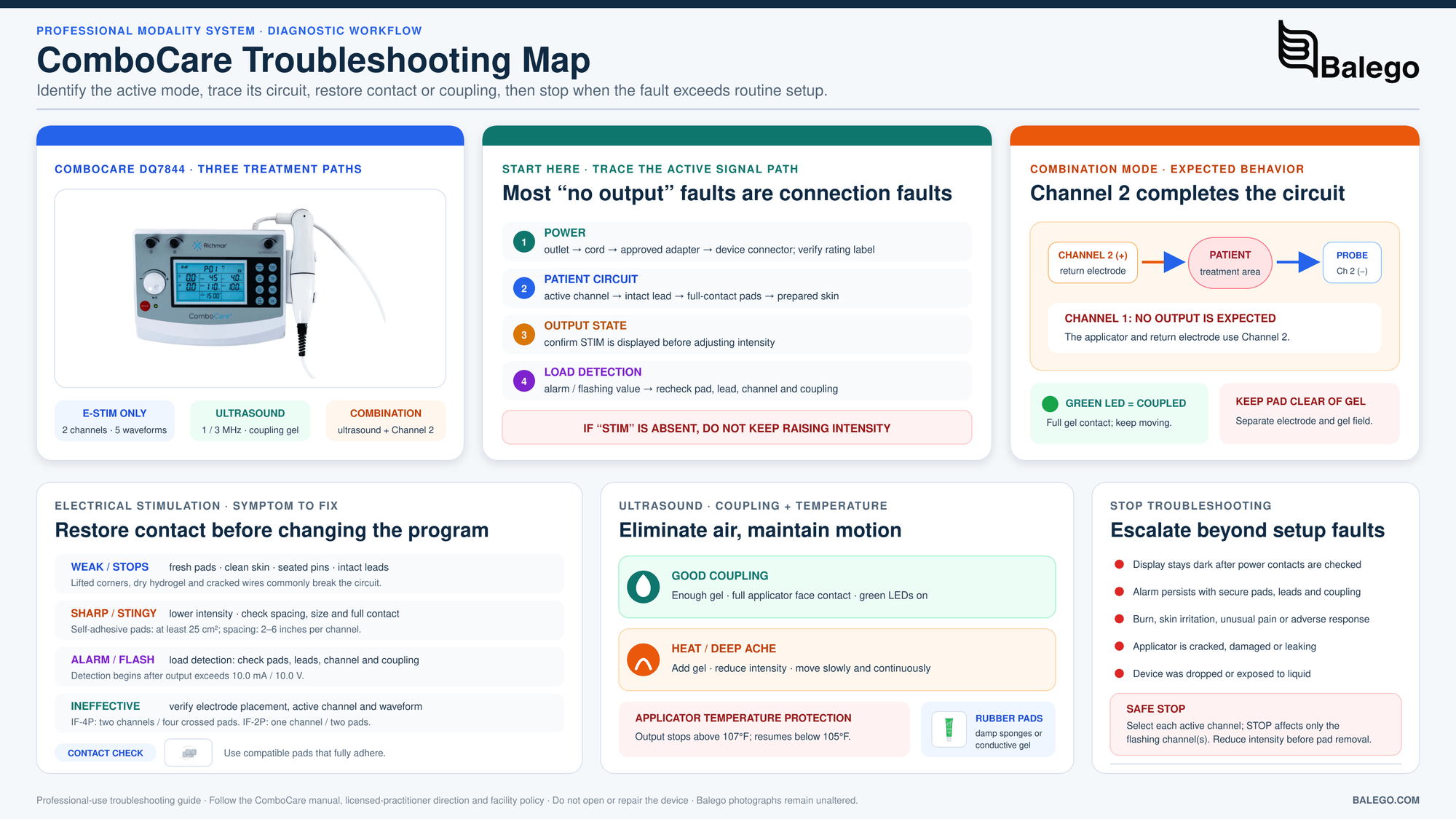
ComboCare Troubleshooting: Quick Diagnosis Table
| Symptom | Most likely area to check first | First action |
|---|---|---|
| The screen will not turn on. | Power adapter / connection | Confirm the approved adapter and all contacts are securely connected. |
| E-stim feels unusually weak. | Electrodes, placement, or lead wires | Inspect pad adhesion and leads; replace worn components. |
| Stimulation stops or resets. | Open circuit / electrode contact | Reapply electrodes and inspect all connections. |
| Intensity flashes and unit beeps | Load detection | Check electrode contact and circuit continuity. |
| The STIM symbol disappears | The program may be in a rest interval, or the output is interrupted. | Do not continue increasing intensity until active stimulation returns. |
| Channel 1 has no output during combo therapy. | Normal ComboCare combination-mode design | Use Channel 2 as specified for combination therapy. |
| Ultrasound LEDs will not turn solid green. | Poor coupling or applicator connection | Add coupling gel and restore full applicator contact. |
| The ultrasound head becomes excessively hot. | Inadequate coupling/contact or abnormal operation | Stop, restore the coupling, and allow the applicator to cool. |
| Deep aching during ultrasound | Possible periosteal discomfort | Reduce intensity and reassess treatment technique. |
| E1 or E2 | Hardware fault | Restart once; escalate if it recurs. |
| E3 | Device over-temperature condition | Allow the unit to stop and cool before reuse |
| E4 | Working current exceeds limit. | Allow the unit to stop; investigate before restarting. |
| E5 | Memory/memorizer failure | Restart; contact support if the error returns. |
The current Richmar manual specifically identifies E1 through E5 and instructs users to escalate unresolved problems to the manufacturer or distributor.
ComboCare Error Codes E1–E5 Explained
The current Richmar Rev. V3 instruction manual provides the following error code definitions.
| Error | Manufacturer description | Appropriate response |
|---|---|---|
| E1 | Hardware problem | Restart the ComboCare. If the problem returns, arrange technical support. |
| E2 | Hardware problem | Restart the ComboCare. If the problem returns, arrange technical support. |
| E3 | Device detected above its temperature limit | Treatment stops automatically; allow the device to cool for several minutes. |
| E4 | Working current detected above the limit | The device stops treatment; allow it to stop and investigate the cause before reuse. |
| E5 | Memorizer failure | Restart the unit; contact the manufacturer/distributor if the error persists. |
Important: older ComboCare manuals may show different E3/E4 definitions.
Older units map E3 to a temperature-sensor failure and E4 to an over-temperature condition, whereas the newer Richmar Rev. V3 documentation maps E3 to over-temperature and E4 to working-current-over-limit.
That means an online error-code table should not be used blindly for every production revision.
Use the current manual associated with your ComboCare DQ7844 and confirm the device/manual revision if an error-code description differs from the table above. Do not attempt internal repairs based solely on an older online manual.
Why Is My ComboCare Beeping and Flashing the Intensity?
ComboCare includes load detection.
During electrical stimulation, the current Richmar manual states that load detection operates after stimulation exceeds 10.0 mA in constant-current operation or 10.0 V in constant-voltage operation. If the electrodes are not connected to the patient or the circuit is open, the unit can sound an alarm, flash the intensity, and reset the output.
Start with the complete electrical path:
| Check | What to look for |
|---|---|
| Electrode adhesion | The entire conductive surface should remain against intact skin. |
| Electrode condition | Dry, curled, or contaminated pads should be replaced. |
| Electrode-to-lead connection | Pins/connectors should be fully inserted. |
| Lead wires | Look for cracks, intermittent output, or damaged connectors. |
| Device cable | Confirm the stimulation cable is fully seated. |
| Electrode spacing | Follow ComboCare's required placement range. |
| Correct channel | Confirm the intensity is being adjusted on the channel actually connected. |
The current troubleshooting table identifies dried or contaminated electrodes, improper placement, and old or damaged lead wires among the main reasons stimulation becomes weak or stops.
For replacement self-adhering pads, compare our TENS/NMES/FES electrodes.
Why Does ComboCare Reset the Intensity to Zero?
This can be normal protective behavior when the unit detects an open stimulation circuit.
For applicable e-stim modes, the manual states that when load detection triggers, the alarm sounds and the displayed intensity can flash and reset to zero.
Do not simply turn the intensity back up repeatedly.
Instead:
- Stop treatment.
- Inspect both electrodes in the affected channel.
- Check the lead-wire connections.
- Replace questionable pads or damaged leads.
- Re-establish the complete circuit.
- Restart output gradually according to the clinical protocol.
There is also a less obvious detail for TENS/EMS programs: when pulse duration is below 80 µs, the current Richmar manual describes a different load-detection threshold of 40.0 mA/40.0 V.
That helps explain why an open-circuit alarm may not appear at exactly the same displayed intensity under every program.
Why Is ComboCare Stimulation Weak?
The troubleshooting table identifies three major categories:
electrode condition, electrode placement, and lead-wire condition.
A useful diagnostic sequence is
| Test | Interpretation |
|---|---|
| Replace the electrodes with known-good pads. | Improvement suggests the old pads were dry, contaminated, or poorly adhering. |
| Reseat every lead connection. | Improvement suggests an intermittent connection. |
| Try another known-good lead wire | Helps isolate a damaged lead |
| Confirm the intended electrode placement. | Poor motor/sensory targeting can make functioning output appear ineffective. |
| Verify CC/CV and waveform settings. | An unexpected program or output mode can change what the patient perceives. |
| Compare both channels using known-good accessories. | Helps distinguish accessory problems from a channel/output problem |
ComboCare's manual instructs users to keep electrodes at least 2 inches and no more than 6 inches apart per channel in its standard stimulation setups.
Do not solve weak output simply by increasing intensity before checking contact.
Why Does the Stimulation Feel Sharp, Stingy, or Uncomfortable?
An unpleasant concentrated sensation frequently points to the electrode-skin interface.
The troubleshooting guidance identifies:
| Possible cause | Corrective action |
|---|---|
| Intensity too high | Reduce intensity |
| Electrodes too close | Reposition them. |
| Damaged/worn electrode | Replace |
| Damaged/worn lead wire | Replace |
| Electrode area too small | Use an appropriately sized electrode. |
Richmar specifies an active electrode area of at least 25 cm² in its troubleshooting guidance.
Poor adhesion deserves particular attention. If only part of a pad remains conductive against the skin, the effective contact area decreases and the stimulation can feel disproportionately sharp.
For the underlying electrical principle, our separate Constant Current vs. Constant Voltage in Electrotherapy guide explains how electrode impedance and CC/CV regulation affect delivered stimulation.
Keeping that technical explanation on the CC/CV page avoids duplicating it here.
What Does the “STIM” Symbol Mean?
The STIM indicator tells the operator when active electrical stimulation is actually being delivered.
This matters because some waveforms contain programmed rest intervals.
Richmar specifically warns not to keep raising the intensity when STIM is absent because output may resume later at the higher setting and produce an abrupt increase in sensation.
If STIM disappears unexpectedly, determine whether:
- The program is in a normal rest interval.
- The channel has been paused.
- Load detection has interrupted output;
- the electrode circuit is open; or
- The treatment has stopped.
Do not treat every temporary disappearance of STIM as a hardware failure.
Why Doesn't Channel 1 Work During Combo Therapy?
This is one of the most important ComboCare troubleshooting questions because Channel 1 being inactive is normal in combination ultrasound/e-stim mode.
In combo mode:
| Connection | Function |
|---|---|
| Ultrasound applicator | Negative side of the Channel 2 stimulation circuit |
| Combination lead/electrode | Positive side of Channel 2 |
| Channel 2 | Electrical-stimulation channel used for combination treatment |
| Channel 1 | Remains open / has no output |
Richmar explicitly states that Channel 1 has no output during this setup.
Therefore:
Channel 1 works in regular e-stim mode but does nothing in combo mode, which is likely normal operation.
That distinction deserves a prominent section because otherwise clinicians may assume that Channel 1 has failed.
The manufacturer also instructs users to keep the return electrode far enough from the ultrasound treatment area that it does not come into contact with ultrasound gel.
Why Is My ComboCare Ultrasound Not Coupling?
Therapeutic ultrasound requires a continuous coupling medium between the applicator and skin because air transfers ultrasonic energy poorly.
With ComboCare, the applicator's green LEDs provide immediate coupling information.
| Applicator indication | Meaning |
|---|---|
| Solid green LED | Good contact; ultrasound energy is being emitted. |
| No green LED | Treatment may be paused, the applicator may be improperly connected, or adequate coupling may not be present. |
| Flashing LED during temperature condition | Applicator protection may have stopped output. |
Richmar instructs the clinician to apply a suitable ultrasound coupling medium, maintain contact over the applicator surface, and move the sound head continuously during treatment.
For an ultrasound-specific contact medium, see TheraSonic Ultrasound Gel.
Do not substitute an electrical electrode gel simply because both products are called “conductive gel.” SignaGel specifically distinguishes electrical contact gel from ultrasound coupling media.
Why Does the Ultrasound Applicator Get Hot?
First distinguish normal treatment sensation from applicator overheating.
According to the Richmar manual:
If applicator movement is too slow, the patient may experience periosteal discomfort described as a deep ache.
If movement is too fast or good contact is not maintained, ultrasound transfer may be reduced and the applicator can overheat.
The unit also incorporates thermal protection.
The manual states that ultrasound output stops and the applicator LED flashes if applicator temperature rises above approximately 107°F / 42°C. Output can resume after the temperature falls below approximately 105°F / 41°C.
If the sound head is becoming unusually hot
Check coupling gel coverage, full applicator contact, applicator movement, cable condition, and whether the head has suffered physical damage.
Do not defeat a thermal shutdown by repeatedly restarting the treatment.
What Should I Do if the Patient Feels a Deep Ache During Ultrasound?
A deep aching sensation during therapeutic ultrasound can represent periosteal discomfort.
Richmar's current manual instructs the clinician to reduce intensity when this occurs and states that a moving technique should be used at ultrasound intensities above 0.5 W/cm² to promote more even tissue exposure.
This is different from an applicator-overtemperature fault.
| Finding | More likely issue |
|---|---|
| Deep localized ache felt by patient | Technique/intensity and possible periosteal discomfort |
| Applicator LED flashing after heating | Applicator thermal protection |
| No green coupling indication | Poor coupling or connection |
| Alarm during Combo mode | Could involve either an electrode circuit or ultrasound coupling |
Stop treatment when the cause is unclear or symptoms are unexpected.
Why Does ComboCare Alarm During Ultrasound + E-Stim Combination Therapy?
Combination therapy has two contact systems that must work simultaneously:
- the electrical stimulation return electrode; and
- the ultrasound applicator-to-skin interface.
The manual describes combo-mode load detection after stimulation or ultrasound output reaches its monitoring threshold. Inadequate electrode connection or poor applicator coupling can trigger the alarm and flashing indicators.
Therefore, when Combo mode alarms, do not troubleshoot only the electrode.
Check both sides:
| Electrical side | Ultrasound side |
|---|---|
| Channel 2 connection | Applicator connection |
| Combination lead wire | Coupling gel |
| Return electrode adhesion | Full soundhead contact |
| Electrode condition | Applicator movement |
| Cable seating | Applicator temperature |
This dual-path troubleshooting logic is one of the main differences between Combo mode and ordinary e-stim.
Why Isn't IF-4P Working Correctly?
Traditional four-pole interferential stimulation requires two channels and four electrodes.
If only one pair is connected, the intended four-pole setup cannot be produced.
By contrast, premodulated/IF-2P uses a two-electrode arrangement.
| Mode | Channels | Electrodes |
|---|---|---|
| IF-4P traditional interferential | 2 | 4 |
| IF-2P / premodulated | 1 | 2 |
| TENS | 1 or 2 depending on setup | At least 2 per active circuit |
| EMS | 1 or 2 depending on setup | At least 2 per active circuit |
| Russian | 1 or 2 depending on setup | At least 2 per active circuit |
| Ultrasound | — | Ultrasound applicator |
| Combination ultrasound/e-stim | Channel 2 | Applicator + return electrode |
If IF-4P seems incomplete, verify both stimulation channels and the four-electrode arrangement before assuming a hardware problem.
CC or CV Is Showing: Is That an Error?
No.
CC and CV are selectable ComboCare output-control modes.
CC means constant current, and CV means constant voltage. They describe how the stimulator regulates electrical output as the load changes; they are not error indicators. ComboCare supports selectable CC/CV operation for its applicable stimulation waveforms.
For the detailed engineering difference, use our Constant Current vs. Constant Voltage Electrotherapy guide rather than duplicating that explanation on this troubleshooting page.
What if My Settings Will Not Save?
First distinguish a programming mistake from an E5 memorizer error.
ComboCare includes programmable treatment settings, but the manual's setup sequences require the applicable save steps to be completed. If settings merely revert after incomplete programming, recheck the saving procedure.
If E5 appears, however, the current manual defines this as a memorizer failure.
Restart the ComboCare once. If E5 returns, contact the manufacturer or distributor rather than repeatedly reprogramming the unit.
How Should ComboCare Electrodes and Leads Be Maintained?
Accessory problems account for many symptoms that resemble equipment failures.
The current Richmar manual recommends periodic cleaning of lead wires with a cloth dampened in a mild soap solution, followed by gentle drying. It specifically warns that rubbing alcohol can damage lead-wire insulation and recommends replacement of lead wires every six months.
Do not confuse this with the rubber-electrode cleaning instructions: the manual permits different cleaning procedures for those components.
| Component | Important maintenance distinction |
|---|---|
| Self-adhesive electrodes | Single-patient use; replace when they no longer adhere completely |
| Rubber electrodes | Follow the manufacturer's cleaning/disinfection procedure. |
| Electrode sponges | Wash, rinse, and dry; replace damaged sponges. |
| Lead wires | Mild soap solution; do not clean with rubbing alcohol. |
| Ultrasound applicator | Inspect for cracks or damage before use. |
| Device enclosure | Follow manufacturer surface-cleaning instructions. |
For replacement stimulation pads, see our electrotherapy electrodes.
Should I Turn ComboCare On With the Patient Connected?
No.
The Richmar manual instructs the operator to allow the device to complete its startup self-check before connecting the patient.
This point belongs prominently in a troubleshooting guide because repeated power cycling is a common response to an error.
The safer sequence is
disconnect patient → restart device → allow startup/self-check → reconnect only after normal startup.
The manufacturer also cautions against connecting or disconnecting the ultrasound applicator while the device is switched on.
Why Didn't the STOP Button Stop Both Channels?
ComboCare handles its active channels individually.
The instructions state that STOP applies to the selected flashing channel or channels. To stop another channel, select that channel and then press STOP. Each channel must likewise be paused individually.
This can look like a control malfunction when two electrical-stimulation channels are operating independently.
If immediate patient safety is a concern, discontinue treatment according to the device instructions rather than assuming one STOP action necessarily canceled every active output.
When Should I Stop Troubleshooting?
Basic troubleshooting is appropriate for obvious connection and accessory problems.
Internal repair is not.
| Situation | Recommended action |
|---|---|
| E1 or E2 returns after restart. | Contact technical support. |
| E3 repeatedly occurs under normal use. | Stop using until evaluated. |
| E4 returns. | Stop and arrange a technical evaluation. |
| E5 returns after restart. | Contact technical support. |
| The display remains dead after power checks. | Service may be required. |
| Output remains abnormal with known-good pads/leads | Service may be required. |
| The ultrasound applicator is cracked. | Discontinue ultrasound use. |
| The applicator/cable was dropped or damaged. | Inspect/service before further clinical use. |
| Liquid entered the device enclosure. | Disconnect and arrange service. |
| Burning, unexpected severe pain, or adverse skin reaction occurs. | Stop treatment and clinically evaluate. |
| Repair would require opening the enclosure. | Authorized service only |
Maintenance and repairs should be performed only by an authorized agency, and any unauthorized opening of the equipment can terminate warranty coverage.
Our customers can use Balego Product and Technical Support and include the device model, serial information, error code, and a description of what occurred.
If ComboCare Needs Replacement: Which Clinical Setup Is Closest?
A clinic replacing an older ComboCare does not necessarily need another identical workflow. The right replacement depends on whether integrated ultrasound/e-stim combination therapy or additional stimulation channels matter more.
| System | E-stim | Ultrasound | Integrated combination therapy | Main reason to consider it |
|---|---|---|---|---|
| Richmar ComboCare DQ7844 | 2 channels | 1 & 3 MHz | Yes. | Keeps stimulation, ultrasound, and true combo treatment in one Richmar platform |
| Richmar Quattro 2.5 + separate ultrasound unit | 4 channels | Separate device | No integrated ComboCare-style circuit | Better fit when four-channel e-stim capacity matters more than one-box combo treatment |
| Chattanooga Intelect Transport 2 Combo 4738 | 2 channels | 1 & 3.3 MHz | Yes. | Current portable Chattanooga alternative with optional battery ecosystem |
The Richmar Quattro 2.5 provides four stimulation channels but no integrated ultrasound. Clinics that prefer separate systems can pair it conceptually with a dedicated device such as our Richmar Portable Therapeutic Ultrasound systems.
For a current two-channel professional combo platform, the Chattanooga Intelect Transport 2 Combo combines electrotherapy with dual-frequency ultrasound and combination treatment.
For additional clinical systems, browse our therapeutic ultrasound and combination equipment.
ComboCare Troubleshooting FAQ
What does E1 mean on ComboCare?
The manual identifies E1 as a hardware problem. Restart the device. If the error returns, contact the manufacturer or distributor rather than attempting internal repair.
What does E2 mean on ComboCare?
E2 is also identified as a hardware problem in the current manual. Restart once and escalate a recurring error.
What does E3 mean?
In the current Richmar Rev. V3 manual, E3 indicates that the device has exceeded its temperature limit. The unit stops treatment automatically and should be allowed to cool. Some older ComboCare manuals use different E3/E4 terminology, so confirm the manual revision for the device.
What does E4 mean?
The manual identifies E4 as a condition in which the working current is over the limit. Stop using the device and allow its protection system to respond. Repeated E4 errors warrant technical support.
What does E5 mean?
E5 indicates a memorizer failure. Restart the unit. If E5 persists, contact the manufacturer or distributor.
Why is ComboCare beeping?
In ordinary e-stim or combination therapy, beeping can indicate load detection because the stimulation circuit is open, electrode contact is poor, or ultrasound coupling is inadequate. Error conditions can also produce beeping. Determine what is flashing or displayed before restarting treatment.
Why does the intensity flash and go back to zero?
ComboCare's load-detection system can flash the displayed stimulation intensity and reset it when the device detects an open stimulation circuit above its applicable monitoring threshold. Inspect the electrodes, leads, and connections before turning the output back up.
Why is Channel 1 not working during ultrasound/e-stim?
That is normal in Combo therapeutic mode. The ultrasound applicator forms one side of the Channel 2 stimulation circuit, and a separate return electrode is connected to Channel 2. Channel 1 remains open.
Why isn't the green ultrasound light on?
The green applicator indicator is associated with adequate coupling and active ultrasound delivery. Check the applicator connection, coupling gel, and complete treatment-head contact.
What does a flashing ultrasound applicator LED mean?
The current manual states that the unit stops ultrasound output and flashes the applicator LED if the applicator temperature exceeds approximately 107°F/42°C. Output can resume after it cools below approximately 105°F/41°C.
Why does ultrasound cause a deep ache?
Slow sound-head movement or excessive local exposure may cause periosteal discomfort. Reduce intensity and reassess technique according to the treatment protocol.
What size self-adhesive electrode should ComboCare use?
The manual troubleshooting guidance specifies an active electrode area of at least 25 cm² and elsewhere recommends approximately 2 × 2-inch self-adhering electrodes as a minimum.
How far apart should ComboCare electrodes be?
The manual repeatedly specifies at least 2 inches but no more than 6 inches apart per channel for the illustrated standard stimulation setups.
Can I clean ComboCare lead wires with rubbing alcohol?
No. Richmar specifically warns that rubbing alcohol can damage the lead-wire insulation and shorten service life. Use the manual-directed mild-soap cleaning procedure instead.
Where can I find other equipment manuals?
We maintain a dedicated Device Manuals, Setup Guides, and Safety & Troubleshooting center covering clinical and portable electrotherapy equipment.
Bottom Line
The fastest way to troubleshoot a ComboCare is to identify which subsystem is actually failing.
If electrical stimulation is weak or stopping, start with the electrodes, lead wires, and complete circuit.
If the unit beeps or resets intensity, investigate load detection.
If ultrasound will not couple, inspect gel, contact, and the applicator.
If Channel 1 appears dead only during ultrasound/e-stim combination therapy, that is normal ComboCare behavior.
If the unit displays E1, E2, E3, E4, or E5, use the error code rather than guessing from the symptom—and confirm you are referencing the correct ComboCare manual revision.
Most importantly, recurring hardware, overcurrent, memory, or thermal faults are service issues, not reasons to bypass the device's protective systems.
For replacement components, current ComboCare availability, or product questions, see the ComboCare product page or contact our technical support.
Technical and clinical notice: This troubleshooting guide supplements rather than replaces the current Richmar ComboCare instruction manual. Treatment parameters, electrode placement, ultrasound technique, indications, contraindications, and patient selection must follow the applicable device instructions and qualified professional direction.


