



Nuprep® Skin Prep Gel and Ten20® Conductive Paste are commonly used together in neurodiagnostic electrode workflows, but their formulas perform different jobs and require slightly different handling.
This guide focuses specifically on:
- Storage after opening
- Expiration-date control
- Protection from cold and freezing
- Patient cleanup
- Removal from hair and clothing
- Spill management
- Container hygiene
- Disposal
- Clinic inventory procedures
For the functional difference between the two products, read Ten20 vs. Nuprep: When to Use Each Product.
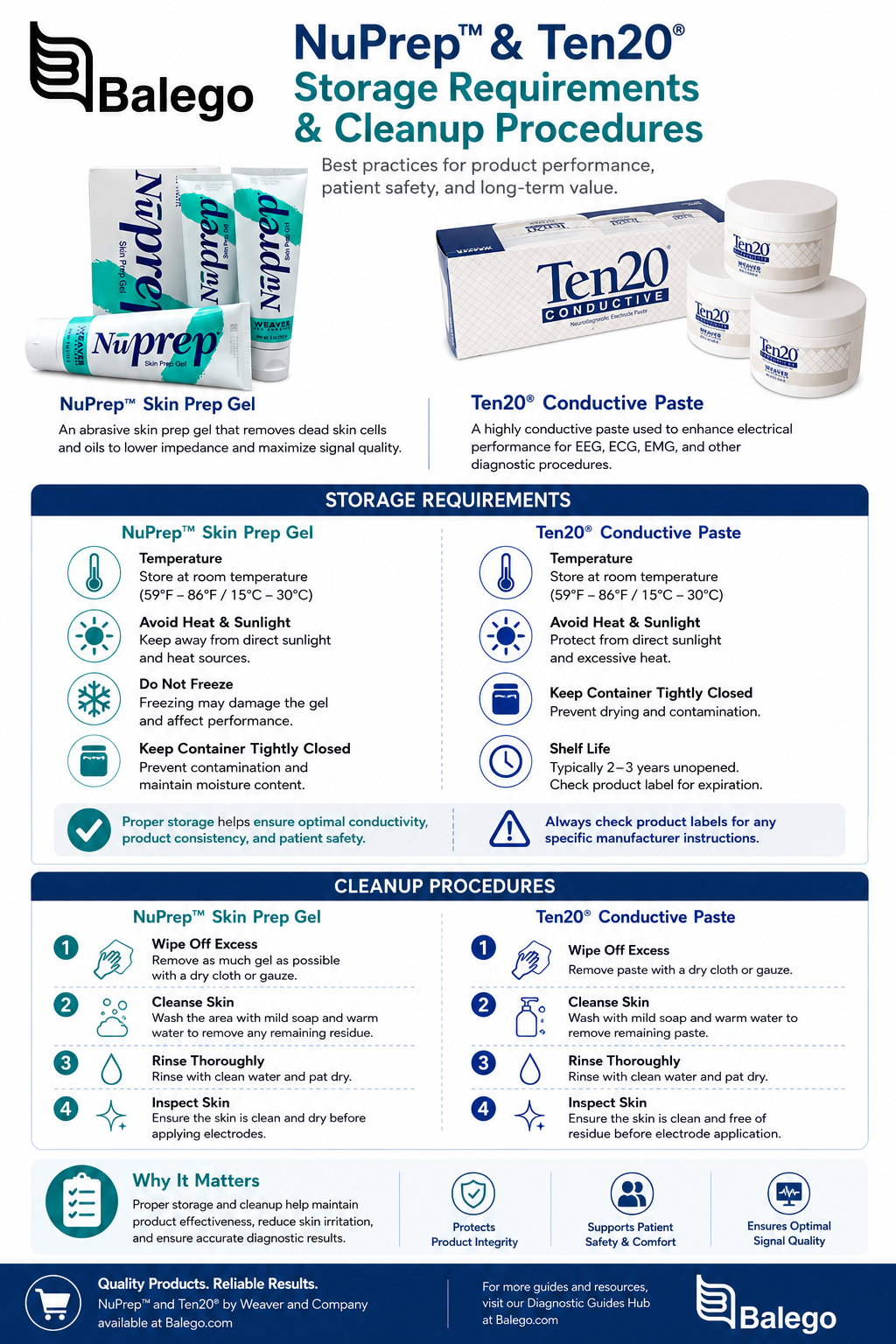
Quick Storage and Cleanup Comparison
| Handling question | Nuprep® Skin Prep Gel | Ten20® Conductive Paste |
|---|---|---|
| Keep container closed? | Yes—close tightly when not in use | Yes—close tightly when not in use |
| Storage environment | No special storage conditions required in the current IFU; room-temperature storage is appropriate | Store at room temperature |
| Protect from freezing? | No specific freezing warning appears in the current Nuprep IFU | Yes—avoid prolonged cold temperatures and freezing |
| Labeled shelf life | Three years when properly stored | Three years when properly stored |
| Usable after opening? | Yes, through the labeled shelf life when stored properly | Yes, through the labeled shelf life when stored properly |
| Patient cleanup | Wash away with warm water | Wash away with warm water |
| Hair cleanup | Rinse thoroughly; remove remaining product gently | Comb out large clumps first, then rinse promptly with warm water |
| Clothing cleanup | Remove excess and launder according to fabric instructions | Scrape away clumps and wash in very warm water |
| Spill cleanup | Wipe up; no special spill measures required | Wipe up; no special spill measures required |
| Special disposal | No special product handling required; follow local rules | No special product handling required; follow local rules |
| Main cleanup concern | Remove all abrasive residue from the electrode site | Remove adhesive paste from skin, hair and reusable equipment surfaces |
| MRI-related cleanup | All Nuprep residue must be removed before MRI | Remove all neurodiagnostic materials according to MRI and facility policy |
Instructions require both products to be kept tightly closed. Nuprep requires no special storage conditions, while Ten20 is specifically stored at room temperature and protected from prolonged cold or freezing.
How Long Do Nuprep and Ten20 Last?
Weaver states that its products have a three-year shelf life marked on both the outer packaging and the individual product containers. Opening a jar or tube does not create a separate shortened “use within” period: when the product is stored properly, it may remain usable through the printed expiration date.
Shelf-Life Rules for Both Products
| Inventory question | Recommended practice |
|---|---|
| Where is the expiration date? | Printed or stamped on each product container and packaging |
| Does opening shorten the official shelf life? | Not according to Weaver, provided the product is properly stored |
| Should a clinic write the opened date on the container? | Optional facility practice; helpful for traceability even though the manufacturer does not specify a shorter after-opening period |
| Can expired product be used if it looks normal? | No, follow the printed expiration date |
| Should the product be transferred to an unlabeled container? | No, retain the original labeled container whenever possible |
| What should be recorded for inventory control? | Product name, lot number, expiration date and opened date if required by facility policy |
| Which stock should be used first? | First-expiring, first-out inventory rotation |
A product should still be removed from service before its expiration date if its container is damaged, its identity or lot number is unreadable, or its physical condition has changed unexpectedly.
Nuprep Storage Requirements
The current Nuprep tube instructions state the following:
- Keep the container tightly closed when not in use.
- No special storage conditions are required.
- The product may be disposed of without special handling.
Recommended Nuprep Storage Setup
| Storage condition | Recommendation |
|---|---|
| Normal clinical room temperature | Appropriate |
| Refrigerator | Not required |
| Freezer | Not required and offers no identified benefit |
| Hot vehicle or direct sunlight | Avoid as a general medical-supply practice |
| Near a sink where the container may become wet | Avoid |
| Cap or flip-top left open | Avoid closing immediately after dispensing |
| Original tube | Preferred |
| Unlabeled secondary container | Avoid |
| Patient-care cart | Acceptable when protected from contamination and environmental extremes |
| Central supply cabinet | Appropriate with expiration and lot rotation |
Ten20 Storage Requirements
Ten20 has more specific temperature guidance than Nuprep. The manufacturer instructs users to:
- Keep the container tightly closed when not in use.
- Store it at room temperature.
- Avoid prolonged cold temperatures or freezing.
- Keep it out of children’s reach.
Why Freezing Ten20 Should Be Avoided
Ten20 is a formulated adhesive conductive paste containing water, humectants, salts, calcium carbonate, and thickening components. Prolonged cold or freezing may change the consistency or uniformity of a water-based paste even if the container appears intact. The manufacturer therefore specifically warns against these conditions.
Do not intentionally freeze Ten20 to extend its shelf life.
Ten20 Storage Decision Table
| Storage situation | Use or avoid? | Reason |
|---|---|---|
| Climate-controlled supply room | Use | Matches room-temperature guidance |
| Closed cabinet in an EEG or sleep lab | Use | Convenient when the lid remains secure |
| Refrigerator | Avoid unless Weaver provides different written instructions | Refrigeration is unnecessary and may expose paste to prolonged cold |
| Freezer | Avoid | The manufacturer specifically warns against freezing |
| Overnight in a vehicle during freezing weather | Avoid using until product condition and manufacturer guidance are assessed | May have been exposed to prohibited conditions |
| Hot vehicle or direct sun | Avoid | Uncontrolled heat can affect medical-supply integrity |
| Open jar between patients | Avoid | Promotes drying, contamination and accidental spills |
| Tightly closed original jar | Use | Preserves product and label information |
What If Ten20 Has Frozen?
Users should avoid freezing, but it does not publish a validated thaw-and-reuse procedure in the current instructions.
A conservative clinic response is
- Quarantine the affected container.
- Record the lot number and expiration date.
- Do not restore it to patient use merely because it thawed.
- Contact the facility’s materials-management department for disposition guidance.
- Replace it if product integrity cannot be confirmed.
Do not microwave, heat, or dilute frozen or thickened Ten20.
Does Either Product Dry Out After Opening?
Both containers should be closed promptly after dispensing.
Ten20 is described as a non-drying paste during its intended clinical use, but that description does not mean an open jar can be left uncovered indefinitely. Keeping the lid closed also reduces the risk of surface contamination, spills, and changes in consistency.
Nuprep is a water-based gel. Its current instructions similarly require the container to remain tightly closed when it is not being used.
Signs That Require Evaluation Before Use
Remove or quarantine a container when you observe:
- A broken cap or jar lid
- Leakage around the container
- Missing or unreadable labeling
- Unknown lot or expiration date
- Unexpected separation that does not resolve normally
- Unusual odor
- Foreign material
- Evidence that a used applicator was placed directly into the container
- Suspected freezing of Ten20
- A container that was left open for an unknown period
- A product subject to a current manufacturer notice
Do not add water, saline, or another gel to change either product’s consistency.
A Cleaner Dispensing Workflow
Users should place only the amount of product needed on a separate surface, such as gauze or surgical tape. This supports a cleaner workflow and avoids repeatedly contacting the main container during patient preparation.
Suggested Clinic Procedure
- Verify the product name, lot, and expiration date.
- Perform hand hygiene and use gloves according to facility policy.
- Dispense only the anticipated amount onto clean gauze, tape, or another appropriate disposable surface.
- Close the original container immediately.
- Do not return unused dispensed product to the original jar or tube.
- Use a new applicator for each patient.
- Discard unused material from the working surface after the procedure.
- Clean the exterior of the container if visibly soiled, following facility policy without allowing liquid into the opening.
- Return the container to its designated room-temperature storage location.
How to Clean Nuprep From the Skin
Nuprep is used as a skin-preparation product rather than a leave-on adhesive. Weaver instructs users to remove excess gel from prepared electrode sites before applying the electrodes. For cardiac electrodes, all Nuprep is removed with dry gauze before electrode placement.
Remaining residue can be washed away with warm water.
Nuprep Cleanup Steps
- Remove the electrode according to its instructions.
- Wipe away visible Nuprep with clean gauze.
- Wash the site gently with warm water.
- Do not perform additional abrasive rubbing during cleanup.
- Pat the skin dry.
- Inspect for persistent redness, soreness, burning, itching, or swelling.
- Follow facility or provider instructions when a skin reaction is present.
Because Nuprep contains an abrasive component, aggressive cleanup is unnecessary and may further irritate already prepared skin.
How to Remove Ten20 From the Skin
Ten20’s washable, non-drying formulation is designed to be removed with warm water without requiring a harsh chemical solvent.
Ten20 Skin-Cleanup Steps
- Remove the electrode and securing tape or gauze carefully.
- Lift away the largest amount of paste with gauze or a disposable towel.
- Wash the electrode site with warm water.
- Use gentle mechanical action rather than harsh scrubbing.
- Continue rinsing until adhesive residue is removed.
- Dry the site and inspect the skin.
- Report persistent redness, soreness, burning, itching, or swelling according to the patient’s care instructions.
Ten20 should be washed off immediately when rash, redness, itching, swelling, or another abnormal skin response appears. Long-term electrode sites should be uncovered and inspected at least daily.
How to Remove Ten20 From Hair
Hair cleanup is a common concern after EEG and sleep-study procedures. Weaver recommends using warm water and gently removing large clumps before rinsing.
Recommended Hair-Cleanup Sequence
- Remove cup electrodes, gauze, and tape carefully.
- Use a comb or gloved fingers to lift out large clumps of Ten20.
- Avoid pulling forcefully on tangled hair.
- Rinse the area promptly with warm water.
- Massage the remaining paste gently while rinsing.
- Repeat as needed until the paste releases.
- Wash the hair normally when appropriate.
- Avoid getting paste or rinse water into the eyes.
Starting with water while a large mass of paste remains in the hair can spread the paste through a wider area. Removing the larger clumps first makes rinsing more efficient.
Ten20 Hair Cleanup: What to Avoid
| Avoid | Why |
|---|---|
| Pulling dried paste from hair forcefully | May pull or break hair |
| Cutting hair routinely to remove paste | Usually unnecessary |
| Using a sharp tool near the scalp | Injury risk |
| Adding another conductive gel | Creates more residue |
| Applying aggressive household solvent | Not required by manufacturer guidance |
| Rubbing near the eyes | Increases the chance of eye exposure |
| Very hot water on sensitive skin | May be uncomfortable or irritating |
How to Remove Ten20 From Clothing and Linens
- Scrape or lift off large clumps.
- Wash the item in very warm water.
Before laundering:
- Follow the textile manufacturer’s care label.
- Avoid forcing paste deeper into the fabric.
- Do not place heavily contaminated material directly into a dryer before checking that the residue has been removed.
- Follow facility procedures for patient-care linens.
- Treat any blood or body-fluid contamination according to infection-control policy rather than as a simple paste stain.
Very warm water may not be appropriate for every fabric, so the item’s care instructions and facility laundering policy take priority.
Cleaning Spills From Work Surfaces
The safety data sheets state that no special accidental-release measures are required. Spilled product may be wiped up and disposed of according to local rules.
Basic Spill Procedure
| Step | Action |
|---|---|
| 1 | Restrict contact with the spill |
| 2 | Put on gloves as required by facility policy |
| 3 | Scoop or wipe up the bulk product with disposable material |
| 4 | Clean remaining residue with warm water and a compatible surface-cleaning method |
| 5 | Prevent material from entering equipment ports, keyboards or electrical connectors |
| 6 | Dispose of cleanup material according to local and facility rules |
| 7 | Perform hand hygiene |
| 8 | Inspect the area for slippery residue |
A medical-surface disinfectant may still be required by the facility after physical soil has been removed. Product removal and environmental disinfection are separate steps.
Cleaning Reusable Electrodes and Equipment
The product instructions primarily address patient use, not the validated reprocessing procedure for every electrode brand.
For reusable cup electrodes, lead wires and accessories:
- Follow the electrode manufacturer’s cleaning and disinfection instructions.
- Remove visible paste before disinfection.
- Do not immerse connectors unless the equipment instructions permit it.
- Do not scrape electrode surfaces with an abrasive tool.
- Confirm that all conductive paste is removed from cup openings and cable junctions.
- Inspect reusable equipment for damage before its next use.
Warm water may remove the paste, but it does not automatically disinfect a reusable medical device.
Eye Exposure
Both product instructions state that if Nuprep or Ten20 enters the eye,
- Do not rub the eye.
- Rinse thoroughly with warm water for 10 to 15 minutes.
- Seek medical attention if irritation continues.
This is different from routine skin or hair cleanup. Eye exposure should be handled immediately rather than waiting until the examination is complete.
Skin-Reaction Cleanup
Both products are intended for intact skin. If rash, redness, itching, swelling, or another abnormality develops, wash the product off promptly. Persistent symptoms should be reported to an appropriate healthcare professional.
Response by Symptom
| Observation | Recommended response |
|---|---|
| Mild removable residue only | Complete normal warm-water cleanup |
| Temporary electrode outline without discomfort | Observe according to facility policy |
| Increasing redness or itching | Remove product and inspect the skin |
| Burning, soreness or swelling | Remove product and notify the clinician |
| Broken or weeping skin | Discontinue use at that site and follow clinical guidance |
| Suspected infection | Prompt clinical assessment |
| Eye exposure | Rinse for 10–15 minutes; do not rub |
| Breathing difficulty or facial swelling | Seek emergency medical care |
Nuprep Cleanup Before MRI
Nuprep contains insoluble materials that may shadow or interfere with an MRI examination. Users ensure that all materials from the neurodiagnostic examination are removed from the electrode sites before MRI.
Pre-MRI Site Check
Before the patient proceeds to MRI:
- Remove all electrodes.
- Remove Nuprep completely.
- Remove Ten20 and other conductive media.
- Remove tape, gauze, and adhesive residue.
- Inspect the scalp or skin for remaining material.
- Follow the MRI department’s screening and preparation procedures.
The requirement to remove Nuprep is not merely cosmetic cleanup.
Disposal Requirements
Neither Nuprep nor Ten20 requires special product-disposal handling under the manufacturer’s instructions. Normal waste must still be handled according to local, regional, and facility rules.
Waste Classification Depends on What Else Is Present
| Waste item | Disposal consideration |
|---|---|
| Unused Nuprep or Ten20 | No special product handling identified; follow local rules |
| Empty container | Follow local recycling or facility-waste policy |
| Gauze containing product only | General facility waste unless policy states otherwise |
| Material contaminated with blood or body fluid | Follow regulated medical-waste policy |
| Used sharp or needle | Sharps container, regardless of paste or gel |
| Electronic electrode or accessory | Follow equipment and electronic-waste procedures |
| Expired unopened stock | Facility inventory-disposal policy |
| Recalled product | Follow manufacturer, distributor and regulatory instructions |
Do not assume that the product’s normal disposal status overrides requirements created by another contaminant.
Nuprep vs. Ten20: Storage and Cleanup Differences
This comparison is limited to handling and does not repeat the broader clinical-use discussion available in our Ten20 vs. Nuprep guide.
| Feature | Nuprep Skin Prep Gel | Ten20 Conductive Paste |
|---|---|---|
| Typical container sold by Balego | 4 oz tubes, pack of three | 4 oz or 8 oz jars, pack of three |
| Container behavior | Flip-top dispensing tube | Wide-mouth jar |
| Storage instruction | Keep closed; no special conditions required | Keep closed at room temperature |
| Cold warning | Not stated in current IFU | Avoid prolonged cold and freezing |
| Shelf life | Three years when properly stored | Three years when properly stored |
| Main residue characteristic | Mildly abrasive gel | Adhesive, non-drying paste |
| Cleanup from skin | Wipe excess and wash with warm water | Remove bulk paste and wash with warm water |
| Cleanup from hair | Rinse gently | Comb out large clumps, then rinse |
| Cleanup before electrode placement | Excess or all gel is removed, depending on the procedure. | Remains with the non-gelled electrode during the exam |
| MRI issue | Remove all residue before the MRI. | Remove as part of the full neurodiagnostic setup |
| Special disposal | No | No |
Recommended Clinic Storage and Cleanup SOP
At Receipt
- Inspect the shipping carton for temperature or container damage.
- Verify quantities, lot numbers, and expiration dates.
- Check Ten20 shipments for possible freezing exposure during cold weather.
- Rotate stock using the earliest expiration date first.
- Retain traceable lot information.
At Storage
- Keep products in their original labeled containers.
- Store in a clean room-temperature area.
- Keep lids and caps tightly closed.
- Do not refrigerate or freeze Ten20.
- Keep containers away from direct sunlight and uncontrolled vehicles.
- Separate expired or quarantined stock.
At Dispensing
- Check the expiration date.
- Dispense only the amount needed onto a clean working surface.
- Close the container immediately.
- Do not return excess product.
- Prevent patient-contact applicators from touching the container opening.
After the Examination
- Remove electrodes carefully.
- Remove bulk Ten20 before rinsing.
- Remove Nuprep and all other residue.
- Use warm water for routine product cleanup.
- Inspect the skin.
- Clean and reprocess reusable equipment according to its manufacturer.
- Document and report abnormal reactions.
At End of Day
- Wipe container exteriors if needed.
- Check lids and flip tops.
- Return products to room-temperature storage.
- Confirm that no Ten20 was left in a cold vehicle or mobile unit.
- Remove expired or compromised containers from active stock.
Frequently Asked Questions
How should Nuprep be stored?
Keep the container tightly closed. The current Weaver instructions state that no special storage conditions are required. Room-temperature clinical storage is appropriate.
How should Ten20 be stored?
Keep the container tightly closed at room temperature. Avoid prolonged cold temperatures and freezing.
Does Nuprep need to be refrigerated?
No. Refrigeration is not required by the manufacturer.
Does Ten20 need to be refrigerated?
No. Ten20 should be stored at room temperature, and prolonged cold should be avoided.
Can Ten20 freeze?
Avoid prolonged cold temperatures or freezing. It does not provide a validated thaw-and-reuse procedure.
What is the shelf life of Nuprep?
Products have a three-year shelf life marked on the product packaging and container when stored properly.
What is the shelf life of Ten20?
Ten20 has a three-year labeled shelf life when properly stored.(Weaver and Company)
How long is Ten20 good after opening?
Opening the container does not shorten the labeled three-year shelf life when the product continues to be stored properly.
How long is Nuprep good after opening?
The same statement applies: properly stored product remains usable through its marked three-year shelf life.
How do you remove Nuprep?
Remove excess with gauze and wash remaining gel away with warm water. Avoid aggressive rubbing because the skin has already been abraded.
How do you remove Ten20 from skin?
Remove the bulk paste with gauze or a towel, then wash with warm water. Harsh chemical removers are not normally required.
How do you remove Ten20 from hair?
Gently comb out large clumps and immediately rinse with warm water.
How do you remove Ten20 from clothing?
Scrape off large clumps and launder using very warm water when compatible with the fabric’s care instructions.
Can shampoo be used after Ten20?
Routine hair washing may follow the initial removal of large clumps and warm-water rinsing. Follow patient and facility requirements.
Do you need acetone to remove Ten20?
No. Ten20 is washable with warm water and states that harsh chemicals are not required for routine cleanup.
Can unused paste be returned to the jar?
A cleaner clinic practice is to dispense only what is needed onto a separate surface and discard any unused dispensed paste rather than returning it to the original container.
How should a Ten20 spill be cleaned?
Wipe up the bulk material and dispose of it according to local regulations. Remove any remaining residue using a compatible surface-cleaning process. No special spill measures are identified in the SDS.
How should a Nuprep spill be cleaned?
Wipe it up and dispose of it according to local rules. The SDS does not identify special spill measures.
Does warm-water cleanup disinfect reusable electrodes?
No. Warm water removes visible product. Reusable electrodes must then be cleaned and disinfected according to their own manufacturer’s instructions.
Why must Nuprep be removed before MRI?
The gel contains insoluble materials that may shadow or interfere with MRI. All residue and neurodiagnostic materials should be removed from electrode sites before the examination.
What should be done if either product enters the eye?
Do not rub the eye. Rinse with warm water for 10 to 15 minutes and seek medical attention if irritation persists.
Where can I purchase Nuprep and Ten20?
- Nuprep Skin Prep Gel, 4 oz tubes, pack of three
- Ten20 Conductive Paste in 4 oz and 8 oz jars
- Additional products in our Electromedical Contact Media collection
The Bottom Line
Nuprep and Ten20 are both straightforward to store and remove, but their requirements are not identical.
For Nuprep:
- Keep the container tightly closed.
- No special storage conditions are required.
- Properly stored product retains its labeled three-year shelf life after opening.
- Remove excess gel before electrode placement as directed.
- Wash residue away with warm water.
- Remove all material before MRI.
For Ten20:
- Keep the container tightly closed at room temperature.
- Avoid prolonged cold temperatures and freezing.
- Properly stored product remains usable through its three-year expiration date after opening.
- Remove large clumps from hair before warm-water rinsing.
- Routine cleanup does not require harsh chemical solvents.
- Inspect long-term electrode sites at least daily.
For role and application differences, see Ten20 vs. Nuprep: When to Use Each Product, or browse all EEG and ECG diagnostic supply guides.
Professional-Use and Safety Notice
Nuprep and Ten20 are intended for professional neurodiagnostic or monitoring workflows according to their respective labeling. Use them only on intact skin and do not use either product with current-inducing electrodes.
This article provides storage and cleanup guidance. It does not replace the current manufacturer instructions, safety data sheets, infection-control policies, equipment-reprocessing instructions, or individualized clinical judgment.


