



Low back pain is a symptom, not a single diagnosis. It may arise from muscles, fascia, ligaments, joints, nerve-related structures, or conditions outside the lumbar spine. For that reason, iontophoresis should not be applied simply because a patient points to a painful area of the lower back.
A lumbar iontophoresis protocol is most defensible when a qualified healthcare professional has identified a localized, relatively superficial treatment target; determined that transdermal medication delivery is appropriate; and obtained the necessary medication order.
Iontophoresis should be positioned as an adjunct—not as a replacement for movement, exercise, education, or other diagnosis-specific care. Current physical therapy guidelines consistently emphasize exercise, manual therapy, and active patient education for appropriate low back pain presentations. Iontophoresis is not identified as a core stand-alone treatment in those guidelines, and research specific to lumbar iontophoresis remains limited.
Clinical notice: This protocol is for professional education and product-selection support. Medication, polarity, dose, electrode placement and treatment frequency require an appropriate prescription, clinical judgment and compliance with the drug, device and electrode instructions for use.
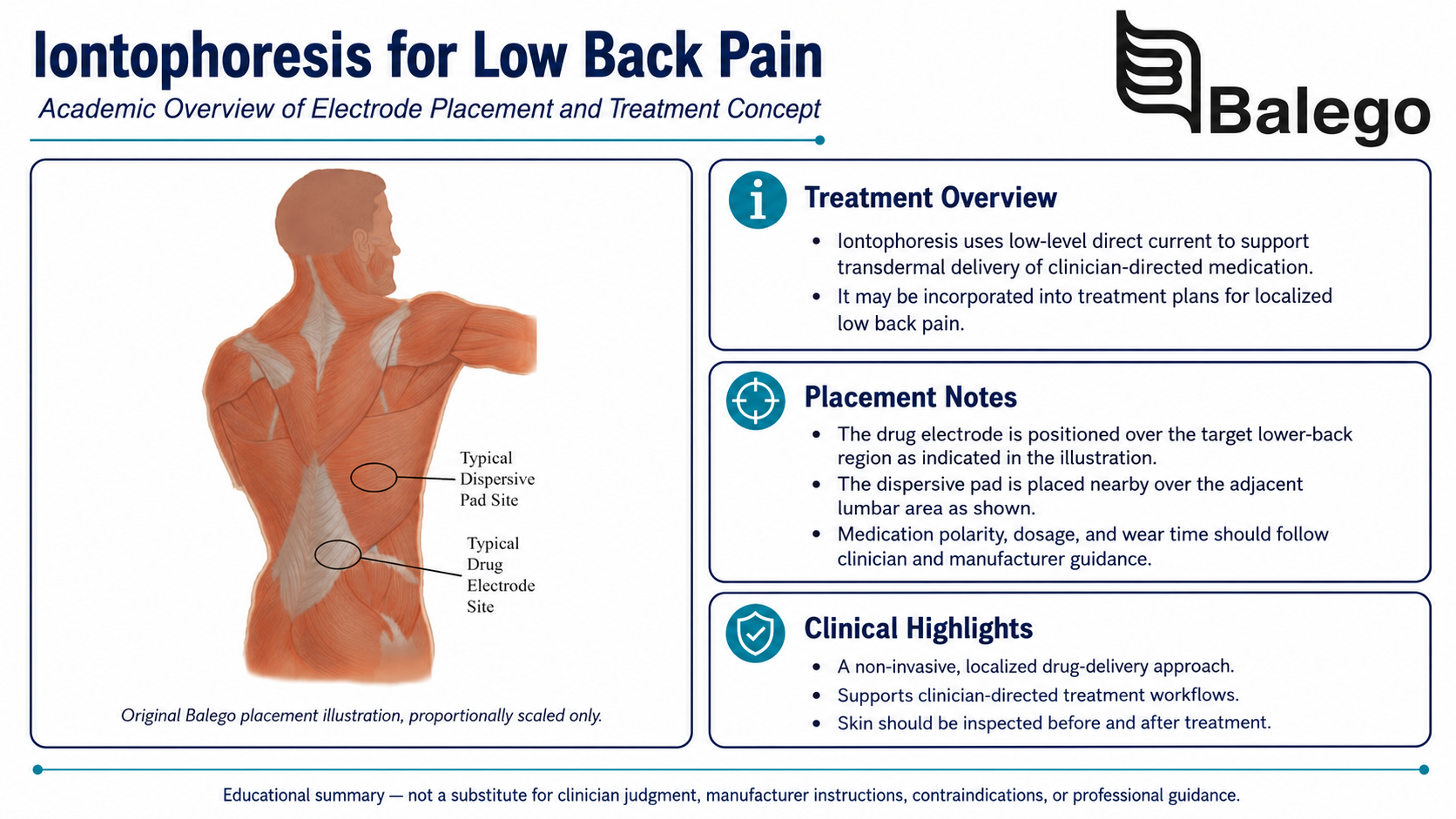
Low Back Iontophoresis at a Glance
| Clinical question | Practical answer |
|---|---|
| Is iontophoresis appropriate for every type of low back pain? | No. Lumbar pain must first be evaluated and classified. |
| What presentation may be the best fit? | A focal, accessible soft-tissue target with localized tenderness and an appropriate medication order. |
| When is it unlikely to be the primary intervention? | Diffuse nonspecific pain, suspected disc or nerve-root compression, widespread sensitization, or pain without a clearly localized target. |
| What dose is commonly described in this protocol? | A clinician-directed 40 mA-min treatment, adjusted according to the prescription and product instructions. |
| Where is the drug electrode placed? | Over the professionally identified treatment target—not automatically over the center of the lumbar spine. |
| What determines success? | Improved function and activity tolerance, not merely temporary changes in a pain score. |
Is Iontophoresis Appropriate for This Patient’s Low Back Pain?
The first decision is not which patch or electrode to use. The first decision is whether the patient’s presentation is suitable for localized transdermal drug delivery.
Patient-selection guide
| Presentation | Where iontophoresis may fit |
|---|---|
| Focal tenderness that can be reproduced over an accessible lumbar soft-tissue structure | May be considered as an adjunct after examination and medication review |
| Broad bilateral aching without a distinct tender point | Often a weak match for a focal drug-delivery treatment |
| Pain extending into the leg with numbness, weakness or altered reflexes | Complete a neurological assessment and address possible nerve-root involvement |
| Pain primarily associated with fear of movement, deconditioning or reduced activity tolerance | Prioritize education, graded movement and an individualized exercise program |
| New bowel or bladder changes, perineal numbness or progressive weakness | Stop the protocol and arrange immediate medical assessment |
| Suspected fracture, infection, malignancy, vascular disorder or referred visceral pain | Medical evaluation takes priority over localized modality treatment |
| Broken, infected, irritated or insensate skin at the proposed electrode site | Do not proceed until suitability has been established under the applicable instructions |
New bladder or bowel disturbance, perineal sensory loss, rapidly progressive weakness, and bilateral neurological symptoms can indicate cauda equina involvement and require urgent assessment. Red flags may also raise concern for fracture, malignancy, or spinal infection.
Focused Lumbar Evaluation Before Treatment
A useful examination should establish whether there is a specific target for iontophoresis and create measurable baselines for reassessment.
1. Clarify the pain pattern
Document:
- Location and distribution of symptoms
- Onset, duration and suspected mechanism
- Constant versus intermittent symptoms
- Aggravating and relieving positions
- Morning, evening and activity-related patterns
- Leg symptoms, numbness, tingling or weakness
- Previous episodes and prior treatment response
- Current medications, allergies and relevant medical history
2. Screen for nonmechanical and serious causes
Determine whether symptoms could reflect:
- Cauda equina syndrome
- Progressive neurological compromise
- Vertebral fracture
- Infection
- Malignancy
- Inflammatory disease
- Vascular pathology
- Referred abdominal, urinary or reproductive-system symptoms
Routine modality treatment should not delay referral when the history or examination suggests serious pathology.
3. Identify a reproducible treatment target
Palpation may help distinguish a localized tender point from generalized guarding or diffuse sensitivity. Note:
- Exact site and size of the tender area
- Depth and quality of tenderness
- Whether palpation reproduces the patient’s familiar pain
- Presence of swelling, warmth, bruising or altered skin
- Relationship between the tender point and lumbar movement
Deep midline pain or widespread symptoms or pain that cannot be reliably localized may be poorly suited to a focal iontophoresis application.
4. Establish functional baselines
Record at least one activity that matters to the patient, such as:
- Sitting tolerance
- Standing tolerance
- Walking distance
- Bending or lifting
- Transitional movement
- Work duties
- Sleep interruption
- Sport or household activity
Pain ratings can be useful, but function provides a better basis for determining whether treatment is helping.
When Iontophoresis May—and May Not—Fit the Plan
Iontophoresis uses direct current to assist the transdermal delivery of an appropriately charged medication. For an explanation of medication polarity and mA-min dosing, refer patients and clinicians to our Iontophoresis Frequently Asked Questions.
The lumbar application presents several clinical challenges:
- Low back pain is frequently diffuse. A small drug electrode is better suited to a defined target than to a broad region of symptoms.
- Many lumbar pain generators are deep. A surface drug-delivery treatment should not be described as directly correcting a disc herniation, spinal stenosis, vertebral lesion, or nerve compression.
- The application site is exposed to pressure. Chair backs, car seats, belts, waistbands, and lying positions can compress or displace a lumbar patch.
- Movement changes skin tension. Lumbar flexion, extension, and rotation may lift an adhesive edge or concentrate pressure across an electrode.
- Perspiration and clothing friction matter. These factors may affect adhesion and skin tolerance during a wearable treatment.
The goal is therefore not to “treat the entire lower back.” It is to determine whether a specific, professionally identified target is compatible with localized medication delivery.
Step-by-Step Low Back Pain Iontophoresis Protocol
Step 1: Verify the prescription and treatment objective
Before opening a patch or electrode kit, confirm:
- Prescribed medication or solution
- Medication concentration
- Required electrical polarity
- Intended dose
- Treatment location
- Relevant medication allergies
- Device-specific precautions and contraindications
Medication is not included with iontophoresis patches, electrodes, or dose controllers.
Step 2: Inspect and map the skin
Examine the proposed active and return-electrode sites. Do not place an electrode over compromised, infected, or significantly irritated skin.
Mark the focal treatment target when appropriate so it remains identifiable after skin preparation.
Step 3: Select the delivery system
Choose between a self-powered wearable patch and a controller-based electrode system according to the prescribed dose, treatment environment, required monitoring, and ability to avoid pressure on the lumbar area.
See the product comparison below for lumbar-specific considerations.
Step 4: Prepare the skin
Follow the electrode or patch instructions for use. In general:
- Remove lotion, oil and residue
- Ensure the skin is clean and dry
- Clip excess hair when necessary
- Avoid creating fresh skin irritation immediately before treatment
- Do not apply over cuts, abrasions or active dermatitis
Detailed preparation and polarity guidance is available in our Iontophoresis Electrodes Directions for Use.
Step 5: Prepare the medication chamber or electrode
Add only the prescribed amount and type of medication or solution. Confirm the medication’s polarity before connecting the active electrode or preparing the appropriate patch chamber.
Do not assume that every corticosteroid, anesthetic, or anti-inflammatory solution uses the same polarity.
Step 6: Position the active electrode
Place the active drug-delivery electrode over the identified focal target.
For low back treatment:
- Avoid automatic placement directly over the spinous processes
- Avoid prominent bone when a flatter soft-tissue site is available
- Ensure complete adhesive contact
- Do not bridge damaged skin or deep skin folds
- Select an electrode footprint that reasonably matches the target
The treatment location should follow the evaluation—not a generic diagram.
Step 7: Position the return electrode
With a controller-based system, place the return electrode on nearby intact tissue according to the electrode and device instructions.
The site should:
- Provide complete contact
- Avoid excessive pressure
- Avoid damaged or poorly innervated skin
- Permit adequate separation from the active electrode
- Remain visible or accessible for monitoring when possible
Step 8: Check the treatment position
Before beginning treatment, simulate the patient’s likely movement and posture.
Confirm that the patient will not:
- Lie directly on the electrodes
- Press the patch against a chair back
- Trap it beneath a belt or tight waistband
- Repeatedly flex or twist in a way that lifts the adhesive
- Cover it with a rigid brace unless explicitly permitted
A wearable patch is wireless, but it is not pressure-proof.
Step 9: Deliver the prescribed dose
The source lumbar protocol describes a 40 mA-min dose. That dose should not be treated as universal. Final dosing must follow the medication order, clinical response, device instructions, and electrode limits.
For controller-based treatments, dose is calculated as current multiplied by time. The ActivaDose II Iontophoresis Dose Controller displays the selected dose, actual current, and remaining treatment time and automatically recalculates time when the current is adjusted.
The source protocol describes treatment every other day with reassessment during a course of approximately three to six treatments. Current frequency should be individualized rather than applied as a fixed rule.
Step 10: Monitor the patient and skin
During treatment, ask about:
- Increasing burning
- Sharp or painful stimulation
- Excessive itching
- Patch movement
- Clothing or surface pressure
- New neurological symptoms
After treatment, inspect and document the skin response. Mild transient redness may occur, but pain, blistering, persistent irritation, or other unexpected reactions require appropriate follow-up under the product instructions and facility policy.
Comparing Iontophoresis Products for a Lumbar Workflow
The table below focuses specifically on treatment logistics for the low back rather than repeating the full specifications available on each product page.
| Product approach | How the workflow differs | Potential lumbar advantage | Important lumbar consideration |
|---|---|---|---|
| IontoPATCH iontophoresis patches | Self-contained, single-use wearable treatment without an external controller or lead wires | Allows treatment outside a conventional wired session when professionally directed | The patient must avoid sitting, lying or placing clothing pressure directly over the patch |
| ACTIVApatch iontophoresis patches | Wireless models provide several treatment-duration choices without an external controller | Treatment duration can be matched to clinic scheduling and patient activity | Shorter wear does not eliminate the need for secure adhesion, skin monitoring and pressure avoidance |
| ActivaDose II controller with iontophoresis electrode kits | The reusable controller provides selectable current and dose with disposable active and return electrodes | Supports direct clinician monitoring and multiple electrode-size choices | Requires lead wires, compatible electrodes and an appropriate monitored treatment position |
| ActivaDose II with Trivarion electrodes | Controller-based treatment using flexible, form-fitting electrode options | May help when an irregular contour makes consistent contact difficult | Electrode shape should be selected for the actual target, not solely because the patient reports broad back pain |
IontoPatch and ACTIVApatch are self-powered wearable product families, while ActivaDose II provides a reusable, adjustable controller-based workflow. Balego’s electrode lines include multiple sizes for matching the footprint and medication capacity to the clinical application.
For a detailed model-by-model wearable comparison, use our IontoPatch vs. ACTIVApatch guide rather than reproducing those specifications here.
Combine Symptom Management With Active Rehabilitation
For most appropriate low back pain presentations, iontophoresis should support a broader plan rather than become the entire plan.
| Iontophoresis objective | Active-care companion |
|---|---|
| Reduce a localized symptom barrier | Gradually restore comfortable movement |
| Improve tolerance for a specific activity | Practice that activity with appropriate progression |
| Address focal tenderness under a medication order | Improve strength, endurance or movement control as indicated |
| Help a patient participate in therapy | Continue education and self-management outside the clinic |
| Support return to work or recreation | Progress task-specific loading and activity tolerance |
Physical therapy guidelines recommend exercise for numerous acute and chronic low back pain classifications. Chronic presentations may benefit from trunk strengthening, endurance training, movement-control exercise, aerobic activity, or other individualized exercise approaches. Education is more effective when integrated with active treatment than when provided as passive information alone.
Reassessment: How to Decide Whether Treatment Is Helping
Reassess the same measures collected at baseline.
Positive indicators
- Reduced focal tenderness
- Improved tolerance for sitting, standing or walking
- Easier bending, lifting or transitional movement
- Improved lumbar movement without increased symptoms
- Reduced reliance on protective movement
- Progress toward work, household or recreational goals
- Acceptable skin response
Reasons to reconsider the plan
- No meaningful functional change after the planned trial
- Pain becomes more diffuse
- Increasing leg symptoms
- New weakness, numbness or reflex changes
- Repeated skin irritation
- Inability to keep the electrode free from pressure
- Findings no longer support the original treatment target
A lack of improvement should prompt reconsideration of the diagnosis, target, dose, delivery method, and overall rehabilitation plan—not merely repetition of the same modality.
Frequently Asked Questions
Can iontophoresis be used for lower back pain?
It may be considered when a clinician identifies a localized treatment target and a prescriber orders a suitable ionized medication. It is not appropriate for every cause of lumbar pain and should not be promoted as a direct treatment for spinal stenosis, disc herniation, fracture, infection, or cauda equina syndrome.
Where are iontophoresis electrodes placed for low back pain?
The active drug electrode is generally positioned over the professionally identified focal target. With a controller-based system, the return electrode is placed on nearby intact tissue according to the device and electrode instructions. There is no single placement that is correct for every patient.
What is the typical iontophoresis dose for lumbar pain?
The protocol reviewed here describes 40 mA-min. The prescribed dose, current, and treatment time may differ depending on the medication, device, electrode limits, and patient response.
Is dexamethasone included with an iontophoresis patch?
No. Iontophoresis products sold by Balego do not include medication. Medication selection, concentration, polarity, and placement require professional direction.
How many iontophoresis treatments are used for low back pain?
The source protocol describes approximately three to six treatments, often performed every other day, followed by reassessment. This is not a universal schedule. The course should be based on the prescription, clinical response, and product labeling.
Can a patient sit or lie on a lumbar iontophoresis patch?
Direct pressure should be avoided. A chair, car seat, treatment table, brace, belt, or tight garment may compress or displace the patch and increase skin irritation risk.
Is lumbar iontophoresis the same as TENS?
No. Iontophoresis is a drug-delivery modality using direct current and a prescribed ionized medication. TENS is an electrical stimulation modality used for sensory-level pain management and does not use a drug reservoir. Browse our complete iontophoresis collection for compatible patches, controllers, and electrode systems.
Closing Clinical Perspective
The most important part of a low back iontophoresis protocol occurs before the device is opened. Clinicians must determine whether the pain is local or diffuse, superficial or deep, mechanical or potentially systemic, and whether there is a clearly defined target for prescribed transdermal medication delivery.
When those conditions are met, iontophoresis may be incorporated as a focused adjunct to help the patient participate in an active, function-centered rehabilitation plan. When they are not met, a patch placed over the painful area is unlikely to address the underlying clinical problem.
Continue exploring our Iontophoresis Treatment Protocols for additional evaluation, placement, and documentation guides.


