



The SmartPower™ LED is the visual feedback system built into the ACTIVApatch IntelliDose 2.5 iontophoresis patch. Its flash pattern communicates whether the patch has been activated, whether skin resistance is acceptable, which treatment stage is underway, and when the electrical treatment has ended.
SmartPower is available only on IntelliDose 2.5. The ACTIVApatch IontoGo 4.0 and IontoGo 12.0 are self-powered patches with automatic treatment shutoff, but they do not provide the same microprocessor-controlled LED status display.
IntelliDose 2.5 can provide:
- A 40 mA-min electrical treatment in approximately 1 hour and 15 minutes
- An 80 mA-min electrical treatment in approximately 2 hours and 30 minutes
- Skin-resistance monitoring
- Treatment-stage feedback
- Automatic treatment completion through SHUNT® technology
- Wireless treatment without an external controller or lead wires
The LED reports the patch’s electrical operating status. It does not directly measure how much medication has entered the skin or reached the targeted tissue.
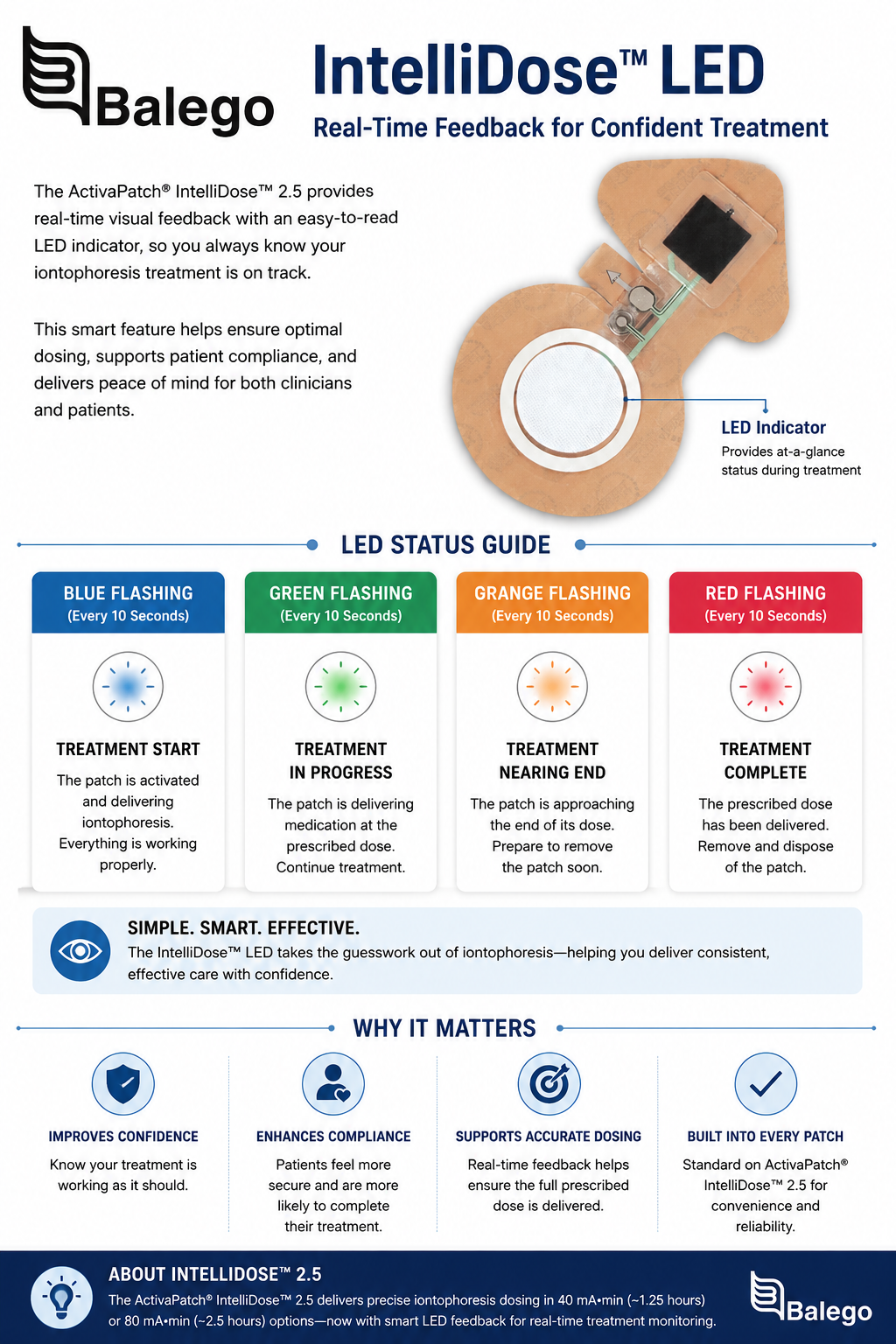
IntelliDose 2.5 LED Flash Codes at a Glance
| LED pattern | What it means | Recommended response |
|---|---|---|
| One flash every 4 seconds | Open circuit: patch is activated, functional, and ready to apply | Continue preparing and applying the patch |
| Three flashes every 10 seconds | Skin resistance is too high | Leave the patch in place for up to 15 minutes while it continues checking resistance |
| One flash every 30 seconds | Skin resistance is acceptable; treatment has started | The first 40 mA-min treatment is underway |
| Short-long-short pattern for 3 minutes | The first 40 mA-min treatment is complete | Remove if 40 mA-min was prescribed, or leave in place for the second stage |
| Two flashes every 30 seconds | The second 40 mA-min treatment is underway | Continue wearing the patch until completion |
| LED off after the full treatment | End of the 80 mA-min treatment | Remove and discard the patch as instructed |
| No light after pulling the activation tab | The patch did not activate properly | Do not apply it; discard it and use another patch |
The flash chart identifies the patterns by timing and cadence. It does not assign different meanings to green, red, or other LED colors.
What Is SmartPower LED Feedback?
SmartPower combines an intelligent microprocessor with a flashing LED. The microprocessor evaluates the electrical resistance between the patch and the patient’s skin, while the LED translates that information into recognizable flash patterns.
The system helps answer several practical questions:
- Has the patch been activated?
- Is the circuit still open because the patch has not yet been applied?
- Is skin resistance within the acceptable range?
- Has treatment actually begun?
- Is the first 40 mA-min stage complete?
- Has the second 40 mA-min stage started?
- Is the full 80 mA-min treatment complete?
This is more information than a conventional extended-wear patch without a display can provide. However, SmartPower does not diagnose the patient, assess clinical improvement, verify medication selection, or measure tissue drug concentration.
The Complete IntelliDose LED Sequence
Stage 1: One Flash Every Four Seconds
After the battery pull tab is removed, the LED should flash once every four seconds.
This means:
- The patch has activated.
- The circuit is open because the patch is not yet connected through the skin.
- The electronic system is functioning.
- The patch is ready for reservoir preparation and application.
This initial pattern does not mean that iontophoresis treatment has started. It is a pre-application readiness signal.
If the LED does not light after the tab is removed, the manufacturer instructs the user to discard the patch and use another one.
Stage 2: The Patch Checks Skin Resistance
Once the prepared patch is placed on the skin, the microprocessor evaluates resistance across the treatment circuit.
The LED will then show one of two patterns:
| Pattern after application | Interpretation |
|---|---|
| One flash every 30 seconds | Resistance is acceptable and treatment has started |
| Three flashes every 10 seconds | Resistance is too high for normal treatment to begin |
Skin resistance is affected by factors such as skin preparation, dryness, treatment location, electrode contact, creams or oils, and individual skin characteristics.
Stage 3: One Flash Every 30 Seconds
When the LED changes to one flash every 30 seconds, skin resistance is within the acceptable range, and the first treatment stage has begun.
The patch is now working toward the first 40 mA-min electrical dose. This stage takes approximately 1 hour and 15 minutes.
The LED confirms normal electrical operation and acceptable impedance. It should not be described as proof that a specific number of medication milligrams has reached the tissue.
Stage 4: Short-Long-Short Transition Pattern
At the end of the first treatment stage, the LED enters a transition pattern lasting approximately three minutes:
Short flash → long flash → short flash
This sequence indicates that the first 40 mA-min treatment has been completed.
At this point:
- The patch may be removed if the prescribed treatment is 40 mA-min.
- The patch may remain in place if the prescribed treatment is 80 mA-min.
- The patient should follow the treating clinician’s specific instructions rather than independently changing the dose.
The transition sequence is not an error message. It is a treatment milestone.
Stage 5: Two Flashes Every 30 Seconds
After the three-minute transition, the LED begins flashing twice every 30 seconds.
This indicates:
- The second 40 mA-min stage has started.
- The patch is continuing toward the full 80 mA-min treatment.
- Approximately another 1 hour and 15 minutes remains under typical treatment conditions.
The combined treatment time for both stages is approximately 2 hours and 30 minutes.
Stage 6: LED Turns Off
At completion of the full 80 mA-min electrical treatment:
- The LED turns off.
- Patch power turns off.
- The patch can be removed.
- The single-use device should be discarded.
IntelliDose uses patented SHUNT® technology to terminate the electrical treatment. Learn more in our guide to SHUNT technology and automatic iontophoresis shutoff.
What Do Three Flashes Every 10 Seconds Mean?
Three flashes every 10 seconds indicate high skin resistance.
The patch has detected that the treatment circuit does not yet permit normal current flow. The user to leave the patch in place for up to 15 minutes while IntelliDose continues measuring resistance.
What Happens Next?
| What the LED does | Meaning |
|---|---|
| Changes to one flash every 30 seconds | Resistance has fallen into the acceptable range and treatment has begun |
| Continues flashing three times every 10 seconds after 15 minutes | Skin resistance remains too high for IntelliDose treatment |
| Turns off unexpectedly | Do not assume treatment is complete; follow clinician or manufacturer guidance |
When acceptable resistance is not established within 15 minutes, the manufacturer recommends considering a controller-based treatment such as the ActivaDose II Iontophoresis Dose Controller with appropriate electrodes such as Trivarion iontophoresis delivery kits.
What Can Cause High Skin Resistance?
Possible contributors include:
- Skin that was not adequately cleaned
- Residual lotion, cream, oil, or other skin products
- Incomplete contact between the patch and skin
- A difficult or highly contoured treatment location
- Excessive hair
- Very dry skin
- Improper reservoir filling
- Visible dry areas within the medication reservoir
- Patient-specific skin impedance
These are possible contributors rather than a diagnosis of the exact cause. The patient should not improvise by adding more medication, taping the patch down, tightly wrapping it, or compressing it.
What Should You Do When High Resistance Persists?
- Leave the patch in place for up to 15 minutes while it continues evaluating resistance.
- Watch for the LED to change to one flash every 30 seconds.
- Do not add more medication after the patch has been applied.
- Do not tape, bind, wrap, or compress the patch.
- Do not assume that three flashes mean treatment is progressing normally.
- If the pattern does not change within 15 minutes, follow the treating clinician’s instructions.
- The clinician may choose a wired dose controller and compatible iontophoresis electrodes.
Public guidance specifically recommends the ActivaDose II and an appropriate wired electrode when IntelliDose cannot establish acceptable resistance.
What the SmartPower LED Can—and Cannot—Confirm
SmartPower Can Indicate
- Successful activation
- Open-circuit readiness before application
- High or acceptable skin resistance
- Start of electrical treatment
- Completion of the first 40 mA-min stage
- Start of the second treatment stage
- Completion of the full 80 mA-min electrical treatment
SmartPower Cannot Directly Confirm
- The exact quantity of medication transported through the skin
- Medication concentration within a tendon, joint, or other tissue
- Whether the correct medication was placed in the reservoir
- Whether medication polarity was correctly identified
- Whether the patient’s condition is improving
- Whether a treatment is medically appropriate
- Whether redness or discomfort is clinically acceptable
- Whether a medication reaction is developing
What Does 40 or 80 mA-min Mean?
The IntelliDose treatment rating is expressed in milliamp-minutes, abbreviated mA-min or mA·min.
The calculation is:
Electrical dose = current in milliamps × treatment time in minutes
A 40 mA-min treatment and an 80 mA-min treatment describe electrical charge delivered over time. They do not mean 40 or 80 milligrams of medication.
| Term | Meaning |
|---|---|
| 40 mA-min | First electrical treatment stage |
| 80 mA-min | Full two-stage electrical treatment |
| 2.0 cc | Solution volume used to fill the medication reservoir |
| Medication concentration | Amount of medication per unit of liquid |
| Medication loaded | Amount placed in the patch |
| Medication transported | A portion moved across the skin |
| Tissue concentration | Amount ultimately present at a sampled tissue location |
Actual medication transport can vary with the medication formulation, ionic charge, concentration, skin resistance, treatment site, reservoir preparation, and patient physiology. The LED monitors the electrical treatment—not medication molecules within the body.
SmartPower™ vs. SHUNT® Technology
SmartPower and SHUNT work together in IntelliDose 2.5, but they serve different functions.
| Feature | SmartPower™ | SHUNT® |
|---|---|---|
| Primary purpose | Treatment-status and skin-resistance feedback | Automatic electrical treatment termination |
| Main components | Microprocessor and LED | Internal shutoff technology |
| Provides visible information | Yes | Not by itself |
| Monitors skin resistance | Yes | Not described as its primary role |
| Indicates treatment stages | Yes | No visible stage display |
| Ends the full treatment | LED reports completion | Terminates or turns down electrical output |
| Available on IntelliDose 2.5 | Yes | Yes |
| Available on IontoGo 4.0 | No | Yes |
| Available on IontoGo 12.0 | No | Yes |
SmartPower tells the user what stage the electrical treatment is in. SHUNT ends the treatment after the intended electrical capacity is complete.
IntelliDose 2.5 vs. IontoGo 4.0 vs. IontoGo 12.0
All three current ACTIVApatch products are self-contained, wireless, single-use iontophoresis patches. They do not require a separate controller, charging station, lead wires, or saline activation.
Only IntelliDose 2.5 includes SmartPower LED feedback.
| Feature | IntelliDose 2.5 | IontoGo 4.0 | IontoGo 12.0 |
|---|---|---|---|
| Electrical dose | 40 or 80 mA-min | 80 mA-min | 80 mA-min |
| Approximate treatment time | 1.25 or 2.5 hours | 4 hours | 12 hours |
| SmartPower LED | Yes | No | No |
| Intelligent microprocessor | Yes | No | No |
| Skin-resistance alert | Yes | No visible alert | |
| SHUNT shutoff | Yes | Yes | Yes |
| Fill volume | 2.0 cc | 2.0 cc | 2.0 cc |
| Saline required | No | No | No |
| External controller | No | No | No |
| Medication included | No | No | No |
| Main distinction | Fastest option with visible feedback | Four-hour wearable treatment | Slower extended-wear treatment |
Patented shutoff technology on all three models, while the intelligent microprocessor and SmartPower LED are exclusive to IntelliDose 2.5.
Which Patch Offers the Most Feedback?
Choose IntelliDose 2.5 when the clinician wants:
- Visible confirmation that the patch activated
- Skin-resistance monitoring
- A high-resistance warning
- Confirmation of first-stage completion
- A choice between 40 and 80 mA-min
- A shorter treatment window
Choose an IontoGo model when:
- A simpler extended-wear patch is preferred
- A visible LED is not required
- A four- or 12-hour treatment window better fits the patient’s schedule
- An 80 mA-min treatment is prescribed
Model selection must still account for medication, polarity, skin condition, treatment location, prescribed electrical dose, and clinician judgment.
IntelliDose vs. a Wired Iontophoresis Controller
SmartPower provides more feedback than a basic wearable patch, but it does not offer the same level of direct control as a reusable controller.
| Feature | IntelliDose 2.5 | ActivaDose II |
|---|---|---|
| System type | Disposable wireless patch | Reusable wired controller |
| Current setting | Controlled internally | Clinician adjustable |
| Dose selection | 40 or 80 mA-min | Programmable up to 80 mA-min |
| Display | Flashing LED patterns | Numeric display for current, time, and dose |
| High-resistance warning | Three-flash pattern | Visual and audible alerts |
| Treatment time | Approximately 1.25 or 2.5 hours | Calculated from selected dose and current |
| External lead wires | No | Yes |
| Separate electrodes | No | Yes |
| Mobility during treatment | Greater | Patient remains connected |
| Best fit | Fast wearable treatment with status feedback | Supervised treatment requiring direct current control |
A wired setup can be paired with Trivarion electrodes or another compatible delivery kit. It may be preferable when skin resistance remains too high for IntelliDose or when the clinician wants to monitor and adjust current directly.
How to Apply IntelliDose 2.5 and Read the LED
1. Open the treatment pouch.
Each treatment pouch includes:
- One IntelliDose 2.5 patch
- One alcohol wipe
- One patient instruction card
2. Pull the Activation Tab
Hold the battery case and remove the pull tab.
Look for one flash every four seconds. This confirms that the patch is functional and ready for use.
Do not use the patch if the LED does not activate.
3. Inspect and Prepare the Skin
Confirm that the skin is intact. Current IntelliDose instructions direct the clinician to clean the treatment site with the supplied alcohol wipe and allow it to dry thoroughly.
Do not apply over:
- Damaged skin
- Recent scar tissue
- Gels, creams, or oils
- A freshly shaved area
Clip excessive hair when necessary rather than shaving immediately before treatment.
4. Fill the Medication Reservoir
Use a marked syringe to place 2.0 cc of the prescribed negatively charged ionic solution in the active reservoir.
- Do not underfill.
- Do not overfill.
- Make sure there are no visible dry spots.
- Lightly touch up a dry area with the syringe tip when necessary.
- Do not flood the reservoir.
ACTIVApatch uses a prehydrated dispersive hydrogel and does not require separate saline.
5. Apply the Patch
Remove the release liner and place the patch on the prescribed treatment area.
Do not press firmly over the filled reservoir because excessive pressure can cause solution leakage.
6. Confirm Treatment Has Started
After application:
- One flash every 30 seconds means acceptable resistance and normal treatment.
- Three flashes every 10 seconds mean resistance is too high.
7. Follow the Prescribed Dose
- Remove at the short-long-short transition only when a 40 mA-min treatment is prescribed.
- Leave the patch in place for two flashes every 30 seconds when an 80 mA-min treatment is prescribed.
- Remove when the LED turns off at full completion.
IntelliDose LED Troubleshooting
| Problem | Likely meaning | What to do |
|---|---|---|
| No LED after pulling tab | Patch failed to activate | Discard and use a new patch |
| One flash every 4 seconds before application | Open circuit and ready | Continue the application. |
| One flash every 4 seconds after attempted application | The circuit may not have closed | Check instructions and contact the clinician |
| Three flashes every 10 seconds | High skin resistance | Wait up to 15 minutes |
| The three-flash pattern continues beyond 15 minutes | Resistance remains too high | Stop and follow clinician guidance; wired treatment may be appropriate |
| One flash every 30 seconds | First stage operating normally | Continue treatment |
| Short-long-short pattern | First 40 mA-min completed | Remove for prescribed 40 mA-min or continue for 80 |
| Two flashes every 30 seconds | Second stage operating normally | Continue until completion |
| LED off at approximately 2.5 hours | Full 80 mA-min treatment complete | Remove and discard |
| LED goes off substantially earlier than expected | Completion cannot be assumed | Contact the clinician or product support |
| Burning or unusual discomfort | Possible adverse skin or medication response | Remove immediately and report it |
Safety Guidance While Wearing IntelliDose
| Topic | Manufacturer guidance |
|---|---|
| Prescription status | Use by or on the order of a physician |
| Medication polarity | Use only with an appropriate negatively charged ionic solution |
| Skin | Apply only to intact skin |
| Implanted electronics | Contraindicated with cardiac pacemakers or other electrically sensitive implanted devices |
| Drug sensitivity | Screen for allergies and sensitivities |
| Movement | Excessive motion may reduce electrode contact |
| Hair | Clip when necessary; do not shave the application site |
| Water | Do not get the electrodes wet |
| Pressure | Do not lean against, bind, tape, or compress the patch |
| Weight-bearing areas | Do not apply to weight-bearing surfaces |
| Metal | Keep jewelry and metallic objects away from the electrodes |
| MRI | Remove before MRI |
| Burning or discomfort | Remove immediately and report the reaction |
| Reuse | Single-use only |
| Skin redness | Temporary uniform redness may occur and should resolve within several hours |
Medication delivered by iontophoresis can potentially reach the bloodstream and produce systemic effects. Medication labeling, allergy information, dosing guidance, and contraindications must therefore be reviewed separately from the device instructions.
Frequently Asked Questions
Why is my IntelliDose light flashing once every four seconds?
That pattern indicates an open circuit. Immediately after activation and before application, it means the patch is functional and ready to use.
When has treatment actually started?
Treatment has started when the patch is on the skin and the LED flashes once every 30 seconds. That pattern means skin resistance is in the acceptable range.
What do three flashes every 10 seconds mean?
They indicate high skin resistance. Leave the patch in place for up to 15 minutes while the microprocessor continues checking resistance. If the pattern does not change, follow the clinician’s instructions.
Should I add more medication when the high-resistance light appears?
No. Do not add medication after application or assume that extra solution will correct resistance. Overfilling can produce leakage and uneven current distribution.
Can I tape IntelliDose down when the edges lift?
The manufacturer instructs users not to bind, tape, or compress the patch. Contact the treating clinician if movement or poor contact is interfering with treatment.
Does one flash every 30 seconds mean the medication is reaching the tissue?
It confirms acceptable skin resistance and normal electrical treatment. It does not directly measure the medication amount reaching tissue.
What does the short-long-short flash pattern mean?
It means the first 40 mA-min stage is complete. The sequence lasts approximately three minutes.
Can I remove IntelliDose after the first stage?
Yes, when the clinician has prescribed a 40 mA-min treatment. Leave it in place when an 80 mA-min treatment is prescribed.
What do two flashes every 30 seconds mean?
They indicate that the second 40 mA-min treatment stage is underway.
Why did the IntelliDose LED turn off?
At the expected completion time, the light turning off indicates that the full 80 mA-min electrical treatment is complete. The patch can then be removed.
What should I do if the light turns off too early?
Do not assume that the full prescribed treatment was delivered. Contact the treating clinician or Balego product support for guidance.
Does the LED change from green to red?
Instructions do not define green and red status codes. They identify each condition by flash frequency and sequence.
Do IontoGo 4.0 and 12.0 have the same LED?
No. SmartPower LED feedback is exclusive to IntelliDose 2.5. IontoGo patches use automatic SHUNT shutoff without a visible treatment-stage display.
Is SmartPower the same as SHUNT technology?
No. SmartPower monitors resistance and communicates status through the LED. SHUNT ends or turns down the electrical treatment at completion.
Does IntelliDose require saline?
No. Its hydrogel dispersive electrode is prehydrated. The active reservoir is filled with the prescribed ionic solution according to the instructions.
Can IntelliDose be used with positively charged medication?
The current instructions specify negatively charged ionic solutions. Do not use an unverified medication or polarity.
What should I do if the patch burns?
Remove it immediately and report the burning or discomfort to the treating healthcare professional. Do not continue simply to reach the expected treatment time.
The Bottom Line
The IntelliDose 2.5 SmartPower LED communicates treatment status through a specific sequence:
- One flash every four seconds: activated and ready
- Three flashes every 10 seconds: high skin resistance
- One flash every 30 seconds: first 40 mA-min treatment underway
- Short-long-short for three minutes: first 40 mA-min complete
- Two flashes every 30 seconds: second 40 mA-min underway
- LED off: full 80 mA-min treatment complete
The LED verifies electrical operation, skin-resistance status, and treatment stage. It does not measure the exact amount of medication entering the body or guarantee a clinical result.
Compare IntelliDose 2.5, IontoGo 4.0, and IontoGo 12.0, learn how SHUNT automatic shutoff works, or explore our complete collection of iontophoresis patches, controllers, and electrodes.
Medical and Professional-Use Notice
ACTIVApatch IntelliDose 2.5 is intended for professional, clinician-directed iontophoresis. Medication selection, concentration, electrical polarity, dose, treatment site, application, treatment duration, and frequency must be determined by an appropriately licensed healthcare professional.
This guide explains LED operation and does not replace the current product instructions, medication labeling, patient screening, clinical judgment, or emergency medical care.


