



IontoPatch® is a family of single-use, self-contained iontophoresis patches used in clinician-directed transdermal medication-delivery treatments. Unlike a conventional iontophoresis setup, the patch does not require a reusable controller or external lead wires while the treatment is being delivered.
IontoPatch is not a premedicated pain patch. The prescribed ionic medication is supplied separately, placed in the correct chamber according to its electrical charge, and used under the direction of an appropriately licensed healthcare professional.
This FAQ addresses the questions patients and clinicians most often have after IontoPatch has been selected:
- Which model should be used?
- Is medication included?
- Which chamber receives the medication?
- Can the patch be worn during exercise?
- What happens if it becomes wet?
- How long should it remain in place?
- What sensations and skin reactions are expected?
- How should the patch be removed and discarded?
For a visual application sequence, use our IontoPatch Application Quick-Start Guide. To learn about the electrical principles behind the patch, refer to How Does IontoPatch Work?.
Professional-use notice: The medication, formulation, concentration, polarity, patch model, treatment location, wear time, frequency, and total course must be determined by the treating or prescribing healthcare professional.
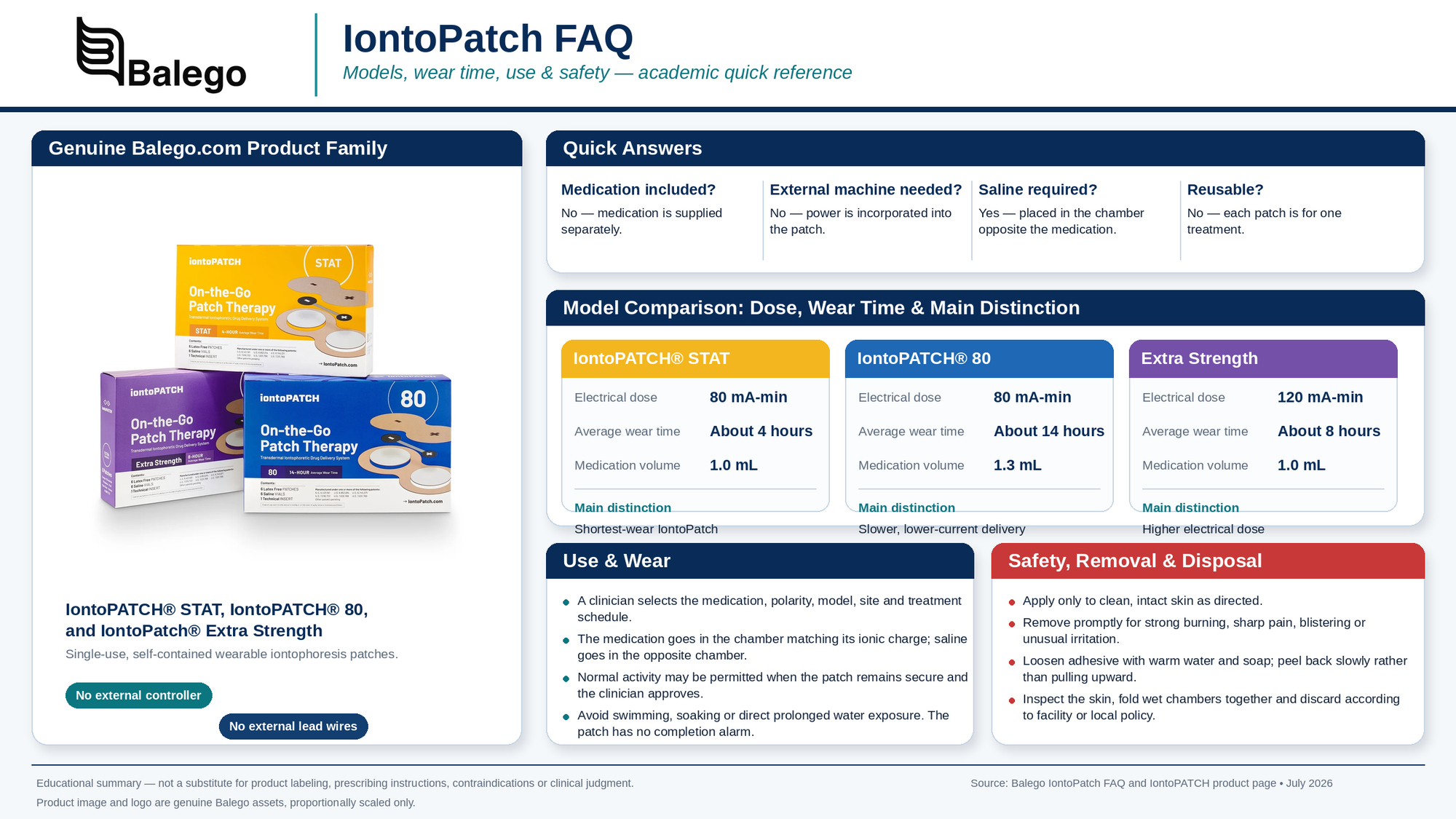
Quick Answers
| Question | Answer |
|---|---|
| Is IontoPatch preloaded with medication? | No. Medication is supplied separately. |
| Does it need an external machine? | No. The electrical power system is incorporated into the single-use patch. |
| Does it use external lead wires? | No. |
| Is it reusable? | No. Each patch is used for one treatment. |
| Which models does Balego currently carry? | IontoPATCH STAT, IontoPATCH 80, and IontoPatch Extra Strength |
| What doses are available? | 80 mA-min and 120 mA-min |
| What are the average wear times? | Approximately 4, 8, or 14 hours, depending on the model |
| Is saline required? | Yes. Saline is placed in the chamber opposite the medication. |
| Can either chamber carry medication? | The medication is placed in the chamber that matches its ionic charge. |
| Can the patient select the medication? | No. Medication selection requires professional direction. |
| Should every new patient start with STAT? | No. Model selection depends on the prescribed dose, skin, site, and schedule. |
| Is there a standard 12-treatment course? | No. Treatment number and frequency are condition- and patient-specific. |
| Can it be worn during normal activity? | Often, when the site remains secure and the clinician permits the activity. |
| How is it removed? | Slowly loosen the adhesive using soap and water. |
Is IontoPatch a Medication Patch?
IontoPatch is a medication-delivery device, but it does not contain medication when purchased.
A qualified professional must determine the following:
- Whether iontophoresis is appropriate
- Which medication or solution is prescribed
- The exact formulation and concentration
- The medication’s electrical charge
- The treatment target
- The correct IontoPatch model
- How often treatments should be performed
- How response and skin tolerance will be reassessed
The patch contains one positive and one negative treatment chamber. The prescribed ionic solution is placed in the chamber with the same electrical polarity as the medication. Saline is placed in the opposite chamber to complete the conductive circuit.
Which IontoPatch Models Are Available?
There are three models through the IontoPATCH product page.
| Model | Electrical dose | Average wear time | Medication volume | Main distinction |
|---|---|---|---|---|
| IontoPATCH STAT | 80 mA-min | About 4 hours | 1.0 mL | Shortest-wear IontoPatch |
| IontoPATCH 80 | 80 mA-min | About 14 hours | 1.3 mL | Slower, lower-current delivery |
| IontoPatch Extra Strength | 120 mA-min | About 8 hours | 1.0 mL | Higher electrical dose per application |
Each box contains six single-use treatment kits. Medication is not included. Average wear time varies because the patient’s skin resistance and treatment conditions affect current flow.
Which IontoPatch Should Be Selected?
There is no universal starter model.
| Clinical or scheduling priority | Model commonly considered | Reason |
|---|---|---|
| Shortest IontoPatch treatment window | IontoPATCH STAT | Provides 80 mA-min over an average of about four hours |
| Longer, lower-current delivery | IontoPATCH 80 | Spreads the same 80 mA-min dose across a longer period |
| Sensitive or fair skin | IontoPATCH 80 | Commonly positioned as the comfort-focused, lower-current model |
| Higher prescribed electrical dose | Extra Strength | Provides 120 mA-min |
| Larger medication volume | IontoPATCH 80 | Holds 1.3 mL rather than 1.0 mL |
| Busy daytime schedule | STAT | Shorter average wear period |
| Extended or overnight-directed workflow | IontoPATCH 80 | Approximately 14-hour average treatment window |
| Fewer higher-dose applications when prescribed | Extra Strength | Provides 50% more electrical dose than an 80 mA-min model |
Model selection should also account for the body contour, patch footprint, skin condition, medication formulation, treatment goal, activity during wear, and the patient’s ability to remove the patch at the instructed time.
Why STAT is not automatically the best first patch
STAT may be convenient because it has the shortest average wear time, but faster delivery is not automatically better for every patient.
IontoPATCH 80 may be a better fit when:
- Lower-current delivery is preferred
- Skin tolerance is a concern
- A 1.3 mL medication volume is required
- The patient can accommodate extended wear
Extra Strength should be selected only when the treating professional specifically wants a 120 mA-min treatment. It should not be chosen simply because symptoms are described as severe.
Does the patch include dexamethasone?
No. IontoPatch products do not include dexamethasone or another prescription medication.
Dexamethasone sodium phosphate is frequently discussed in iontophoresis treatment protocols, but the clinician must verify the following:
- The exact medication name
- Its formulation
- Concentration
- Ionic charge
- Prescribed volume
- Medication allergies
- Potential local and systemic effects
Which Chamber Receives the Medication?
The medication goes into the chamber that has the same charge as the medication.
| Medication charge | Correct chamber |
|---|---|
| Negatively charged ionic medication | Negative chamber |
| Positively charged ionic medication | Positive chamber |
The medicated chamber is then positioned over the clinician-identified treatment target. Saline is placed in the opposite chamber.
Where does dexamethasone sodium phosphate go?
Dexamethasone sodium phosphate is commonly treated as a negatively charged medication in iontophoresis workflows. However, the prescriber, pharmacist, and product instructions should still confirm the exact formulation and polarity before application.
Do not shorten this into a universal rule that “all dexamethasone always goes on the negative side.”
Why Is Saline Placed in the Other Chamber?
The saline moistens the return chamber and helps complete the electrical circuit through the skin. It is not the active medication.
The manufacturer instructs the clinician to:
- Place medication in the appropriately charged chamber
- Apply saline to the opposite chamber
- Leave a small, dry border around each chamber
- Avoid overfilling
- Discard unused saline
Typically, only part of the saline vial is used.
Can Medication Be Placed in Both Chambers?
The two-chamber design is technically capable of holding positively and negatively charged compounds. That does not mean two medications should routinely be combined.
Using more than one medication requires professional confirmation of:
- Ionic charge
- Chemical compatibility
- Concentration
- Stability
- Prescribed dose
- Medication interactions
- Patient-specific risks
Patients should never use the second chamber for an additional medication unless the complete treatment has been specifically ordered and professionally reviewed.
Where Should IontoPatch Be Placed?
The medicated chamber should be centered over the professionally identified treatment target, not merely the broad region where the patient reports pain.
Appropriate site selection considers:
- Which structure is being treated
- Whether the target is superficial enough for localized transdermal delivery
- Skin integrity and sensation
- Joint and muscle movement
- Bony prominences
- Clothing pressure
- Footwear, braces, or straps
- Ability to keep both chambers fully attached
- Ability to inspect and remove the patch
For diagnosis-specific positioning, use our Iontophoresis Treatment Guides.
Can IontoPatch Be Used Near the Base of the Thumb or Wrist?
It is possible when a clinician has identified a suitable target and the entire patch can maintain contact. However, the base of the thumb and the radial wrist can be challenging because of the following:
- Small surface area
- Frequent movement
- Bony contours
- Skin creases
- Sleeve or brace pressure
- Difficulty keeping both chambers flat
- Multiple possible causes of thumb-side wrist pain
Thumb arthritis, De Quervain’s tenosynovitis, intersection syndrome, nerve irritation, and wrist-joint disorders are not interchangeable diagnoses. The patient should not place a patch on the thumb side of the wrist solely because that location hurts.
For a diagnosis-specific examination and placement discussion, read our De Quervain’s Tenosynovitis Iontophoresis Protocol.
Can It Be Used on a Joint or Curved Body Area?
IontoPatch is flexible, but flexibility does not guarantee adequate contact at every location.
Before application:
- Position the joint in a comfortable midrange.
- Confirm that both chambers fit on intact skin.
- Apply the medicated chamber over the target.
- Smooth and secure the outer perimeter.
- Avoid pressing directly on the liquid-filled centers during initial application.
- Move the joint gently to ensure the edges do not lift.
Recommend positioning the joint midway through its available range and securing the patch around its outer edge.
Where Should IontoPatch Not Be Applied?
The manufacturer’s technical information specifically identifies the following restrictions:
- Do not apply over damaged or denuded skin.
- Do not use for treatment in the orbital region of the head.
- Do not wear the patch during an MRI procedure.
- Do not use a medication to which the patient is allergic or sensitive.
- Do not tightly wrap or apply prolonged excessive pressure over the patch.
The treating professional must also review all contraindications and warnings associated with the prescribed medication and the patient’s medical history.
Can I Exercise While Wearing an IontoPatch?
IontoPatch is designed to remain flexible during normal daily activity and can be worn during exercise when appropriate. Whether a particular activity is sensible depends on the application site and treatment plan.
Exercise may be unsuitable when it does the following:
- Repeatedly folds the patch
- Lifts an adhesive edge
- Produces heavy perspiration beneath the patch
- Places direct pressure over the reservoirs
- Causes friction from clothing or equipment
- Makes the treatment site painful
- Prevents the patient from monitoring the patch
- Conflicts with the injury’s activity restrictions
A clinician may permit additional securing tape or a loose supportive covering when needed. Do not tightly compress the patch or apply prolonged excessive pressure.
For a fuller activity discussion, read IontoPatch During Exercise.
Can I Shower While Wearing It?
The manufacturer advises minimizing direct water exposure.
When showering:
- Keep the patch out of the direct water stream when possible.
- Do not scrub it.
- Pat it dry gently if it becomes wet.
- Do not soak or immerse it in bathwater.
- Ensure that the edges remain fully attached.
Soap and prolonged immersion loosen the adhesive, which is useful during removal but not during continued treatment.
Can I Swim With IontoPatch?
No. The patch should not be immersed in a pool, hot tub, bath, lake, or other body of water.
Immersion can loosen the adhesive, disrupt skin contact, and make the treatment unreliable. Chlorinated, salty, or contaminated water may also irritate the treatment site.
Can I Sleep While Wearing IontoPATCH 80?
An extended-wear model may overlap with sleep when the clinician’s schedule allows it. The decision depends on the treatment site.
Avoid sleeping directly on the patch or placing it where
- Body weight compresses the reservoirs
- Bedding rolls the edges
- The patient cannot recognize worsening discomfort
- The patch will be trapped beneath a brace or tight clothing
- The adhesive will be exposed to substantial friction
Record the application and planned removal times before going to sleep. Do not extend treatment simply because the patient remains asleep beyond the intended removal time.
How long should the patch stay on?
| Model | Average delivery time |
|---|---|
| IontoPATCH STAT | About 4 hours |
| IontoPATCH 80 | About 14 hours |
| IontoPatch Extra Strength | About 8 hours |
These are average delivery times, not exact timers. Skin resistance, hydration, placement, contact, and individual physiology can alter current flow. Follow the clinician’s instructed removal time rather than waiting for a sensation or visual signal.
Does IontoPatch beep or indicate that treatment is complete?
No. The current IontoPatch models do not provide a completion alarm or LED status display.
The patient should be given:
- The application time
- The expected removal time
- The model name
- Instructions for early removal
- A contact number for questions
This differs from selected ACTIVApatch products, which use SHUNT® dose-completion technology or, in the case of IntelliDose, visible LED feedback.
What If I Forget to Remove the Patch?
Remove it when the oversight is noticed, using soap and water to loosen the adhesive.
Then inspect the skin for:
- Unusual redness
- Burning
- Blistering
- Swelling
- Discoloration
- Rash
- Medication reaction
Contact the treating professional when the patch has remained on substantially beyond the instructed time or when an abnormal skin or systemic reaction develops.
Do not intentionally extend wear to obtain “more medication.” Delivery is governed by the patch’s electrical capacity and declines after the model’s expected treatment period.
What Should I Feel During Treatment?
Many patients feel little or nothing during normal operation. Some may notice:
- Mild tingling
- A faint tugging sensation
- A light pulling sensation
- Awareness of the adhesive
Significant pain, strong burning, progressively worsening stinging, or unusual discomfort is not an intended treatment sensation.
When unexpected pain or burning occurs:
- Remove the patch with soap and water.
- Clean the site.
- Inspect the skin.
- Notify the healthcare provider.
- Do not apply another patch until instructed.
Prompt removal and professional notification when unusual discomfort or pain develops.
For more detail, read IontoPatch Discomfort: Irritation, Burning, and Removal.
Is Redness Normal After Removal?
Mild, temporary redness beneath the chambers or adhesive may occur. It should begin improving after the patch is removed.
Possible reasons include the following:
- Direct-current exposure
- Adhesive contact
- Friction during removal
- Sensitivity to the medication
- Sensitivity to saline or another solution
- Pressure over the patch
- Extended skin-contact time
Contact the treating professional when redness is severe, painful, blistered, spreading, unusually swollen, or persists longer than expected. Medication-related reactions can occur independently of the patch adhesive.
How Should IontoPatch Be Removed?
Do not pull the patch off quickly while it is dry.
A gentler removal method is the following:
- Wet the adhesive with warm water.
- Apply soap around the edges.
- Allow the adhesive to loosen.
- Peel the patch back slowly rather than pulling upward.
- Continue using soap and water as needed.
- Wash and dry the site.
- Inspect the skin.
A shower or bath can help loosen the adhesive during removal, but immersion should be avoided while treatment continues.
How Is the Used Patch Discarded?
After removal:
- Fold the patch so the two treatment chambers face one another.
- Seal the wet surfaces together.
- Follow facility policy or local disposal requirements.
- Keep used patches and medication residue away from children and pets.
A used patch may normally be folded closed and discarded. Healthcare facilities should still follow their own medication-waste and infection-control policies.
Can IontoPatch Be Reused?
No. The patch is single-use.
It should not be
- Refilled
- Reapplied
- Shared
- Repositioned after prolonged use
- Saved for another treatment
- Used after the chambers have dried
- Cut into a smaller shape
The electrode coatings and electrical capacity are consumed during treatment, and the adhesive and reservoirs are not designed for reuse.
Does IontoPatch Automatically Shut Off?
IontoPatch does not operate like a programmable electronic controller with a mechanical on/off switch.
The current is generated through its integrated electrode and power design when the prepared chambers make contact with the skin. Current flow declines as the electrochemical capacity is consumed. The absence of a felt sensation does not independently confirm treatment completion.
Can IontoPatch Cause Systemic Medication Effects?
Yes, potentially.
Although the treatment is intended for localized delivery, medication passing through the skin may enter systemic circulation. The patient must therefore be screened for the following:
- Drug allergies
- Medication interactions
- Contraindications
- Dose-related risks
- Pregnancy-related considerations
- Kidney, liver, cardiovascular, or other relevant medical conditions
- Previous reactions to the medication or adhesive
The patch format does not remove the medication’s pharmacological risks. Read the labeling for the prescribed drug or solution and report systemic symptoms promptly.
How Many IontoPatch Treatments Are Needed?
There is no universal number.
The current FAQ’s recommendation to begin with two boxes, or 12 treatments, should be removed. The treatment course depends on:
- Diagnosis
- Symptom duration
- Medication order
- Prescribed dose
- Treatment response
- Skin tolerance
- Rehabilitation plan
- Whether function is improving
- Whether the original diagnosis remains credible
A six-patch box is a purchasing unit, not a recommended clinical course.
How Often Should IontoPatch Be Used?
There is no universal daily-then-every-other-day schedule.
Treatment frequency must be determined by the prescribing or treating professional. It may depend on:
- Medication labeling
- Diagnosis
- Dose per patch
- Local skin response
- Systemic medication exposure
- Treatment goals
- Response to prior applications
- Other rehabilitation interventions
Patients should not increase frequency if symptoms remain present or if a previous patch caused little sensation.
How Should Treatment Success Be Measured?
Do not judge the treatment solely by whether the area feels different immediately after removal.
Useful reassessment measures include:
- Pain during a specific activity
- Joint movement
- Grip or lifting tolerance
- Walking or running tolerance
- Tenderness at the original target
- Strength
- Ability to participate in exercise
- Work or sport function
- Validated condition-specific outcome scores
- Skin tolerance
Continued passive treatment is difficult to justify when repeated applications do not produce a meaningful functional change.
Does Research Prove IontoPatch Works for Every Condition?
No.
Research supports the principle that iontophoresis can increase transdermal transport of appropriately charged medications. Clinical results differ according to the diagnosis, medication, dose, delivery system, comparison treatment, and study design.
A study of one tendon or one medication should not be generalized to the following:
- Every painful joint
- Every inflammatory condition
- Every medication
- Every patch model
- Every chronic pain problem
Our IontoPatch Research Guide reviews condition-specific studies and their limitations rather than treating all iontophoresis evidence as equivalent.
IontoPatch vs. Other Iontophoresis Systems
This brief comparison addresses workflow. For a complete model-by-model analysis, use our IontoPatch vs. ACTIVApatch comparison.
| Feature | IontoPatch | ACTIVApatch | ActivaDose II with electrodes |
|---|---|---|---|
| Treatment format | Self-contained patch | Self-contained patch | Reusable controller plus disposable electrodes |
| External lead wires | No | No | Yes |
| Saline required | Yes | No | It depends on selected electrode system |
| Dose choices | 80 or 120 mA-min | 40 or 80 mA-min | Clinician-selectable within system limits |
| Fastest current Balego option | STAT, about 4 hours | IntelliDose 80 mA-min, about 2.5 hours | Depends on prescribed dose and current |
| Extended-wear option | IontoPATCH 80, about 14 hours | IontoGo 12.0, about 12 hours | Usually a shorter monitored clinic treatment |
| Positively charged medication | Can use the matching positive chamber | Current models are labeled for negative ionic solutions | Depends on electrode and controller setup |
| Visual operating feedback | No LED | IntelliDose includes LED feedback | Controller display |
| Highest patch dose | 120 mA-min | 80 mA-min | Up to the controller and electrode limits |
| Best workflow distinction | Broadest patch dose and polarity range | No-saline preparation and faster options | Maximum control over current, dose, and treatment time |
No format is automatically superior. Selection depends on medication charge, prescribed dose, fluid volume, treatment site, required monitoring, skin-contact time, and clinic workflow.
Explore all available systems in our Iontophoresis Collection.
Frequently Asked Questions
What is the IontoPatch used for?
It is used for clinician-directed transdermal delivery of an appropriately selected soluble ionic medication through intact skin. It is often incorporated into treatment for localized musculoskeletal conditions when iontophoresis is clinically appropriate.
For examples of conditions and evidence boundaries, see What Is IontoPatch Used For?
Is IontoPatch a pain-relief patch sold with medication?
No. It is a medication-delivery device, and the prescribed medication is supplied separately.
Do I need a prescription?
Medication selection and iontophoresis treatment require professional direction. Purchasing rules and prescription requirements may vary according to the product, medication, jurisdiction, and intended use.
Which IontoPatch is best for a first-time patient?
There is no universal first-time model. STAT offers shorter wear, IontoPATCH 80 offers slower delivery, and Extra Strength provides a higher dose. The clinician should select the model.
Is IontoPATCH 80 stronger than STAT?
No. Both have an 80 mA-min electrical-dose capacity. STAT delivers the dose over a shorter average period, while IontoPATCH 80 delivers it more slowly over a longer period.
Is extra strength faster than STAT?
No. Extra Strength provides the larger 120 mA-min dose over approximately eight hours. STAT provides 80 mA-min over approximately four hours.
Does Extra Strength contain more medication?
Not necessarily. STAT and Extra Strength both have a listed 1.0 mL medication capacity. “Extra Strength” refers to its 120 mA-min electrical-dose capacity, not a preloaded medication amount.
Which side receives dexamethasone?
Dexamethasone sodium phosphate is commonly placed in the negative chamber, but the exact formulation and polarity must be professionally verified.
Does the negative side always go over the painful area?
Only when the prescribed medication is negatively charged. The medicated chamber goes over the identified treatment target, whether that chamber is positive or negative.
Can the patch be used on a hand or wrist?
Possibly when the diagnosis, target, skin, and body contour are suitable. High movement, creases, and small surface area can make application difficult.
Can I exercise with IontoPatch?
You may exercise with IontoPatch when your clinician permits it and your activity does not loosen, fold, compress, or saturate the patch.
Can I wear a brace over it?
Only when specifically directed. A brace may compress the reservoirs, roll the adhesive, trap moisture, and prevent skin monitoring.
Can I shower with it?
Minimize direct water exposure, do not immerse it, and pat it dry if it gets wet.
Can I wear it in a pool or hot tub?
No. Do not immerse the patch.
Should I feel electrical stimulation?
Many patients feel little or nothing. Mild tingling or tugging may occur. Burning, substantial pain, or progressively worsening discomfort requires removal.
What if the patch starts to peel?
Follow the clinician’s instructions. The outer perimeter may sometimes be supported with appropriate tape, but the reservoirs should not be tightly compressed. Replace or discontinue the treatment when secure contact cannot be maintained.
Can I move the patch after it has been applied?
It should not be repeatedly lifted and repositioned. Lifting can contaminate the adhesive, disturb the solutions, and reduce contact.
What if I put the medication on the wrong side?
Do not apply the patch. Contact the clinician or pharmacist for instructions and use a new patch if directed. Do not attempt to wash, reverse, or reuse the incorrectly prepared patch.
Can I add more medication if the chamber looks dry?
No. Use only the prescribed amount during initial preparation. Do not lift or refill an active patch.
Can I leave the patch on longer for a stronger treatment?
No. Follow the instructed removal time. Longer wear does not automatically produce a higher appropriate dose and may increase skin exposure.
How should it be removed?
Slowly loosen the adhesive using soap and water.
Is temporary redness normal?
Mild temporary redness can occur. Severe, painful, blistered, spreading, or persistent reactions require professional review.
Can IontoPatch be worn during an MRI?
No. Remove it before an MRI.
Can it be reused?
No. It is a single-use device.
How many patches come in a box?
Balego’s current STAT, 80, and Extra Strength options contain six treatment kits per box.
Does one box equal a complete treatment course?
No. Box quantity is not a clinical dosage schedule.
Is IontoPatch equivalent to an injection?
No. Iontophoresis and injection use different delivery routes, depths, concentrations, risks, and evidence. A wearable patch should not be described simply as an injection without a needle.
Where to Find More Detailed Guidance
| Reader’s question | Best Balego resource |
|---|---|
| What is IontoPatch? | About IontoPatch |
| How does iontophoresis move medication? | How Does IontoPatch Work? |
| How do I prepare and apply it? | IontoPatch Application Quick-Start Guide |
| What do mA-min and current mean? | IontoPatch Technical Overview |
| Which conditions are commonly discussed? | What Is IontoPatch Used For? |
| What does the research show? | IontoPatch Research |
| What if it burns or irritates the skin? | IontoPatch Discomfort Guide |
| Can it be worn during activity? | IontoPatch During Exercise |
| How do the three IontoPatch models compare? | IontoPATCH Product Page |
| How does it compare with ACTIVApatch? | IontoPatch vs. ACTIVApatch |
| What products does Balego carry? | Iontophoresis Collection |
| Where can I find diagnosis-specific protocols? | Iontophoresis Treatment Guides |
Key Takeaway
IontoPatch provides a wearable, self-contained alternative to a conventional wired iontophoresis treatment, but it is not a self-selected over-the-counter pain patch.
Safe and useful treatment requires the clinician to determine:
- The diagnosis and localized target
- Medication and formulation
- Ionic polarity
- Medication volume
- Electrical dose
- Appropriate patch model
- Wear time
- Treatment frequency
- Functional reassessment plan
The chamber matching the medication’s charge is placed over the identified treatment site. IontoPATCH STAT, IontoPATCH 80, and IontoPATCH Extra strength differs in electrical dose, medication capacity, current delivery rate, and average wear time. No model is automatically the correct starting choice for every patient.
Shop IontoPATCH STAT, IontoPATCH 80, and IontoPatch Extra Strength, or compare the complete selection of iontophoresis patches, controllers, and electrode systems.


