



NAD+ Polarity and Iontophoresis: Charge, Precursors and Clinical Evidence
Nicotinamide adenine dinucleotide, commonly abbreviated as NAD⁺, is an essential cellular coenzyme involved in oxidation-reduction reactions. Its name, molecular structure, and familiar plus sign often lead to a deceptively simple question:
Should NAD+ be placed under the positive electrode during iontophoresis?
The scientifically responsible answer is
The name NAD+ alone is not enough to determine electrode polarity.
Iontophoresis depends on the ionic behavior of the actual prepared solution, including its:
- Exact chemical form
- Salt and counterion
- Concentration
- Final pH
- Vehicle
- Ionic strength
- Stability
- Conductivity
- Electrode chemistry
- Device instructions
The plus sign in NAD+ distinguishes its oxidized biochemical form from NADH. It should not be treated as a universal instruction to place every product labeled “NAD+” under a positive iontophoresis electrode.
For the general principles of direct-current medication delivery, read Iontophoresis: Frequently Asked Questions. This article focuses specifically on NAD chemistry, precursor comparisons, and the limited clinical evidence for iontophoretic NAD delivery.
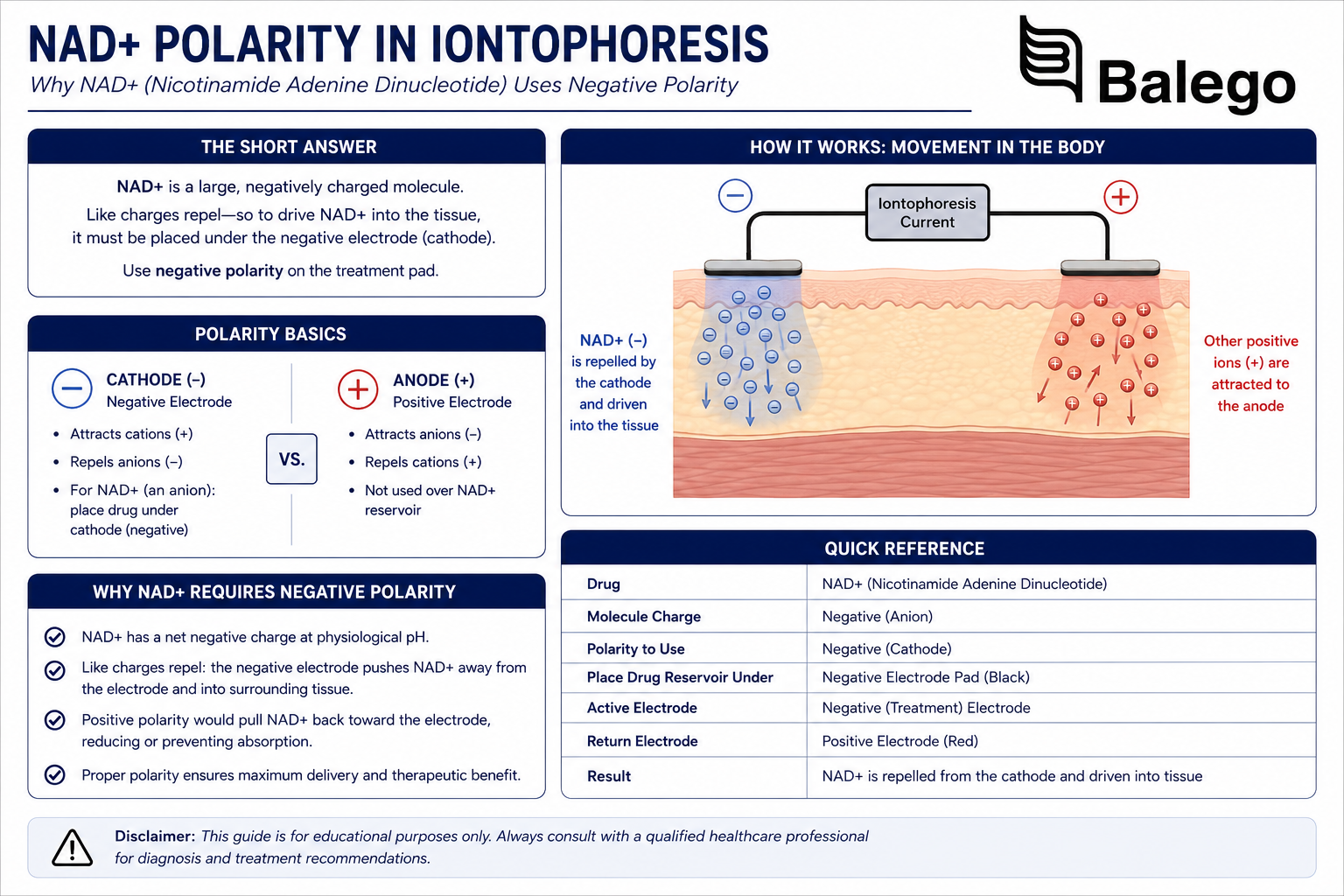
Quick answer: Is NAD+ positive or negative?
NAD+ contains a positively charged nicotinamide ring in its oxidized form. It also contains phosphate groups that can lose protons and become negatively charged in water.
The resulting net charge depends on pH and protonation state.
ChEBI catalogs:
- NAD+ as the oxidized coenzyme
- An NAD species with a net charge of −1 as a major species at pH 7.3
- NADH with a net charge of −2 as a major species at pH 7.3
Therefore, the biochemical abbreviation NAD+ does not establish that a prepared NAD solution will behave as a simple monovalent cation during iontophoresis. (EMBL-EBI)
Three different meanings of “polarity”
Much of the confusion comes from using the word "polarity" for three different chemical concepts.
| Meaning | What it describes | Does it determine the iontophoresis electrode? |
|---|---|---|
| Net ionic charge | The overall positive, negative or neutral charge of the species in the prepared solution | This is directly relevant, but must be established at the solution’s actual pH |
| Chemical polarity or lipophilicity | Whether a molecule preferentially associates with water or lipid environments | No, it may affect skin transport but does not identify positive versus negative electrode placement |
| Redox state | Whether NAD is in its oxidized NAD+ form or reduced NADH form | No, the plus sign identifies the redox form, not necessarily the final net solution charge |
Why XLogP cannot select an iontophoresis electrode
XLogP estimates how a neutral form of a compound partitions between octanol and water. It is often used in drug development as one measure of lipophilicity.
It does not directly inform the clinician about the dominant ionic species at the final pH.
- Which ionic species dominate at the final pH
- Whether the compound exists as a cation, anion or zwitterion
- Which counterions are present
- How much current competing ions will carry
- Whether the solution remains chemically stable
- Whether the molecule will move primarily through electromigration or electroosmosis
- Whether the medication is compatible with the electrode
- Whether meaningful transdermal delivery will occur
Iontophoresis can enhance transport through direct interaction between an electrical field and a charged molecule, through electroosmotic solvent movement, and through changes in membrane permeability. Both charged and neutral compounds can sometimes be transported, but their mechanisms and efficiency differ. (PubMed Central (PMC))
Electromigration versus electroosmosis
Electromigration
Electromigration—also called electrorepulsion—uses the principle that like charges repel.
- A positively charged drug species may be repelled from an anode.
- A negatively charged drug species may be repelled from a cathode.
This simple rule is most useful when the medication is predominantly present as one well-characterized ionic species in the actual treatment solution.
Electroosmosis
Electrical current can also create bulk solvent movement through the skin. That flow may carry:
- Neutral molecules
- Weakly charged molecules
- Larger compounds
- Species whose movement is not predicted by charge alone
The contribution of electroosmosis depends on the skin, pH, ionic strength, molecular size, and formulation properties. A neutral or zwitterionic molecule can be delivered, but its transport should be demonstrated rather than inferred from a name or structural formula. (PubMed)
NAD-family charge and chemistry comparison
The table below describes representative chemical species. It is not an electrode-placement chart.
| Compound | Biochemical role | Representative charge information | Can the name alone determine electrode polarity? |
|---|---|---|---|
| NAD+ | Oxidized cellular redox coenzyme | Contains a positively charged nicotinamide ring, but phosphate deprotonation can yield net-neutral or net-negative species; NAD(1−) is cataloged as a major species at pH 7.3 | No |
| NADH | Reduced redox partner of NAD+ | NADH(2−) is cataloged as a major species at pH 7.3 | No, exact formulation still matters |
| NMN | Nucleotide precursor used to synthesize NAD | ChEBI catalogs an NMN zwitterion with net charge 0 as well as protonated and deprotonated forms | No |
| NR | Nucleoside precursor of NAD | The parent structure contains a pyridinium cation and is commonly supplied as a salt such as NR chloride | No; salt, pH, and counterion must be considered |
| Nicotinamide | Vitamin B3 form and NAD precursor | Different structure from NR and NMN; final ionic behavior must be evaluated in the actual formulation | No |
| Nicotinic acid | Vitamin B3 form and NAD precursor | Nicotinate, with net negative charge, is the major species at pH 7.3 | No, confirm formulation pH |
| NADP+ | Phosphorylated cellular redox cofactor | Contains additional phosphate ionization and multiple possible charge states | No |
| NADPH | Reduced phosphorylated cellular cofactor | Highly anionic under many biological conditions | No |
NMN is cataloged as a zwitterion with a net charge of zero; NR is described structurally as a pyridinium compound, and nicotinate is the negatively charged major species of nicotinic acid at pH 7.3. (EMBL-EBI)
NAD⁺, NADH, NMN, and NR are not interchangeable
Although all participate in NAD metabolism, they differ substantially.
| Form | Category | Direct metabolic relationship | Common research or commercial context |
|---|---|---|---|
| NAD+ | Full oxidized coenzyme | Participates directly in redox reactions | Laboratory research, wellness infusions and limited experimental delivery research |
| NADH | Full reduced coenzyme | Donates reducing equivalents and converts back to NAD+ | Dietary supplements and metabolic research |
| NMN | Nucleotide precursor | Can be converted into NAD through biosynthetic pathways | Oral-supplement and aging research |
| NR | Nucleoside precursor | Converted through NR kinase and related pathways | Dietary supplements and human NAD-metabolism trials |
| Nicotinamide | Vitamin B3 form | Enters the NAD salvage pathway | Nutrition, dietary supplements and treatment of niacin deficiency |
| Nicotinic acid | Vitamin B3 form | Enters the Preiss–Handler pathway | Nutrition: prescription oral formulations have also been used for lipid disorders |
NIH defines niacin broadly to include nicotinic acid, nicotinamide, and related derivatives such as nicotinamide riboside. These forms should not be treated as identical medications or assumed to have interchangeable dosing, safety, or transdermal-delivery characteristics. (Ods)
What each NAD-related form is actually used for
A more accurate comparison separates established use from investigational interest.
| Compound | Established or recognized role | Investigational or marketed claims | Evidence caution |
|---|---|---|---|
| NAD+ | Essential endogenous cellular coenzyme | Fatigue, energy, recovery, aging and wellness applications | Direct therapeutic supplementation and transdermal delivery remain insufficiently established |
| NADH | Endogenous reduced coenzyme | Energy, fatigue, cognition and mitochondrial support | Disease-treatment claims are not established by its biochemical role |
| NMN | NAD biosynthetic precursor | Healthy aging, energy, metabolism and physical performance | Human studies may raise NAD-related biomarkers, but consistent clinical benefit remains unclear |
| NR | Vitamin B3-related NAD precursor | Healthy aging, metabolism and cellular-energy support | Human supplementation can alter NAD metabolism, but many functional outcomes remain uncertain |
| Nicotinamide | Vitamin B3 source; prevention or treatment of niacin deficiency | Skin health, metabolic and wellness applications | High-dose use differs from ordinary nutritional replacement |
| Nicotinic acid | Vitamin B3 source: prescription oral preparations have lipid indications | Cholesterol management and cardiovascular-risk marketing | Flushing, liver effects and other risks make medical supervision important at pharmacologic doses |
| NADP+/NADPH | Intracellular cofactors in biosynthesis and antioxidant systems | Occasionally included in broad “NAD family” discussions | They are not established substitutes for NAD⁺ therapy |
| NAADP | Intracellular signaling molecule involved in calcium signaling | Primarily laboratory research | It is not an established consumer treatment |
Niacin’s established role as vitamin B3 and the use of prescription nicotinic-acid preparations for lipid management should not be transferred to NAD⁺, NMN, NR, or NADH. (Ods)
Does raising NAD biomarkers mean a treatment works?
No.
A precursor can
- Be absorbed
- Change blood NAD metabolites
- Increase a laboratory biomarker
- Be tolerated for a short study period
without proving that it:
- Treats a disease
- Improves physical function
- Improves cognition
- Extends lifespan
- Reverses aging
- Reduces fatigue
- Improves long-term clinical outcomes
Reviews of human NAD-precursor trials conclude that NR and NMN can influence NAD metabolism, but evidence that those biochemical changes consistently improve physiological function remains unclear. Human tissue data and long-term clinical outcomes remain limited. (PubMed)
What evidence exists for NAD+ iontophoresis?
The most directly relevant published human study identified in this review was a 2024 pilot involving people with persistent fatigue after COVID-19.
What the study did
Participants received both:
- Low-dose naltrexone, prescribed at up to 4.5 mg per day
- NAD+ through an IontoPATCH STAT once weekly
The paper reports the following:
- 36 participants received treatment
- 31 were included in the efficacy analysis
- Treatment continued for 12 weeks
- The compounded solution contained 400 mg/mL NAD+
- One milliliter was applied to the positive electrode
- Saline was placed under the negative electrode
- Patches were worn for approximately four to six hours
The study began with a placebo-controlled concept but was converted into an unblinded, open-label observational treatment arm because of enrollment difficulties.
What the study found
Self-reported quality-of-life and fatigue scores improved from baseline. The authors stated that larger randomized controlled trials would be needed to confirm the findings. Skin irritation at the patch site was the most frequent reported adverse event. (PubMed)
What the study cannot establish
The study cannot determine whether improvement was caused by:
- NAD+
- Low-dose naltrexone
- The combination
- Placebo effects
- Natural recovery
- Other concurrent care
It lacked a comparable control group in its final design, failed to isolate the effect of the patch, and relied primarily on patient-reported survey outcomes. The authors expressly acknowledged the lack of a comparable control and the possibility of a placebo effect or natural improvement.
Why the positive electrode does not create a universal rule
The investigators placed their specific compounded 400 mg/mL NAD+ solution under the positive electrode. That is a description of the study procedure—not proof that every NAD product, concentration, or formulation should be applied to the positive side.
The paper did not provide a complete ion-speciation analysis showing:
- Final solution pH
- Dominant net ionic species
- Counterion concentrations
- Conductivity
- Stability during the wear period
- Competing-ion transport
- Transdermal pharmacokinetics
- Systemic NAD exposure attributable to the patch
A clinician should not reproduce electrode polarity from the study without confirming the exact formulation with the prescriber, dispensing pharmacy, and device manufacturer.
Is NAD+ iontophoresis proven?
No.
The available pilot is hypothesis-generating. It does not establish:
- A validated NAD+ iontophoresis indication
- A standard concentration
- A standard electrical dose
- A universally correct electrode
- A proven systemic absorption profile
- Superiority to placebo
- Superiority to oral precursors
- Long-term safety
- Effectiveness for fatigue, aging, addiction, cognition or another condition
A claim such as “NAD+ iontophoresis treats chronic fatigue” would overstate the evidence.
A more accurate statement is
A small uncontrolled pilot evaluated weekly iontophoretic NAD⁺ as part of a combination regimen with low-dose naltrexone. Controlled studies are needed to determine whether the NAD component produces a clinically meaningful benefit.
Can IontoPATCH be used with NAD+?
IontoPATCH iontophoresis patches are self-contained electrical drug-delivery devices. They do not come prefilled with NAD⁺, dexamethasone, or another medication. The prescribing and treating professionals remain responsible for selecting the solution, polarity, concentration, volume, placement, and treatment plan.
The fact that one research group used IontoPATCH STAT does not mean the following:
- NAD⁺ is a standard labeled medication for the patch
- Every compounded NAD solution is compatible
- The positive chamber is universally correct
- A patient should fill or apply the patch independently
- Balego’s sale of the patch constitutes endorsement of NAD treatment
- The study’s protocol should be copied into routine practice
For the device mechanism and model options, read How Does IontoPatch Work? and the IontoPatch Technical Overview.
Information required before selecting iontophoresis polarity
A clinically usable polarity decision requires more than the ingredient name.
| Required information | Why it matters |
|---|---|
| Exact chemical identity | “NAD” may refer to NAD⁺, a salt, reduced NADH, or another derivative |
| Manufacturer or compounding source | Formulations may use different salts, buffers and excipients |
| Concentration | Affects conductivity, stability and competition among ions |
| Final pH | Determines protonation and the dominant ionic species |
| Counterion | May carry current and influence solution behavior |
| Vehicle | Water, saline and buffers have different ionic compositions |
| Ionic strength | Competing ions can reduce delivery efficiency |
| Net charge at treatment pH | Determines the direction of direct electromigration |
| Molecular stability | Current, pH and time may alter an unstable molecule |
| Electrode compatibility | The drug reservoir and electrode chemistry must tolerate the formulation |
| Prescriber instructions | Establish the intended medication, dose and clinical purpose |
| Pharmacist confirmation | Helps verify preparation, concentration, stability and handling |
| Manufacturer compatibility | Confirms whether the device has been evaluated for the intended solution |
For established iontophoresis-electrode handling principles, review Iontophoresis Electrodes—Directions for Use.
A safer polarity-verification workflow
Before treating with any uncommon or compounded iontophoresis solution:
- Obtain the exact prescription.
- Record the complete chemical name and salt form.
- Obtain the compounding formula or pharmacy label.
- Confirm the final concentration and vehicle.
- Obtain the measured or specified final pH.
- Determine the dominant ionic species at that pH.
- Confirm the medication chamber and return chamber.
- Verify device and electrode compatibility.
- Confirm electrical-dose and current-density limits.
- Document the clinical rationale and informed discussion.
- Inspect the skin during and after treatment.
- Stop for significant burning, pain, blistering, or unusual irritation.
Do not assign polarity based only on:
- A plus or minus symbol in the compound’s common name
- An XLogP value
- A supplement bottle
- An oral research study
- A marketing page
- A protocol using a different formulation
- The color of a solution
- A patient’s prior infusion dose
NAD+ iontophoresis versus oral precursors
| Question | NAD+ iontophoresis | Oral NMN or NR |
|---|---|---|
| Substance delivered | Full NAD compound in a prepared solution | Metabolic precursor |
| Route | Electrically assisted transdermal delivery | Gastrointestinal absorption |
| Evidence base | Very limited human clinical evidence | More human trials, but clinical benefits remain inconsistent |
| Electrode polarity required | Yes, based on formulation and device | No |
| Formulation pH important | Critically important | Relevant to product stability, but not electrode selection |
| Pharmacokinetic equivalence | Not established | Route-specific |
| Can evidence be transferred between routes? | No | No |
| Standard disease indication | Not established | Not established for general anti-aging or wellness claims |
Oral NR has been shown to alter NAD metabolism in human trials, and oral NMN studies have also reported increases in NAD-related biomarkers. Those results do not validate a transdermal NAD patch or establish an equivalent dose. (PubMed)
Iontophoresis system comparison for research and professional workflows
The device controls electrical delivery; it does not independently validate the medication.
| Balego option | Delivery format | Relevant advantage | NAD-specific limitation |
|---|---|---|---|
| IontoPATCH STAT, 80 and Extra Strength | Self-contained wearable patch | No reusable controller or external lead wires | Does not establish NAD formulation, polarity, absorption or efficacy |
| ActivaDose II Controller | Adjustable wired dose controller | Allows clinician selection of current and mA·min. dose | Greater electrical control does not validate an experimental medication |
| Ionto4 Electrode Kits | Single-use electrodes used with a compatible controller | Several reservoir sizes and shapes | The solution still requires verified polarity, stability and compatibility |
| Trivarion Electrode Kits | Flexible controller-based electrodes | Conforms to curved or irregular areas | Electrode flexibility does not establish systemic NAD delivery |
| ACTIVApatch | Self-contained wearable patch family | Several treatment-time formats | No inference should be made that NAD is validated for these models |
IontoPATCH, ACTIVApatch, and controller-based electrode systems are sold without medication. Their product pages describe electrical dose, reservoir, and workflow differences—not clinical validation of NAD delivery.
Why NADP⁺, NADPH, and NAADP should not appear in a treatment chart
NADP⁺, NADPH, and NAADP are important biological molecules, but their biological importance does not make them established therapeutic alternatives.
NADP+ and NADPH
These cofactors participate in:
- Biosynthetic reactions
- Redox balance
- Antioxidant systems
- Cellular metabolism
They contain additional phosphate-related charge and should not be treated as simple variants of a commercial NAD+ solution.
NAADP
Nicotinic acid adenine dinucleotide phosphate is an intracellular signaling molecule associated with calcium release. It is primarily relevant to laboratory and mechanistic research.
Including these compounds in a “what each treats” table could incorrectly suggest that they are clinically available alternatives for fatigue, aging, or wellness treatment.
Safety considerations for experimental NAD formulations
Potential risks include more than the electrical current itself.
| Risk category | Examples |
|---|---|
| Electrical | Burning, excessive current density and uneven electrode contact |
| Adhesive | Irritation, dermatitis and blistering |
| Formulation | Incorrect pH, instability, precipitation or excessive conductivity |
| Medication | Uncertain systemic exposure, interactions and adverse effects |
| Compounding | Concentration error, contamination or incompatible excipients |
| Clinical | Treating fatigue or neurological symptoms without evaluating the cause |
| Evidence | Assuming that biomarker changes establish clinical benefit |
The long-COVID pilot reported patch-site skin irritation as its most common adverse event. The table in the published report listed irritation in 11 of 36 participants.
For patch discomfort and removal guidance, use IontoPatch Discomfort: Irritation, Burning, and Removal.
Frequently asked questions
Does the plus sign in NAD+ mean it goes under the positive electrode?
No. The plus sign identifies the oxidized form and a positive center within the molecule. The completed molecule can have a different net charge after phosphate ionization. The actual prepared solution must be evaluated.
Is NAD+ positively charged at physiological pH?
Not necessarily as a whole molecule. ChEBI identifies an NAD species with net charge −1 as a major species at pH 7.3. (EMBL-EBI)
Is NADH negative?
ChEBI identifies NADH(2−) as a major species at pH 7.3. That supports predominantly anionic behavior under those conditions, but the actual product and solution still require verification. (EMBL-EBI)
Is NMN positively charged?
NMN has several possible protonation states. ChEBI catalogs a zwitterionic form with a net charge of zero, as well as positive and negative forms. The exact solution pH matters. (EMBL-EBI)
Is NR positively charged?
The NR structure contains a pyridinium cation, and commercial NR is frequently supplied as a salt. The counterion and completed formulation must still be considered before any electrotransport conclusion is made. (EMBL-EBI)
Is nicotinic acid negative?
At pH 7.3, nicotinate—the deprotonated, negatively charged form—is identified as the major species. (EMBL-EBI)
Is NAD+ more polar than NR or NMN?
It may be more hydrophilic according to certain calculated partition metrics, but that does not determine which electrode should be used or whether it will cross skin effectively.
Can a neutral compound be delivered with iontophoresis?
Potentially. Electroosmotic solvent flow can contribute to the movement of neutral molecules. Delivery efficiency must be demonstrated for the exact formulation and system rather than assumed. (PubMed)
Has NAD+ iontophoresis been proven to treat long COVID?
No. One small combination-treatment pilot reported improvements in self-reported outcomes, but it lacked a comparable control and could not isolate the effects of NAD+ from low-dose naltrexone or natural recovery. (PubMed)
Did the published study use the positive electrode?
Yes. The paper reports that its specific compounded NAD solution was placed under the positive electrode. This does not establish a universal polarity rule for all NAD formulations.
Did the study measure how much NAD crossed the skin?
The report focused on patient surveys and adverse events. It did not establish a general pharmacokinetic profile proving the amount of intact NAD delivered through the skin.
Can oral NMN or NR research be used to support an NAD patch?
No. Oral precursors and transdermal full-molecule NAD involve different compounds, formulations, metabolism, and delivery routes.
Does NMN treat aging?
Human research has investigated NAD biomarkers and selected functional outcomes, but clinical evidence does not establish NMN as a treatment that reverses aging. (PubMed Central (PMC))
Does NR treat fatigue or metabolic disease?
NR can increase NAD-related metabolites, but studies have not established consistent disease-treatment benefits across populations and outcomes. (PubMed)
Is niacin the same as NAD+?
No. Niacin is the general vitamin B₃ term encompassing nicotinic acid, nicotinamide, and related derivatives. The body uses these nutrients to synthesize NAD, but they are not chemically identical to NAD+. (Ods)
Is IontoPATCH supplied with NAD+?
No. IontoPATCH products are supplied without medication. The prescribed solution is selected and supplied separately.
Can a patient prepare a NAD patch at home?
A compounded or experimental iontophoresis medication should not be prepared from a dietary supplement, opened capsule, injectable vial, or infusion product without specific professional authorization and compatibility confirmation.
Key takeaway
| Question | Evidence-based answer |
|---|---|
| Is NAD+ always net positive? | No |
| Does XLogP determine the electrode? | No |
| Does the plus sign identify a universal polarity? | No |
| Can final pH alter net charge? | Yes |
| Are NAD⁺, NADH, NMN, and NR interchangeable? | No |
| Does raising NAD biomarkers prove disease treatment? | No |
| Has NAD+ iontophoresis been validated by controlled trials? | Not yet |
| Did one pilot place NAD under the positive electrode? | Yes, for its specific formulation |
| Should that placement be copied universally? | No |
| Does an iontophoresis device validate the medication? | No |
| What is needed before treatment? | Exact formulation, pH, ionic species, prescription, pharmacy confirmation and device compatibility |
The most accurate conclusion is
NAD+ polarity cannot be determined from the “+” symbol or an XLogP table. Electrode selection must be based on the actual prepared formulation at its final pH. Human evidence for NAD⁺ iontophoresis is still limited, and no universal NAD concentration, polarity, dose, or treatment indication has been established.
Browse our Iontophoresis FAQ library, compare iontophoresis patches, electrodes and dose controllers, or contact Balego for product-specific compatibility information.


