



TENS for Cervical Strain and Upper-Trapezius Pain: Settings, Pad Placement and Safety
Transcutaneous electrical nerve stimulation, or TENS, delivers electrical pulses through reusable electrodes attached to the skin. In an appropriately evaluated cervical or upper-trapezius strain, TENS may be considered as a temporary pain-modulation tool alongside movement, exercise, postural changes, and other clinician-selected rehabilitation.
TENS does not:
- Repair a strained cervical muscle
- Reverse disc degeneration
- Correct cervical alignment
- Eliminate nerve compression
- Cure headaches
- Replace evaluation after a collision, fall or other trauma
- Replace exercise and active rehabilitation
Important device-labeling note: The Balego TENS Digital Edition is FDA-cleared over the counter for temporary relief of sore and aching muscles in the low back and upper or lower extremities arising from exercise or ordinary activity. Its cleared OTC indication does not include the neck. A cervical TENS protocol should therefore be clinician-directed and performed with a device whose current labeling and instructions permit the intended use.
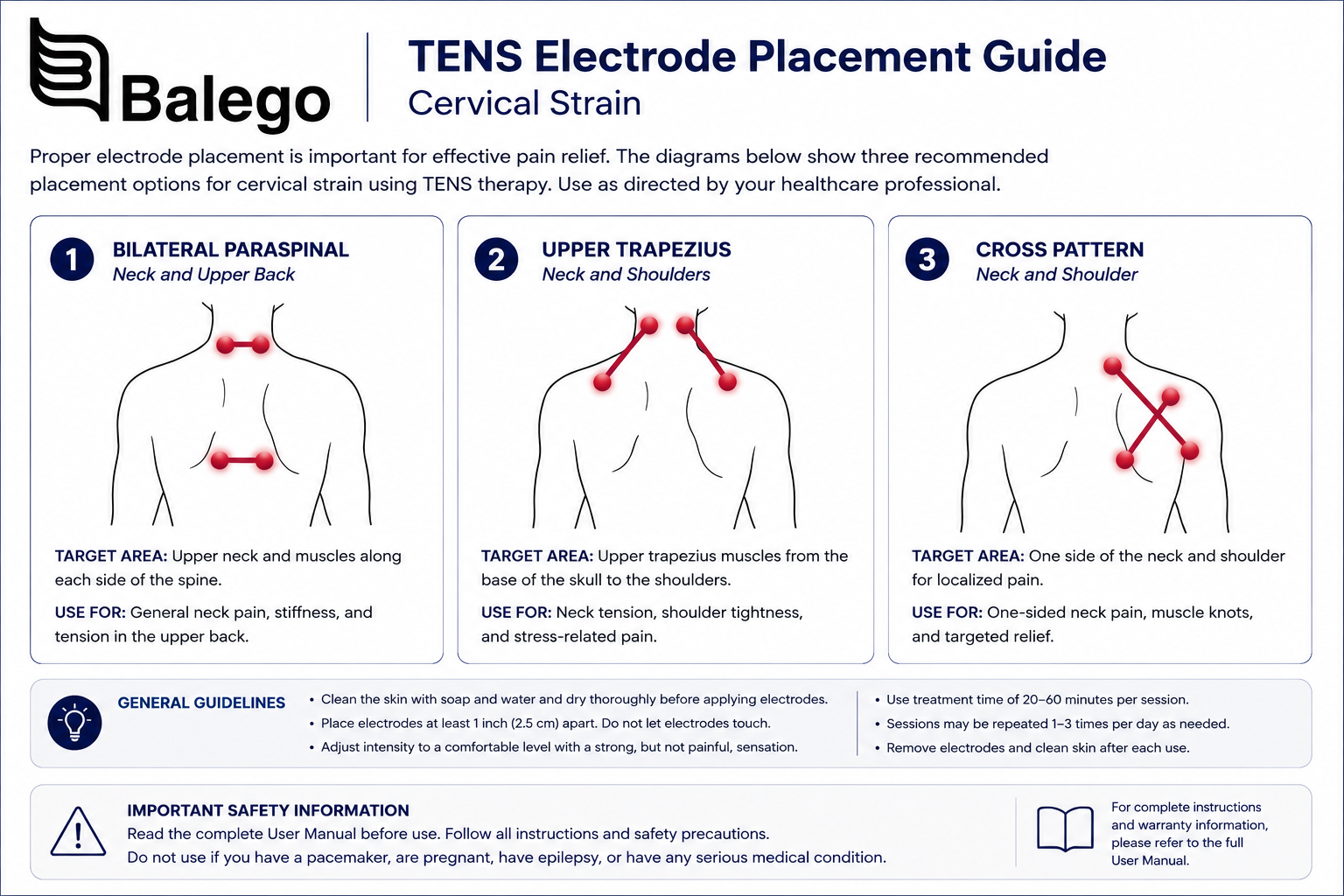
Suggested cervical-strain TENS settings at a glance
The settings below are conservative educational starting points for an adjustable, appropriately labeled TENS device. They are not a universal prescription.
| Parameter | Conservative starting point | Practical meaning |
|---|---|---|
| Mode | Modulation or Normal/Constant | Changing stimulation or steady sensory stimulation |
| Pulse rate, when adjustable | Approximately 80–100 Hz | Faster conventional-TENS sensation |
| Pulse width, when adjustable | Approximately 50–100 microseconds | Short-to-moderate sensory pulse |
| Intensity | Strong but comfortable | Clearly perceptible without burning or sharpness |
| Muscle response | No visible contraction intended | TENS should remain at a sensory level |
| Initial session | 20–30 minutes | Reassess pain, skin and function afterward |
| Electrodes | Two or four | One focused pair or two same-side pairs |
| Common pad size | Approximately 2 inches round or 2 × 2 inches | Enough surface area for comfortable posterior placement |
| Repeat sessions | Based on response and professional guidance, | Do not automatically repeat every 30 minutes all day |
There is no single TENS frequency, pulse width, or treatment schedule proven to be best for every acute or chronic cervical strain. The user’s diagnosis, device labeling, skin condition, electrode size, and response to treatment all matter.
For a changing sensory pattern, modulation is the closest current option. Balego’s TENS Modes Explained guide describes how these modes generally feel.
Do not manually enter 100 Hz and 70 microseconds on the BAL820
The FDA submission for the BAL820 states that pulse rate, pulse width, and waveform characteristics are fixed within its preprogrammed modes and that only amplitude is user-adjustable. Accordingly, this cervical protocol should not tell BAL820 users to manually enter a 100 Hz rate or 70-microsecond pulse width.
For that device, the operating instruction should be
- Confirm that the intended use is permitted under the current manual or clinician’s instructions.
- Select Modulation or another professionally recommended preset.
- Begin both channels at zero.
- Increase only the intensity until stimulation is strong but comfortable.
- Stop if the sensation becomes sharp, painful, or concentrated beneath one pad.
Exact pulse-rate and pulse-width recommendations are more appropriate for a manually adjustable prescription device such as the TENS 3000.
Who this suggested protocol may be appropriate for
This guide is most relevant to an adult with a previously evaluated musculoskeletal presentation involving the posterior cervical or upper-trapezius muscles, such as:
- Localized aching or soreness in the upper trapezius
- Posterior neck muscle discomfort
- Muscle tenderness related to posture or ordinary activity
- Mild stiffness that changes with movement
- A diagnosed cervical or trapezius muscle strain
- Chronic mechanical neck discomfort already evaluated by a professional
- Temporary pain that limits tolerance for a prescribed exercise program
“TENS for cervical strain” should not be interpreted as “TENS for any pain near the neck.” Neck pain may arise from muscle, joint, nerve, vascular, infectious, inflammatory, or other conditions.
Do not begin this protocol when neck pain has not been evaluated
Seek medical evaluation before using TENS for neck pain associated with the following:
- A motor-vehicle collision
- A significant fall, sports impact or other trauma
- New or worsening arm or hand weakness
- Increasing numbness or tingling
- Hand clumsiness
- Problems with balance or walking
- A severe or unusual headache
- Fever or feeling systemically unwell
- Known cancer, infection or inflammatory disease
- Unexplained weight loss
- Severe pain that is rapidly worsening
- Pain accompanied by dizziness, visual changes or fainting
- Loss of bladder or bowel control
- Symptoms affecting both arms or legs
Clinical neck-pain guidance emphasizes screening for neurological compromise, trauma, infection, malignancy, and other serious causes before treating the symptoms as an uncomplicated muscle strain.
Acute versus chronic cervical strain
The word "acute" generally describes a recent episode, while "chronic" describes symptoms that have persisted or recurred over a longer period. That distinction alone does not determine the correct TENS setting.
| Consideration | Recent or acute presentation | Persistent or chronic presentation |
|---|---|---|
| Evaluation priority | Rule out meaningful trauma or neurological involvement | Reassess diagnosis when symptoms persist or change |
| First TENS session | Short, conservative trial after appropriate evaluation | 20–30-minute trial with outcome tracking |
| Intensity | Begin low and increase gradually | Strong but comfortable sensory level |
| Mode | Normal or Modulation | Modulation may help when a steady sensation becomes less noticeable |
| Main rehabilitation focus | Comfortable movement and return to normal activity | Mobility, endurance, strengthening and activity progression |
| Reason to discontinue | Pain spreads, intensifies or produces neurological symptoms | No meaningful symptom or functional benefit after repeated trials |
The same TENS settings should not automatically be prescribed simply because two patients both have “neck strain.”
How strong should cervical TENS feel?
For pain-focused TENS, the intended sensation is usually
- Clearly noticeable
- Strong
- Comfortable
- Non-painful
- Sensory rather than contraction-producing
It should not feel
- Sharp
- Burning
- Stabbing
- Painful
- Highly concentrated beneath one corner
- Strong enough to produce repeated neck or shoulder contractions
TENS and NMES have different treatment goals. TENS primarily provides sensory stimulation for temporary pain modulation, while NMES is intended to activate motor nerves and produce muscle contraction. Read TENS vs. NMES: Differences, Uses, and Device Guide before substituting one modality for the other.
Posterior cervical and trapezius electrode placement principles
Cervical TENS placement requires particular care because the front and sides of the neck contain the airway, carotid sinus, and other sensitive structures.
Never place TENS electrodes:
- On the front of the neck
- On either side of the throat
- Directly over the carotid-sinus region
- On the face
- On the head
- So current passes through the head
- So current passes across the chest
- Over broken, infected, irritated or numb skin
- Where a pad cannot remain fully attached
Electrical-stimulation manuals warn against front-of-neck and carotid-sinus stimulation and against electrode arrangements that direct current through the head or chest.
General posterior-placement rules
- Keep the electrodes on posterior muscular tissue.
- Avoid the throat and anterior neck completely.
- Position pads beside, rather than directly over, prominent cervical vertebrae.
- Keep each electrode pair within one localized posterior treatment region.
- Do not use a cross-body current path from the neck or shoulder toward the opposite chest.
- Begin with one channel when a focused pair provides adequate coverage.
- Add a second channel only when broader bilateral coverage has been prescribed.
Placement option 1: unilateral posterior bracket
This two-electrode arrangement is appropriate when symptoms are primarily on one side.
Electrode 1: Place on the posterior cervical muscle adjacent to the painful region.
Electrode 2: Place lower on the same side over the upper trapezius.
The pair should bracket the symptomatic muscle region without placing either pad on the side or front of the neck.
| Advantage | Limitation |
|---|---|
| Uses one channel and two pads | Covers only one side |
| Keeps the electrical path localized | Requires enough intact skin for both pads |
| Easier to monitor for unequal contact | May not cover bilateral symptoms |
| Uses independent intensity control | Exact placement still requires professional guidance |
Placement option 2: bilateral two-channel setup
Use four electrodes when both sides require treatment.
- Channel 1: One posterior cervical pad and one upper-trapezius pad on the left.
- Channel 2: One posterior cervical pad and one upper-trapezius pad on the right.
Keeping both pads from each channel on the same side creates a more localized posterior pathway than arranging a single channel from one side of the neck to the other.
Adjust the channels independently. The same numeric setting may feel different on each side because of differences in skin resistance, pad contact, and tissue contour.
Placement option 3: upper trapezius to medial scapular region
When symptoms extend from the upper trapezius toward the muscle tissue along the shoulder blade, a clinician may select a same-side pair involving the following:
- One electrode over the upper trapezius
- One electrode over muscular tissue near the medial scapular region
Do not place the lower electrode so far around the trunk that the current pathway crosses the chest.
What about C7–T1 placement?
Place electrodes on the muscular tissue adjacent to the lower cervical and upper thoracic region when directed by a clinician. Avoid placing the pad directly on a prominent spinous process or using a pathway that crosses the front or sides of the neck.
The C7 spinous process is often prominent, and a pad positioned directly over a bony prominence may have less uniform contact than one positioned on adjacent muscle.
Should TENS pads be placed on the head for a neck-related headache?
No. Do not place TENS electrodes on the head, temples, face, or where stimulation passes through the head.
A diagnosed cervicogenic headache may be addressed through a clinician-directed plan involving posterior cervical treatment, mobility work, exercise, or manual therapy, but a headache should not automatically be assumed to originate from a neck strain. Neck-pain guidelines emphasize classification and examination rather than choosing treatment solely based on symptom location.
Two electrodes versus four electrodes
| Setup | Best fit | Advantages | Watch for |
|---|---|---|---|
| Two electrodes | Focused unilateral region | Simple setup and easier monitoring | Limited coverage |
| Four electrodes | Bilateral or broader posterior symptoms | Separate intensity control on each side | More connections and more opportunities for edge lift |
| One electrode only | None | No complete circuit | Incorrect setup |
| Three electrodes across two channels | None | One channel remains incomplete | Incorrect setup |
Each active channel requires a complete pair of electrodes.
More pads do not automatically provide better pain relief. Begin with the simplest arrangement that covers the prescribed area.
Which electrode size works best around the upper trapezius?
The upper trapezius and posterior cervical region provide less placement space than the low back. Pad size should balance useful coverage with the ability to maintain full contact.
| Electrode size | Practical fit | Considerations |
|---|---|---|
| 2-inch round | Curved or more confined muscular areas | Rounded edges may reduce corner lift |
| 2 × 2-inch square | General-purpose cervical and trapezius placement | Easy to replace and standardize |
| 2 × 3.5-inch rectangle | Broader upper-trapezius coverage | Requires more uninterrupted skin surface |
| Very small pad | Limited placement space | Concentrates current and may feel sharper |
The earlier protocol recommended “2-inch round or smaller.” Remove “or smaller.” A smaller electrode concentrates current into less surface area and can produce a sharper sensation.
Our reusable TENS, NMES, and FES electrodes are available in multiple sizes. The TENS Electrode Buying Guide compares round, square, and rectangular options.
Step-by-step cervical TENS setup
1. Confirm that the symptoms are appropriate for home TENS
Do not begin with unexplained pain, significant trauma, progressive neurological symptoms, or other warning signs.
2. Read the exact device instructions
Confirm:
- Whether the device is OTC or prescription
- Its labeled treatment regions
- Its available modes
- Whether pulse rate and width are fixed or adjustable
- Its contraindications
- Its timer options
- Its electrode requirements
3. Turn both channels to zero
Do not connect, move, or remove electrodes while output is active.
4. Connect the lead wires
Attach two pads to every channel that will be used. Push the connectors in completely so no exposed metal remains.
5. Prepare the skin
Clean and dry the posterior treatment region. Remove:
- Lotion
- Massage oil
- Perspiration
- Topical pain products
- Adhesive residue
- Dirt and skin oils
Clip excessive hair when needed rather than shaving immediately before treatment.
6. Inspect the pads
Do not use a pad that is
- Dry
- Torn
- Folded
- Contaminated
- Permanently curled
- Lifting at the edges
- Loose at its connector
7. Apply the electrode pair
Position both pads on the clinician-approved posterior muscular region. Press across the full surface and every edge.
8. Select the mode
For an initial sensory trial, choose:
- Modulation when a changing sensation is preferred
- Normal or Constant when a steady sensation is preferred
Reduce intensity before changing from one mode to another because a new pattern may feel stronger at the same control position.
9. Enter prescribed parameters when the device is adjustable
A conservative conventional TENS starting point is approximately the following:
- Rate: 80–100 Hz
- Pulse width: 50–100 microseconds
- Time: 20–30 minutes
Do not attempt to enter those settings on a device that uses fixed preset parameters.
10. Increase intensity slowly
Raise the active channel one step at a time until stimulation is strong but comfortable.
11. Recheck the skin and symptoms
Stop immediately if:
- The sensation burns or stings
- Pain spreads into the arm
- Numbness or weakness develops
- A headache becomes severe or unusual
- The skin becomes markedly irritated
- The pads begin to lift
12. Turn the device off before removing pads
Return both channels to zero and power the device off. Lift the electrode itself rather than pulling on its wire.
How long should a cervical TENS session last?
A conservative initial trial is approximately 20–30 minutes. The person should then reassess:
- Pain intensity
- Neck movement
- Ability to perform normal activity
- Exercise tolerance
- Skin condition
- Duration of any benefit
The previous instruction—30 minutes on, 30 minutes off, repeated several times daily—should not be presented as a universal schedule. Study protocols and device instructions vary, and repeated treatment should depend on the individual response, product labeling, and clinician’s plan.
TENS should be discontinued or reconsidered when repeated sessions provide no practical improvement.
How to tell whether TENS is helping
A pleasant tingling sensation is not, by itself, evidence that the treatment is useful.
Track outcomes that matter:
| Measure | Before TENS | During TENS | 30 minutes after | Later that day |
|---|---|---|---|---|
| Pain, 0–10 | ||||
| Neck rotation | ||||
| Ability to sit at a desk | ||||
| Ability to drive safely after treatment | ||||
| Exercise tolerance | ||||
| Headache symptoms | ||||
| Skin reaction | ||||
| Duration of relief |
A useful trial might temporarily make it easier to:
- Rotate the head comfortably
- Sit or work with less discomfort
- Walk or perform aerobic activity
- Complete prescribed neck or scapular exercises
- Sleep with fewer pain interruptions
- Resume ordinary daily activities
If TENS does not improve a meaningful symptom or activity after several properly performed trials, it may be an unhelpful part of the plan.
TENS should support active cervical rehabilitation
Clinical guidelines for common mechanical neck-pain presentations emphasize education, maintaining or returning to normal activity, cervical and scapulothoracic exercise, mobility work, endurance training, and other individualized interventions.
TENS may be used to make active care more tolerable, but it should not replace the following:
- Cervical range-of-motion exercises
- Scapular strengthening
- Postural endurance work
- Aerobic activity
- Ergonomic changes
- Gradual return to work or recreation
- Professional evaluation when recovery is not progressing
Evidence for TENS in cervical pain
Research findings should be represented honestly.
| Evidence source | Main finding |
|---|---|
| Cochrane review of chronic neck pain | Evidence was very uncertain; two included studies found no superiority over inactive treatment |
| Umbrella review of cervical pain | TENS appeared to reduce acute and chronic cervical pain in the short term, but study quality and heterogeneity limited confidence |
| Broader pain meta-analysis | Active TENS reduced pain during or immediately after treatment across varied pain conditions, but this does not prove a specific long-term benefit for cervical strain |
| Neck-pain clinical guidelines | Greater emphasis is placed on exercise, education, activity and selected manual therapy than on passive electrotherapy alone |
TENS may provide short-term symptom reduction for some people with an evaluated cervical or upper-trapezius strain, but response varies and long-term effectiveness is uncertain. It should be used as an optional adjunct to active rehabilitation.
Troubleshooting cervical and trapezius TENS
| Problem | Likely cause | Corrective action |
|---|---|---|
| Stimulation feels sharp | Pad edge lifting, dry gel or excessive intensity | Turn off, inspect the pad and reduce intensity |
| One side feels stronger | Different skin resistance or pad contact | Inspect adhesion and adjust channels separately |
| No sensation | An incomplete circuit or channel remains at zero | Confirm two pads per active channel |
| Output is intermittent | Loose connector or damaged lead wire | Turn off and inspect all connections |
| Pads lift with shoulder movement | Worn hydrogel or poor skin preparation | Clean and dry the skin or replace the pads |
| Neck muscles visibly contract | Intensity or pulse parameters are too high for sensory TENS | Reduce intensity and confirm the selected modality |
| Skin becomes very red | Irritation, repeated placement or concentrated current | Stop treatment and allow the skin to recover |
| Pain spreads into an arm | Possible nerve involvement or unsuitable placement | Stop and obtain professional guidance |
| Headache worsens | The headache may not be a simple muscular symptom | Stop and seek appropriate evaluation |
| The device feels weak everywhere | Low battery or worn electrodes | Replace the battery or pads |
| Sensation fades during treatment | Sensory accommodation | Make a small comfortable intensity adjustment or use Modulation when appropriate |
Old, dry, dirty, or partially attached electrodes can cause weak, sharp, or inconsistent stimulation. Balego’s TENS collection notes that electrode condition is a major part of comfortable current delivery.
When should the pads be replaced?
Replace reusable electrodes when:
- The entire surface no longer adheres
- Corners repeatedly lift
- The gel is dry or contaminated
- Stimulation becomes sharp or uneven
- The backing is torn or permanently curled
- The pigtail or connector becomes loose
- The electrode was used by another person
- Skin irritation repeatedly occurs
Reusable pads should be assigned to one individual. Return them to their storage liner and sealed package after each session.
Cervical TENS device comparison
This table focuses on which Balego devices best support a clinician-directed cervical protocol rather than repeating every product specification.
| Device | Status and controls | Cervical-protocol fit | Best reason to choose it |
|---|---|---|---|
| TENS 3000 | Prescription; manually adjustable rate and width; Normal, burst, and Modulation | Strong fit when exact clinician-selected TENS parameters are required | Direct adjustment of 80–100 Hz and 50–100 µs settings |
| Twin Stim IV | Prescription, rechargeable TENS and NMES, and body-area presets including neck | Good fit for guided TENS plus separate NMES needs | Combines sensory and muscle-stimulation programs |
| InTENSity Select Combo II | Prescription: TENS, NMES, IF, and Russian neck presets | Good fit for trained users requiring multiple modalities | Rechargeable four-mode system with custom programming |
| Balego TENS Digital Edition | OTC; preset TENS programs with intensity adjustment | Its FDA-cleared OTC indication does not include the cervical region | Straightforward OTC TENS for its labeled low-back and extremity uses |
| Twin Stim Plus DS5402 | Prescription: four channels; TENS, NMES, IFC, and Russian | More capacity than usually needed for a focused cervical setup | Clinics needing broad or multiple-region coverage |
The TENS 3000 is the clearest choice when the clinician wants to enter a specific rate and pulse width. The Twin Stim IV adds NMES, while the Select Combo II adds interferential and Russian stimulation. These additional modalities should not be selected merely because they are available.
Contraindications and essential safety precautions
Do not independently use TENS when the person has the following:
- A pacemaker
- An implanted defibrillator
- Another implanted electronic device
- A condition that prevents reliable communication of discomfort
- Undiagnosed or rapidly changing neck pain
Do not apply electrodes:
- On the front or sides of the neck
- Over the carotid-sinus region
- Across the chest
- On or through the head
- Over the mouth, face or eyes
- Over damaged, infected or inflamed skin
- Where normal sensation is absent
- Over a known or suspected cancerous lesion
- Where a pad contacts metal jewelry
Do not use TENS:
- While driving
- While operating machinery
- While bathing or showering
- While sleeping
- In a way that prevents continuous monitoring of symptoms
Stop treatment for burning, severe irritation, dizziness, breathing difficulty, unusual heart sensations, increasing pain, new numbness, weakness, balance problems, or other unexpected symptoms.
Frequently asked questions
What TENS mode is suggested for cervical strain?
Modulation is a reasonable starting option when an automatically changing sensory pattern is desired. "Normal" or "constant" may be used when a steady sensation is preferred.
Is SMP mode available on the Balego TENS?
No. The current Balego TENS Digital Edition uses Constant, Burst, Modulation, SD1, and SD2. Select modulation rather than SMP.
What frequency should be used?
For an adjustable prescription TENS device, approximately 80–100 Hz is a conservative conventional-TENS starting range. There is no single frequency proven best for every cervical strain.
What pulse width should be used?
Approximately 50–100 microseconds is a conservative sensory starting range on a manually adjustable device. Wider pulses may feel stronger and may require a lower intensity.
Can I enter those settings on the Balego BAL820?
The FDA submission describes the BAL820’s pulse rate and pulse width as fixed within each preset program, with intensity being the adjustable output. Follow the exact current instructions rather than trying to enter manual parameters.
How intense should the stimulation be?
Use a strong but comfortable tingling sensation. It should not burn, sting, or produce repeated visible contraction.
Where should the pads go?
Use posterior muscular tissue adjacent to the painful cervical or upper-trapezius region. Never place the pads on the front or sides of the neck.
Can pads be placed directly on C7?
Position them on an adjacent muscle rather than directly over a prominent vertebral spinous process.
Can one electrode be placed on each side of the neck?
A more conservative bilateral arrangement uses a separate complete channel on each side, with both electrodes from each channel remaining on the same posterior side.
Can TENS be used for a headache?
Do not place electrodes on the head or face. Headaches should be evaluated when severe, unusual, worsening, or accompanied by neurological or systemic symptoms.
How many pads are needed?
Use two pads for a focused one-channel arrangement or four for a bilateral two-channel setup.
How long should a session last?
Begin with approximately 20–30 minutes unless the device instructions or clinician specifies otherwise.
Can sessions be repeated every 30 minutes?
Do not use “30 minutes on, 30 minutes off all day” as a universal schedule. Repeat use should follow product labeling, professional guidance, and the individual response.
Can TENS heal a cervical strain?
No. It may temporarily change pain perception but does not directly repair the strained tissue.
Should the neck muscles twitch?
Not during a sensory-level TENS protocol. Visible contraction suggests that intensity is too high or that a motor-stimulation modality may have been selected.
Is NMES better for trapezius pain?
Not automatically. NMES is used when muscle activation or neuromuscular training is the goal. Pain alone does not establish a reason to use contraction-producing stimulation.
What electrode size is best?
A 2-inch round or 2 × 2-inch square electrode is a practical starting size for many posterior cervical and trapezius placements. Larger pads may be appropriate when sufficient muscular surface is available.
Can TENS be used after whiplash?
Neck pain following a collision or meaningful trauma should be evaluated before home TENS placement or settings are selected.
Final suggested cervical TENS starting point
For an appropriately evaluated adult using a compatible, clinician-approved adjustable TENS device:
| Setting | Suggested starting point |
|---|---|
| Mode | Modulation or Normal |
| Pulse rate | 80–100 Hz when manually adjustable |
| Pulse width | 50–100 microseconds when manually adjustable |
| Intensity | Strong but comfortable sensory stimulation |
| Muscle contraction | None intended |
| Time | 20–30 minutes initially |
| Electrodes | Two for unilateral symptoms or four for bilateral symptoms |
| Placement | Posterior cervical and upper-trapezius muscular tissue |
| Avoid | Front or sides of neck, head, face and cross-chest pathways |
TENS should remain an optional symptom-management tool. Continue to prioritize appropriate evaluation, comfortable movement, cervical and scapular exercise, gradual return to activity, and reassessment when symptoms persist or worsen.
Compare TENS units, electrodes, and lead wires, browse replacement electrotherapy electrodes, or contact Balego for product and connector assistance.


