



The TheraTouch® LX2 supports two applicator styles with different treatment patterns:
- The 9-diode cluster applicator treats several adjacent points at the same time and is supplied as the standard LX2 applicator.
- The optional single-diode applicator concentrates its output through one treatment head for a smaller, more precisely defined target.
The choice is not simply “more power versus less power” or “shallow versus deep.” Applicator selection should account for the size and shape of the treatment region, the number of points being treated, the selected energy dose, the applicator’s output pattern, and the amount of time available for treatment.
The cluster applicator is included with the TheraTouch LX2 Laser Light Device. Clinics can also purchase a replacement LX2 cluster applicator or add the optional LX2 single-diode applicator.
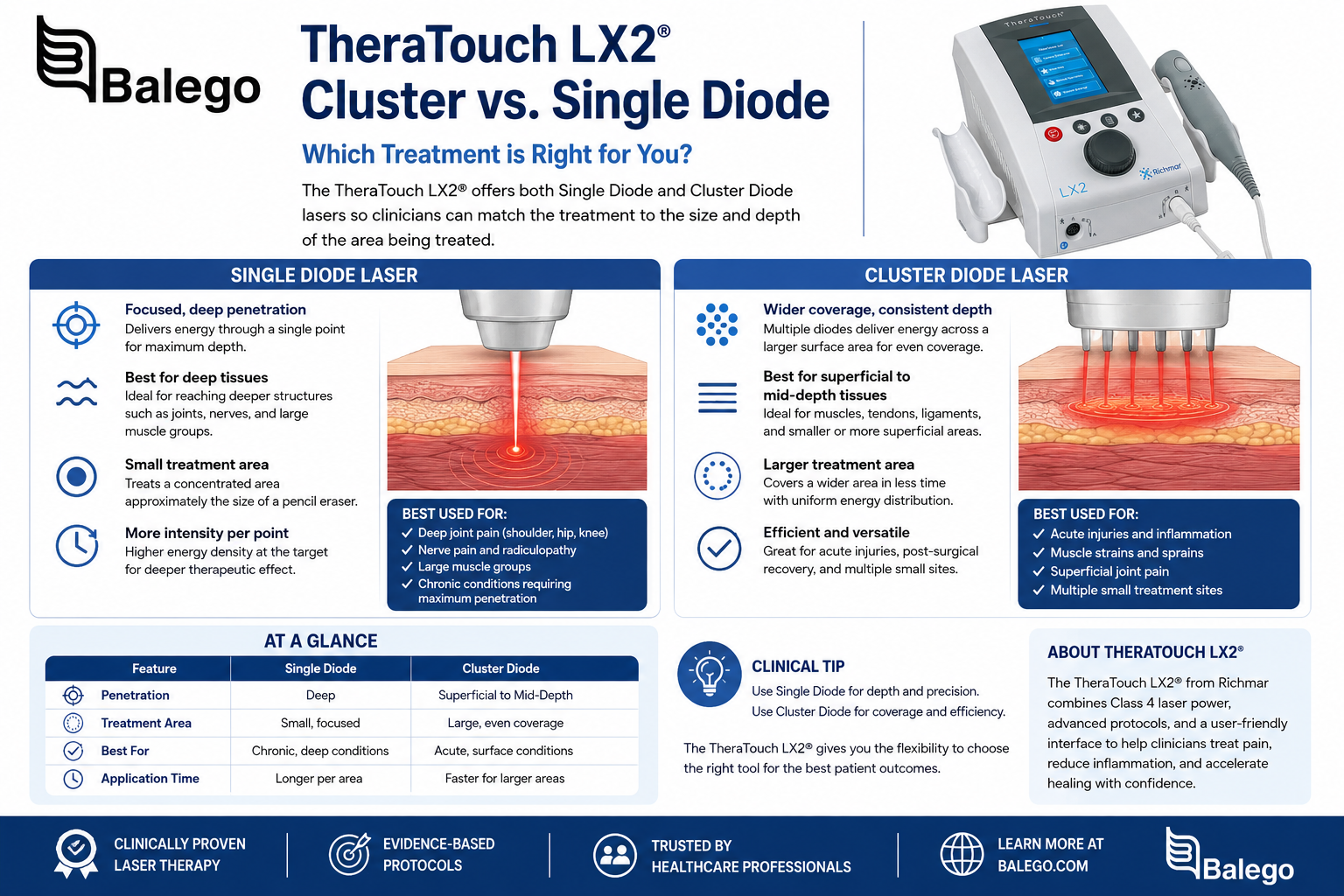
Quick Comparison
| Feature | 9-Diode Cluster Applicator | Single-Diode Applicator |
|---|---|---|
| LX2 role | Standard applicator | Optional accessory |
| Number of emitters | 9 | 1 |
| Output configuration | 4 red LEDs plus 5 infrared laser diodes | One laser diode |
| Total rated output | 1040 mW | 200 mW |
| Treatment pattern | Multiple adjacent points simultaneously | One focused point |
| Primary workflow advantage | Broader coverage and treatment efficiency | Precision and access to a small target |
| Best suited to | Larger or diffuse treatment regions | Small, localized anatomical targets |
| Dose display considerations | Total joules, J/cm², and joules per laser diode | Total joules and J/cm² apply to one emitter |
| Included with a standard LX2 | Yes | No |
| Balego product | Cluster applicator | Single-diode applicator |
The Most Important Difference: Treatment Geometry
The cluster and single-diode applicators distribute light differently.
The cluster is not one large laser beam producing 1040 mW at a single point. Its output is divided among nine emitters arranged across the applicator face:
- Five infrared laser diodes provide a combined 1000 mW of laser output.
- Four red LEDs contribute another 40 mW.
- Each emitter delivers energy to its own portion of the treatment pattern.
The single-diode applicator directs its 200 mW through one emitter. This makes it useful when the clinician wants to address one small point without simultaneously covering the surrounding area.
Multi-Point Coverage vs. Single-Point Precision
| Treatment question | Cluster applicator | Single diode |
|---|---|---|
| Does it treat several points at once? | Yes | No |
| Is it efficient for a broad region? | Yes | Less efficient when many points must be treated sequentially |
| Can it isolate one small point? | Less precisely | Yes |
| Does each point receive the full applicator output? | No, output is distributed among the emitters | The applicator output comes from one emitter |
| Is total output the only dosing consideration? | No | No |
| Must the clinician consider spot size and J/cm²? | Yes | Yes |
When the Cluster Applicator Is Usually More Practical
The cluster applicator is generally the more efficient choice when the clinician has identified a treatment region that is wider than one small point.
Examples of applicant-selection situations include:
- A broader muscle region
- A larger joint region
- Several adjacent soft-tissue points
- A treatment plan requiring repeated applications across a wider field
- A clinic seeking an efficient general-purpose LX2 applicator
Because five laser diodes and four LEDs operate together, the cluster can deliver energy to several neighboring points during the same timed application.
Cluster Applicator Advantages
| Advantage | Clinical workflow significance |
|---|---|
| Nine simultaneous emitters | Reduces the need to reposition a single probe across every adjacent point |
| 1040 mW combined output | Delivers substantially more total energy per second than one 200 mW diode |
| Mixed red and infrared output | Provides both 650 nm LED and 850 nm laser output within the cluster pattern |
| Standard LX2 accessory | A new LX2 can be used without purchasing an additional applicator |
| Multiple dose displays | The LX2 can display total joules, J/cm², and joules per laser diode |
| Broad applicator face | Helps organize repeatable placement over a larger region |
Limitations of the Cluster Applicator
The cluster is not automatically preferable for every application.
Its broader treatment face may be less convenient when:
- The anatomical target is very small.
- The treatment point lies near an area the clinician does not intend to irradiate.
- The body contour makes it difficult to maintain complete, level contact.
- A protocol requires point-by-point placement.
- The clinician needs to identify exactly which single location received each application.
The operator should hold the applicator directly against the skin with firm, comfortable pressure and without tilting the treatment head. A small or highly contoured site may therefore be easier to access with the single applicator.
When the Single-Diode Applicator Is Usually More Practical
The single diode is designed for a smaller, more precisely defined treatment area. Instead of exposing several neighboring points simultaneously, it allows the clinician to position one emitter at a selected location.
It may be useful when:
- The treatment target is small.
- The clinician is following a point-by-point protocol.
- A larger cluster face cannot remain level against the body contour.
- The provider wants to minimize exposure of adjacent tissue.
- Treatment documentation requires a clearly identified point.
- A sequence of individual sites will be treated separately.
The single diode is an optional accessory and does not replace the standard cluster in every workflow. It adds a second style of application to the LX2 platform.
Single-Diode Advantages
| Advantage | Clinical workflow significance |
|---|---|
| One treatment emitter | Provides more precise point selection |
| Smaller treatment head | May fit irregular or narrow anatomical locations more easily |
| 200 mW rated power | Allows point-specific energy calculation |
| Clear point documentation | Makes it easier to record the exact site of each application |
| Optional add-on | Expands the LX2 without replacing the included cluster |
Single-Diode Limitations
A single diode can require more clinician time when a broad region contains many treatment points. Each location may need to be positioned and timed separately.
The operator must also avoid assuming that a single probe is inherently “deeper” simply because its beam is focused. Tissue exposure depends on several variables, including wavelength, beam area, power density, contact technique, tissue optical properties, and the selected energy dose.
Is the Cluster Five Times More Powerful?
The answer depends on which output is being compared.
The five infrared laser diodes in the cluster provide a combined 1000 mW of laser power, compared with 200 mW from the single applicator. By that measure, the cluster has five times the total laser output.
When the four 10 mW LEDs are included, the cluster’s combined optical output is 1040 mW, or 5.2 times the single applicator’s 200 mW output.
That does not mean one point under the cluster receives five times the output of the single diode. The cluster’s energy is divided among multiple emitters and treatment spots.
| Comparison | Cluster | Single diode |
|---|---|---|
| Infrared laser diodes | 5 × 200 mW | 1 × 200 mW |
| Combined laser power | 1000 mW | 200 mW |
| Additional LED power | 40 mW | None listed |
| Combined optical output | 1040 mW | 200 mW |
| Number of simultaneously treated emitter locations | 9 | 1 |
| Output from each 200 mW laser diode | 200 mW | 200 mW |
Does the protocol call for simultaneous treatment of several neighboring points or precise treatment of one point?
Why Joules Alone Do Not Tell the Whole Story
The LX2 can display:
- Total joules
- Joules per square centimeter
- Joules per laser diode
These values answer different questions. The built-in calculator updates the dose information as treatment settings change.
Understanding the Dose Displays
| Measurement | What it describes | Why it matters |
|---|---|---|
| Total joules | Total optical energy produced during the timed application | Useful for documenting the overall application |
| J/cm² | Energy density relative to the beam or spot area | Helps compare energy concentration |
| Joules per diode | Energy delivered by each laser diode | Particularly important when interpreting a multi-diode cluster |
| Power in mW or W | Rate at which energy is produced | Affects how quickly a given energy total is reached |
| Treatment time | Duration of emission | Works with power to determine joules |
The underlying relationship is:
Energy in joules = power in watts × treatment time in seconds
A higher-power applicator reaches a larger total-energy value more quickly, but total energy must still be interpreted in relation to the number of emitters and treatment area.
A Useful LX2 Dosing Example
The operation manual provides a continuous-output comparison that illustrates why cluster and single-applicator values should not be treated as interchangeable.
For the example shown in the manual:
| Applicator | Output | Treatment time | Total energy |
|---|---|---|---|
| Cluster | 1040 mW total | 20 seconds | 20.8 J total |
| Single diode | 200 mW | 20 seconds | 4 J total |
Within the cluster’s 20.8 J total, the five laser diodes provide 20 J—equivalent to 4 J per laser diode—while the LED components account for the remaining 0.8 J. The single diode supplies 4 J through its one emitter during the same 20-second period.
This means:
- Both applicators can deliver 4 J per laser diode during that example.
- The cluster delivers that laser energy through five locations simultaneously.
- The cluster also adds energy from four red LEDs.
- The single diode delivers its 4 J at one location.
The correct choice depends on the intended distribution—not merely the largest total-joule number.
Why the Same Treatment Time Does Not Mean the Same Treatment
Setting both applicators for 20 seconds does not create an equivalent exposure pattern.
| During the same timed application | Cluster | Single diode |
|---|---|---|
| Number of laser emitters | 5 | 1 |
| Laser energy at 20 seconds | 20 J total | 4 J total |
| Laser energy per diode | 4 J | 4 J |
| LED energy | Approximately 0.8 J | None listed |
| Treatment pattern | Five laser points plus four LED points | One point |
| Main implication | Several locations receive energy simultaneously | One location receives the application |
For this reason, a clinic should not copy a time setting from one applicator to the other without reviewing the resulting joules, J/cm², and J/diode displayed by the LX2.
Applicator Selection Decision Table
| Treatment-region characteristic | Applicator generally favored | Reason |
|---|---|---|
| Broad and relatively flat | Cluster | Several adjacent emitters can maintain contact |
| Small and clearly localized | Single diode | Better point precision |
| Several neighboring treatment points | Cluster | Simultaneous multi-point output |
| One anatomical landmark | Single diode | Easier to isolate and document |
| Highly curved or narrow surface | A single diode may fit better | Smaller treatment face |
| Large muscle region | Cluster | More efficient coverage |
| Point-by-point protocol | Single diode | One emitter matches the workflow |
| Clinic purchasing its first LX2 | Cluster | Included with the standard system |
| The clinic already uses the cluster but needs focal access | Add single diode | Complements the existing applicator |
| The clinic treats both broad and focal targets | Maintain both | Allows applicator selection by target geometry |
These examples describe application workflow. They are not condition-specific prescriptions.
A Five-Step Applicator Selection Process
1. Define the Actual Target
Identify the anatomical region and the clinical objective before selecting the applicator. “Shoulder,” “knee,” or “back” is too broad to determine which applicator is appropriate.
Document whether the intended treatment region is:
- One point
- Several adjacent points
- A broad region
- A narrow or irregular contour
- A superficial area
- A target beneath multiple tissue layers
2. Determine the Required Coverage Pattern
Choose the cluster when simultaneous multi-point exposure is useful. Choose the single diode when the treatment should remain confined to one small location.
3. Review the Dose Display
Confirm the values shown for:
- Joules
- J/cm²
- Joules per diode
- Treatment time
- Continuous or pulsed output
- Frequency when pulsed mode is selected
The LX2 supports continuous or pulsed operation and includes real-time dose calculation.
4. Confirm Contact and Position
Richmar recommends direct skin contact, firm but comfortable pressure, and no tilting of the applicator head. The target should be treated at several points when required by the selected protocol.
5. Document the Application
A useful clinical record can include:
| Documentation field | Example of what to record |
|---|---|
| Applicator | Cluster or single diode |
| Treatment location | Specific anatomical site |
| Number of points | One or multiple |
| Output mode | Continuous or pulsed |
| Pulse frequency | Hz when applicable |
| Total joules | Device-displayed value |
| J/cm² | Device-displayed value |
| J/diode | Especially relevant to cluster use |
| Time | Duration at each point |
| Skin contact | Direct contact, applicator level |
| Patient response | Tolerance and any adverse reaction |
Can Both Applicators Be Used in One Treatment Plan?
A clinic may maintain both applicators so the provider can choose the appropriate treatment pattern at each visit or for different portions of a clinical plan.
For example, the provider may use:
- The cluster for a broader surrounding region
- The single diode for a separate, clearly defined focal point
That does not mean the two doses should simply be added without calculation. The clinician should account for overlap, total energy, J/cm², treatment time, and the device protocol.
The LX2 has two output channels, but treatment setup and simultaneous-accessory operation must follow the current manufacturer instructions rather than being inferred from the number of connectors.
Cluster Applicator vs. Single Diode: Purchasing Comparison
| Purchasing option | What it includes | Best fit |
|---|---|---|
| TheraTouch LX2 with cluster applicator | LX2 system and standard cluster applicator | Clinic purchasing the complete system |
| LX2 cluster applicator only | Replacement or additional cluster applicator | Existing LX2 owner needing another cluster |
| LX2 single-diode applicator only | Optional point-treatment applicator | An existing LX2 owner adding focal capability |
| TheraTouch therapy cart | Compatible mobile equipment cart | Clinics moving the LX2 between rooms |
| Balego Laser Therapy collection | Laser devices, probes, applicators, and accessories | Comparing available laser equipment |
The standard LX2 configuration includes the cluster but not the single diode or therapy cart.
Common Applicator-Selection Mistakes
Mistake 1: Choosing Only by Total Power
The cluster has more total power, but it distributes that power across several emitters. The treatment geometry and dose per diode also matter.
Mistake 2: Assuming the Single Diode Is Always Deeper
A small applicator is more precise, but treatment depth cannot be determined from applicator size alone. Wavelength, irradiance, tissue properties, contact, and dose all contribute.
Mistake 3: Using the Same Time With Both Applicators
The cluster and single diode produce different total-energy values during an identical treatment period.
Mistake 4: Recording Only “Laser for 20 Seconds”
That record does not identify the applicator, total joules, energy density, number of points, or output mode.
Mistake 5: Counting Total Cluster Power as Power at One Point
The 1040 mW rating is the combined output of nine emitters, not one 1040 mW spot.
Mistake 6: Treating Through Clothing or Over-Lotioning
Users are not to treat through clothing or over skin containing lotion or ointment.
Mistake 7: Tilting the Treatment Head
Recommends direct contact with the applicator held level against the skin to maximize energy delivery.
Application Technique That Applies to Both Applicators
Before using either applicator:
- Screen the patient according to the complete LX2 instructions.
- Make sure the operator and patient wear the required protective eyewear.
- Clean and dry the treatment area.
- Do not treat through clothes.
- Do not apply coupling gel to the laser applicator.
- Position the treatment head directly against the skin.
- Use firm, comfortable pressure without tilting.
- Observe the skin and patient response during and after treatment.
- Clean the applicator between patients as instructed.
- Record the applicator and dose values used.
Frequently Asked Questions
Which applicator comes with the TheraTouch LX2?
The standard TheraTouch LX2 includes the 9-diode cluster applicator. The single-diode applicator is optional.
Is the cluster applicator more powerful?
It has greater total output: 1040 mW combined, compared with 200 mW for the single diode. However, the cluster output is distributed across nine emitters.
Does each cluster diode produce 1040 mW?
No. The 1040 mW figure is the combined output. Each of the five infrared laser diodes is rated at 200 mW, and each of the four red LEDs is rated at 10 mW.
Is the cluster five times faster?
It has five times the total infrared laser power and 5.2 times the combined optical power. It can therefore deliver more total energy per second, but it treats several emitter locations at once. Treatment times should be based on the displayed dose rather than a simple five-times rule.
When should a single diode be selected?
It is generally most useful for a small, localized point, a narrow anatomical location, or a point-by-point protocol.
Is the single diode better for every tendon or trigger point?
No. The applicator should be selected according to the actual target size, body contour, dose, protocol, and clinician judgment rather than a diagnosis name alone.
What wavelength is the LX2 single diode?
850 nm, 200 mW single diode. Its downloadable operation manual lists a 650 nm, 200 mW single applicator.
What wavelength does the cluster use?
The cluster includes four 650 nm red LEDs and five 850 nm infrared laser diodes.
What does "J/diode" mean?
Joules per diode describe how much energy each laser emitter delivers. This value is useful with the cluster because the total energy is divided among multiple laser diodes.
Why is J/cm² important?
J/cm² expresses energy in relation to the treatment spot area. It provides information that total joules alone do not convey.
Can I copy a single-diode treatment time to the cluster?
Not without reviewing the resulting dose. The applicators have different total output and treatment patterns.
Can I move the applicator continuously over the skin?
Follow the manufacturer’s protocol. The LX2 manual describes placing the applicator directly against the skin and treating several points for the selected period rather than assuming that continuous scanning produces an equivalent dose.
Is coupling gel required?
No, users are not to apply coupling agents to the laser applicator.
Is protective eyewear required?
Yes. Appropriate protective eyewear must be worn by the patient and operator during LX2 treatment.
Can the cluster and single diode be used with other devices?
They are listed as applicators for the TheraTouch LX2. Do not assume compatibility with another laser system based on connector appearance.
The Bottom Line
The TheraTouch LX2 cluster and single-diode applicators are complementary rather than interchangeable.
Choose the cluster applicator when the treatment plan calls for:
- Several adjacent treatment points
- Broader coverage
- Greater total energy per timed application
- Combined red LED and infrared laser output
- Efficient general-purpose clinic workflow
Consider the single-diode applicator when the treatment plan calls for the following:
- One small, clearly defined point
- Greater placement precision
- Access to a narrow or contoured site
- Point-by-point dosing and documentation
The cluster’s 1040 mW total output does not mean one point receives 1040 mW. Its output is divided among five 200 mW laser diodes and four 10 mW LEDs. The optional single applicator supplies 200 mW through one emitter. Applicator selection should therefore be based on treatment geometry, joules, J/cm², joules per diode, and the intended clinical workflow—not total power alone.
Compare the complete TheraTouch LX2 system, replacement cluster applicator, optional single-diode applicator, and other products in our Laser Therapy collection.
Professional-Use and Safety Notice
The TheraTouch LX2 is a prescription Class IIIb professional laser device. Applicator choice, treatment parameters, dose, placement, frequency, and treatment duration should be determined by an appropriately trained and licensed professional following the current Richmar operation manual and applicable laser-safety procedures.
This article explains applicator differences and does not establish a diagnosis, prescribe a protocol, guarantee tissue penetration, or predict a treatment outcome.


