



EMS 5.0 DE5030 Manual: Setup, Analog Controls and Troubleshooting
The EMS 5.0 Analog NMES Stimulator, model DE5030, is a portable, battery-powered electrical muscle stimulation device with two isolated output channels.
Unlike a conventional TENS unit, which is primarily used to create a sensory tingling sensation for temporary pain modulation, the EMS 5.0 is designed for motor-level stimulation. Its electrical pulses are intended to activate motor nerves and produce a visible or palpable muscle contraction as part of a professionally directed rehabilitation program.
This guide explains how to:
- Identify the analog controls
- Connect one or two electrode pairs
- Set contraction, relaxation, pulse rate, and ramp
- Increase each channel’s intensity
- Understand the output indicator lights
- Replace the 9V battery
- Troubleshoot weak, intermittent, or uncomfortable stimulation
- Clean and store the unit safely
For condition-specific settings and electrode-placement articles, use our NMES Protocols and Settings library rather than selecting a treatment program from this operating guide.
Prescription-device notice: Sale by or on the order of a physician or licensed practitioner. Electrode placement, pulse rate, contraction time, relaxation time, ramp, intensity, session duration, and treatment frequency should be established by an appropriately qualified professional.
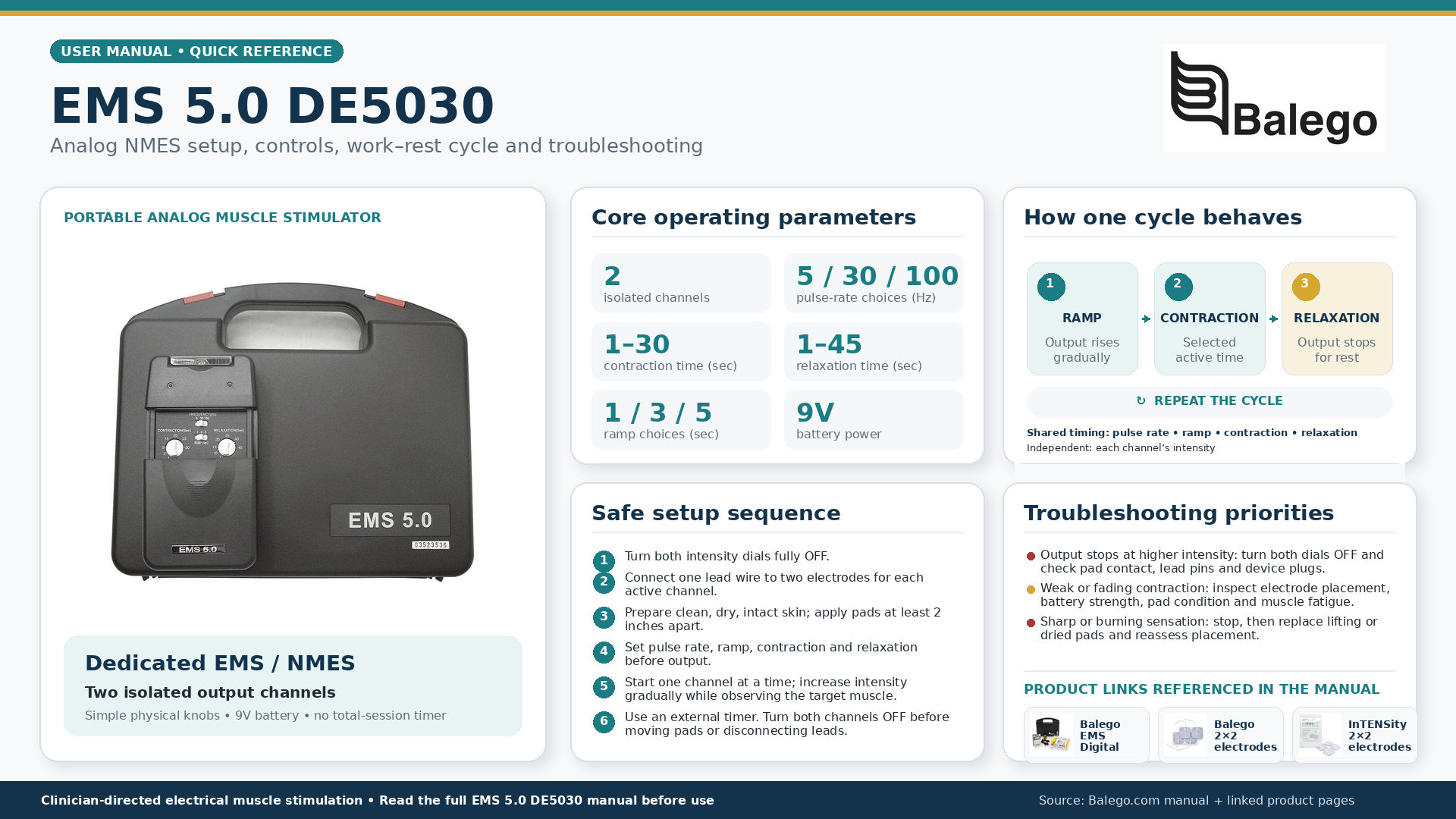
EMS 5.0 quick-reference table
| Feature | EMS 5.0 DE5030 |
|---|---|
| Device type | Analog EMS/NMES muscle stimulator |
| Channels | Two isolated output channels |
| Intended response | Visible or palpable muscle contraction |
| Pulse-rate choices | 5, 30, or 100 Hz |
| Contraction time | Adjustable from 1 to 30 seconds |
| Relaxation time | Adjustable from 1 to 45 seconds |
| Ramp choices | 1, 3, or 5 seconds |
| Channel intensity | Independently adjustable |
| Maximum listed output | 80 mA peak-to-peak into 500 ohms per channel |
| Maximum listed voltage | 50 V peak-to-peak into 500 ohms |
| Waveform | Asymmetrical biphasic square pulse |
| Power source | One 9V battery, type 6F22 |
| Supplied electrode size | 2 × 2 inches |
| Total-session timer | Not included |
| Safety cover | Clear intensity cap and sliding parameter cover |
| Size | 95 × 65 × 23.5 mm |
| Weight | Approximately 115 g with battery |
The listed parameters may tolerate up to ±20 percent.
What is the EMS 5.0 used for?
The manufacturer lists the following intended uses for powered muscle stimulation:
- Relaxation of muscle spasms
- Increasing local blood circulation
- Muscle re-education
- Maintaining or increasing range of motion
- Prevention or retardation of disuse atrophy
- Immediate postoperative stimulation of calf muscles to help prevent venous thrombosis
These are professionally directed treatment purposes, not self-diagnosis instructions. Postoperative and circulation-related use requires especially careful screening and medical supervision.
The EMS 5.0 does not:
- Diagnose the reason a muscle is weak
- Replace active exercise
- Repair a torn muscle, tendon, or nerve
- Correct joint instability
- Treat every source of pain
- Replace evaluation of unexplained weakness
- Function as a blood-clot treatment
- Automatically provide functional electrical stimulation during walking
For a fuller explanation of sensory versus motor stimulation, read TENS vs. NMES: Differences, Uses, and Device Guide.
EMS 5.0 controls explained
The EMS 5.0 uses physical knobs and selectors rather than a digital screen.
| Control | What it changes | Does it affect both channels? |
|---|---|---|
| Channel 1 intensity dial | Turns Channel 1 on and adjusts its strength | Channel 1 only |
| Channel 2 intensity dial | Turns Channel 2 on and adjusts its strength | Channel 2 only |
| Pulse-rate selector | Selects 5, 30, or 100 pulses per second | Yes |
| Contraction control | Sets how long stimulation remains active | Yes |
| Relaxation control | Sets how long stimulation stops between contractions | Yes |
| Ramp selector | Sets a 1-, 3-, or 5-second gradual rise | Yes |
| Output LEDs | Indicate pulse activity during the contraction phase | One indicator for each channel |
| Sliding cover | Helps prevent accidental timing changes | Covers shared parameters |
| Clear top cap | Helps protect the two intensity controls | Covers both intensity dials |
The two channels have independent intensity controls, but they share the same pulse rate, contraction time, relaxation time, and ramp setting. Both active channels therefore follow the same work-rest cycle.
Understanding the five main EMS settings
Intensity
Intensity determines how strong the electrical output feels and how forcefully the muscle contracts.
Each channel is adjusted separately. One channel may require a different dial position because of differences in:
- Electrode placement
- Muscle size
- Skin resistance
- Electrode condition
- Tissue depth
- Motor-point location
- Patient sensitivity
The objective is not simply to turn the dial as high as possible. Intensity should produce the clinician-defined contraction without sharpness, burning, excessive pain, or loss of control.
Pulse rate
The pulse-rate selector provides three choices:
| Rate | Pulses per second | General output character |
|---|---|---|
| 5 Hz | 5 | Separate twitches or low-frequency pulsing |
| 30 Hz | 30 | More sustained muscle activation |
| 100 Hz | 100 | High-frequency stimulation pattern |
These descriptions explain how the choices differ; they are not condition-specific recommendations. The appropriate rate depends on the intended response and the treatment plan.
Contraction time
The contraction dial sets how long stimulation remains active during each work cycle.
Available range:
1–30 seconds
During this phase, the output ramps up, and the target muscle should produce the prescribed response.
Relaxation time
The relaxation dial sets how long output stops between contractions.
Available range:
1–45 seconds
Adequate rest is important because electrically stimulated contractions can fatigue quickly. Shortening rest merely to produce more repetitions may reduce contraction quality.
Ramp time
The ramp selector changes how gradually output rises toward the selected intensity.
Available choices:
- 1 second
- 3 seconds
- 5 seconds
A longer ramp creates a slower and generally smoother contraction onset. It does not change the selected contraction or relaxation duration.
Pulse width is not independently adjustable by the user. The current manufacturer specification lists a 10–250 µs output range.
Before the first treatment
The user should receive written instructions for all of the following:
| Treatment decision | Information required |
|---|---|
| Target muscle | Exact muscle or muscle group |
| Electrode placement | Exact position of both pads on each active channel |
| Number of channels | One or two |
| Pulse rate | 5, 30, or 100 Hz |
| Contraction time | Seconds of active stimulation |
| Relaxation time | Seconds of rest |
| Ramp time | 1, 3, or 5 seconds |
| Intensity goal | Desired visible or palpable contraction |
| Voluntary exercise | Whether to contract voluntarily during the stimulation |
| Session duration | Total minutes measured with an external timer |
| Frequency of use | Sessions per day or week |
| Stop instructions | Symptoms requiring discontinuation |
The EMS 5.0 does not include a total-session timer. Use a separate timer and follow the prescribed treatment duration.
How to set up the EMS 5.0
1. Turn both intensity dials fully off
The white marks should align with the OFF positions. When both dials are off, the unit is powered off.
Do not connect lead wires, apply pads, or change electrode placement while either channel is active.
2. Check the battery
Install a fresh 9V battery when:
- The device does not power on
- The output feels weak on both channels
- The LEDs do not illuminate
- Output becomes inconsistent
- The battery has been stored for a prolonged period
3. Connect each lead wire to two electrodes
Every active channel requires:
- One lead wire
- Two electrodes
Insert both electrode pins completely. No exposed metal should remain visible.
4. Connect the lead wires to the device
Hold the insulated connector body and push the plug fully into Channel 1, Channel 2, or both.
Do not pull a lead wire by its cord when disconnecting it. Pulling on the wire rather than the insulated plug can damage the internal conductor.
5. Prepare the skin
Wash the treatment area with mild soap and water, then dry it completely.
Remove:
- Lotion
- Oils
- Perspiration
- Conductive gel
- Adhesive residue
- Other topical products
Residual lotion or gel can weaken electrode adhesion and produce uneven current concentration.
6. Apply the electrodes
Press the full conductive surface against clean, intact skin.
The manufacturer instructs users to:
- Use two electrodes per active channel
- Keep pads at least 2 inches apart
- Keep pads no more than 6 inches apart within a channel
- Avoid allowing electrodes to touch
- Use the supplied 2 × 2-inch size for replacement unless otherwise directed
- Avoid placement directly over the spine
- Replace pads that lift or lose adhesion
Exact motor-point placement has a major effect on contraction quality. Use our NMES protocols and electrode placement guides for professionally directed examples.
7. Set pulse rate, ramp, contraction, and relaxation
Make these selections before turning either channel on.
8. Start one channel at a time
Rotate the first connected channel’s intensity dial clockwise until it clicks on.
Increase gradually while observing the target muscle. After the first channel is properly adjusted, set the second channel when it is required.
9. Start the external timer
Begin measuring total session time after the intended contraction pattern and intensity have been established.
10. Monitor the contraction
A useful NMES session generally requires more than a faint tingling sensation. The exact target may range from a visible twitch to a stronger functional contraction, depending on the clinician’s instructions.
Stop or reduce intensity when the response is
- Painful
- Sharp
- Burning
- Uncontrolled
- Occurring in the wrong muscle
- Causing unwanted joint movement
- Becoming progressively weaker from fatigue
11. End treatment safely
Turn both intensity dials fully counterclockwise to OFF before
- Removing electrodes
- Moving electrodes
- Disconnecting lead wires
- Inspecting a connection
- Replacing the battery
Using one channel versus two channels
| Setup | Electrodes | Shared settings | Independent setting |
|---|---|---|---|
| Channel 1 only | 2 | Rate, ramp, contraction, relaxation | Channel 1 intensity |
| Channel 2 only | 2 | Rate, ramp, contraction, relaxation | Channel 2 intensity |
| Both channels | 4 | Rate, ramp, contraction, relaxation | Each channel’s intensity |
| One pad connected to a channel | 1 | Incomplete circuit | No proper treatment |
| Two channels with different timing needs | 4 | Not supported | Use a more programmable device |
The EMS 5.0 cannot provide Channel 1 and Channel 2 different contraction or relaxation times. Only their intensity levels are independent.
How the work-rest cycle behaves
A complete cycle consists of:
- Ramp: Output gradually rises for 1, 3, or 5 seconds.
- Contraction: Stimulation remains active for the selected contraction time.
- Relaxation: Output stops for the selected rest time.
- Repeat: The cycle begins again.
The ramp occurs within the active phase rather than adding a separate rest phase.
For example, a clinician might choose a gradual ramp to make the onset smoother and a longer relaxation period to manage fatigue. That example explains the controls; it is not a universal treatment protocol.
What do the LED lights mean?
Each output channel has an impulse indicator.
During the contraction phase:
- The light flashes with the electrical pulse pattern at lower rates.
- At approximately 30 Hz and above, the flashes occur too rapidly for the eye to distinguish.
- The light may therefore appear continuously illuminated at 30 or 100 Hz.
During the relaxation phase, the light should turn off because stimulation has stopped.
An illuminated LED confirms that the device electronics are generating output. It does not prove that:
- The pads are fully attached
- The lead wire is intact
- The electrodes are positioned correctly
- The intended muscle is contracting
- The intensity is appropriate
Why did the output suddenly stop?
The manual describes an electrode-contact safety response. When the intensity setting is above approximately level 5 and the electrode circuit is open or poorly connected, output may stop automatically.
Possible causes include:
- A pad lifted from the skin
- A pad is dry or worn
- Only one electrode is connected
- A lead-wire pin is loose
- The device-side plug is not fully inserted
- A lead wire is damaged
- The skin was not cleaned and dried
- Movement pulled the electrode away
How to restart safely
- Turn both intensity controls fully off.
- Inspect both electrodes on the affected channel.
- Push the lead pins fully into the pad connectors.
- Push the device plug fully into the output socket.
- Replace any pad that is lifting or dry.
- Restart at a low intensity.
- Increase gradually.
Do not repeatedly raise intensity to overcome poor electrode contact.
Why am I not getting a muscle contraction?
| Possible cause | What to check |
|---|---|
| Intensity too low | Increase slowly during the contraction phase |
| Poor electrode placement | Reposition according to the clinician’s motor-point plan |
| Pads too far from the motor point | Review the target muscle anatomy |
| Worn electrodes | Replace pads that no longer adhere evenly |
| Weak battery | Install a fresh 9V battery |
| Loose connector | Reconnect both pad pins and device plug |
| Lead-wire damage | Test with a replacement lead |
| Muscle fatigue | Increase rest time or stop the session |
| Incorrect rate | Confirm the prescribed 5, 30, or 100 Hz setting |
| Incorrect work-rest timing | Confirm contraction and relaxation controls |
| Wrong muscle selected | Stop and have placement reassessed |
| Nerve or muscle impairment | Obtain professional evaluation rather than continually increasing output |
For more adjustable pulse-rate and pulse-width options, compare the Balego EMS Digital NMES Stimulator.
Why does stimulation feel sharp or burn?
Sharp or localized stimulation commonly indicates a pad or contact problem rather than an appropriate muscle contraction.
Check for:
- A lifted electrode corner
- Dried hydrogel
- Dirty or oily skin
- A cracked electrode pigtail
- A loose lead-wire connection
- Pads placed too close together
- An undersized electrode
- Excessive intensity
- Application over irritated or poorly innervated skin
- A pad touching metal jewelry or a belt buckle
Turn the device off before touching the pads.
Skin irritation and burns beneath powered-stimulation electrodes are recognized adverse reactions.
Why does one channel feel stronger?
Channel sensation can differ because of the following:
- Electrode placement
- Proximity to a motor point
- Muscle size
- Skin resistance
- Pad age
- Adhesion quality
- Lead-wire condition
- The amount of soft tissue beneath each pad
The intensity dial numbers do not represent a guaranteed amount of current delivered to the body. Adjust each channel according to the target contraction and patient response rather than matching the two dial positions.
EMS 5.0 troubleshooting guide
| Problem | Likely cause | Corrective action |
|---|---|---|
| The device does not turn on | Both dials are off or battery is depleted | Turn on one connected channel or replace the battery. |
| Neither LED illuminates | Battery issue | Check polarity and install a fresh 9V battery |
| One channel does not work | Incomplete pad pair, loose lead, or intensity still off | Inspect that channel’s full circuit |
| Both channels feel weak | Weak battery or worn electrodes | Replace battery and pads |
| Output stops after intensity rises | Open-circuit protection activated | Turn off and correct pad or wire contact |
| Output is intermittent | Loose plug or internally damaged lead | Reconnect or replace the lead wire |
| Contraction is weak | Poor motor-point placement or inadequate intensity | Review placement and increase gradually |
| Contraction fades over time | Muscle fatigue | Stop or increase the prescribed rest interval |
| Contraction is abrupt | The ramp is set too short | Use a longer ramp when professionally directed |
| Contraction is too slow to begin | The ramp may be longer than intended | Confirm the 1-, 3-, or 5-second setting |
| Muscle never rests | The relaxation dial or control may be incorrect | Confirm the programmed rest time |
| LED looks continuously lit | The rate is 30 or 100 Hz | This may be normal |
| Pad produces stinging | The pad edge is lifting or gel is worn | Turn off and replace the pad |
| Wrong muscle contracts | Electrode placement is incorrect | Stop and reposition professionally |
| The unit behaves unpredictably near electronics | Electromagnetic interference | Move away from RF equipment and restart |
| The device remains unreliable | Internal fault | Stop use and contact the distributor |
How to replace the battery
The EMS 5.0 uses one 9V battery.
- Turn both intensity controls fully off.
- Slide the battery-compartment cover downward.
- Remove the old battery using the battery strip.
- Match the new battery’s terminals correctly.
- Insert the battery without forcing the contacts.
- Replace the cover.
- Confirm normal operation after the electrodes have been connected.
Remove the battery during prolonged storage to reduce the risk of leakage.
Replacement electrodes and lead wires
The manufacturer recommends replacement electrodes matching the supplied 2 × 2-inch size. Smaller electrodes can increase current density and the risk of discomfort, irritation, or burns. Significantly larger electrodes may spread the current and make it harder to obtain the intended contraction without increasing intensity.
Useful options include:
- Balego Reusable TENS, NMES, and FES Electrodes
- InTENSity 2 × 2-Inch Electrodes
- Classic Electrodes for TENS, NMES, and FES
- KF5050 2 × 2-Inch Electrodes
- Electrotherapy Electrode collection
When should electrodes be replaced?
Replace a pad when it:
- Lifts at the edges
- No longer adheres across the full surface
- Has dry or contaminated gel
- Produces repeated stinging
- Has a damaged backing
- Has a cracked or loose pigtail
- Disconnects intermittently
- Has been used by another person
Reusable electrodes are single-patient accessories and should not be shared.
Electrode care and storage
After treatment:
- Turn both channels off.
- Lift each pad by its edge rather than pulling the wire.
- Disconnect the electrode from the lead wire.
- Return the pad to its plastic liner.
- Place it in its resealable package.
- Store it in a cool, dry place.
- Keep pads away from direct sunlight and excessive heat.
Do not apply ointment or solvent to the electrode gel or skin before stimulation.
Cleaning the EMS 5.0
- Turn the device off.
- Disconnect the lead wires.
- Wipe the housing gently with a soft, slightly moistened cloth.
- Keep liquid away from the output sockets and battery compartment.
- Do not immerse the device.
- Do not use thinner, benzene, or other aggressive chemicals.
- Please allow the housing to dry before returning it to the case.
Routine sterilization of the unit and accessories is not required according to the current manual.
Long-term storage and inspection
Store the unit:
- In its carrying case
- At approximately 14°F–131°F, or −10°C–55°C
- At 10%–90% relative humidity
- Away from direct sunlight
- Away from excessive heat and moisture
- Out of reach of children
- Without heavy objects placed on top
Remove the battery during extended storage.
Recommended regularly checking:
- Housing condition
- Output sockets
- Control labels
- LED operation
- Lead-wire insulation
- Electrode condition
Contraindications and major warnings
A cardiac demand pacemaker as a contraindication and provides broader warnings concerning implanted electronic devices. The following summarizes key safety points rather than replacing the complete manual.
| Do not use or apply the EMS 5.0 | Safety concern |
|---|---|
| With a cardiac pacemaker or implanted defibrillator | Electrical interference, shock, burns, or rhythm disturbance |
| With other implanted electronic devices without specific clearance | Potential device interference |
| With electronic life-support equipment | Possible interference with operation |
| Near active ECG or monitoring equipment | Monitors or alarms may malfunction |
| During pregnancy | Safety has not been established |
| On children or infants | The device has not been evaluated for pediatric use |
| On a person unable to report discomfort | Treatment cannot be monitored safely |
| On the head or face | Manufacturer-prohibited placement |
| On the neck or throat | Risk of airway spasm, blood-pressure changes, and cardiac effects |
| Across the chest or thorax | Possible cardiac-rhythm disturbance |
| Over open, infected, inflamed, or swollen skin | Increased irritation and burn risk |
| Over-skin without normal sensation | Excessive output may not be detected |
| On or near a cancerous lesion | Manufacturer-prohibited placement |
| Directly over the spine | Manufacturer-prohibited placement |
| Simultaneously on both calves | Manufacturer-prohibited configuration |
| Simultaneously on both soles | Manufacturer-prohibited configuration |
| While bathing or showering | Electrical hazard |
| While sleeping | The user cannot monitor the response |
| While driving or operating machinery | Unexpected contraction can cause injury |
When to stop treatment
Turn both intensity dials fully off and discontinue treatment for the following:
- Burning or stabbing pain
- Significant skin redness
- Blistering
- Dizziness
- Nausea
- Breathing difficulty
- Unexpected heart sensations
- Painful or uncontrolled contraction
- Increasing pain
- New numbness or weakness
- Electrode-site swelling
- Repeated output interruption
- Damage to the housing, pads, or wires
- Contraction occurring in an unintended muscle
Do not continue increasing intensity when the intended contraction cannot be obtained.
EMS 5.0 compared with other muscle stimulators
This table focuses on operating differences rather than duplicating every product specification.
| Device | Modalities | Channels | Interface | Main distinction | Best fit |
|---|---|---|---|---|---|
| EMS 5.0 Analog NMES | EMS/NMES | 2 | Analog knobs and selectors | Straightforward shared work-rest controls | Budget-focused dedicated muscle stimulation |
| Balego EMS Digital NMES | EMS/NMES | 2 | Digital display | Wider rate and pulse-width adjustment, multiple channel modes, and treatment timer | Users wanting greater NMES control |
| InTENSity Twin Stim IV | TENS and NMES | 2 | Digital body-area programs | Adds sensory-level TENS and rechargeable power | Home programs requiring both pain and muscle stimulation |
| InTENSity Select Combo II | TENS, NMES, IF, Russian | 2 | Digital programs | Four modalities in one rechargeable unit | Users needing broader electrotherapy options |
| Twin Stim Plus DS5402 | TENS, EMS/NMES, IFC, Russian | 4 | Digital | Four channels and broader treatment coverage | Clinics or multi-area programs |
The EMS 5.0 is our simplest dedicated analog muscle stimulator. The Balego EMS Digital provides more parameter flexibility, while the Twin Stim IV and Select Combo II add other stimulation modalities.
Frequently asked questions
Is the EMS 5.0 a TENS unit?
No. It is a dedicated EMS/NMES muscle stimulator designed to produce muscle contractions. A TENS unit is primarily used for sensory-level pain modulation.
Does the EMS 5.0 have two independent channels?
The two channels have independent intensity controls. They share pulse rate, contraction time, relaxation time, and ramp.
Can I use only one channel?
Yes. Connect one complete electrode pair to either channel and leave the other intensity control fully off.
Can Channel 1 and Channel 2 use different intensities?
Yes. Adjust each intensity dial independently.
Can the channels have different contraction times?
No. Both channels follow the same contraction, relaxation, ramp, and rate settings.
Does the unit have a total treatment timer?
No. Use an external timer for the prescribed total session duration.
What pulse rates are available?
The device provides 5, 30, and 100 Hz selections.
What does ramp mean?
Ramp controls how gradually the stimulation rises at the start of each contraction. The choices are 1, 3, or 5 seconds.
What is contraction time?
It is the active stimulation period during which the target muscle contracts. It can be adjusted from 1 to 30 seconds.
What is relaxation time?
It is the rest period between stimulated contractions. It can be adjusted from 1 to 45 seconds.
Why does the LED appear continuously illuminated?
At approximately 30 Hz and above, pulses occur too quickly for the eye to distinguish individual flashes. The light may therefore appear steady.
Why did the output turn off after I increased the intensity?
The electrode-contact protection may have detected a lifted pad, loose lead wire, or incomplete circuit. Turn both channels off and inspect the setup.
Why is there tingling but no contraction?
Intensity may be too low, placement may miss the motor point, the battery or electrodes may be weak, or the selected settings may not match the target muscle.
Should the stimulation hurt?
No. NMES may create a strong pulling or tightening sensation, but it should not burn, sting, or cause unacceptable pain.
Can electrodes be placed on the neck?
No. The manufacturer’s warning section prohibits application to the neck or throat.
What size replacement pads should be used?
The current manual recommends the same 2 × 2-inch size supplied with the unit.
What battery does the EMS 5.0 use?
One 9V battery, type 6F22.
Can the battery be recharged inside the device?
No. The EMS 5.0 does not contain an internal charging system.
Can the EMS 5.0 be used for post-surgical rehabilitation?
It can only be used under direct professional or surgical guidance. The appropriateness of stimulation depends on the procedure, healing stage, electrode placement, and treatment objective.
Can it be used for calf circulation?
The labeling includes increasing local blood circulation and postoperative calf stimulation among its intended purposes, but calf use requires professional screening. Do not use simultaneously on both calves, and do not use it as a substitute for evaluation of swelling, vascular disease, or suspected blood clots.
Can I use it while exercising?
Only when the treatment plan specifically coordinates stimulation with an exercise or functional task. Unexpected contraction can affect balance and joint control.
EMS 5.0 products and support
Review the EMS 5.0 Analog NMES Stimulator, compare neuromuscular stimulation devices, or browse replacement electrotherapy electrodes.
For condition-specific settings and placement education, visit the NMES Protocols, Settings, and Electrode Placement library.
For help identifying compatible pads, lead wires, or an alternative stimulator, contact Balego.


