



Capacitive and inductive shortwave diathermy use the same radio frequency modality but create different electromagnetic fields around the treatment area.
- Capacitive shortwave diathermy positions the body region within an electric field formed by two insulated electrodes.
- Inductive shortwave diathermy uses a coil housed in a drum or related applicator to create a magnetic field and induce circulating electrical currents within tissue.
The most important difference is not simply that one is “superficial” and the other is “deep.” Each method distributes energy according to tissue conductivity, tissue resistance, applicator geometry, electrode spacing, body contour, and treatment parameters.
The Intelect Shortwave Diathermy SWD100 can operate with inductive and capacitive applicators. The TheraTouch DX2, by comparison, is supplied with an inductive monode drum and is designed around that method.
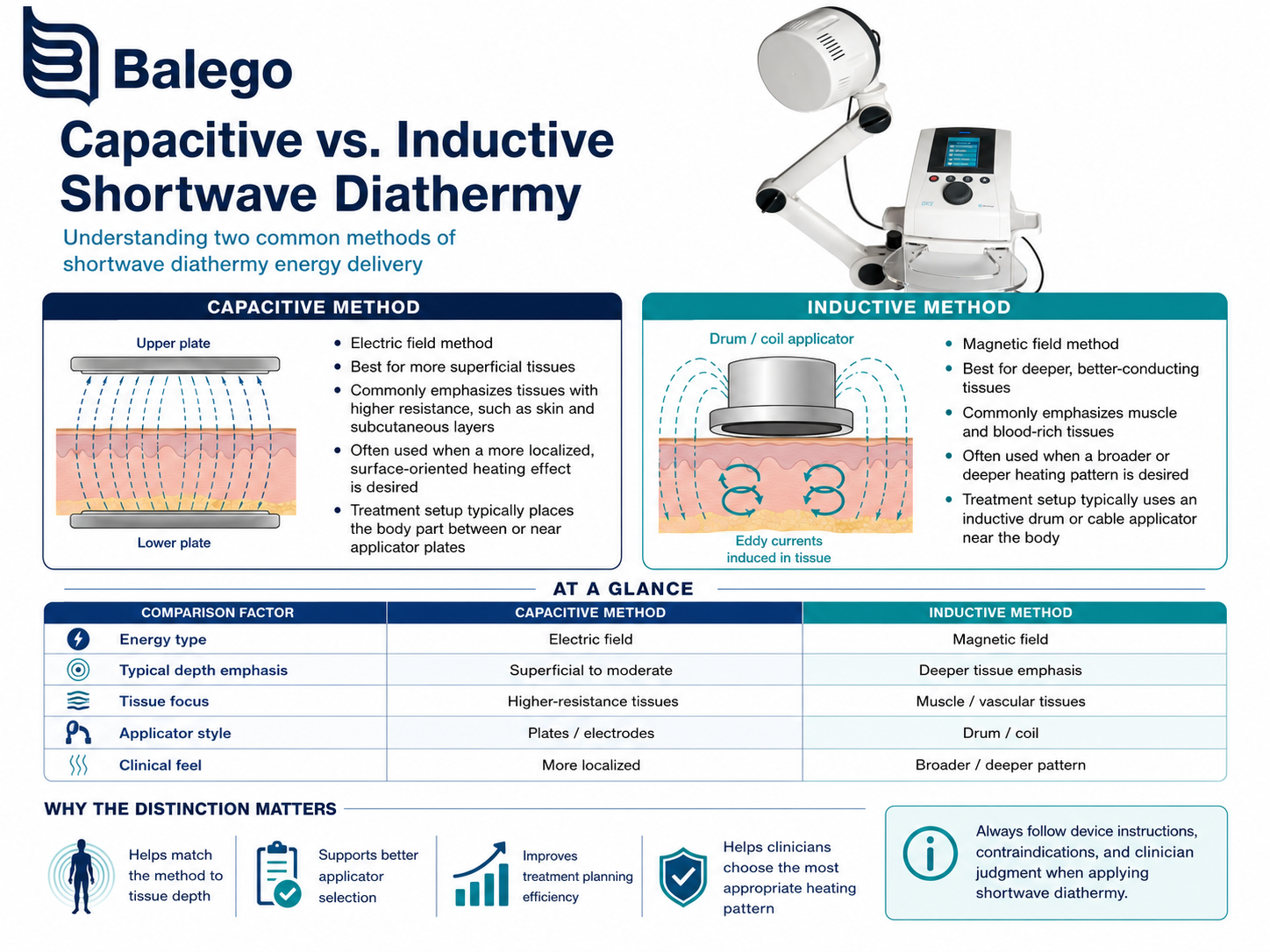
Quick Comparison
| Feature | Capacitive-field SWD | Inductive-field SWD |
|---|---|---|
| Primary field | Electric field | Magnetic field |
| Common applicator | Two insulated plates or flexible electrodes | Monode drum, coil, or Diplode |
| Basic mechanism | Tissue and electrodes form a capacitor | A magnetic field induces eddy currents |
| Tissue-heating tendency | Greater heating in relatively resistive tissue, including subcutaneous fat | Greater heating in conductive, fluid-rich tissue such as muscle |
| Applicator arrangement | Treatment region positioned between or within the electrode field | Drum or coil positioned over or around the treatment region |
| Main setup variable | Electrode size, alignment, spacing, and electrode-skin distance | Applicator size, position, contact or spacing, and field orientation |
| Surface-heating concern | Higher when fat layers or edge effects concentrate the electric field | Reduced by shielding in an appropriately designed drum, although hot spots remain possible |
| Common workflow strength | Ability to shape the field with electrode placement | Efficient application over muscle-rich regions |
| Standard on TheraTouch DX2 | No | Yes |
| Available on Intelect SWD100 | Yes, with optional accessories | Yes, monode is standard |
Instructions for the Intelect SWD100 state that capacitive treatment warms fat more effectively than muscle, while inductive eddy currents preferentially heat tissues with better electrical conductivity, including muscle and internal tissue.
Why Tissue Composition Changes the Heating Pattern
Shortwave energy is not absorbed equally by every tissue layer.
Conductive Tissue
Tissue with more water, electrolytes, and blood flow generally conducts electrical current more readily. Examples include:
- Skeletal muscle
- Blood
- Fluid-rich soft tissue
- Many internal organs
An inductive magnetic field creates closed circulating currents, often called eddy currents, within conductive tissue. The density of those currents increases with tissue conductivity, which is why inductive applicators tend to emphasize muscle-rich regions rather than subcutaneous fat.
Resistive Tissue
Subcutaneous fat has lower conductivity and greater electrical resistance than muscle. Within a capacitive electric field, this resistive layer can convert more energy into heat.
This does not mean that fat is the desired clinical target. It means that fat may become a limiting layer because it can warm before deeper muscle reaches the intended temperature. Clinicians must account for adipose thickness, patient heat sensation, electrode spacing, and field alignment.
Tissue-Heating Tendency
| Tissue characteristic | Capacitive-field tendency | Inductive-field tendency |
|---|---|---|
| High electrical resistance | Greater relative heating | Lower relative heating |
| High conductivity | Lower relative heating than resistive layers | Greater induced-current heating |
| Thick subcutaneous fat | May increase superficial heat concentration | Shielded drums help reduce direct electric-field heating of fat |
| Large muscle mass | It can be heated, but overlying fat may limit comfort | Often well suited to the induced-current pattern |
| Irregular surface | Requires careful electrode alignment and spacing | Applicator contour and positioning still matter |
| Small bony prominence | Edge effects and concentrated heating require caution | Applicator size and surrounding soft tissue must be considered |
These are general energy-distribution tendencies, not automatic prescriptions for a specific diagnosis.
How Capacitive Shortwave Diathermy Works
With the capacitive method, two insulated electrodes and the body region form a capacitor. The high-frequency electric field extends through the tissues positioned between the electrodes, producing heating throughout the field.
Compatible capacitive accessories can include:
- Rigid plate electrodes
- Adjustable capacitive electrodes
- Flexible rubber electrodes
- Felt spacing layers
- Positioning arms and supports
The Intelect SWD100 accommodates capacitive electrodes in multiple diameters as well as flexible rubber electrodes. We offer shortwave diathermy accessories, including 80 mm, 120 mm, and 165 mm capacitive electrodes.
Capacitive Electrode Size Comparison
| Electrode size | Relative field area | Practical consideration |
|---|---|---|
| 80 mm | Smaller | More localized field setup: the SWD100 manual limits this electrode to 80 W in continuous mode |
| 120 mm | Medium | Balanced option for many intermediate-size treatment regions |
| 165 mm | Larger | Broader field coverage |
| Flexible rubber electrode | Conforms to body shape | Uses felt layers and straps to establish spacing and position |
The appropriate size is based on the treatment region and equipment instructions, not simply the desire to concentrate more power. The SWD100 manual specifically states that the 80 mm capacitive electrodes should not exceed 80 W in continuous mode.
Why Electrode-Skin Distance Matters
The distance between the internal metal plate and the patient’s skin changes the capacitive-field distribution.
According to the SWD100 instructions:
- A small electrode-skin distance emphasizes heating nearer the surface.
- A larger electrode-skin distance supports a deeper and more broadly distributed field.
- A larger distance is particularly important when a patient has a substantial subcutaneous fat layer and the clinical objective is to reduce excessive surface concentration while reaching deeper tissue. (Enovis)
SWD100 Capacitive Spacing Positions
| Adjusting-pin position | Approximate electrode-skin distance |
|---|---|
| Inserted | 1 cm |
| Half pulled out | 1.75 cm |
| Fully pulled out | 2.5 cm |
These values are specific to the adjustable capacitive electrodes described in the Intelect SWD100 manual. They should not be transferred automatically to another shortwave system or electrode design.
Small vs. Large Electrode-Skin Distance
| Setup | Typical field effect | Important consideration |
|---|---|---|
| Smaller distance | Greater concentration nearer the surface | May increase superficial warming |
| Larger distance | Broader field and greater depth emphasis | May require more available output |
| Unequal spacing | Asymmetrical field distribution | Can increase localized concentration and requires careful control |
| Felt spacers | Establish controlled spacing with flexible electrodes | Must remain properly positioned and dry |
| Electrode close to a curved edge | Greater risk of field concentration | Align surfaces and avoid constriction |
Electrode spacing is therefore part of dose delivery—not merely a way to keep the plate from touching the patient.
Capacitive Electrode Alignment and Edge Effects
Capacitive electrodes should generally be positioned with their surfaces nearly parallel to the treatment region. Poor alignment can concentrate the electric field around an edge, body contour, constriction, or metallic object.
The SWD100 manual warns that local overheating can occur because of the following:
- One-sided electrode application
- Electrode edges directed toward tissue
- A narrow or constricted body contour
- Unequal spacing
- Metal within or near the field
Increasing the distance with appropriate felt layers or positioning materials can help reduce concentrated surface heating.
Capacitive Setup Check
| Check | Why it matters |
|---|---|
| Are the electrode faces nearly parallel? | Reduces uneven field concentration |
| Is the treatment region centered within the field? | Improves distribution through the intended area |
| Are both electrodes appropriately spaced? | Helps control depth and superficial heating |
| Is one edge substantially closer to the patient? | May create an edge effect and localized hot spot |
| Are felt layers flat and dry? | Moisture or folds can distort the field |
| Are metal objects absent? | Metal can concentrate energy and cause overheating |
| Is the patient positioned comfortably and immobile? | Movement changes spacing and field geometry |
| Can the patient reliably report warmth? | Thermal dosage depends partly on patient sensation |
How Inductive Shortwave Diathermy Works
An inductive applicator contains a coil that produces a high-frequency magnetic field. This field induces circulating eddy currents within the patient’s tissues. More conductive tissues develop stronger currents and therefore greater heating.
Common inductive applicators include:
- Monode or drum: Used over a moderate-size region
- Diplode: Designed for broader coverage or for surrounding an appropriate body region from multiple sides
- Cable coil: Found on some systems, although it is less common on current cart-based units
The Intelect SWD100 monode is for medium-sized areas, and the diplode is for larger areas or body regions suited to multi-sided warming.
Monode vs. Diplode
| Feature | Monode drum | Diplode |
|---|---|---|
| Field type | Inductive | Inductive |
| Common coverage | Medium-size region | Larger region |
| Positioning | Placed over or against the treatment area as instructed | Can encompass a suitable area from multiple sides |
| Included with SWD100 | Yes | Optional |
| Included with TheraTouch DX2 | Monode is standard | Not listed for the DX2 |
| Primary advantage | Straightforward single-drum application | Broader field distribution |
The shortwave diathermy accessory page includes both Monode and Diplode options for compatible equipment.
Why an Inductive Drum Can Reduce Fat-Layer Heating
An inductive applicator generates both magnetic and electric field components. A properly designed, electrically shielded drum reduces the electric-field component that would otherwise concentrate heating in resistive subcutaneous fat.
The TheraTouch DX2 manual states that its monode incorporates electrostatic shielding intended to prevent the electric field from heating upper-skin adipose tissue, allowing the magnetic field to emphasize more conductive tissue. The patient’s perception of warmth may consequently be delayed, so the manual recommends starting at a lower intensity and increasing gradually rather than raising output quickly.
Inductive Treatment Characteristics
| Characteristic | Clinical implication |
|---|---|
| Magnetic-field energy | Induces current inside conductive tissue |
| Muscle preference | Muscle tends to heat more readily than fat |
| Delayed warmth sensation | Do not increase output too rapidly |
| Applicator shielding | Helps reduce electric-field heating of superficial fat |
| Applicator distance | Field intensity falls rapidly as distance increases |
| Drum orientation | Determines which area receives the strongest field |
| Large applicator | Better suited to broader tissue regions |
| Single-layer towel | May absorb perspiration and reduce moisture-related hot spots when directed by the manual |
The DX2 specifies using a single layer of absorbent toweling between the patient and monode to manage perspiration and reduce hot spots. It also advises against treating through clothes.
Capacitive vs. Inductive: Which Heats Deeper?
Neither method should be described as always deeper.
Depth depends on:
- Applicator type and size
- Electrode-skin distance
- Tissue thickness
- Subcutaneous fat
- Field alignment
- Output power
- Continuous or pulsed mode
- Treatment duration
- Patient circulation
- Equipment tuning and coupling
Inductive treatment often produces a useful depth emphasis in muscles because the induced currents are stronger in conductive tissue and shielded drums reduce superficial electric-field heating. Capacitive treatment can also produce deeper heating when the field is properly spaced and aligned, but overlying fat may absorb a disproportionate amount of energy.
Better Question Than “Which Is Deeper?”
Instead of asking which method is universally deeper, ask:
- What tissue composition lies between the applicator and target?
- Is the target region primarily muscle-rich or fat-covered?
- Does the desired field need to pass through the region from two sides?
- Can two capacitive electrodes be positioned evenly?
- Would a drum provide more reliable contact and field geometry?
- Which applicators are actually compatible with the clinic’s equipment?
- Can the patient accurately report thermal sensation?
- Does the clinician need continuous thermal or pulsed shortwave delivery?
Applicator Selection by Treatment Geometry
| Treatment-region characteristic | Method commonly considered | Reason |
|---|---|---|
| Large, muscle-rich region | Inductive | Conductive muscles develop stronger eddy-current heating |
| Moderate-size muscle region | Inductive monode | A single-drum setup can cover the region efficiently |
| Larger region suited to multi-sided exposure | Inductive Diode | Broader inductive-field configuration |
| Region that can be positioned between two electrodes | Capacitive | Allows the field to pass through the selected tissue volume |
| Small or medium region needing plate-size selection | Capacitive | Multiple electrode diameters are available |
| Irregular contour | Flexible capacitive electrodes or appropriately sized inductive drum | It depends on which setup maintains uniform geometry |
| Thick subcutaneous fat over deeper tissue | Often inductive; capacitive requires larger spacing and careful dosing | Helps reduce excessive superficial fat heating |
| Small bony area with limited soft tissue | Requires particular caution regardless of method | Field concentration and thermal tolerance may limit use |
| Treatment area where two plates cannot be aligned | Inductive | May simplify positioning |
| The clinic needs both field types | Intelect SWD100 | Supports inductive and optional capacitive accessories |
This table is a field-selection framework, not a diagnosis-specific treatment protocol.
Device Comparison: Which Balego Systems Support Each Method?
TheraTouch DX2 vs. Intelect SWD100
| Feature | TheraTouch DX2 | Intelect SWD100 |
|---|---|---|
| Primary applicator method | Inductive | Inductive and capacitive |
| Standard applicator | 14 cm monode drum | Monode / inductive drum |
| Capacitive operation | Not listed | Supported with optional accessories |
| Optional plate sizes | Not applicable | 80, 120, and 165 mm |
| Flexible capacitive electrodes | Not listed | Available in manufacturer accessory configurations |
| Diplode | Not listed | Optional |
| Continuous output | 100 W | 100 W |
| Pulsed peak output | 200 W | 200 W |
| Frequency | 27.12 MHz | 27.12 MHz |
| Treatment-time range | 1–30 minutes | 1–60 minutes |
| Main positioning | Inductive-focused system with monode arm | Multi-applicator system for clinics requiring both field types |
| Best fit | The clinic is primarily using inductive drum treatment | Clinic needing broad applicator flexibility |
The monode drum, shielded cable, and mechanical arm are the DX2 standard accessories. The SWD100 standard package also begins with an inductive monode, while capacitive electrodes, a second arm, flexible electrodes, and the Diplode are optional.
Equipment-Purchasing Implication
Choose the TheraTouch DX2 when the clinic’s intended workflow centers on inductive monode treatment and does not require capacitive plates.
Consider the Intelect SWD100 when the clinic wants:
- Inductive monode treatment
- Optional Diplode treatment
- Multiple capacitive electrode sizes
- Flexible capacitive electrodes
- Two applicator arms
- A wider range of field configurations
The standard SWD100 does not automatically include every capacitive accessory. Those components can be selected on our Shortwave Diathermy Accessories page.
Common Oversimplifications to Avoid
“Capacitive plates heat high-water tissues.”
This is inaccurate. Capacitive electric fields tend to produce greater heating in electrically resistive tissue, especially subcutaneous fat, compared with muscle.
“Inductive drums heat only deep tissue.”
Inductive heating is not confined to one exact depth. The distribution depends on applicator geometry, distance, tissue conductivity, output, and patient anatomy.
“Inductive is always better for tendons.”
Tendons are not electrically identical to muscle. Applicator selection should be based on the target’s location, surrounding tissue, anatomy, field distribution, and manufacturer-supported clinical reasoning.
“The plate closest to the patient is safest.”
Reducing capacitive electrode-skin distance increases surface emphasis. It may increase superficial heating rather than improving safety.
“More spacing always means less treatment.”
Increasing capacitive spacing can reduce surface concentration and broaden depth distribution, although the device must provide sufficient output and proper coupling.
“The patient will feel inductive heat immediately.”
Warmth may be delayed with an inductive drum. Increasing the output too quickly can result in excessive heating before the patient fully perceives it.
“The DX2 can switch between capacitive and inductive applications.”
The DX2 identifies a monode inductive drum. Capacitive plates are not listed as a DX2 accessory or operating method.
Setup Errors That Can Change the Field
| Setup error | Possible consequence |
|---|---|
| Capacitive electrodes not parallel | Uneven field and concentrated edge heating |
| One capacitive electrode much closer than the other | Asymmetrical heating |
| Electrode placed over a skin fold or constriction | Localized concentration |
| Metal left near the field | Local overheating and safety risk |
| Wet towels or pooled perspiration | Hot spots |
| Treating through synthetic clothing | Moisture may pool against the skin |
| Inductive drum positioned too far away | Rapid reduction in magnetic-field energy |
| Increasing inductive output before warmth develops | Excessive eventual heating |
| The patient changes position during treatment | Changes coupling and field geometry |
| Applicator arm not locked | The position may shift during treatment |
| Using an incompatible accessory | Unpredictable output or device damage |
| Choosing an applicator only by diagnosis | Ignores anatomy, tissue composition, and equipment limits |
Emphasize maintaining a stable position, removing metal, avoiding treatment through clothing, controlling moisture, and securing applicator arms to prevent movement.
A Practical Field-Selection Checklist
Before selecting capacitive or inductive SWD, document:
1. Treatment Region
- Exact anatomical location
- Size and shape of the target
- Depth estimate
- Presence of thick subcutaneous fat
- Proximity to bony prominences
- Ability to position applicators evenly
2. Intended Heating Pattern
- Surface-biased
- Broad through-field
- Muscle-emphasized
- Multi-sided
- Localized or regional
- Thermal or subthermal
3. Applicator Availability
- Monode
- Diplode
- 80 mm capacitive plates
- 120 mm capacitive plates
- 165 mm capacitive plates
- Flexible rubber electrodes
- Required electrode arms and cables
4. Patient Factors
- Thermal sensation
- Communication ability
- Circulation
- Tissue thickness
- Skin condition
- Ability to remain still
- Presence of metal or implanted devices
- Complete contraindication and precaution screening
5. Documentation
Record:
- Device
- Applicator type
- Electrode size
- Electrode-skin distance
- Applicator position
- Continuous or pulsed output
- Dosage level or power
- Pulse width and frequency when applicable
- Treatment time
- Patient heat perception
- Skin response
- Any interruption or position adjustment
Frequently Asked Questions
What is the main difference between capacitive and inductive shortwave diathermy?
Capacitive SWD creates an electric field between two electrodes. Inductive SWD creates a magnetic field that induces circulating currents in tissue. The different fields produce different heating patterns according to tissue resistance and conductivity.
Which method heats muscle more effectively?
Inductive fields tend to emphasize muscle because muscle is electrically conductive and contains substantial water and electrolytes. Eddy-current density increases with tissue conductivity.
Which method heats fat more?
Capacitive fields tend to warm subcutaneous fat more than muscle because fat is relatively resistive. Excessive superficial heating is therefore an important concern with thick adipose layers.
Is capacitive shortwave only superficial?
No. The field exists between the electrodes and can heat deeper tissue. Increasing electrode-skin distance can shift the distribution toward greater depth, although tissue composition and available output remain important.
Is inductive shortwave always deeper?
No. Inductive applicators often emphasize deeper muscle relative to overlying fat, but actual depth depends on applicator size, spacing, tissue composition, output, and treatment duration.
What is a monode?
A monode is a drum-style inductive applicator containing a coil that creates a magnetic field. The SWD100 manual describes it as an applicator for medium-size regions.
What is a Diplode?
A Diplode is a larger inductive applicator intended for broader areas or appropriate body regions that can be exposed from several sides. It is an optional accessory for the Intelect SWD100.
Why are two electrodes needed for capacitive treatment?
The electrodes and the body region together form a capacitor. The treatment region lies within the high-frequency electric field between the electrodes.
Should capacitive plates touch the skin?
That depends on the electrode design. Adjustable rigid electrodes may contact the patient through an insulated housing while the internal metal plate remains at a selected distance. Flexible electrodes use felt spacing. Follow the specific system manual rather than applying a universal rule.
Does a larger electrode-skin distance reduce surface heating?
The SWD100 manual states that surface warming can be reduced and depth emphasis increased by enlarging the electrode-skin distance.
Can unequal capacitive spacing be used intentionally?
Unequal spacing changes the field distribution, but it can also concentrate heating. Any deliberate asymmetric arrangement requires careful dose control and must follow the equipment instructions.
Does the TheraTouch DX2 support capacitive plates?
A monode inductive drum, such as the DX2 applicator. They do not list a capacitive plate system.
Does the Intelect SWD100 support both methods?
Yes. The device supports inductive and capacitive treatment. The monode is supplied as the standard applicator, while capacitive electrodes and some additional applicators are optional.
Which capacitive electrode sizes does Balego offer?
80 mm, 120 mm, and 165 mm capacitive electrode options for compatible shortwave diathermy equipment. See the Shortwave Diathermy Accessories page.
Can a patient be treated through clothing?
The DX2 manual directs clinicians to remove clothing from the treatment area, particularly synthetic materials that may allow perspiration to pool and cause localized overheating.
Why is a towel used with an inductive drum?
A single layer of absorbent toweling can absorb perspiration and help prevent hot spots caused by moisture collecting on the skin. Use only the setup specified by the equipment manufacturer.
Why might warmth be delayed with an inductive drum?
The shielded drum reduces superficial electric-field heating, while the magnetic field emphasizes conductive underlying tissue. The patient may therefore take several minutes to perceive warmth.
The Bottom Line
Capacitive and inductive shortwave diathermy differ primarily in the field they create and the tissues that preferentially absorb their energy.
Capacitive SWD:
- Uses two insulated electrodes
- Places tissue within an electric field
- Tends to heat resistive tissue such as subcutaneous fat more than muscle
- Allows field distribution to be adjusted through electrode size, position, and electrode-skin distance
- Requires careful management of edge effects, spacing, and superficial heat
Inductive SWD:
- Uses a coil or drum to create a magnetic field
- Generates eddy currents within conductive tissue
- Tends to emphasize muscle and other fluid-rich tissue relative to fat
- Simplifies application over many muscle-rich regions
- May produce delayed warmth sensation, requiring gradual dosage progression
The correct method is not determined by diagnosis alone. It depends on tissue composition, target geometry, patient anatomy, applicator availability, equipment design, and the clinician’s intended field distribution.
- The inductive-focused TheraTouch DX2 Shortwave Diathermy
- The dual-method Intelect Shortwave Diathermy SWD100
- Capacitive electrodes, Monode, Diplode, and positioning arms
- Balego’s complete Diathermy collection
Professional-Use and Safety Notice
Shortwave diathermy is a professional medical modality that produces radio-frequency electromagnetic fields. Applicator selection, field arrangement, electrode spacing, output, pulse settings, treatment time, and patient screening should be performed by appropriately trained healthcare professionals following the current manufacturer instructions.
This article explains field and applicator differences. It does not replace the complete device manual, contraindication screening, facility electromagnetic-safety policies, or individualized clinical judgment.


