



Interferential current therapy and adjustable interference frequency are not two competing treatment types.
- Interferential current therapy, usually abbreviated IFC or IFT, is the electrotherapy modality.
- Adjustable interference frequency describes a control available on certain IFC devices.
- That adjustable control usually changes the beat frequency, also called the difference frequency or amplitude-modulated frequency.
- Some advanced clinical systems also allow adjustment of other parameters, including the carrier frequency, sweep range, vector field, output type, or treatment sequence.
In practical terms, asking whether a device provides “IFC or adjustable interference frequency” is similar to asking whether a vehicle has “an engine or adjustable speed.” The second is a controllable feature of the first—not a separate category.
Quick Answer
| Term | What it means |
|---|---|
| Interferential current therapy | The overall electrical-stimulation modality |
| Carrier frequency | The medium-frequency current used to carry the stimulation |
| Beat or difference frequency | The difference between two carrier frequencies |
| Amplitude-modulated frequency | Another name commonly used for the resulting beat rate |
| Fixed frequency | One selected beat frequency remains in use |
| Adjustable frequency | The operator can choose the beat frequency |
| Frequency sweep | The device automatically moves through a selected frequency range |
| Vector or scan | Changes the distribution of a four-pole treatment field; it is not the same as a frequency sweep |
Interferential stimulation commonly uses medium-frequency currents around the kilohertz range. When two slightly different carrier frequencies interact, they create an amplitude-modulated effect at a much lower rate.
IFC, IFT, and ICT: Which Abbreviation Is correct?
The terminology is not completely uniform across manufacturers and sellers.
| Abbreviation | Typical meaning | Recommended use |
|---|---|---|
| IFC | Interferential current or interferential current therapy | Clearest term for product and educational content |
| IFT | Interferential therapy | Common in clinical and international literature |
| ICT | Sometimes used for interference or interferential current therapy | Understandable, but less precise and less consistently used |
| IF | Interferential mode | Common on compact device screens and manuals |
Browse our interferential therapy machines and IFC devices to compare currently available formats.
How Interferential Frequency Is Created
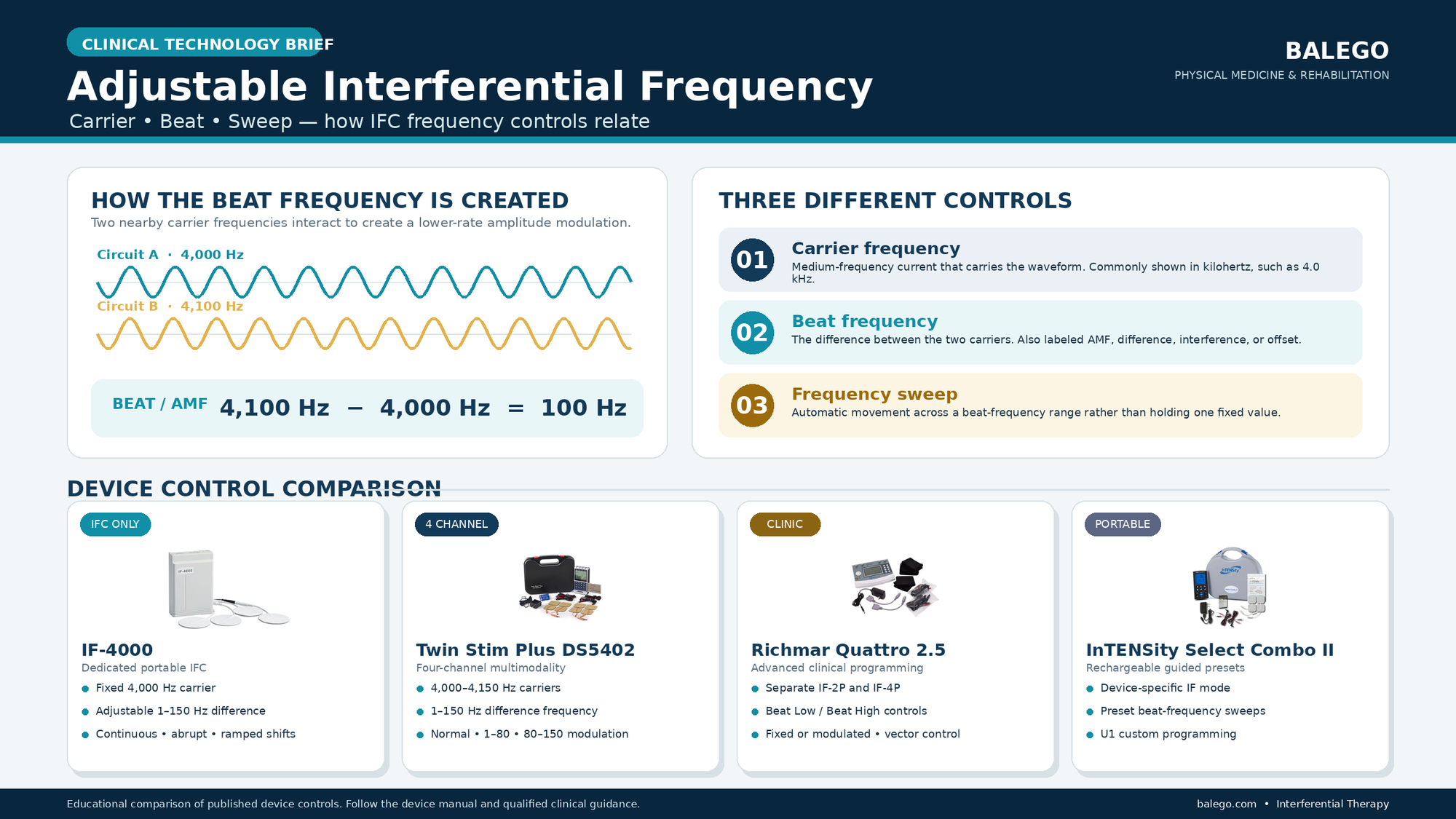
A traditional four-pole IFC setup uses two electrical circuits. Each circuit carries a medium-frequency current, but the frequencies are slightly different.
Consider this simplified example:
| Circuit | Carrier frequency |
|---|---|
| Circuit A | 4,000 Hz |
| Circuit B | 4,100 Hz |
| Difference between them | 100 Hz |
The two carrier currents differ by 100 Hz. Their interaction therefore creates a 100 Hz amplitude-modulated or beat-frequency effect.
The important distinction is that the device is not simply delivering a conventional 100 Hz pulse in the same way as a standard low-frequency stimulator. The 100 Hz value describes the modulation created by the two medium-frequency carriers.
The simplified relationship
Beat frequency = higher carrier frequency − lower carrier frequency
Using the example above:
4,100 Hz − 4,000 Hz = 100 Hz
Manufacturers may label this adjustable value as
- Beat frequency
- Difference frequency
- Interference frequency
- Amplitude-modulated frequency
- AMF
- Beat low and beat high
- Frequency offset
These labels may describe closely related controls, but users should follow the terminology and operating instructions in the manual supplied with the specific device.
Carrier Frequency and Beat Frequency Are Not the Same
Confusing these two values is one of the most common problems when comparing IFC machines.
| Feature | Carrier frequency | Beat or amplitude-modulated frequency |
|---|---|---|
| Typical scale | Kilohertz, such as 4,000 Hz | Lower rate, often within a range such as 1–150 Hz |
| Main role | Carries the stimulation waveform | Determines how rapidly the amplitude-modulated effect repeats |
| Usually adjusted? | Often fixed on portable units | Frequently fixed, selectable, or swept |
| Example | 4,000 Hz | 100 Hz |
| What a product listing may call it | Base frequency or carrier | Difference, beat, AMF, interference frequency, or offset |
A product described as having a “4,000 Hz interferential frequency” may therefore be referring to its carrier, not its beat frequency. A separate specification may identify the selectable difference-frequency range.
For example, the IF-4000 Interferential IFC Machine uses a fixed 4,000 Hz carrier and an adjustable difference frequency from 1 to 150 Hz.
Fixed, Adjustable and Sweep Frequencies
These terms describe different ways an IFC unit can manage the beat frequency.
Fixed beat frequency
A fixed setting maintains one selected beat frequency throughout the session.
For example, if the device maintains carriers of 4,000 Hz and 4,100 Hz, the difference remains 100 Hz.
A fixed setting may be useful when:
- A professional protocol calls for one consistent setting.
- The clinician wants to evaluate the user’s response to a controlled parameter.
- The device offers a simple continuous mode.
- Reproducibility between sessions is important.
“Fixed” does not necessarily mean that the device has only one factory-set frequency. An IFC machine may allow the clinician to select a value and then hold that selected value steady.
Adjustable beat frequency
An adjustable device allows the operator to select the difference between the carrier currents.
For example, a device with a 1–150 Hz adjustable range may permit the clinician to select a specific value anywhere within that range, subject to the device’s programming options.
Adjustability provides more control, but it does not mean that every available number corresponds to a universally accepted diagnosis or treatment result.
Frequency sweep
A sweep automatically changes the beat frequency between a lower and upper limit.
A hypothetical 80–120 Hz sweep would move through that range rather than staying at one fixed value. Depending on the device, the change may occur:
- Gradually
- In steps
- Abruptly at set intervals
- In a ramped pattern
- According to a manufacturer-defined modulation program
The IF-4000, for example, provides continuous, abrupt, and ramped frequency-shift patterns. The Twin Stim Plus DS5402 provides a fixed Normal program and modulation ranges covering 1–80 Hz and 80–150 Hz.
Does sweeping prevent accommodation?
Frequency variation is commonly used to vary the sensation and may help reduce perceptual accommodation during a session. However, a sweep should not automatically be described as clinically superior to a fixed setting.
Research comparing carrier frequencies, amplitude-modulated frequencies, and swing patterns has produced mixed results. These parameters can affect comfort and sensory response, but published findings do not support a universal rule that one frequency or sweep pattern is best for every pain condition.
Frequency Sweep vs. Vector Scan
A frequency sweep and a vector scan are frequently confused, especially on professional four-pole systems.
| Control | What changes | What does not necessarily change |
|---|---|---|
| Frequency sweep | The beat frequency over time | Electrode locations |
| Vector or scan | The relative current distribution within the four-electrode field | The selected beat-frequency range |
| Intensity modulation | Output amplitude or perceived strength | Carrier or beat frequency |
| Treatment timer | Session duration | Waveform frequency |
| Constant current/constant voltage | How the device regulates output under changing resistance | The selected therapeutic program |
A vector control is relevant primarily to a traditional four-pole interferential field. The device changes the relative amplitude delivered through the intersecting circuits, shifting the region in which the strongest interference effect occurs.
The Richmar Quattro 2.5, for example, provides four-pole vector controls as well as Beat Low and Beat High frequency settings. Its frequency and vector controls perform different jobs.
Two-Pole vs. Four-Pole Interferential Current
The number of electrodes also affects how an IFC waveform is produced and applied.
| Feature | Two-pole or premodulated IF | Four-pole interferential |
|---|---|---|
| Electrodes for one treatment field | Two | Four |
| Where modulation is created | Inside the device before output | Through interaction of two circuits across the treatment field |
| Setup complexity | Simpler | Requires two properly arranged circuits |
| Useful for | Smaller or less accessible treatment regions | Broader regions and crossed-current placement |
| Vector-field control | Generally not applicable | May be available on advanced systems |
| Device terminology | IF-2P, premodulated, bipolar IF | IF-4P, quadripolar, traditional IFC |
Two-electrode output should not automatically be assumed to be identical across every machine. A device may deliver a manufacturer-specific premodulated waveform, or it may use a dedicated bipolar operating mode.
The IF-4000 supports both two-electrode and four-electrode operation. The professional Quattro 2.5 lists separate IF-2P premodulated and IF-4P traditional interferential waveform families.
What Does Adjustable IFC Actually Let a Clinician Change?
The phrase “adjustable interferential frequency” can be too vague by itself. Before comparing products, identify which controls are genuinely adjustable.
| Adjustable parameter | Question to ask |
|---|---|
| Beat frequency | Can one exact value be selected? |
| Beat-frequency range | What are the minimum and maximum values? |
| Beat Low and Beat High | Can the sweep boundaries be programmed independently? |
| Sweep pattern | Is the change gradual, abrupt, ramped, or preset? |
| Carrier frequency | Is it fixed or selectable? |
| Two-pole/four-pole output | Does the device support one format or both? |
| Vector control | Can the four-pole field be scanned or redirected? |
| Intensity | Are channels controlled together or independently? |
| Presets | Are body-area or treatment programs included? |
| Custom memory | Can professional protocols be saved? |
| Constant current/voltage | Does the device offer either or both output-regulation methods? |
A device may advertise “adjustable IFC” while allowing only preset sweep programs. Another may permit direct entry of Beat Low, Beat High, carrier, vector, and output-regulation values. The second provides more parameter control, but it may also require more training.
Comparison of Balego IFC Devices
The following comparison focuses specifically on the frequency controls discussed in this article rather than repeating the complete specifications provided on each product page.
| Device | IFC format | Relevant frequency controls | Other modalities | Best fit |
|---|---|---|---|---|
| IF-4000 Interferential IFC Machine | Two- or four-electrode operation | Fixed 4,000 Hz carrier; adjustable 1–150 Hz difference frequency; continuous, abrupt, and ramped shift patterns | IFC only | Dedicated, straightforward portable IFC |
| Richmar Twin Stim Plus DS5402 | Four-pole IFC using paired channels | 4,000–4,150 Hz carriers; 1–150 Hz difference frequency; Normal, 1–80 Hz modulation, and 80–150 Hz modulation programs | TENS, EMS/NMES, Russian | Portable four-channel multimodality use |
| Richmar Quattro 2.5 | Separate IF-2P and IF-4P waveforms | 4.0 kHz carrier; Beat Low/Beat High settings; fixed or frequency-modulated operation; four-pole vector controls | TENS, EMS, Russian | Advanced professional clinic programming |
| InTENSity Select Combo II | Portable device-specific IF mode | Preset beat-frequency sweeps and U1 custom programming | TENS, NMES, Russian | Rechargeable two-channel unit with guided presets |
The IF-4000 is the most focused choice when a clinic wants a dedicated IFC machine. The Twin Stim Plus is more appropriate when four portable channels and multiple stimulation modalities are required. The Quattro 2.5 provides the most extensive clinic-oriented interferential controls in this group, including separate two-pole and four-pole waveforms and vector programming. The Select Combo II emphasizes portability, rechargeable operation, and body-area presets rather than a large clinical control panel.
For a broader selection, visit our interferential current therapy collection.
Is an Adjustable Interference Frequency Better?
An adjustable frequency is more flexible, but it is not automatically more effective.
Adjustability may be valuable when:
- A clinician needs to reproduce a particular professional protocol.
- Patient comfort differs between settings.
- Fixed and swept programs need to be compared.
- Multiple body regions or treatment plans are managed with one device.
- Custom protocols need to be stored.
- A clinic wants greater control than a preset-only device provides.
A simpler device may be preferable when:
- A limited number of professionally selected programs is sufficient.
- Portability is more important than extensive manual programming.
- The user has been prescribed one consistent setup.
- A home program needs fewer adjustable controls.
- The clinic wants a dedicated IFC unit rather than a multimodality console.
The clinically appropriate device is the one that provides the required waveform, electrode configuration, output, controls, safety features, and professional oversight—not simply the largest number of frequency settings.
Why a Diagnosis-to-Frequency Chart Can Be Misleading
Charts often assign narrow frequency bands to acute pain, chronic pain, edema, circulation, muscle contraction, or tissue repair. These charts may be useful as historical teaching conventions, but they should not be presented as universal treatment rules.
The response to electrical stimulation can also depend on the following:
- Output intensity
- Electrode size and position
- Two-pole versus four-pole delivery
- Treatment duration
- Sweep pattern
- Skin-electrode contact
- Patient tolerance
- Pain mechanism and diagnosis
- Concurrent rehabilitation
- The exact waveform generated by the device
Clinical studies have evaluated different combinations of carrier frequency and amplitude-modulated frequency, with inconsistent findings. In one randomized trial involving chronic nonspecific low-back pain, changing the carrier between 1 kHz and 4 kHz did not establish a straightforward frequency-based solution for the primary pain outcome. Experimental research has also found tradeoffs between sensory comfort and measured hypoalgesic responses at different carrier frequencies.
For that reason, frequency should be selected according to current device labeling, a qualified clinician’s assessment, the intended waveform, and the individual response—not from an isolated online chart.
How to Read an IFC Product Listing
Before purchasing or comparing an interferential stimulator, look for answers to these questions:
- Is the listed kilohertz value the carrier or the beat frequency?
- Is the beat frequency fixed, manually adjustable, or preset?
- Can the unit sweep between two limits?
- What sweep patterns are available?
- Does it provide two-pole, four-pole, or both forms of IFC?
- How many channels are required for one four-pole field?
- Are channel intensities independently adjustable?
- Does the device include vector or field-scan controls?
- Is it a dedicated IFC unit or a multimodality stimulator?
- Is the device intended for professional or clinician-directed use?
- Are the required electrodes and lead wires included?
- Is there a complete manual explaining the manufacturer’s terminology?
Two listings may both say “adjustable interferential current” while providing substantially different control, channel, waveform, and electrode options.
Frequently Asked Questions
Are IFC and adjustable interference frequency the same thing?
Not exactly. IFC is the therapy modality. Adjustable interference frequency is a feature that lets the operator change the beat or difference frequency used within that modality.
Is ICT the same as IFC?
ICT is sometimes used informally for interference or interferential current therapy. IFC is the clearer and more commonly recognized abbreviation for interferential current.
Is 4,000 Hz the therapeutic beat frequency?
Usually not. On many IFC devices, 4,000 Hz is the carrier frequency. The lower beat frequency is created from the difference between two carrier frequencies.
What is amplitude-modulated frequency?
Amplitude-modulated frequency, or AMF, is the rate at which the resulting interferential amplitude rises and falls. In common IFC terminology, it is closely associated with the beat or difference frequency.
What is an IFC frequency sweep?
A frequency sweep automatically moves the beat frequency across a programmed range instead of holding one constant value.
Is a sweep the same as a vector scan?
No. A frequency sweep changes the beat-frequency setting over time. A vector scan changes the relative distribution of current within a four-electrode interferential field.
Does a higher carrier frequency mean stronger treatment?
No. Frequency and intensity are separate parameters. A higher carrier frequency does not automatically mean that the output is stronger or clinically more effective.
Can IFC be delivered through two electrodes?
Yes, when the device supports two-pole, bipolar, or premodulated interferential output. The waveform is modulated by the device before it reaches the electrodes. Follow the specific unit’s instructions because two-electrode operation is not configured identically on every machine.
Does a four-channel device provide four separate IFC treatments?
Not necessarily. Traditional four-pole IFC uses two channels for one four-electrode treatment field. On the Twin Stim Plus DS5402, Channels 1 and 2 form one IFC pair, while Channels 3 and 4 may form a second field. Other devices may group channels differently.
Is adjustable IFC always better than preset IFC?
No. Adjustable IFC offers more programming flexibility, while preset systems may simplify operation. The appropriate choice depends on the professional protocol, treatment setting, desired waveform, number of channels, and required level of control.
Where can I find setup and safety instructions?
- IF-4000 Interferential Stimulator Guide
- Quattro 2.5 Manual Summary, Setup, Safety and Specifications
- InTENSity Select Combo II Manual
These resources cover product-specific operating procedures, electrode connections, contraindications, precautions, troubleshooting, and technical specifications without duplicating that information here.
Compare Interferential Therapy Equipment
Shop our complete collection of interferential current therapy devices, including portable dedicated IFC units, rechargeable combination stimulators, four-channel devices, and professional clinical systems.
Compatible pads and accessories are available in our electrotherapy electrode collection. Always confirm the electrode connector, size, device labeling, and intended waveform before use.
Important: This article explains terminology and product features. It does not prescribe a frequency or treatment protocol. Follow the device manual and the instructions of a qualified healthcare professional.


