



TENS and NMES Electrode Connectors: Pigtail vs. Tab, Pin, Snap and Side-Pin
Two electrode pads can look nearly identical yet require entirely different lead wires.
Before ordering replacement TENS or NMES electrodes, identify both ends of the connection system:
- The plug that connects the lead wire to the stimulation device
- The connector that joins the lead wire to the electrode pad
Matching only one end is not enough. A lead wire may have the correct 2 mm electrode pins but the wrong device-side plug—or it may fit the stimulator while being unable to connect to the selected pads.
This guide focuses specifically on connector identification and compatibility. For guidance about electrode size, shape, hydrogel, adhesion, and replacement frequency, use our separate TENS Electrode Buying Guide.
Quick answer: Most conventional portable TENS and NMES systems use lead wires terminating in male 2 mm electrode pins. Those pins commonly insert into female sockets attached to pigtail-style electrodes. Flat-tab electrodes require a clip or pin-to-clip adapter, while snap electrodes require a matching snap lead or pin-to-snap adapter. Compatibility must be confirmed at every connection point.
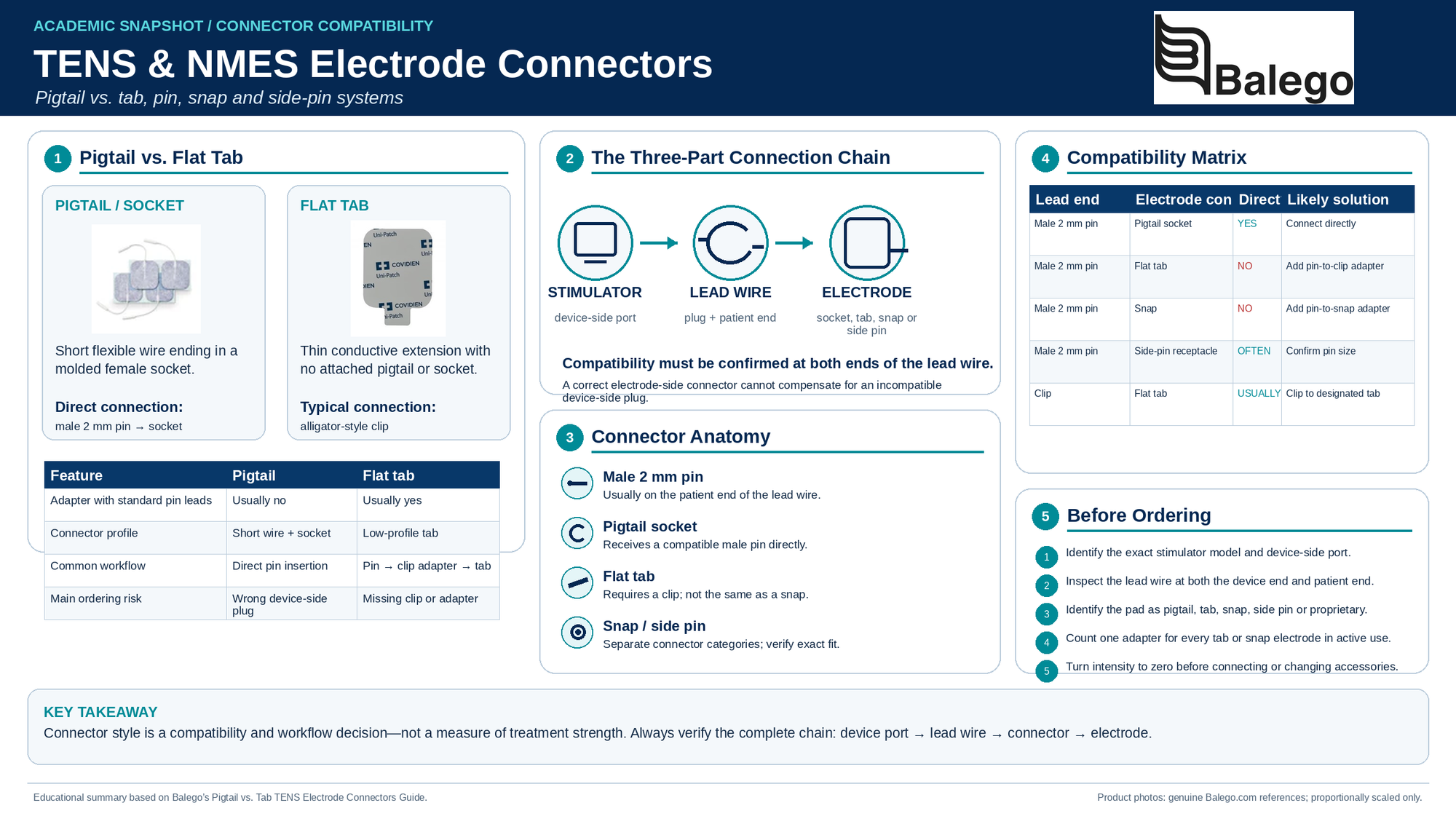
The Three-Part Connection Chain
A conventional electrotherapy setup contains three separate components:
| Component | What to inspect | Why it matters |
|---|---|---|
| Stimulation device | Shape and diameter of the output port | Determines which lead wire can connect to the unit |
| Lead wire | Device-side plug and electrode-side termination | Both ends must match the surrounding components |
| Electrode pad | Pigtail socket, flat tab, snap, side pin or proprietary connector | Determines whether the lead connects directly or needs an adapter |
A complete setup may be represented as
Stimulator → device-side lead plug → lead wire → electrode-side connector → electrode pad
An adapter installed at the electrode end does not change the plug that enters the stimulator. For example, a pin-to-clip adapter can make a qualifying 2 mm pin connect to a flat-tab electrode, but it cannot make the lead wire’s opposite end fit an incompatible device.
Correct Connector Terminology
Connector names are often used inconsistently in product listings. The following descriptions make the physical relationship clearer.
| Connector term | Located on | What it looks like | How it connects |
|---|---|---|---|
| Male 2 mm pin | Usually the patient end of the lead wire | A narrow metal pin approximately 0.080 inch or 2 mm, in diameter | Inserts into a compatible electrode socket or adapter |
| Pigtail socket | Electrode pad | A short flexible wire extending from the pad and ending in a molded female socket | Receives a compatible male 2 mm lead-wire pin |
| Flat tab | Electrode pad | A thin conductive strip extending from the electrode | Gripped by a compatible alligator-style clip |
| Snap | Electrode pad or garment accessory | A round metal stud similar to a clothing snap | Attaches to a matching snap lead or adapter |
| Side pin | Built into the edge of certain electrodes | A receptacle positioned directly at the pad’s side | Receives a compatible lead-wire pin without a pigtail |
| Proprietary connector | Device, cable or electrode system | Manufacturer-specific shape or safety housing | Requires the specified compatible accessory |
The most important terminology correction is that the pigtail electrode generally does not supply the exposed male pin. The short electrode wire terminates in the socket; the lead wire supplies the pin. Balego’s standard replacement leads use male 2 mm electrode pins, while Balego’s reusable pigtail electrodes use soft-molded sockets.
Pigtail vs. Tab Electrodes
Pigtail electrodes
A pigtail electrode includes a short flexible lead extending from the pad. At the end of that lead is a molded socket designed to receive a compatible electrode pin.
Examples include Balego TENS/NMES/FES electrodes, Classic Electrodes, InTENSity 2-Inch Square Electrodes, and many other reusable hydrogel pads.
Tab electrodes
A tab electrode has no attached pigtail wire or molded socket. Instead, a flat conductive tab projects from the pad. A compatible clip grips that tab.
Uni-Tab Stimulating Electrodes are available in three sizes and are packaged in quantities of 48. Conventional pin-ended lead wires do not connect directly to the flat tab; they generally require a suitable pin-to-clip adapter.
Pigtail vs. Tab Comparison
| Feature | Pigtail/socket electrode | Flat-tab electrode |
|---|---|---|
| Electrode connector | Molded female socket on a short wire | Flat conductive tab |
| Typical lead connection | Direct male 2 mm pin | Alligator-style electrode clip |
| Adapter needed with standard pin leads | Usually not. | Usually yes |
| Number of junctions | Fewer | More when an adapter is used |
| Electrode profile | Includes a short attached wire and socket | Thin, low-profile pad with no attached pigtail |
| Common packaging | Frequently four-pad packs, bulk packs or cases | Uni-Tab models are sold in 48-electrode packages |
| Setup approach | Insert each lead-wire pin directly into its electrode socket | Insert each pin into an adapter, then clip the adapter to the tab |
| Common use case | Portable home units and routine clinical electrotherapy | Clinics preferring thin electrodes, bulk inventory or clip-based connections |
| Main purchasing risk | Assuming every 2 mm lead also fits the device | Ordering tab pads without the required clips or adapters |
Neither connector format automatically delivers “stronger” or “better” stimulation. Connector style is primarily a physical compatibility and workflow decision. Electrode materials, skin contact, pad size, placement, device output, and pad condition also affect treatment performance.
A compatible pin-to-clip adapter is a passive connector and does not intentionally change the waveform, frequency, pulse width, intensity, or treatment mode.
How to Identify a Pigtail Electrode
Look for:
- A short wire permanently attached to the electrode
- A molded socket at the free end of that short wire
- An opening sized to receive a lead-wire pin
- No exposed flat conductive strip
- No round snap stud on the pad
To connect it, insert the lead-wire pin into the socket until it feels fully seated. Do not pull the electrode from the skin by its pigtail wire.
Balego reusable electrodes use a soft-molded socket with conductive pigtail strands and are available in several shapes and sizes. Their detailed hydrogel and construction information remains on the product page so it does not need to be duplicated here.
How to Identify a Tab Electrode
Look for:
- A thin conductive extension projecting from the pad
- No molded pigtail socket
- No round snap
- A connection point designed to be gripped by a clip
- A relatively flat, low-profile construction
The metal clip should attach to the designated conductive tab—not to the adhesive surface or directly to the patient’s skin.
Our Uni-Tab electrodes are offered in the following formats:
| Model | Electrode size | Package |
|---|---|---|
| 7020 | 1.25 × 1.5 inches | 48 electrodes |
| 7022 | 2 × 2.25 inches | 48 electrodes |
| 7024 | 4 × 2.25 inches | 48 electrodes |
Current product information describes them as thin, flexible, self-adhering flat-tab electrodes for compatible TENS, NMES, and FES systems. Trimming should be performed only when permitted by the current product labeling and clinical protocol; the conductive tab and required conductive area must remain intact.
How to Use Tab Electrodes With Standard 2 mm Leads
When an otherwise compatible lead wire ends in a conventional male 2 mm pin, Balego’s Uni-Patch Model 770 Pin-to-Clip Adapter can provide the required alligator-style clip.
The connection sequence is:
Compatible stimulator → correct lead wire → 2 mm male pin → Model 770 adapter → clip → flat-tab electrode
Each electrode requires its own adapter.
| Active setup | Electrodes being used | Adapters required |
|---|---|---|
| One channel | 2 | 2 |
| Two channels | 4 | 4 |
| Four channels | 8 | 8 |
The Model 770 package contains ten individual adapters. The adapters are red rather than packaged as matched red-and-black pairs.
What a pin-to-clip adapter does
- Receives a compatible 0.080-inch or approximately 2 mm pin
- Provides an alligator-style clip
- Allows the clip to grip a qualifying flat electrode tab
- Preserves an existing compatible pin-style lead-wire system
- Supports quick changes between tab electrodes
What it does not do
- Change the device-side lead plug
- Convert a pin to a snap
- Repair a damaged lead wire
- Correct a dry or poorly adhering pad
- Change the stimulation mode or electrical settings
- Make every tab electrode compatible with every stimulator
- Permit clipping directly to the patient’s skin
Snap Electrodes Are Different From Tab Electrodes
A snap electrode has a round metal stud. A tab electrode has a flat conductive extension. These connectors are not interchangeable.
When a compatible lead wire ends in a male 2 mm pin but the electrode uses a snap, the appropriate accessory may be a Model 745 Pin-to-Snap Adapter.
| Adapter | Input | Output | Intended connector |
|---|---|---|---|
| Model 770 pin-to-clip | Approximately 2 mm male pin | Alligator-style clip | Flat-tab electrodes |
| Model 745 pin-to-snap | Approximately 2 mm male pin | Snap connection | Compatible snap electrodes |
| No adapter | Approximately 2 mm male pin | Direct connection | Pigtail/socket or qualifying side-pin electrodes |
Do not order a pin-to-snap adapter for Uni-Tab electrodes. A snap adapter cannot grip a flat tab.
What Is a Side-Pin Electrode?
A side-pin electrode has its connector built directly into the edge of the pad instead of attached through a short pigtail.
For example, the Uni-Patch Softy Model 699 EC89455 uses a side-pin connection. A compatible pin enters the side of the electrode directly. This differs physically from pigtail, tab, and snap designs.
| Connector | Attached pigtail wire | Separate clip required | A separate snap adapter required |
|---|---|---|---|
| Pigtail socket | Yes | No | No |
| Flat tab | No | Yes, unless the lead already has clips | No |
| Snap | No | No | Yes, when starting with pin leads |
| Side pin | No | No | No, when the lead pin fits directly |
Compatibility Matrix
| Your lead-wire end | Electrode connector | Direct connection? | Likely solution |
|---|---|---|---|
| Male 2 mm pin | Female pigtail socket | Yes | Connect directly |
| Male 2 mm pin | Compatible side-pin receptacle | Often | Confirm the exact pin size |
| Male 2 mm pin | Flat tab | No | Add a compatible pin-to-clip adapter |
| Male 2 mm pin | Snap | No | Add a compatible pin-to-snap adapter |
| Alligator-style clip | Flat tab | Usually | Clip directly to the designated tab |
| Snap lead | Snap electrode | Usually | Snap directly together |
| Proprietary safety connector | Standard electrode | Depends on both ends of the proprietary lead | Confirm the original cable and electrode specifications |
| Unknown connector | Any replacement pad | Unknown | Compare the original parts or contact Balego before ordering |
Why “Universal TENS Lead Wire” Can Be Misleading
Many portable electrotherapy systems use familiar connector sizes, but no lead wire fits every TENS, NMES, EMS, FES, or combination stimulator.
45-inch TENS/NMES Replacement lead wire use:
- An approximately 2.35 mm shielded device-side plug
- Male 2 mm electrode pins at the patient end
The electrode pins work with many compatible pigtail/socket electrodes, but the opposite plug does not fit proprietary EMPI ports, Chattanooga Continuum safety connections, tab clips, snap leads, or devices using a different port diameter.
Always inspect both ends
| Lead-wire end | Question to answer |
|---|---|
| Device end | Does this plug fit the stimulation unit’s output port? |
| Electrode end | Does this pin, clip, or snap fit the electrode? |
A correct electrode-end pin cannot compensate for an incorrect device-side plug.
Legacy EMPI Compatibility
Many legacy EMPI lead wires use a proprietary connector at the device while still terminating in standard pin-style electrode plugs at the patient end. In that configuration, a current pigtail electrode accepting compatible 2 mm pins may work without replacing the EMPI-specific lead wire.
However, a standard portable TENS lead wire should not be ordered for an EMPI device merely because both cables use pin-ended electrode connections. The device-side plugs can be different.
For a product-focused explanation, see EMPI TENS Pads Replacement. Starburst Electrodes and compare our available EMPI-compatible electrode products.
Pigtail vs. Tab Product Comparison
This table focuses on connector workflow rather than repeating the complete material, gel, and size specifications available on each product page.
| Product | Connector | Adapter with standard 2 mm pin leads | Package format | Best connector-related fit |
|---|---|---|---|---|
| Balego TENS/NMES/FES Electrodes | Pigtail with molded female socket | No | 4 per package | Straightforward direct connection for compatible portable lead wires |
| Classic Electrodes | Pigtail/socket | No | 4 per package | Users wanting a conventional reusable pad connection |
| InTENSity 2-Inch Square Electrodes | Pigtail with 2 mm-compatible female socket | No | 40 electrodes | Clinics stocking bulk pin-compatible replacement pads |
| KF5050 Bulk Electrodes | Pigtail/socket for compatible 2 mm pins | No | 16 or 200 electrodes | High-volume use with conventional portable leads |
| Uni-Tab Electrodes | Flat tab | Yes, unless clips are already installed | 48 electrodes | Clinics preferring a low-profile tab pad and reusable clip system |
| Model 770 Adapter | Converts pin to a clip. | This is the adapter | 10 adapters | Connecting compatible standard-pin leads to flat-tab electrodes |
Which Connector Is Better?
There is no universally superior connector.
Choose pigtail/socket electrodes when:
- Your existing lead wires terminate in compatible male 2 mm pins
- You want a direct connection without an additional adapter
- You use a portable TENS, NMES, or combination unit with conventional leads
- You want fewer connection points in the treatment circuit
- You are purchasing replacement pads for home use
Consider tab electrodes when:
- Your clinic already uses clip-ended leads or reusable pin-to-clip adapters
- You prefer the thin, low-profile Uni-Tab design
- You need 48-electrode bulk packaging
- You want quick clip attachment and removal
- Your protocol permits an available Uni-Tab size or approved trimming
Consider snap electrodes when:
- The existing lead system already uses snaps
- A garment, wrap or specialty accessory requires a snap
- A compatible pin-to-snap adapter is available and permitted
The connector style should be chosen after confirming the device, lead wire, electrode labeling, and intended electrotherapy modality.
Connector Troubleshooting
| Problem | Possible connector cause | What to check |
|---|---|---|
| The electrode will not connect | Wrong connector format | Determine whether the pad has a socket, tab, snap or side pin |
| The pin seems too large or too small | Pin diameter mismatch | Confirm whether the connection is approximately 2 mm or proprietary |
| Stimulation cuts in and out | Loose socket, damaged wire or worn adapter | Inspect the connector while the unit is off |
| One electrode has no output | Incomplete pin insertion or poor clip contact | Reseat the connection and inspect the pad |
| The clip slips from the tab. | Adapter jaws, tab or strain relief problem | Confirm the clip grips only the designated tab |
| The electrode lifts when the cable moves | Excessive tension on the pigtail or clip | Reposition the lead wire and provide strain relief |
| New pads still feel inconsistent | The lead wire or device-side connector may be damaged | Test a known compatible lead wire |
| The adapter becomes warm, sharp or uncomfortable | Poor or intermittent electrical contact | Stop treatment and inspect the entire connection |
| Lead fits pads but not the unit | Wrong device-side plug | Match the lead wire to the stimulator model and port |
| Pads fit physically but stimulation feels unusually concentrated | Pad condition, size or skin contact may be involved | Turn intensity to zero and inspect the full setup |
Always reduce channel intensity to zero and turn the device off before connecting, disconnecting, or changing electrodes and adapters. Do not force connectors, bend pins to make them fit, or use cracked, corroded, or loose accessories.
Five-Step Compatibility Check Before Ordering
1. Identify the stimulation device
Record the manufacturer, exact model, and any part number printed near the output port or original lead wire.
2. Inspect the device-side plug
Compare:
- Plug shape
- Diameter
- Shielded versus unshielded construction
- Number of conductors
- Safety housing
- Locking or rotating features
3. Inspect the electrode-side lead termination
Determine whether the lead ends in:
- A male 2 mm pin
- A clip
- A snap
- A proprietary connector
4. Inspect the electrode
Determine whether the replacement pad has:
- A pigtail socket
- A flat tab
- A snap
- A side-pin receptacle
- A proprietary connection
5. Count the required connectors
A typical dual-channel system uses four electrodes. When adapters are required, order one adapter for every electrode used at the same time.
When the connector cannot be identified confidently, send Balego the device model and clear photographs of the following:
- The device port
- Both ends of the original lead wire
- The original electrode connector
- Any visible part numbers
Frequently Asked Questions
What is a pigtail TENS electrode?
A pigtail electrode has a short wire attached to the pad. That wire typically ends in a molded female socket that accepts a compatible male electrode pin.
Is the pigtail itself the 2 mm pin?
Usually not. In a conventional portable setup, the lead wire ends in a male 2 mm pin, and the electrode pigtail ends in the matching female socket.
Can a 2 mm lead-wire pin connect directly to a tab electrode?
No. A flat tab must be gripped by a compatible clip. A qualifying standard pin can be converted to a clip using the Model 770 Pin-to-Clip Adapter.
Is a tab connector the same as a snap?
No. A tab is flat and requires a clip. A snap is a round metal stud and requires a snap-style connector.
Does an adapter make the stimulation stronger?
No. A connector adapter does not intentionally change the waveform, frequency, pulse width, mode, or intensity. Its purpose is to bridge two compatible physical connector formats.
Do pigtail electrodes work with TENS and NMES?
Many pigtail electrodes are identified for use with compatible TENS, NMES, EMS, or FES systems. The pad connector alone does not determine the modality; the electrode, lead wires, and device instructions must all permit the intended use.
Can Uni-Tab electrodes be trimmed?
Current Balego product information states that Uni-Tab electrodes may be trimmed when permitted by current labeling and clinical protocol. Do not damage the conductive tab, remove excessive conductive area, or create a shape that conflicts with the device or electrode instructions.
Are all 2 mm TENS lead wires interchangeable?
No. Two leads may have identical 2 mm electrode pins but different plugs at the device end. Always verify both ends.
How many pin-to-clip adapters do I need?
You need one adapter for each tab electrode in active use. A two-channel, four-electrode setup requires four adapters.
Can I use an ECG clip with a tab-style TENS electrode?
Do not assume that a diagnostic ECG connector is appropriate for therapeutic electrical stimulation. Use an adapter specifically intended for the compatible stimulation system and electrode.
Final Connector Selection Guide
For most home TENS or NMES users with conventional pin-ended leads, a compatible pigtail/socket electrode is the simplest replacement because it connects directly without an adapter.
Tab electrodes are most useful when a clinic values their low profile, bulk packaging, and clip-based workflow. When the existing leads terminate in standard 2 mm pins, each tab electrode needs a compatible pin-to-clip adapter.
Snap and side-pin electrodes represent separate connector categories and must not be confused with tabs or pigtails.
Before ordering, verify the complete connection chain:
Device port → device-side plug → lead wire → electrode-end connector → electrode pad
Browse our complete Electrotherapy Electrode Collection to compare pigtail, tab, and specialty electrode options, or review the TENS Electrode Guides for additional compatibility and replacement information.

